

The Complete Guide to Scaling Your Consulting Business

Scaling a consulting business means breaking free from the "time-for-money" trap and building systems that let you grow without working more hours. Many consultants struggle because they rely on inefficient workflows, inconsistent referrals, and lack systems to attract and retain high-value clients. This guide outlines how to create scalable systems, leverage AI for automation, and build a stronger personal brand to grow your business efficiently.
Key takeaways:
- Shift your role: Transition from doing all client work (Technician) to designing systems (Architect).
- Audit your business: Identify bottlenecks in your pipeline, tasks to delegate, and areas to improve.
- Set clear goals: Use SMART goals to focus efforts and track progress with key metrics.
- Leverage AI tools: Automate lead generation, client communication, and build your personal brand with tools like Brandbase.
- Focus on efficiency: Use automation and analytics to streamline workflows and make data-driven decisions.
Scaling isn’t about working harder - it’s about working smarter by creating repeatable systems that deliver results while maintaining quality. With the right strategies, you can grow your consulting business sustainably and profitably.
How To Build Systems (so your consulting business runs without you)
Building a Foundation for Growth
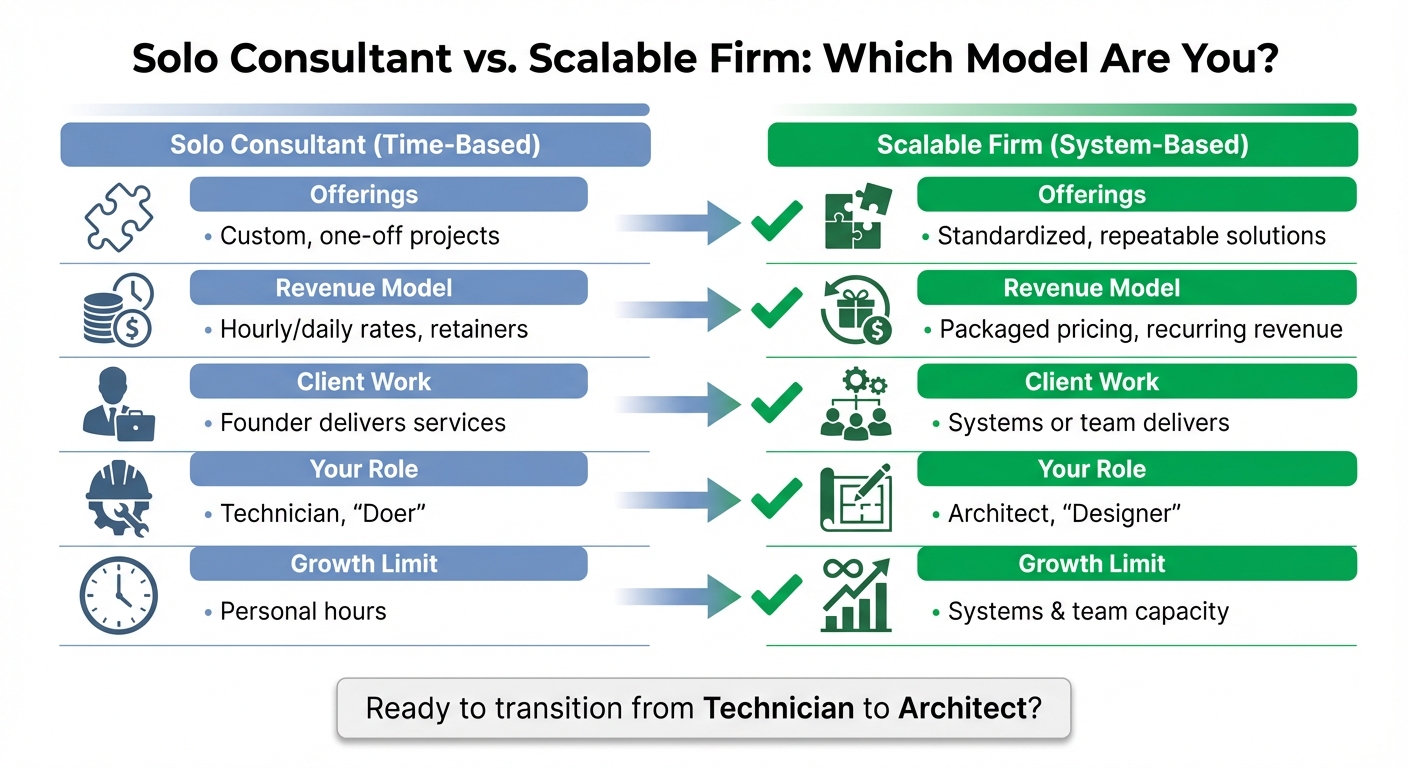
Solo Consultant vs Scalable Consulting Firm Business Model Comparison
Before diving into scaling, take a step back and assess where your business stands. Jumping straight into tactics without a solid foundation often leads to wasted money and unnecessary headaches.
Ask yourself: Are you a Technician or an Architect? If you’re doing all the client work yourself, you’re in Technician mode. Shifting to the Architect role means building systems that allow your business to grow without your constant involvement [3].
Start by analyzing your current processes and market positioning. This will help you identify whether your business can handle more clients without sacrificing service quality or your own well-being. If your consulting process is just a mental checklist instead of a documented system, growth will be much harder to achieve. Without clear playbooks, delegation becomes nearly impossible, and scaling stalls [4].
Financial readiness is just as critical. Implement safeguards like requiring a 50% upfront deposit to maintain healthy cash flow. This is essential because there’s often a 6-to-12-month gap between investing in new resources and seeing the revenue from those efforts [3][7].
Assessing Your Business Readiness
Start with a pipeline audit. List all your current prospects and categorize them based on their stage - lead, conversation, or proposal. This will help you identify where your process might be falling short. For example, are you generating plenty of leads but struggling to close deals? Or are you great at conversions but not attracting enough prospects? Pinpointing the bottleneck is key before scaling [1].
Next, conduct a task audit. Track everything you did last week and sort those tasks into three categories:
- High-value tasks: Strategic client work or business development.
- Medium-value tasks: Project management or client communication.
- Low-value tasks: Administrative work or scheduling.
If more than 30% of your time is spent on low-value tasks, it’s a red flag. You’ll need to delegate these tasks before scaling effectively [7].
Take a hard look at your market positioning. Have you moved beyond being a generalist to become a specialist solving specific, high-value problems for your ideal clients? Specialists tend to earn higher fees and attract better opportunities [1]. If you’re still trying to appeal to everyone, it’s time to narrow your focus and define your niche.
To prepare for growth, line up 2–3 qualified contractors for critical roles like project management, content creation, or research. This ensures you’re ready to handle large projects without scrambling or turning away work [7].
| Area | Solo Consultant (Time-Based) | Scalable Firm (System-Based) |
|---|---|---|
| Offerings | Custom, one-off projects | Standardized, repeatable solutions |
| Revenue Model | Hourly/daily rates, retainers | Packaged pricing, recurring revenue |
| Client Work | Founder delivers services | Systems or team delivers |
| Your Role | Technician, "Doer" | Architect, "Designer" |
| Growth Limit | Personal hours | Systems & team capacity |
This kind of thorough audit lays the groundwork for smoother, more effective scaling.
Setting Clear Goals and Metrics
Vague goals lead to vague results. That’s why using the SMART framework is essential. Your goals should be Specific, Measurable, Achievable, Relevant, and Time-bound [8]. For example, instead of saying, “I want more clients,” set a goal like: “I will sign three new clients at $10,000 each by March 31, 2026, generating $30,000 in new revenue.”
Choose a scaling model that aligns with your business. Whether you’re building a Firm (hiring a team of consultants), a Productized business (offering standardized solutions like workshops), or a Customized model (focusing on niche, high-value projects), your goals and metrics will vary [7][9]. For instance:
- A Firm model might track team utilization rates.
- A Productized model could focus on conversion rates for packaged offerings.
- A Customized model might emphasize average project value and client lifetime value.
"The more focused you are, the more you will accomplish. This one principle has generated millions of dollars for our business." - Consulting Success
Focus on tracking metrics that truly matter. For financial health, monitor Monthly Recurring Revenue (MRR), profit margins, and average project value. For sales, keep an eye on conversion rates, sales cycle length, and customer acquisition costs. Operationally, track team utilization rates and the ratio of billable hours to non-billable hours [7][9]. Stick to 5–7 key performance indicators (KPIs) that directly align with your scaling strategy.
Establish Standard Operating Procedures (SOPs) for all critical tasks, such as onboarding clients, project kickoffs, weekly updates, and project closeouts [3][9]. Tools like Loom videos and Google Docs checklists can help maintain consistency as you delegate. Without these systems, quality can slip as your workload increases.
Finally, review your goals weekly instead of quarterly. Spend 30 minutes every Monday auditing your pipeline, checking your KPIs, and adjusting your strategy [1]. Markets change, client needs evolve, and new opportunities arise - this routine ensures you stay agile.
With these systems and clear goals in place, you’ll be well-positioned to incorporate AI-driven strategies and scale effectively.
Using AI to Build and Scale Your Personal Brand
Your personal brand is one of the most important assets you have as a consultant. It’s what sets you apart and helps you attract the right clients. But let’s face it - managing your online presence can be incredibly time-consuming, pulling you away from your actual consulting work. That’s where AI tools like Brandbase step in. These tools act as a "marketing engine", helping to build your thought leadership and handle outreach, all while requiring minimal input from you [1]. By leveraging AI, you can refine and scale your brand without sacrificing your time.
Brandbase works by capturing your unique voice through in-depth interviews and turning it into digital assets that position you as a leader in your field. Instead of spending hours on landing pages or media outreach, you’ll get a professional framework that’s ready to go. From creating landing pages to securing PR placements, Brandbase takes care of the heavy lifting. Meanwhile, AI assistants qualify leads and automate responses, making your business more efficient and setting the stage for long-term growth.
The real game-changer here is automation. AI tools analyze engagement and intent data to pinpoint prospects who are ready to take the next step. They also personalize outreach, ensuring messages land at the right time and resonate with the right audience [10]. With integrated workflows for email, phone, and LinkedIn, Brandbase simplifies communication and gives you a clear view of your pipeline.
Creating a Professional Online Presence with Brandbase

In today’s crowded consulting market, a polished online presence isn’t optional - it’s critical. Brandbase helps you build custom landing pages that showcase your expertise and include lead capture forms that feed directly into your sales pipeline. These pages are tailored to highlight your unique strengths and appeal to your ideal clients, ensuring your digital presence aligns with your brand.
Media placements are another way Brandbase boosts your credibility. Being featured in well-known publications can make a strong impression on prospects before you even reach out. As part of its service, Brandbase secures these placements for you.
Consistency is key when it comes to branding. Whether it’s your website, LinkedIn profile, or blog posts, having a cohesive message builds trust and makes your brand stand out in a competitive market.
Automating Lead Generation with AI Assistants
Let’s be honest - manual lead generation can be a huge drain on your time. Brandbase’s AI assistants take over repetitive tasks like lead enrichment, initial outreach, and handling responses [10].
The AI streamlines the process by asking targeted questions upfront and filtering out less promising leads. It also tailors communication to each prospect’s industry, challenges, and engagement history, making outreach feel personal and relevant. When prospects respond, the AI takes care of initial inquiries and schedules meetings, ensuring no opportunity slips through the cracks.
This level of automation not only saves you time but also increases efficiency without requiring you to grow your team. Brandbase offers different plans, each with features designed to adapt to your business as it evolves.
Selecting the Right Brandbase Plan
Brandbase provides three plans to match your growth stage, with a one-time $499 setup fee that covers initial brand development and landing page creation.
| Plan | Monthly Price | Best For | Key Features | Limitations |
|---|---|---|---|---|
| Starter | $18/month | Solo consultants testing the waters | Professional landing page built and transferred to your Webflow account | No ongoing support or updates |
| Essential | $99/month | Consultants ready to automate leads | Includes landing page, custom AI assistant, hosting, maintenance, analytics, unlimited edits, 1 PR placement every 6 months, and contact/lead capture forms | None |
| Pro | $499/month | Established consultants scaling fast | Everything in Essential, plus unlimited landing pages, LinkedIn lead generation campaigns, 6 PR placements bi-monthly, and 9 SEO blog posts per month | None |
The Starter plan is perfect if you just need a professional landing page and want to handle other aspects of your brand yourself. The Essential plan is a great choice if you’re ready to automate lead generation and maintain a consistent online presence. For consultants looking to scale aggressively, the Pro plan offers advanced features like LinkedIn campaigns, frequent PR placements, and SEO content creation.
Choose the plan that aligns with your current goals, and let Brandbase help your brand grow effortlessly alongside your business.
Growing Your Client Base Through Digital Marketing
Once you’ve established a strong brand foundation, the next step is connecting with the right audience at the right time. Digital marketing isn’t just about being seen - it’s about intentionally attracting clients who are ready to take action. With 80% of B2B sales expected to occur through digital channels by 2025 and most buyers reaching out only after completing 70% of their decision-making process [10], your online presence and outreach strategy have a direct impact on your success. For example, LinkedIn alone generates 80% of B2B leads from social media [10]. These strategies naturally build on the foundational systems already in place.
Running LinkedIn Outreach Campaigns
LinkedIn is where many of your ideal clients spend their time. Brandbase’s LinkedIn outreach campaigns, included in the Pro plan, allow you to connect with high-value prospects through personalized, multi-step sequences. These campaigns mimic natural interactions - like viewing profiles, engaging with posts, and sending tailored connection requests and follow-ups.
What sets successful outreach apart? Personalization. Instead of sending generic "Let’s connect" messages, effective campaigns address specific challenges the prospect’s company is facing or reference recent developments in their industry. This approach works: using behavioral segmentation can increase conversions by 10–30% compared to generic messaging [11].
Using Content Marketing to Attract Clients
Targeted outreach is just one piece of the puzzle. Content marketing plays a critical role in establishing your authority and building trust with potential clients. By consistently sharing valuable insights, you position yourself as an expert in your field. For instance, blogging can generate 67% more qualified leads, and 81% of consulting firms actively invest in SEO to attract inbound clients [10]. With the Pro plan offering nine SEO-optimized blog posts per month, your website can rank for the search terms your ideal clients are using.
PR placements also enhance your credibility. Brandbase secures these placements for you - ranging from one every six months on the Essential plan to six bi-monthly placements on the Pro plan. Highlighting case studies and success stories with measurable results (like "$2M in cost savings") can improve conversion rates by 54% [10]. The key is creating content that directly addresses your clients’ biggest challenges while showcasing your unique methods or frameworks [1].
Automating Follow-Ups and Client Communication
Converting prospects often requires multiple touchpoints, and automation ensures no opportunity is missed. Research shows that 220% more leads respond after a follow-up email compared to no follow-up [10]. Plus, reaching out to a lead within five minutes can increase conversion rates by up to nine times [10].
Brandbase’s AI assistant takes care of this for you, handling inquiries and scheduling meetings instantly. Automated sequences can be triggered by actions such as downloading a lead magnet or visiting your pricing page, ensuring you stay engaged with potential clients at the right moments.
Email newsletters are another powerful tool for maintaining consistent communication. During the long consulting sales cycle, staying top-of-mind is crucial. Email marketing for consulting businesses delivers an average ROI of 4,200% [10], making it one of the most cost-effective strategies available. The trick is balancing educational content with timely check-ins, ensuring every message provides value without overwhelming or pressuring your prospects.
sbb-itb-f7e72a6
Improving Workflows with Automation and Analytics
Automating Routine Operations
Administrative tasks can eat up hours of your week without pushing your business forward. Things like invoicing, scheduling, and data entry may be necessary, but they often feel like a treadmill of repetitive work. That’s where automation comes in. Tools like Brandbase streamline these routine operations - from tracking leads to managing inquiries - so you can focus on what really matters: delivering results for your clients.
But automation isn’t just about saving time. It can completely transform how efficiently you operate. Some industry leaders report automating up to 95% of their workflows and slashing cycle times by as much as 60% [13].
The secret? Start with the repetitive, high-volume tasks that don’t require creativity or complex judgment. Before diving into automation, map out your current processes step by step. As Yannick, a Senior Consultant at EMPA, wisely puts it:
"The goal is not to replace your team with automation but to empower them with it" [12].
Brandbase’s AI assistant is a great example. It takes care of client inquiries and other everyday tasks, freeing up your team to focus on bigger priorities.
Making Data-Driven Decisions with Analytics
While automation takes care of the grunt work, analytics ensures those improvements actually translate into growth. Automation boosts efficiency, but analytics tells you if that efficiency is driving results. Brandbase’s built-in analytics tools track key performance indicators like website traffic, campaign engagement, and lead quality. This data helps you pinpoint what’s working, whether it’s a LinkedIn campaign generating meetings or identifying where prospects drop off in your sales funnel.
For consultants, metrics like Monthly Recurring Revenue (MRR), Cost Per Lead (CPL), and client acquisition costs are critical [5][7]. Pair these with operational data - like billable hours and team utilization - and you get a clear picture of both your revenue potential and capacity challenges. Relying on traditional ad platform tracking alone can be risky, as it’s been shown to be off by as much as 60% in some cases. That’s why having a centralized analytics dashboard is so important [5].
Start by establishing two weeks of baseline data before making any major changes [5]. This lets you measure the true impact of your adjustments without being misled by short-term fluctuations. As your consulting business grows, making decisions based on data becomes non-negotiable. It’s the difference between scaling intentionally and just hoping for the best. With the right insights, you can build systems that don’t just grow your business but sustain that growth over time.
Measuring Success and Maintaining Growth
Tracking Key Performance Metrics
Growing your consulting business demands a solid grasp of the numbers that influence your revenue and profitability. To stay on track, focus on metrics that directly affect your financial health.
Keep a close eye on financial indicators like revenue growth, profit margins, cash flow, and average revenue per client [15][7]. For sales performance, monitor metrics such as pipeline value, lead conversion rates, cost per lead (CPL), sales cycle length, and proposal win rates [15][2]. On the operational side, measure billable versus non-billable hours, revenue per hour, and project profitability to see how efficiently your time translates into earnings [15].
Equally important are client success metrics. Track key performance indicators like customer satisfaction scores (CSAT), net promoter scores (NPS), client retention rates, and lifetime value (LTV) to ensure your service quality remains high as you grow [15][7]. Interestingly, 85% of seasoned consultants improved their operations simply by refining their core business model and financial tracking [3].
Establish a review schedule that aligns with your business needs. For example:
- Weekly: Evaluate short-term metrics like new leads and billable hours.
- Monthly: Analyze revenue and pipeline value.
- Quarterly: Assess profitability and client retention.
As Consulting Success aptly states:
"What gets measured gets managed" [14].
These metrics are the foundation for making strategic, data-driven decisions.
Reviewing and Adjusting Your Strategy
Once you’ve built a system for tracking metrics, the next step is using that data to refine your approach. Monitoring numbers is only part of the equation - you need to act on what the data tells you. Set aside 30 minutes each week to review your sales pipeline, pinpoint bottlenecks, and plan adjustments [1][7].
Pay attention to leading indicators like cost per click (CPC), CPL, and cost per booked call, which help you forecast future results. Compare these with lagging indicators such as total contract value and cash collected to get a clear picture of your financial status [5][7]. Be cautious with ad platform data, as it can sometimes be off by as much as 60% [5]; independent verification is essential.
Regular audits and feedback loops are key to spotting inefficiencies quickly [6][3]. Shift your focus from being the "technician" who handles every task to the "architect" who designs systems that operate smoothly without constant oversight [7][3]. This shift in mindset is what separates consultants who scale effectively from those who simply end up busier. Keep in mind that scaling efforts often take 6–12 months to show a return on investment [7], so patience and persistence are crucial.
Conclusion
Growing your consulting business isn’t about working longer hours - it’s about working smarter. The most successful consultants move from being hands-on technicians to becoming architects of systems that consistently deliver results [3]. This shift involves strategic positioning, creating productized services, automating workflows, and making decisions based on data. These steps lay the groundwork for sustainable and efficient growth.
Without the right systems in place, growth can quickly lead to burnout. That’s where tools like Brandbase come in. They take care of time-intensive tasks like building your online presence, using AI assistants to qualify leads, and managing personalized LinkedIn campaigns. This allows you to concentrate on what matters most: high-value client work and building strategic relationships.
Automation doesn’t mean losing the personal touch. Instead, AI and automated systems enhance your expertise while keeping the human element that your clients value [1]. With systems handling tasks like follow-ups, scheduling, and lead nurturing, you can reclaim valuable time each week [3][7]. This time can be reinvested into building relationships and focusing on strategic planning - the real drivers of revenue. Meanwhile, your clients enjoy a seamless and professional experience, and you gain the ability to serve more people without compromising quality. These optimized systems free you to focus on high-impact work and long-term growth.
Scaling a consulting business takes patience and consistency. Keep a close eye on your metrics, adapt based on what the data tells you, and stay committed to the process. The most successful consultants prioritize creating repeatable systems that compound over time rather than chasing every opportunity. Document your workflows, automate administrative tasks, and develop reliable marketing systems to expand your reach and increase revenue. These efforts will help you build the consulting business you’ve envisioned.
Your expertise is a powerful asset. Now it’s time to create the infrastructure that lets you share it with more people, grow your revenue, and design the business you’ve always wanted.
FAQs
How can I shift from doing all the work in my consulting business to focusing on strategy and growth?
To move from doing everything yourself to truly leading your consulting business, you need a mindset shift and a focus on building systems that can grow with you. Think of yourself as the architect of your business, designing processes that deliver results consistently without relying solely on your personal involvement.
Here are three essential steps to guide your transition:
- Think strategically: Narrow down your niche, set premium prices, and concentrate on selling outcomes instead of trading hours for dollars.
- Streamline and delegate: Document your workflows and hand off routine tasks to contractors or virtual assistants. This clears your plate for big-picture planning and decision-making.
- Offer scalable solutions: Turn your expertise into services or products that can be repeated and sold without needing your constant input.
By focusing on these strategies, you’ll evolve from managing daily tasks to leading a consulting business that can grow and thrive on its own.
What metrics should I focus on to successfully scale my consulting business?
To grow your consulting business effectively, keeping a close watch on key performance indicators (KPIs) is essential. These metrics give you a clear snapshot of your financial health and operational efficiency.
Start with financial metrics like total revenue, forecasted revenue, gross margin, net margin, and profitability per client. These numbers reveal how well your business is performing financially and where you might need to adjust. Alongside these, track your billable utilization rate - a measure of how much of your team's time is spent on revenue-generating work - and your sales conversion rate, which shows how effectively you’re turning leads into paying clients.
On the operational side, focus on talent metrics like employee turnover rate and headcount growth. These figures provide insight into team stability and capacity, both of which play a huge role in scaling your business sustainably. Regularly reviewing these KPIs allows you to spot trends, address challenges, and make decisions that support long-term growth.
How does Brandbase use AI to simplify lead generation and client communication?
Brandbase uses AI-driven tools to simplify essential parts of lead generation and client communication. It can automatically spot and qualify potential clients, group them into specific target segments, and send out customized outreach and follow-up messages. This allows consultants to dedicate their time to more critical, high-impact tasks.
By taking over repetitive tasks, Brandbase creates smoother workflows, letting you grow your client base while still maintaining personalized and meaningful connections with both prospects and current clients.
Related Blog Posts

Blog title heading will go here
Blog title heading will go here