

Personal Branding for Service Professionals: 5 Essential Steps
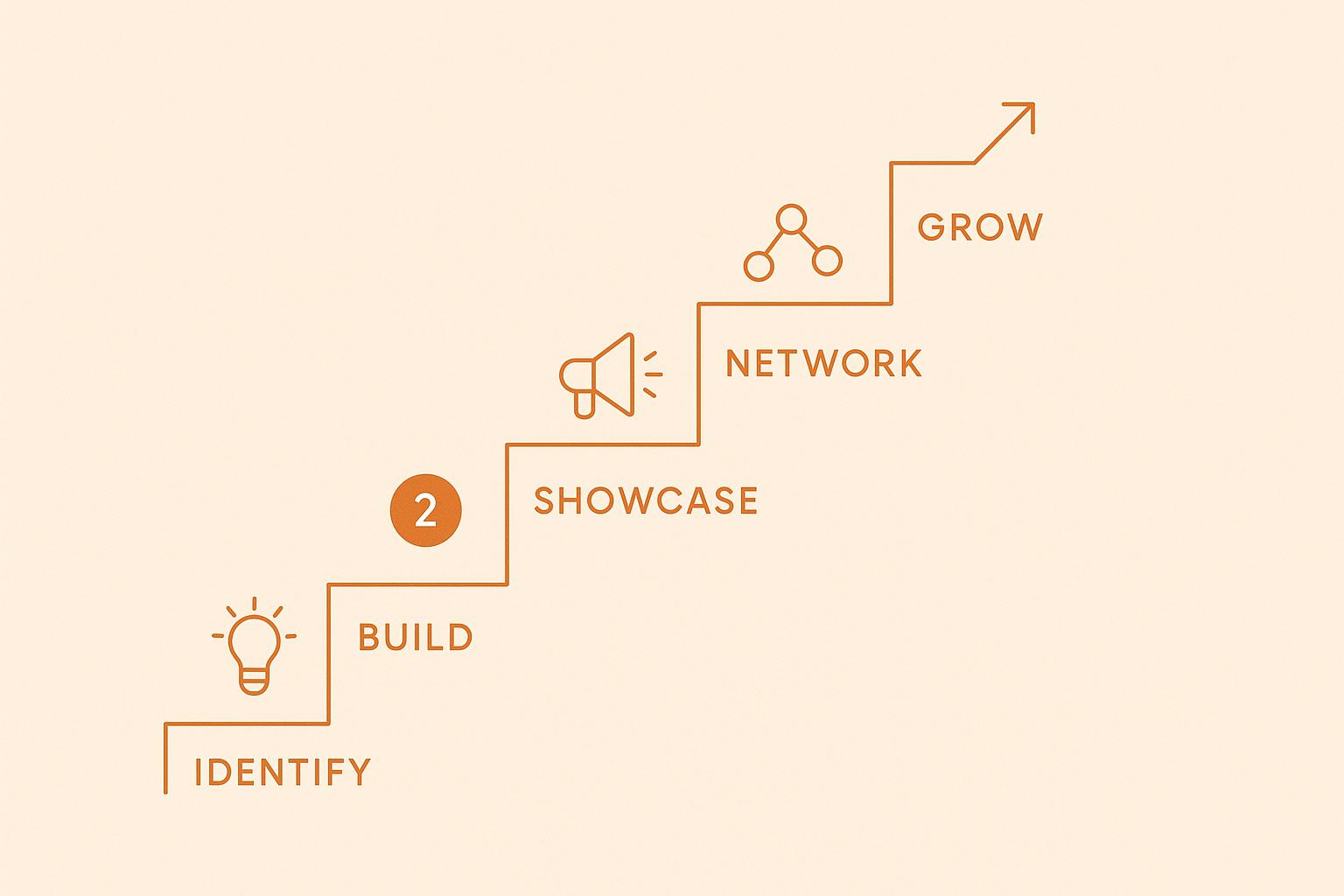
Personal branding is critical for service professionals like consultants, coaches, and lawyers to stand out in a competitive market. It’s not just about showcasing your skills - it’s about building trust and credibility with potential clients. Here’s a quick breakdown of the five steps to craft a strong personal brand:
- Define Your Brand and Audience: Identify your unique value and who your ideal clients are. Focus on their needs and emotions, as 70% of decisions are emotionally driven.
- Create Your Brand Story: Develop a clear narrative that highlights your expertise, process, and results. Use consistent messaging across platforms.
- Build a Personal Brand Hub: Create a central online space (like a website) to showcase your services, testimonials, and expertise.
- Optimize LinkedIn: Use LinkedIn to connect with your audience. Update your profile to reflect your brand and share relevant content regularly.
- Leverage AI and Content: Use AI tools to save time on content creation and lead management. Publish articles, secure media placements, and distribute content across platforms.
These steps help you establish authority, attract the right clients, and grow your business effectively. Start small - refine your LinkedIn profile or draft your brand story - and build from there.
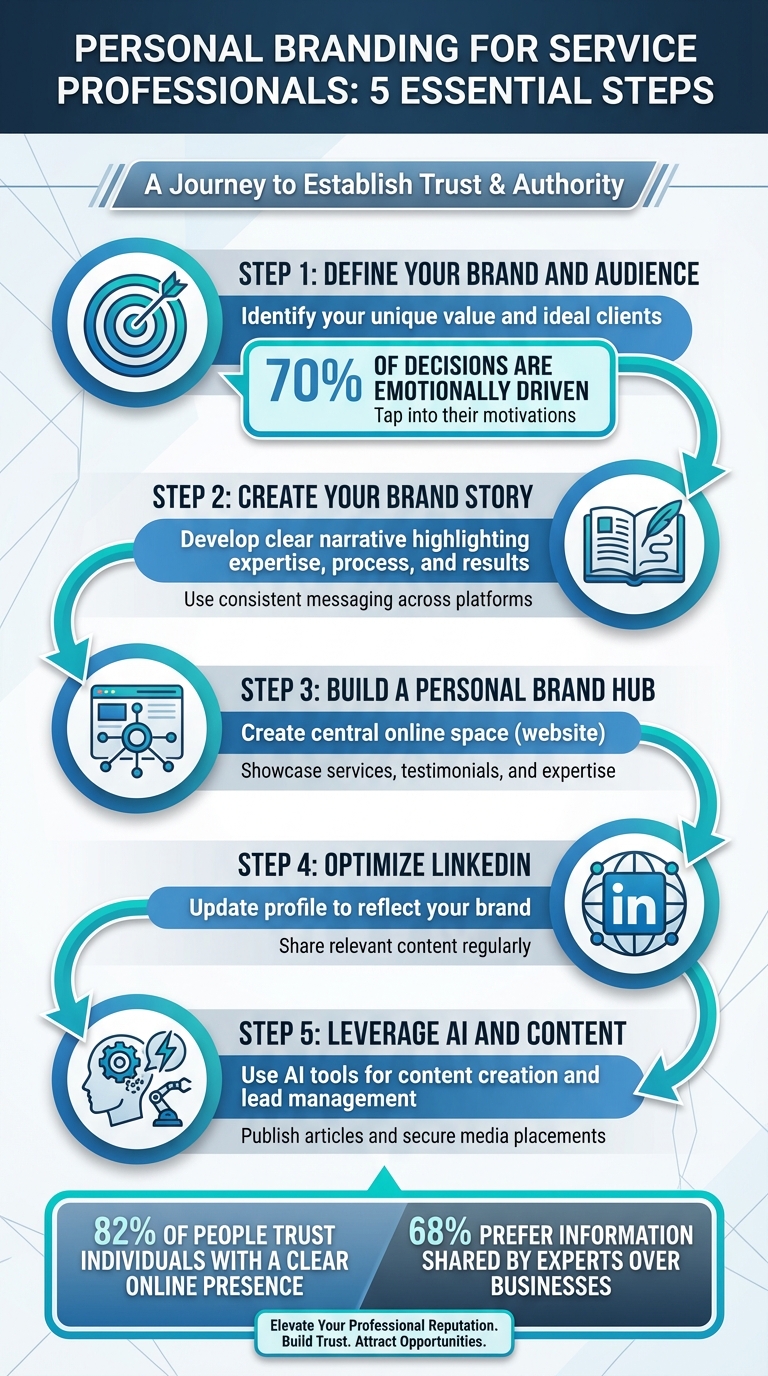
5 Essential Steps to Build Your Personal Brand as a Service Professional
How To Build A Powerful Personal Brand That Sells
Step 1: Define Your Brand and Target Audience
To build a personal brand that draws clients in, you first need absolute clarity on two fundamental things: what you represent and who you aim to reach. Without this clarity, your messaging risks leaving potential clients puzzled or disengaged.
This process involves both introspection and research. You’ll need to pinpoint your unique value, outline the profile of your ideal client, and assess your current brand presence for any gaps. These steps lay the groundwork for every piece of content you produce and every interaction you have. Once you’ve defined your value, focus on identifying the specific clients who will benefit most from your expertise.
Identify Your Value Proposition
Your value proposition is a concise, specific statement that explains what you deliver to clients and why it matters. It’s not just about listing your skills or services - it’s about showing how your expertise leads to real, measurable outcomes. Start by asking yourself: What makes you stand out? How do you deliver results that matter?
For service professionals, this means focusing on the outcomes you create for your clients. Instead of simply highlighting credentials, explain how your work improves their lives or businesses in tangible ways.
Key elements to consider include:
- Personality: What natural traits make you memorable and distinct?
- Values: What beliefs and promises guide the way you work?
- Purpose: How do you help clients achieve their goals?
Your purpose should position your clients as the heroes of the story. When your messaging centers on the positive changes your work brings to their lives, it becomes inherently more compelling.
To simplify, craft a one-sentence statement that captures who you help, the problem you solve, and what makes you different. This statement becomes your guiding principle, shaping all your messaging. Share it with colleagues or past clients to ensure it resonates and reflects your strengths accurately. Once you’ve nailed your value proposition, shift your focus to profiling your ideal client.
Research and Profile Your Ideal Client
Broad messaging attracts broad audiences, but if you want to build a personal brand that truly connects, you need to zero in on your ideal client. This means going beyond surface-level demographics and digging into what they value, the challenges they face, and the goals they’re working toward.
Start by answering some key questions: Who typically buys your services? What industries do you cater to? What roles - such as CEOs, HR directors, or operations managers - are making the decisions? Then, dive deeper. What are their pain points? What objections might they raise? What motivates their decisions, both logically and emotionally?
A detailed client profile should cover specifics like:
- Industry and company size
- Revenue range and budget considerations
- Job titles and years of experience
- Key challenges and short-term goals
- Preferred communication channels
Remember, decisions aren’t purely logical. Research shows that 70% of decisions are driven by emotions, leaving only 30% to rational facts [2]. To connect effectively, your client profile needs to reflect both their practical needs and emotional motivations.
Audit Your Current Brand Presence
Once you’ve defined your value and ideal client, it’s time to take a hard look at your current brand presence. You can’t improve what you don’t measure, so start by auditing your digital assets for inconsistencies or outdated content.
Begin with platforms where clients are most likely to find you, such as your LinkedIn profile, personal website, or email signature. Does your LinkedIn headline align with your value proposition? Are your testimonials showcasing the specific results you deliver? Is your "About" section focused on your ideal client, or does it read more like a career timeline?
Evaluate three core areas:
- Credentials: Do your education, awards, and achievements reflect your expertise?
- Social Capital: Are your professional connections meaningful and relevant?
- Cultural Capital: What unique perspectives or life experiences do you bring to the table?
Be honest with yourself about your strengths and areas for improvement, whether it’s writing, public speaking, or content creation. This self-awareness will help you prioritize where to grow.
Lastly, review client feedback, such as testimonials or LinkedIn recommendations, to uncover patterns in how others perceive you. Their words can reveal gaps between how you want to be seen and how you’re actually coming across. Use this feedback to refine your messaging and emphasize the aspects of your brand that resonate most with your audience.
Step 2: Create Your Brand Story and Messaging System
Take the clarity you've established and turn it into a compelling narrative and messaging framework. Your brand story isn't just a timeline of events - it's the distinct narrative that shapes how others perceive you and your work [1]. When paired with consistent messaging, this story ensures that every interaction reinforces your expertise and builds trust with potential clients.
The aim here is to develop a messaging system that reflects your core identity while remaining flexible enough to resonate with different audiences and platforms [5]. Whether someone finds you on LinkedIn, visits your website, or reads a client proposal, they should instantly recognize your voice and value. This level of consistency doesn’t happen by chance - it requires careful planning and the creation of reusable messaging tools that you can rely on. It’s the bridge that connects your defined brand values to the actionable strategies you’ll implement in the next steps.
Develop Your Brand Story
Your brand story should build trust and credibility by focusing on four key elements: your origin story (what inspired your work), your expertise (what you’ve mastered), your process (how you deliver results), and your credibility markers (proof of success).
Start by identifying the pivotal moments in your professional journey. What challenges or experiences led you to this field? What lessons have shaped the way you approach your work today? Focus on the parts of your story that directly tie into the results you deliver for clients. Authenticity is critical here - clients connect with real, relatable experiences, not overly polished corporate language [2]. Share the obstacles you’ve overcome and the insights you’ve gained, linking them to the value you bring to clients.
Your story should also emphasize what sets you apart. For instance, if you’re a consultant who relies on data-driven strategies, explain how that approach developed and the results it achieves. If you’re a coach who focuses on accountability systems, talk about why that’s important and how it transforms client outcomes. The goal is to craft a message that’s easy to understand yet sparks curiosity [7]. It should make people think, “I want to learn more about how this person works.”
Create a Consistent Messaging System
A consistent messaging framework acts as your blueprint for communicating your brand across various platforms and scenarios [5]. This involves creating reusable assets like positioning statements, bios, service descriptions, and elevator pitches.
Start with a core positioning statement - a concise summary (two to three sentences) of who you help, what you do, and what makes your approach distinctive. Use this as the foundation for everything else. Next, write three versions of your professional bio:
- A short version (50-75 words) for social media profiles
- A medium version (150-200 words) for speaker introductions or guest posts
- A long version (300-400 words) for your website’s About page
For each service you provide, craft descriptions that focus on the outcomes clients can expect rather than the process itself. For example, instead of saying, “I provide strategic planning services,” try something like, “I help mid-sized companies create a clear three-year growth plan and align their teams around measurable goals.” These descriptions should maintain a consistent tone and language across all platforms but adapt to fit the context.
Consistency isn’t a solo effort [6]. If you collaborate with a virtual assistant, marketing consultant, or anyone else who manages your brand presence, share these messaging assets with them. The more aligned your team is in articulating your brand story, the stronger and more unified your presence will be. This foundation also makes it easier to create personalized content using AI tools.
Use AI for Content Creation
AI can help you draft your brand narratives and refine them to reflect your authentic voice. By providing AI tools with your value proposition, client profiles, and core messaging, you can generate drafts that align with your tone and style [4].
For instance, you could use AI to create multiple versions of your bio tailored to different platforms, then tweak them to ensure they sound like you. AI can also assist in brainstorming new ways to describe your services or in generating content ideas based on your expertise. The goal isn’t to replace your personality - it’s to handle the initial drafting so you can focus on fine-tuning and personalizing the final message.
Always review AI-generated content carefully to ensure it accurately represents your expertise and maintains your voice. AI works best when you provide clear guidance and then apply your judgment to refine the output. This blend of efficiency and personalization allows you to produce consistent messaging faster while keeping the personal touch that builds trust with clients.
Step 3: Build a High-Converting Personal Brand Hub
With your brand story and messaging system in place, it’s time to create a central hub - a dedicated space where your expertise shines. This is where people will land after seeing your LinkedIn post, reading your guest article, or hearing about you through a referral. A well-designed hub gives you full control over how you present yourself and highlights what sets you apart [1] [3].
Think of this hub as the heart of your brand, pulling together your story and serving as the starting point for deeper engagement.
Key Components of a Brand Hub
Your brand hub should immediately establish trust, communicate your value, and encourage visitors to take action. Start with professional visuals like a polished headshot, a custom banner, and consistent branding in your color scheme and fonts. These elements create a cohesive look that not only catches the eye but also signals professionalism.
Make sure your content gets straight to the point - explain who you help and the results you deliver. Build trust with client testimonials, case studies, media mentions, or certifications. Clearly outline your services with descriptions that focus on the outcomes you provide. And don’t forget to include lead capture forms to encourage consultations, resource downloads, or subscriptions.
Boost Efficiency with AI and Automation
AI tools can save time and help refine your hub’s content. By feeding your messaging into these tools, you can generate content drafts that align with your voice. Over time, as you learn which parts of your hub resonate most with visitors, AI can suggest updates or fresh ideas, allowing you to focus on ensuring your hub reflects your expertise and builds trust with your audience.
Why Consider Brandbase for Your Hub?

Brandbase is a platform designed specifically for professionals looking to create impactful personal brand hubs. It simplifies the process by offering professional landing pages that handle technical setup, track visitor behavior with analytics, and allow unlimited edits as your brand evolves. Starting at $18/month with a $499 setup fee, Brandbase delivers a landing page you can transfer to your Webflow account. For those who need more, the Essential plan at $99/month includes hosting, maintenance, analytics, contact forms, and even an AI assistant to qualify leads - eliminating the hassle of managing multiple tools or hiring developers.
On top of that, Brandbase produces SEO-optimized blog posts to drive organic traffic to your hub, positioning you as a leader in your field. This turns your hub into more than just a static page - it becomes a dynamic tool that attracts, engages, and converts visitors into clients. With the technical details handled, you can focus on what you do best: delivering exceptional services.
sbb-itb-f7e72a6
Step 4: Optimize Your LinkedIn Profile for Visibility and Engagement
Your personal brand hub serves as your foundation, but LinkedIn is where you actively connect with your audience. With millions of professionals using the platform, LinkedIn is far more than a digital resume - it’s your professional billboard, portfolio, and networking powerhouse. Decision-makers and recruiters frequently rely on LinkedIn to find talent and expertise [9][10].
An optimized LinkedIn profile does more than list your credentials; it establishes you as a trusted authority, boosts your visibility in search results, and encourages others to connect. Every element of your profile, from your headline to your featured content, should reflect your brand story and messaging. When done right, your profile builds trust and inspires action.
Enhance Profile Elements
Start with a high-quality headshot where your face fills about 60% of the frame - it’s your first impression. Your headline should go beyond just stating your job title. Instead, focus on the value you bring. For example, instead of "Marketing Consultant", try something like, "Helping B2B SaaS Companies Generate Qualified Leads Through Strategic Content."
The About section is your chance to showcase your brand story. Start with a hook that directly addresses a challenge your ideal client faces, then describe your approach and the results you deliver. Keep in mind that only the first two lines are visible before the "see more" button, so make them compelling. In your experience section, highlight measurable outcomes rather than just listing tasks - quantify your achievements and tie them to your overall value. To further demonstrate your expertise, add featured content like articles, case studies, or links to your personal brand hub.
Including at least five skills on your profile makes you nearly three times more likely to receive connection requests [8]. Choose skills that align with what your target audience or clients are searching for, and don’t hesitate to request endorsements from colleagues to strengthen your credibility.
Create and Maintain a Content Strategy
Once your profile is visually optimized, focus on sharing content regularly. Posting educational content, success stories, and industry insights can help position you as a thought leader. A good rule of thumb is the 5-3-2 Rule: for every ten posts, share five pieces of educational content, three curated pieces from others (with your added commentary), and two posts that promote your services or achievements. This balanced approach builds trust and keeps your audience engaged before you make any direct pitches.
Posting once or twice a week is enough to stay visible without overwhelming your audience - or your schedule. Just as important as posting is engaging with others’ content. Thoughtfully comment on posts in your network, answer questions, and join relevant conversations. These interactions expand your reach and help you build genuine relationships.
Integrate LinkedIn with Brandbase
To amplify the credibility you’ve built on LinkedIn, consider integrating it with tools like Brandbase. Brandbase simplifies your LinkedIn strategy by offering features such as an AI assistant, PR placements, targeted lead generation campaigns, and SEO blog posts designed to boost engagement.
For example, Brandbase’s Essential plan provides one PR placement every six months, offering third-party content you can share on LinkedIn to strengthen your authority. The Pro plan goes even further, including LinkedIn lead generation campaigns aimed directly at your ideal clients, six PR placements every two months, and nine SEO blog posts per month. All of these tools drive traffic back to your optimized LinkedIn profile and brand hub, helping you attract meaningful client interactions and quality engagement.
Step 5: Scale Your Personal Brand with AI and Content
Once your LinkedIn profile is optimized, the next step is scaling your personal brand. For most service professionals, the issue isn’t expertise - it’s finding the time and resources to reach a broader audience while maintaining quality. That’s where AI tools and strategic content distribution come into play. With 78% of companies worldwide already using AI [12], those who embrace these tools can gain a competitive edge.
Scaling your brand is about extending your reach without burning out. AI can take over repetitive tasks like drafting content, qualifying leads, and managing communications, allowing you to focus on building relationships and delivering results. Pair this with media placements and consistent publishing, and you’ll establish authority across multiple platforms. Let’s dive into how AI can help you expand your reach while keeping your message sharp.
Expand Your Reach with AI Assistants
AI assistants are a game-changer for managing client communication. They can handle tasks like lead qualification, scheduling appointments, and answering routine inquiries, freeing you up for more impactful work. These tools engage with prospects 24/7, prioritize qualified leads, and ensure only serious inquiries make it to your calendar.
Tools like ChatGPT, Jasper AI, and Copy.ai can help you draft outlines, social media updates, newsletters, and even video scripts in no time [11][14]. For instance, in May 2025, brand strategist Jenny Henderson used ChatGPT to create personalized brand color names for clients. She suggested food-inspired names for a vegan restaurant marketer and luxury-themed hues like "cabernet", "rosé", and "champagne" for a real estate brokerage - saving time while tailoring her work to each client’s needs [13].
"Leveraging AI, despite what many believe, is not about replacing humans. It's about optimizing your efforts." - Melanie Borden, CEO & Founder of The Borden Group [14]
To get the most from AI, define your brand voice and provide consistent feedback to fine-tune the tools. Always review AI-generated content to ensure it aligns with your voice and maintains accuracy. AI is meant to enhance your workflow, not replace your judgment [14].
Secure Media Placements and Publish Content
Once you’ve automated routine tasks, shift your focus to building influence through media placements. Guest appearances and articles lend credibility by tapping into established audiences and providing third-party validation. These endorsements can position you as an expert in ways that self-promotion simply can’t. Additionally, search engines and AI models prioritize content from trusted sources, aligning with Google’s E-E-A-T framework (Experience, Expertise, Authoritativeness, Trustworthiness) [15][16].
Start by identifying publications your target audience follows. Pitch guest articles or expert commentary that offer genuine insights, steering clear of overtly promotional content. Publish SEO-friendly blog posts on your website, then repurpose them into LinkedIn articles, social media snippets, or YouTube videos to expand your reach [11][14].
With over 4.8 billion people active on social media [14], distributing content consistently across platforms significantly boosts your visibility. The goal isn’t just to create content - it’s to ensure that the right people see it at the right time.
Use Brandbase for Continued Growth
Brandbase simplifies scaling with tailored plans. The Essential plan, priced at $99/month, includes AI lead qualification, hosting, maintenance, unlimited edits, and one PR placement every six months. The Pro plan, at $499/month, adds unlimited landing pages, targeted LinkedIn campaigns, six PR placements every two months, and nine SEO blog posts per month.
These features work together seamlessly: PR placements enhance authority, SEO blog posts drive organic traffic, LinkedIn campaigns bring in qualified leads, and your AI assistant converts those leads into booked appointments. Instead of juggling multiple tools and vendors, Brandbase offers a unified system designed specifically for service professionals who want to grow their personal brand without compromising quality or authenticity. This integrated approach aligns perfectly with the strategies outlined above, making it easier to scale efficiently.
Conclusion
Personal branding isn’t a one-and-done effort - it’s an ongoing journey of defining your strengths, sharing your story, and staying visible in a crowded digital world. This guide’s five-step plan - clarifying your brand, shaping your narrative, creating your online hub, refining your LinkedIn profile, and leveraging AI and content - lays the groundwork for building trust and credibility. Now it’s time to take action and bring your brand to life.
The numbers back this up: 82% of people trust individuals with a clear online presence [17], and 68% prefer information shared by experts over businesses or institutions [2]. In industries where trust is the currency, your personal brand becomes the bridge that connects you with potential clients. It’s not just about showcasing expertise - it’s about building genuine connections.
Start small if needed. Audit your current presence, polish your LinkedIn profile, or draft the first version of your brand story. In today’s professional landscape, personal branding isn’t just a nice-to-have - it’s expected [18]. Those who prioritize their brand now will be the ones who stand out and thrive in the future.
For those looking to fast-track their growth, Brandbase offers a comprehensive solution. From AI-driven lead qualification to PR placements, SEO blog content, and LinkedIn campaigns, it’s a system designed to simplify and amplify your efforts.
FAQs
How can AI tools help me build a stronger personal brand?
AI tools can be a game-changer when it comes to building your personal brand. They take the hassle out of repetitive tasks and offer insights that can elevate your online presence. For example, AI can automate content creation - think social media posts or blog ideas - saving you time while ensuring your messaging stays consistent and professional.
These tools also shine when it comes to audience analysis. By examining engagement patterns, AI helps you fine-tune your messaging to better connect with your audience. On top of that, AI can give your LinkedIn profile a boost by suggesting updates to your headline, summary, and keywords, making it easier for potential clients or collaborators to find you.
Want to stand out even more? AI can craft personalized messaging tailored to your audience and pinpoint emerging trends in your industry. This not only helps you stay relevant but also positions you as a credible voice in a crowded market.
What makes a strong and engaging brand story for service professionals?
A compelling brand story for service professionals should clearly articulate your purpose while showcasing what sets you apart. To resonate with your audience, it needs to address their concerns and aspirations, creating an emotional connection that makes your services both relatable and memorable.
Consistency is crucial. Your messaging should align across every platform - whether it’s your website or social media channels. This unified approach not only helps you build trust and credibility but also ensures you stand out in a crowded marketplace.
How can I find and connect with my ideal clients effectively?
To begin, pinpoint your niche and clarify your core values - this will guide you in identifying your ideal clients. Take the time to research where they hang out, whether it’s on LinkedIn, in specialized forums, or at local networking events.
Engage with sincerity by offering helpful insights, participating in thoughtful discussions, and nurturing connections through consistent, meaningful interactions. Leverage targeted content and personalized outreach to connect with potential clients. Make sure your messaging speaks to their needs while also highlighting your expertise.
Related Blog Posts

Blog title heading will go here
Blog title heading will go here