

Data-Driven Thought Leadership: Step-by-Step Guide

Data-driven thought leadership is about using facts and insights to position yourself as an authority in your field. Why does this matter? 87% of executives say thought leadership influences purchasing decisions within 90 days, and 60% of decision-makers award business based solely on it. The secret? Ground your expertise in data to stand out in a crowded market.
Here’s the process in a nutshell:
- Set measurable goals: Define clear objectives like increasing brand awareness, generating leads, or improving authority.
- Understand your audience: Use CRM data, analytics, and surveys to identify their needs and preferences.
- Leverage data: Combine internal and external sources to create unique insights.
- Create data-backed content: Use formats that resonate with your audience, like reports, white papers, or visual summaries.
- Distribute effectively: Focus on LinkedIn, media placements, and custom landing pages.
- Track performance: Monitor metrics like branded search volume, high-quality backlinks, and pipeline influence.
- Refine your strategy: Use performance data to double down on what works and adjust underperforming tactics.
The key takeaway? Thought leadership isn’t about opinions - it’s about using data to build trust and drive business results.
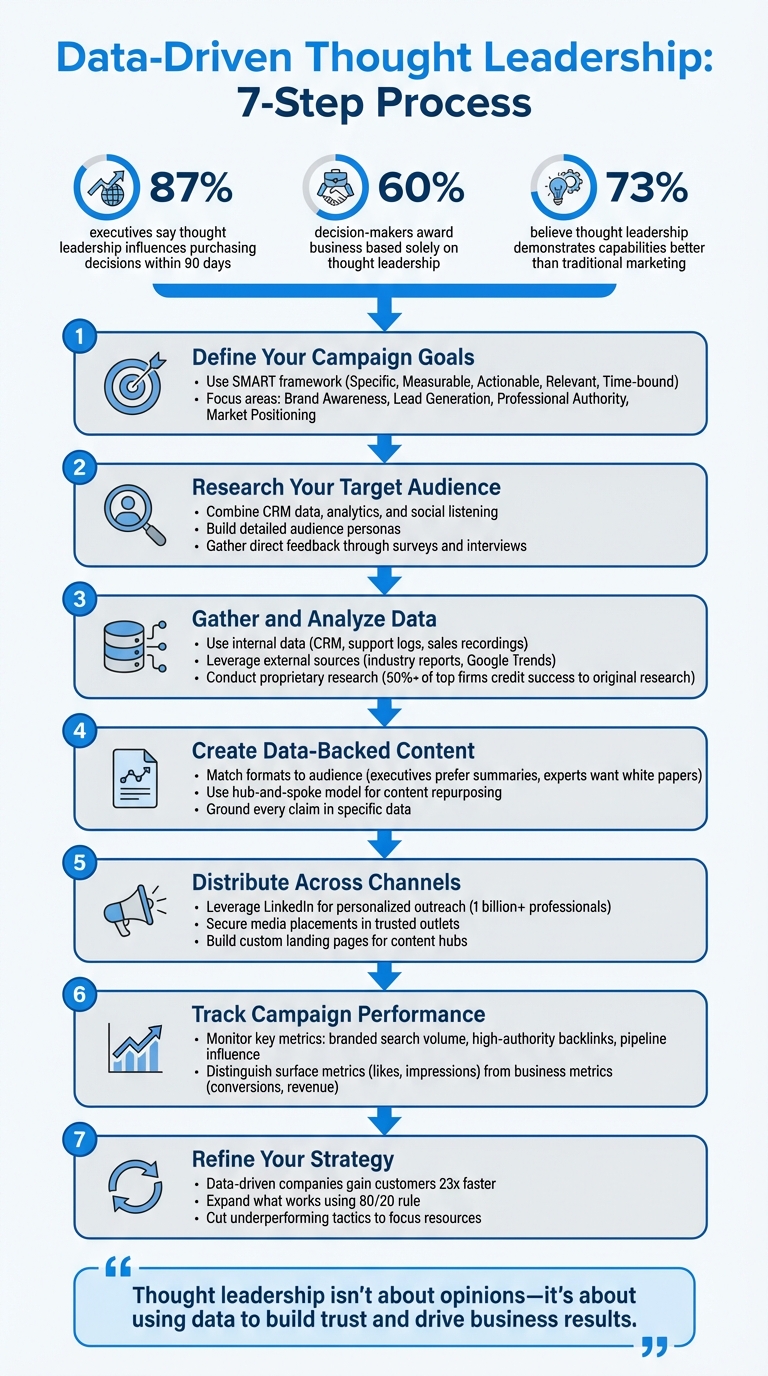
7-Step Data-Driven Thought Leadership Strategy Process
Turning Platform Data into Thought Leadership, with Amy Konary
Step 1: Define Your Campaign Goals
To make the most of your thought leadership efforts, start by setting clear and measurable goals. Without them, it’s impossible to track progress or justify the resources you’re investing. The SMART framework is a helpful guide: your goals should be Specific, Measurable, Actionable, Relevant, and Time-bound [11]. This level of clarity turns thought leadership into a strategic asset that directly supports your business.
Instead of vague ambitions, service professionals need to focus on specific, business-oriented objectives. For instance, 73% of decision-makers believe thought leadership is a better way to understand a company’s expertise than traditional marketing materials [7]. By defining and tracking your goals, you can showcase this value in tangible ways.
Connect Goals to Business Outcomes
Your thought leadership goals should align with one of four core business objectives: brand awareness, lead generation, professional authority, or market positioning [13].
- Brand Awareness: This is all about increasing your visibility and recognition within your industry. For example, you might aim to "Grow LinkedIn followers by 500 professionals in the financial services sector by Q4 2026" or "Earn three media mentions in leading industry publications within six months." These goals help you get noticed by potential clients who may not be familiar with your brand.
- Lead Generation: Focus on attracting and converting prospects. Goals could include "Generate 75 qualified demo requests per month through thought leadership content" or "Boost newsletter sign-ups by 25% by the end of Q2." These objectives ensure your content is driving tangible results.
"I don't think you can gain a competitive advantage without thought leadership. The reason why thought leadership is a prerequisite is because trust is a prerequisite, and thought leadership is a way to build trust." - Joe Chernov, Vice President of Marketing at Pendo [14].
- Professional Authority and Market Positioning: These goals aim to solidify your reputation and credibility. For instance, you might aim to "Receive five speaking invitations at industry conferences within 12 months" or "Increase branded search queries by 40% year-over-year." It’s worth noting that 60% of decision-makers say thought leadership has influenced them to purchase a product or service they hadn’t previously considered [15].
Here’s a snapshot of how these goals can translate into actionable targets:
| Business Goal | Example SMART Objective | Why It Matters |
|---|---|---|
| Brand Awareness | Grow LinkedIn followers by 30% (from 2,000 to 2,600) by December 31, 2026 | Expands your reach to new potential clients |
| Lead Generation | Generate 50 content downloads per month through gated whitepapers by Q2 2026 | Builds a pipeline of qualified prospects |
| Professional Authority | Secure 10 backlinks from industry publications with domain authority above 50 by Q3 2026 | Establishes third-party validation of expertise |
| Market Positioning | Increase branded search volume by 35% within the next financial year | Boosts recognition and recall |
With these objectives in place, you can identify the right metrics to measure your success.
Choose Metrics to Track Progress
Not all metrics are created equal. While surface metrics like likes, shares, and impressions can give you a sense of reach, it’s the business impact metrics - like qualified leads or revenue influenced - that truly matter.
- For Reach and Growth: Monitor website traffic, unique visitors, and social media follower growth. You can calculate growth velocity using this formula: ((New Followers in Period / Followers at Start) × 100) [17].
- For Engagement Quality: Look at how well your content resonates. Metrics like LinkedIn engagement rates (likes, comments, and shares relative to reach), average time spent on pages, and click-through rates (CTR) help you gauge whether your content is sparking meaningful interactions.
- For Authority and Credibility: Third-party validation is key. Track Share of Voice (SOV), backlinks from reputable sources, media mentions, and invitations to speak at events or appear on podcasts. In fact, 9 in 10 decision-makers are more open to sales outreach from companies that consistently produce high-quality thought leadership [14].
- For Business Impact: Tie your efforts to revenue and lead generation. Use tools like CRM systems to measure content-influenced revenue and track how your content impacts the sales cycle. UTM parameters can help identify which specific pieces of content are driving conversions.
A newer metric to consider is your "AI Share of Voice." This measures how often your brand or expertise appears in AI-generated search results, such as ChatGPT or Google’s AI summaries [12]. As more decision-makers rely on AI tools for research, this visibility is becoming increasingly relevant.
Finally, set a consistent review schedule - monthly for tactical metrics and quarterly for strategic ones. Thought leadership is a long-term strategy, and regular tracking ensures you stay on course while building a strong competitive edge for your brand.
Step 2: Research Your Target Audience
After setting your goals, the next step is diving into the details of your target audience. It’s not just about knowing who they are - it’s about understanding what they value and how they make decisions. To get this clarity, you’ll need to pull insights from multiple sources to create a well-rounded picture.
Start by combining data from your CRM, website analytics, and social listening tools. Use CRM demographics - like company size, industry, job roles, and buying cycles - to identify patterns among your most profitable clients. Then, analyze behavioral data from tools like Google Analytics to see how visitors interact with your website: Which pages grab their attention? What content leads to conversions? Finally, social listening tools can help you track industry conversations, revealing common challenges and priorities your audience faces [19].
Also, make sure to separate decision-makers from influencers. While one person might sign the contract, their decision is often shaped by input from colleagues, peers, and industry voices. Your content should speak to both groups. Tools like SparkToro can help you uncover where your audience spends time online, such as the podcasts they listen to or the social accounts they follow. These insights will help you create detailed personas that reflect not just who your audience is but also what motivates their decisions [19].
Build Audience Personas
Creating effective personas means going beyond surface-level details. Don’t stop at “IT Directors at mid-sized manufacturing firms.” Dig deeper. What software tools do they rely on? What triggers their need for outside solutions? What objections come up during sales discussions?
Start with your internal data, but validate it with external research. For example, studies show that only 25% of the companies a business identifies as competitors are actually named by clients [20]. This highlights how assumptions can mislead your strategy. To avoid this, combine broad research (like industry studies and government reports) with specific insights from your CRM and social analytics.
Here’s an example of how to organize persona details:
| Persona Element | IT Director (Manufacturing) | CFO (Professional Services) |
|---|---|---|
| Primary Goal | Reduce downtime, improve efficiency | Control costs, demonstrate ROI |
| Trusted Sources | Gartner reports, peer recommendations | Industry benchmarks, case studies |
| Content Preference | Technical whitepapers, webinars | Executive summaries, data visualizations |
| Purchase Barrier | Budget approval, implementation risk | Proving value, change management |
Store your personas in a shared tool like Notion or Google Docs so your team can easily access and update them. Plan quarterly reviews to keep the information accurate and relevant.
Gather Direct Feedback Through Surveys and Interviews
While internal data provides a starting point, direct feedback helps uncover the “why” behind your audience’s behavior. Analytics might show what actions they take, but surveys and interviews reveal their motivations. Use tools like Typeform or SurveyMonkey for structured surveys, and platforms like UserInterviews to conduct one-on-one conversations.
When creating surveys, avoid leading questions and keep them concise. Use consistent rating scales and focus on these key areas: organizational priorities, problem-solving approaches, action triggers (when they seek help), why they choose you over competitors, and how they view the competitive landscape [20].
"Successful thought leaders have a thorough understanding of what matters and is relevant to the people who sign the contracts - their clients and prospects." - Hinge Marketing [20]
Consider hiring a neutral third party to conduct interviews, as this often leads to more honest feedback. These conversations can reveal blind spots - areas where your assumptions don’t align with your clients’ actual needs. To test your personas, try running quick A/B tests on LinkedIn. This ensures your insights are based on real-world data, not guesswork. Keep in mind that outdated personas can lead to misaligned messaging and wasted efforts, so regular updates are essential [19].
Step 3: Gather and Analyze Data for Your Campaign
Now that you’ve mapped out your audience in Step 2, it’s time to dive into data collection. This phase is all about turning opinions into solid, evidence-based insights. By combining various data sources - both from within your organization and external resources - you can uncover patterns that others might overlook. These insights will serve as the backbone of your thought leadership content.
Use Internal and Public Data Sources
Start with what you already have. Internal data like CRM metrics, customer support logs, and sales call recordings can highlight key revenue drivers and recurring pain points for your clients. Operational data, such as product usage stats or feedback from internal webinars, can shed light on inefficiencies or bottlenecks in your processes.
Next, expand your view with external data. Public and third-party sources, such as industry reports from Gartner or McKinsey, can validate your internal findings and help you see how your clients stack up against market trends. Tools like Google Trends can track shifts in topic popularity, while social listening platforms capture real-time online conversations. Even LinkedIn trends can reveal emerging job roles or skill demands in your target industries.
For a competitive edge, consider conducting proprietary research. This could involve surveys, polls, or focus groups tailored to your audience. Interestingly, over 50% of top-performing firms credit their most successful thought leadership campaigns to original research, compared to just 35% of other firms [21]. To make your surveys effective, aim for at least 80–100 responses to meet a minimum viable threshold. Incentives like gift cards can encourage participation. The resulting data becomes a unique asset - something competitors don’t have.
"Data, especially from senior professionals, adds immense value to thought leadership content, elevating it from mere opinion to expert-backed fact."
– Ashok Iyer, Associate Director of Market Research Operations, iResearch Services [10]
Once you’ve gathered your data, the next step is to turn it into actionable insights that drive your campaign forward.
Convert Data into Practical Insights
Collecting data is just the beginning. The real challenge lies in analyzing it to uncover insights that challenge conventional thinking. For instance, using a "leaders vs. laggards" framework - comparing top-performing clients to underperformers - can help pinpoint the behaviors or traits that lead to success.
Take, for example, a 2023 Harvard Business Review study by DCM Insights. This research analyzed 1,800 partners and identified five seller profiles. It found that “Activators” - those who leverage connected networks over individual expertise - outperformed others significantly. The study also revealed that buyer preference for repeat business has dropped from 76% five years ago to 53% today [21].
To get the full picture, combine quantitative data (like CRM metrics or survey results) with qualitative feedback (from interviews or open-ended survey responses). Quantitative data shows you what’s happening, while qualitative insights explain why. For instance, CRM data might reveal that deals close faster in specific industries, but client interviews could uncover the pain points driving those quicker decisions.
AI tools like GPT-4 can help classify unstructured data, but make sure to manually review and validate the results. You can also conduct longitudinal analysis - tracking metrics over time - to spot trends that might not be obvious in a single snapshot. Finally, tools like Buzzsumo can help identify “white space” topics that competitors are ignoring, allowing you to use your data to address these gaps.
"Data provides that foundation - a structured view of reality. While no dataset is perfect, this perspective offers our best chance to identify where we stand and to spot emerging trends and patterns."
– Yiannis Antypas, Director, Bang Analytics [10]
Step 4: Create Content Supported by Data
Now that you've gathered insights from Step 3, it's time to craft content that not only tells a compelling story but also showcases your expertise. The key here is to weave verified data into your narrative, giving your audience solid reasons to trust your perspective. This isn’t about overwhelming them with raw numbers - it’s about using data thoughtfully to reinforce your message and challenge the status quo.
Match Content Formats to Your Audience
Not everyone consumes information the same way, so tailoring your content format to your audience is crucial. For instance:
- C-suite executives prefer concise formats like executive summaries or data visualizations that deliver strategic insights quickly. In fact, 55% of executives lose interest if the content doesn’t grab their attention within the first minute [5].
- Technical experts and subject matter specialists are drawn to in-depth materials like white papers or detailed case studies that dive into methodologies.
- Mid-level managers often engage with benchmarking reports that help them compare their performance with industry standards [7].
For a broader impact, consider using the hub-and-spoke model. A great example of this is Amber Rhodes, who, as a one-person content team at UserGems, launched the "Move the Needle" report in September 2024. She used survey data from revenue teams to create a flagship report and then repurposed the findings into blog posts, social media updates, and sales materials. This approach allowed her to stretch the value of a single data set across multiple channels [6].
Also, don’t underestimate the power of visuals. Infographics, charts, and videos can make your data more engaging and easier to remember. Once you’ve chosen the right format, ensure every claim is backed by accurate and precise data.
Let Data Drive Your Message
Data is what turns opinions into authority. When making a claim, ditch vague language like "many" or "a number of" - these weaken your credibility. Instead, use specific figures like "79% of respondents" or "a 22.6% increase in engagement." Precision matters [22].
"Numbers persuade, but stories stick."
– Conway Marketing Group [2]
Take HubSpot’s 2024 "Social Media Trends Report" as an example. They surveyed over 1,000 marketers worldwide, added expert insights from Amy Marino (Head of Brand Marketing), and turned the data into a cornerstone asset. This report was then repurposed into blog posts and social media content, showcasing HubSpot’s E-E-A-T (Experience, Expertise, Authoritativeness, and Trustworthiness) in a way that competitors couldn’t easily replicate [3].
When presenting data, always provide context. Don’t just say, "87% of executives report this" - explain why it matters and how it impacts your reader’s business. For example, 73% of decision-makers believe thought leadership content is a better indicator of an organization’s strengths than traditional marketing [7]. By grounding your content in data, you’re not just informing your audience - you’re setting yourself apart from the competition.
sbb-itb-f7e72a6
Step 5: Distribute Your Content Across Channels
Once you've created content based on data-driven insights, the next step is to ensure it reaches the right audience. The key to effective distribution is meeting decision-makers where they already spend their time. By leveraging platforms and media that resonate with your audience, you can maximize your content’s impact and credibility.
Use LinkedIn for Personalized Outreach
With over 1 billion professionals on LinkedIn, the platform is a goldmine for thought leadership. Why? Because people trust the voices of individuals more than corporate accounts [14]. Encourage your team and company leaders to share content from their personal profiles. This approach feels more genuine and helps build connections that traditional corporate messaging often struggles to achieve [8][14].
"LinkedIn is distinct in its purpose. It's a destination for people to find information, explore content, and connect with others, and these activities all take place in a professional context."
– Keith Richey, LinkedIn [8]
Take Evan Knight, for example. In May 2025, the Founder of Thoughtful Content shared that posting thought leadership consistently on LinkedIn led to four direct prospect inquiries in a single week, some of which converted into major clients [12]. To make the most of LinkedIn, track industry hashtags using social listening tools and engage in relevant conversations with insights from your subject matter experts [23]. And here’s a powerful stat: 9 in 10 decision-makers and C-suite executives are more likely to engage with companies that regularly produce high-quality thought leadership [14].
Once you’ve tapped into LinkedIn’s potential, it’s time to widen your reach with media placements and dedicated landing pages.
Secure Media Coverage and Build Landing Pages
While LinkedIn helps you build personal connections, media placements add an extra layer of authority. Getting your content featured in trusted outlets like AP News, Benzinga, or Business Insider can elevate your credibility in ways self-promotion simply can’t match [4]. Editors are especially drawn to guest content that delivers unique insights backed by solid data, so lead with your strongest research findings [9].
"The most important quality of guest content is unique, insider advice backed up by data. Editors will reject your content if it lacks the research to substantiate it."
– Kelsey Raymond, President of Intero Digital Content & PR Division [9]
To complement media placements, create custom landing pages that centralize your content. These pages not only improve SEO and track conversions but also serve as a hub for backlinks. Tools like Brandbase (https://brandbasehq.com) can help you design interactive landing pages with features like Q&As, polls, and visual data displays, making complex information more engaging and shareable [7]. Once your flagship report or white paper is live, build smaller campaigns around specific data points to keep your content calendar full. This "hub-and-spoke" strategy ensures your research continues to deliver value long after its initial release [9].
Step 6: Track Campaign Performance
After successfully distributing your content in Step 5, the next critical move is to measure how well your campaign is performing. Unlike paid campaigns that often deliver immediate results, thought leadership takes time to show its value. Research shows that 61% of decision-makers believe thought leadership does a better job of showcasing a company's potential value than traditional marketing methods [26]. However, 74% of organizations producing thought leadership don't tie their strategy to future sales or measurable wins [24]. This is why tracking the right metrics is so important.
To truly understand your campaign's impact, you need to combine hard numbers with qualitative indicators of authority [18]. Thought leadership success tends to unfold gradually, so short-term metrics may not immediately reflect the bigger picture [18][24]. Instead of fixating on vanity metrics, focus on whether your content is influencing behavior and establishing authority in your field. Tracking performance accurately is the foundation for achieving the long-term goals of thought leadership: building trust and driving growth.
Monitor Key Metrics and Review Results
Focus on metrics that directly connect to business outcomes. For example, lead quality scores are far more telling than just the volume of leads. Use your CRM to see if prospects engaging with your thought leadership content are moving through the sales funnel more quickly [17][26]. Also, keep an eye on branded search queries using tools like Google Search Console. A rise in searches like "[Your Brand Name] + [Industry Topic]" indicates that your brand is becoming a trusted source of information [16][25].
"The true sign of success... is gaining first-page results for non-branded/informational searches" - Neil Patel, Co-Founder of Crazy Egg [16].
Beyond search metrics, track high-authority backlinks using tools like Ahrefs or Semrush. Don’t just count the number of links - look at whether respected industry sources are referencing your work. This signals genuine authority [24]. Additionally, set up Google Alerts or LinkedIn notifications to track media mentions and shares from influential industry leaders. These qualitative signals often carry more weight than raw traffic numbers [18][24].
Finally, analyze your CRM data alongside content engagement to measure pipeline influence. If prospects consuming your thought leadership content are closing deals faster, you've got clear proof of ROI [26].
Distinguish Between Surface Metrics and Business Metrics
Not all metrics are created equal. It's important to separate surface metrics - like likes, impressions, and follower counts - from business metrics that show real impact. Surface metrics might tell you people are noticing your content, but they don’t show whether your efforts are driving actual revenue [17][26].
"Thought leadership isn't just about collecting likes and impressions - it's about creating influence that drives measurable business outcomes" - Thomas Connors, SocialHP [26].
Here’s a quick breakdown of the difference:
| Metric Category | Surface Metrics (Vanity) | Business Metrics (Impact) |
|---|---|---|
| Social Media | Likes, total followers, impressions | Inbound connections from decision-makers, shares by targeted accounts |
| Website/SEO | Total page views, bounce rate | Branded search volume, high-authority backlinks |
| Lead Gen | Total downloads, email signups | Pipeline influence, lead quality, conversion rate |
| Authority | Comments, social mentions | Media mentions, podcast invites, speaking engagements |
Step 7: Improve Your Strategy Using Performance Data
After tracking performance in Step 6, it’s time to fine-tune your strategy using the insights you’ve gathered. Data-driven companies gain customers 23 times faster and are 19 times more profitable than their competitors [28]. Yet, many organizations still waste nearly 26% of their marketing budget on underperforming channels because they fail to adjust based on performance data [28].
The key is to create a continuous improvement loop: set clear objectives, measure results, analyze insights, take action, and then measure again [28]. This cycle ensures your strategy evolves in response to actual performance. In fact, 84% of leaders now consider data-driven decision-making a critical skill, up 6% from last year [29]. Your strategy should adapt based on what’s working - not what you hoped would work.
Expand What Works
When your data highlights successful content or channels, focus your efforts there. Think of the 80/20 rule: figure out which 20% of your tactics deliver 80% of your results, and shift resources accordingly [8]. For example, a B2B software company used multi-touch attribution to uncover that webinars, while not always the final conversion point, played a key role in driving purchases. Attendees were 3.7 times more likely to buy within 90 days. By reallocating budget to webinars, they increased their pipeline value by 32% in just two quarters [28].
Another great example is HubSpot’s annual "Social Media Trends Report." They survey over 1,000 marketers, then repurpose the data into multiple content formats. This approach cuts production costs while maintaining high credibility [3]. Reinvesting in proven channels like these can maximize your results.
Change Tactics That Underperform
On the flip side, your data will also highlight what’s falling flat. If certain topics or formats attract views but fail to engage, it’s time to rethink your approach [1]. For instance, a regional bank used natural language processing to analyze social media feedback on their mortgage campaign. They discovered that while rate-focused messaging drove clicks, educational content for first-time homebuyers led to 28% higher application completion rates. By shifting their focus to education-based content, they saw better results [28].
When making changes, rely on statistically significant data - only pivot once experiments reach a 95% confidence level (Z-score > 1.96) [28]. Compare your performance against industry benchmarks and historical trends rather than isolated metrics [28]. If a content type consistently underperforms despite testing, stop investing in it. This frees up resources for higher-impact projects, which is crucial since 80% of marketers cite limited bandwidth as a major challenge [27]. By cutting low-value efforts, you can focus on work that solidifies your authority and drives results.
Conclusion
Developing a data-driven thought leadership strategy is all about grounding your insights in reliable data. This approach not only boosts your credibility but also significantly impacts purchasing decisions. In fact, 87% of executives report that thought leadership has directly influenced a purchase decision within the last 90 days [2].
Every stage of the process - whether it’s setting clear goals, researching your audience, analyzing data, creating compelling content, or distributing it effectively - works together to build a lasting foundation of authority [2]. By basing your message on solid facts and original research, you carve out a unique space in your industry that’s tough for competitors to imitate [6][2].
"Data-driven thought leadership isn't about replacing creativity - it's about enhancing it. By anchoring bold insights with hard facts, you create a strategy that inspires action." - Thomas Connors, Author, SocialHP [1]
These steps also set the stage for seeking expert support when necessary. Consider this: 73% of decision-makers believe thought leadership demonstrates an organization's capabilities better than traditional marketing, and 47% of readers are willing to share their contact information after engaging with high-quality content [7][4]. For Fortune 100 companies, such programs can generate about $3.6 million annually, delivering a 14x return on investment [4].
To make this process more manageable, Brandbase offers tools that simplify campaign execution. From landing pages to media placements and LinkedIn outreach, Brandbase aligns with this strategy, allowing you to focus on delivering impactful insights. The key is to start small, track your progress, and build on your successes step by step.
FAQs
How can I measure the success of my thought leadership content?
To gauge how well your thought leadership content is performing, start by setting specific, measurable goals. Decide what success means for your efforts - whether it's boosting audience engagement, attracting qualified leads, or strengthening your brand's reputation. Make sure to also set a timeline to achieve these goals. Having clear objectives ensures your content aligns with real business outcomes.
Keep an eye on key metrics that show both engagement and business impact. These can include:
- Engagement metrics: Track likes, shares, comments, and the average time people spend on a page.
- Lead generation stats: Measure newsletter subscriptions, content downloads, or completed inquiry forms.
- Brand awareness indicators: Look for growth in branded search queries or mentions in industry publications.
- Website performance metrics: Monitor unique visitors, bounce rates, and keyword rankings.
Using tools like Google Analytics or a CRM, you can analyze these metrics over time to spot trends. This helps you understand how your content encourages interaction, builds trust, and supports your overall business growth.
How can I effectively distribute data-driven content to reach key decision-makers?
To get your data-driven thought leadership content in front of the right people, start by pinpointing who your decision-makers are and where they consume information. Executives are particularly drawn to research-based insights, often setting aside time weekly to explore content that informs their decisions. Platforms like LinkedIn, personalized outreach, and dedicated landing pages are key to ensuring your message reaches the right audience.
Steps to distribute your content effectively:
- Create a central hub: Build a custom landing page where reports, visuals, and other resources are easy to access and share.
- Tap into trusted platforms: Publish on industry sites and newsletters to boost credibility and expand reach.
- Go multi-channel: Use LinkedIn ads, tailored email campaigns, and AI tools to connect with and engage potential leads.
- Repurpose your data: Break down research into infographics, videos, or other formats to keep your content visible across different platforms.
- Measure and refine: Use analytics to track performance and adjust your strategy to align with what resonates with executives.
By combining these tactics with tools like targeted outreach, AI-driven lead qualification, and centralized landing pages, you can make sure your data-driven insights land in front of the decision-makers who can act on them.
How can I create content that effectively engages different audience segments?
To craft content that truly connects with different audience groups, start by understanding what makes each group tick. Dive into data to create detailed personas, considering factors like their industry, job role, stage in the buying journey, or how they consume content. For instance, blog posts might appeal to those in the research phase, while executives might gravitate toward quick, impactful infographics. And for professionals constantly on the move? Podcasts could be the perfect fit.
Once you’ve got a clear picture of your audience, you can fine-tune your strategy:
- Align content format with intent: Short posts work well for building awareness, while detailed reports can support those in the consideration phase. Webinars or interviews are ideal for people ready to make decisions.
- Use data to tell stories: Include charts or metrics to back up your points, but don’t stop there - tie the data to real-world challenges your audience faces to make it more relatable.
- Track and adapt: Keep an eye on metrics like click-through rates or downloads to see what’s working. Use those insights to tweak your approach and improve results.
Tools like Brandbase can make this process smoother. They help turn your insights into tailored resources - think custom landing pages, AI-powered tools, and personalized campaigns - all designed to stay true to your brand’s voice and cater to the preferences of your U.S. audience.
Related Blog Posts

Blog title heading will go here
Blog title heading will go here