
7 Differences Between Coaches Who Get Press Features and Those Who Don't

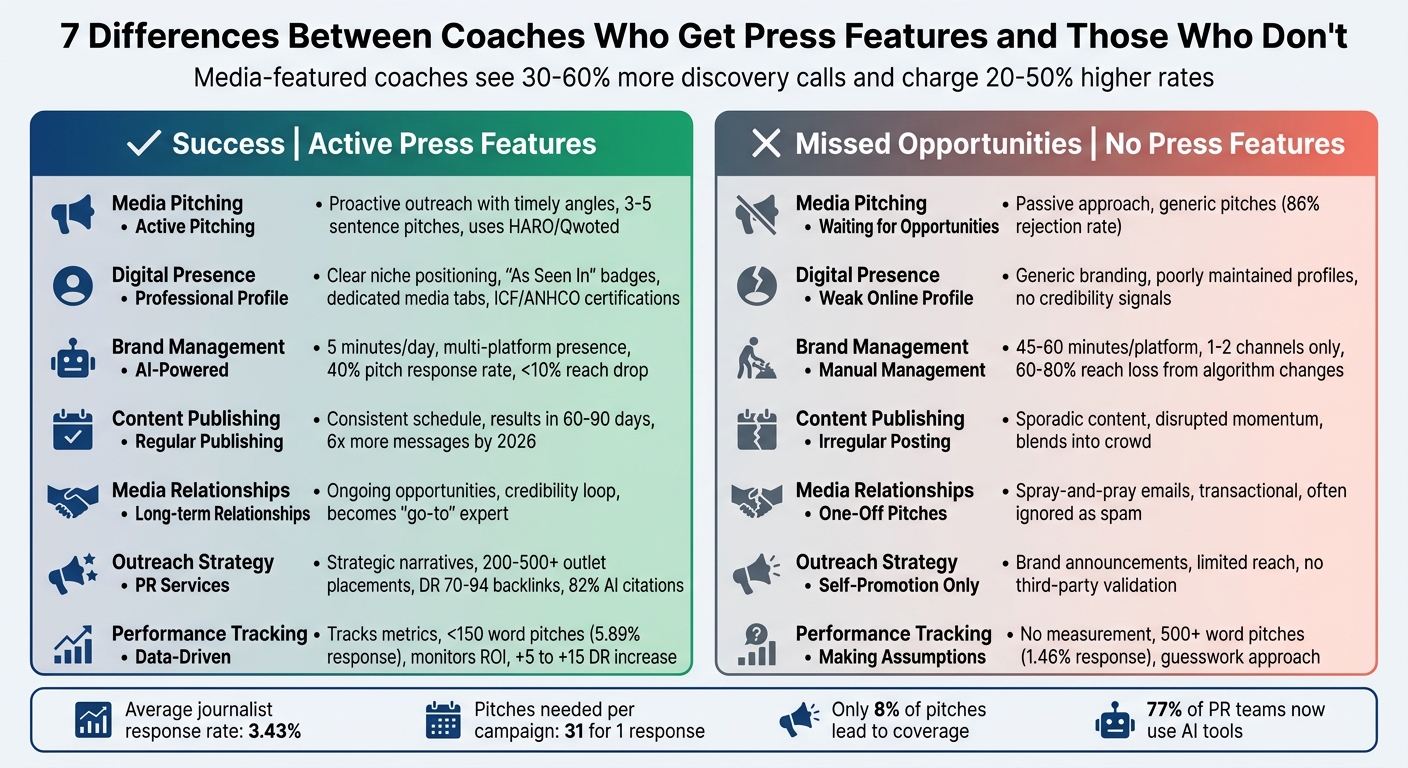
Getting featured in the press can transform a coaching business, leading to 30–60% more discovery calls and allowing coaches to charge 20–50% higher rates. The key? Coaches who secure media coverage follow specific strategies that set them apart. Here are the seven main differences:
- Active Pitching: Successful coaches proactively reach out to journalists with timely, relevant angles instead of waiting for opportunities.
- Professional Digital Presence: They maintain polished online profiles that clearly communicate their niche and expertise.
- AI Tools for Branding: Coaches use AI to streamline branding, outreach, and content creation, saving time and boosting efficiency.
- Consistent Content Publishing: Regularly sharing content builds momentum and keeps them visible to both clients and journalists.
- Building Media Relationships: Long-term connections with journalists lead to recurring opportunities, not just one-off features.
- Leveraging PR Services: Professional PR teams craft narratives that resonate with media outlets, achieving broader exposure.
- Tracking Results: They measure outreach performance and refine strategies based on data, ensuring continuous improvement.
Quick takeaway: Coaches who succeed in media focus on consistent effort, strong branding, and meaningful media relationships. Whether using DIY methods or PR services, the key is to stay visible and relevant.
7 Key Differences Between Coaches Who Get Press Features vs Those Who Don't
1. Active Media Pitching vs. Waiting for Opportunities
Media outreach strategies
Using AI tools and taking a proactive approach can open doors to media features that boost your personal brand.
Coaches who succeed in media outreach don’t sit back and wait. Instead, they actively pitch to journalists. Considering that 86% of journalists reject pitches that don’t align with their editorial focus, waiting for the "perfect opportunity" isn’t a winning strategy[5].
Journalists aren’t interested in generic brand announcements - they want expert opinions on timely, relevant topics. For instance, rather than sending a bland pitch like "I’m a life coach available for interviews", successful coaches craft pitches with engaging angles. A pitch like "Why female entrepreneurs are burning out faster in the AI era" grabs attention and positions the coach as a knowledgeable source[4].
"Reporters don't want your company's point of view. They want a human being with something worth saying."
– Vivek Sharma, Founder & CEO, TS Newswire[1]
Winning pitches are short - usually 3–5 sentences - and start with a bold insight or a quote that sparks interest. These pitches connect the coach’s expertise to a timely "why now" angle, often tied to seasonal trends or current events. For example, pitching strategies for recovering from burnout in January, when people are focused on New Year goals, or during particularly stressful times, tends to resonate more than generic outreach[3][1][4].
Coaches who thrive in media also use tools like HARO (Help A Reporter Out) and Qwoted to respond to journalist requests in real time[3][4]. This approach is far more effective than cold pitching because journalists are already seeking expert commentary. Those who wait passively often miss out on these opportunities. Being proactive in this way is just one of the key habits that separate media success from missed chances.
sbb-itb-f7e72a6
2. Professional Digital Presence vs. Weak Online Profile
Digital Presence and Branding
When journalists research potential features, they often start with a Google search. If your online profile is generic or poorly maintained, it can lead to an instant pass.
Coaches who consistently land press features know the importance of a well-defined digital presence. Every element - whether it’s a LinkedIn banner, a website bio, or even a tagline - needs to clearly communicate their niche. For instance, branding yourself as a "business coach for introverted founders" is far more engaging than simply saying you help entrepreneurs succeed [4].
Attention to detail is key. Successful coaches use elements like "As Seen In" badges or certifications from organizations such as ICF or ANHCO to highlight their authority and establish trust [4][2]. Many also feature dedicated media tabs on their websites, showcasing interviews, guest articles, and video clips [4]. This level of polish not only appeals to journalists but also makes your profile more visible to AI-driven search systems.
This kind of professional presence creates what’s often referred to as the "credibility loop." Once you secure one media placement, it becomes easier to land the next. Coaches with media-validated profiles often report a 30% to 60% uptick in discovery calls and can confidently increase their rates by 20% to 50% [2].
A strong digital footprint also enhances your credibility with AI systems. Search engines and AI assistants assess authority by recognizing repeated mentions across trusted, third-party sites. High-authority backlinks from news domains (with a domain rating of 70 or higher) not only boost SEO but also signal to AI systems that you’re a recognized expert worth highlighting in their results [1][6].
3. AI-Powered Brand Building vs. Manual Brand Management
Digital Presence and Branding
Coaches who secure press features can handle their branding tasks much more efficiently. With manual management, it takes about 45–60 minutes per platform, which often limits coaches to focusing on just one or two channels [7]. AI-powered tools completely change this dynamic, cutting the time needed to just 5 minutes a day while maintaining a presence across several key platforms [7].
This efficiency also helps build "platform resilience." When a platform changes its algorithm (as they often do), coaches managing their brand manually risk losing 60% to 80% of their total reach almost instantly [7]. On the other hand, those leveraging AI-driven multi-channel automation experience less than a 10% drop in visibility because their reach is spread across multiple platforms [7].
In addition to streamlining digital presence, AI takes outreach efforts to the next level.
Media Outreach Strategies
AI turns media outreach into a science. By analyzing recent journalist activity, AI tools create customized pitches that boast a 40% response rate [9]. PR agencies using AI report media placement rates that are 3–5 times higher and campaign execution that is 70% faster compared to traditional methods [9].
AI-researched media lists also achieve 73% greater accuracy in identifying journalists' current beats and employers than traditional databases, which coaches manually update on a quarterly basis [9]. Scott Baradell, CEO of Idea Grove, highlights this shift:
"The way AI platforms surface and characterize companies is driven by credibility signals - press coverage, authoritative content, search presence" [8].
This means that coaches using AI tools aren't just pitching smarter - they're actively building the credibility signals that AI platforms, like ChatGPT, use to recommend them as trusted experts.
AI's impact doesn’t stop at outreach - it also reshapes how content is created and scaled.
Content Creation Consistency
AI doesn’t just save time; it redefines what’s achievable in content creation. Coaches manually managing their outreach can send out 10–15 personalized pitches daily [9]. With AI, this number skyrockets to over 1,000 while still maintaining a personal touch. That said, human oversight is essential to keep the content authentic [9]. Tools like Brandbase can capture a coach’s unique voice during a 60-minute interview and use it as a foundation to generate content that feels genuinely human [10].
The results are tangible. Gartner has forecasted that spending on earned media will nearly double by 2025–2026, largely because AI is so effective at highlighting companies [8]. Coaches focusing on "Generative Engine Optimization" (GEO) - ensuring their expertise is visible in AI-driven search results - are building a foundation that grows exponentially. Each media placement makes them more likely to be cited by AI assistants, which in turn leads to even more media opportunities, creating a cycle of growth [1][11].
4. Regular Content Publishing vs. Irregular Posting
Content Creation Consistency
Coaches who consistently land press features understand one key principle: building a brand isn’t about one-off wins - it’s about sustained momentum. The difference between being featured once and becoming a trusted expert boils down to regularity. Safwan Azeem, an author at ANHCO, explains it perfectly:
"The first interview gets you known. The third builds familiarity. The fifth makes you top-of-mind" [4].
This idea of "compound interest" in media is backed by results. Coaches who stick to a regular publishing schedule often see tangible outcomes - like inbound inquiries and speaking invitations - within 60 to 90 days [1]. The real payoff, though, becomes evident after 6 to 12 months, when the cumulative effect of consistent media appearances solidifies their authority [1]. On the flip side, irregular posting disrupts this momentum. Without consistency, coaches risk being overlooked, blending into the crowd of "just another expert." Regular publishing doesn’t just build credibility - it also strengthens your online presence.
Digital Presence and Branding
Consistency does more than build familiarity with your audience; it also boosts your digital footprint. Regular publishing benefits both human readers and search engines. By 2026, AI-driven tools and search algorithms are expected to favor experts with a steady stream of content on trusted platforms. This can lead to six times more incoming messages and twice as many outreach opportunities [1] [2] [12].
When journalists evaluate potential sources, they’re looking for reliability and media readiness. Irregular posting sends the wrong message - it suggests a lack of commitment to visibility. Paul Irolla, Founder & CEO of Meet Lea, emphasizes this point:
"Building a personal brand on LinkedIn isn't about having a complete profile - it's about consistently demonstrating your unique value through strategic content" [12].
Media Outreach Strategies
A consistent content schedule lays the groundwork for effective media outreach. Successful coaches don’t stop at individual media wins - they leverage them through a systematic plan. This includes monthly guest posts to establish thought leadership and weekly outreach to journalists to maintain visibility between major features [4]. They also align their content with timely trends, like "New Year transformation" in January or "burnout" during stressful seasons, to increase their chances of being featured as relevant experts [3] [4].
The approach is practical and actionable: send out 1–2 press releases each month highlighting program launches, client achievements, or expert commentary [2]. Update your website’s "Media" and "As Seen In" sections with each new feature to enhance both SEO and conversions [4]. Long-form content, such as a 30-minute podcast, can also be repurposed into shorter social media posts to maintain visibility between major media appearances [4]. This keeps the buzz around each feature alive, ensuring coaches remain top-of-mind for both journalists and potential clients.
5. Building Media Relationships vs. One-Off Pitches
Relationship-Building Efforts
Building strong, long-term relationships with the media is what separates the most successful coaches from the rest.
Coaches who frequently land press features understand a key principle: journalists don’t want to feel like they’re being sold something - they want dependable sources they can rely on. A one-off pitch might get you temporary attention, but a real relationship offers ongoing opportunities. To establish this trust, engage proactively. Follow journalists on platforms like LinkedIn or Twitter/X, comment thoughtfully on their articles, and share their work without immediately asking for anything in return. These small, genuine efforts can make you a familiar and trusted source over time [4].
Media Outreach Strategies
When it comes to pitching, think of it as offering a favor rather than promoting yourself. Start your pitch with something bold - a surprising insight, an unexpected trend, or a timely statistic that grabs attention and answers, “Why should readers care about this right now?” Keep it short - under 150 words - and include a sharp angle, your credentials, and a quote they can use right away [4]. Timing matters, too. Tailor your outreach to seasonal trends, like pitching “New Year transformation” stories in January or content on managing burnout during stressful periods.
With journalists receiving an overwhelming number of pitches, standing out is critical. About 77% of PR teams now use AI for tasks like monitoring media and creating content [13]. The first paragraph of your pitch must pass the “smell test.” Including visuals can also make a big difference - press releases with images are seven times more likely to be read than those without [14].
Digital Presence and Branding
Media relationships create what’s often called a “credibility loop.” Every feature you land acts as social proof, making it easier to secure the next one [4]. Smart coaches repurpose these media wins across their social media platforms, signaling to journalists that they’re polished, reliable experts. This consistent presence builds momentum, turning one-time features into long-term authority. Unlike one-off pitches that are quickly forgotten, relationship-driven strategies help establish lasting credibility.
As PressBeat explains:
"When you provide genuine value to a journalist, you build a relationship that can yield authentic coverage for years to come" [13].
By focusing on relationships, you’re not just boosting your digital presence - you’re laying the groundwork for ongoing media opportunities.
| Aspect | One-Off Pitches (Transactional) | Media Relationships (Relational) |
|---|---|---|
| Goal | Immediate, one-time coverage | Long-term authority and recurring features |
| Approach | "Spray and pray" mass emailing | Targeted, personalized outreach |
| Content | Brand-focused announcements | Value-driven insights and trend commentary |
| Pace | Slow, campaign-based | Real-time, always-on engagement |
| Result | Often ignored or marked as spam | Becomes a "go-to" expert source |
6. Using PR Services vs. Self-Promotion Only
Media Outreach Strategies
Professional PR services can elevate your media outreach far beyond what self-promotion alone can achieve. While DIY efforts often rely on generic mass emails that fail to grab attention, PR agencies focus on crafting strategic narratives that align with ongoing media conversations. This approach ensures your expertise resonates with journalists and editors.
The key difference lies in how the message is framed. Self-promotion tends to focus on announcements like, "I launched a new coaching program", which rarely piques editorial interest. On the other hand, PR services reframe the message into something timely and relevant, such as, "Why [Trend] is replacing [Old Method] in 2026." This angle connects your expertise to current news cycles and makes it more appealing to media outlets [3]. As Natalie Thatcher from Fein PR explains:
"Modern PR is less about announcements and more about becoming part of the conversation already happening in media" [3].
This shift in approach often leads to a noticeable boost in visibility, with PR-driven strategies resulting in a 30% to 60% increase in client inquiries and discovery calls for coaches [2].
Digital Presence and Branding
Another major advantage of professional PR services is the lasting credibility they build for your brand. Each media placement not only enhances your authority but also provides valuable backlinks from high-authority sites (typically with a Domain Rating of 70 or higher). These placements can reach hundreds of news outlets, including prominent platforms like Yahoo Finance and Business Insider [2].
The "As Seen In" badges you earn from such placements offer third-party validation that self-promotion simply can't replicate. This credibility often justifies premium coaching fees ranging from $5,000 to $50,000+ [2].
Content Creation Consistency
Creating high-quality, consistent content is a challenge for many coaches, but it's an area where PR services truly shine. They deliver professionally crafted content tailored to your niche, ensuring you're regularly producing material that gets noticed. This is especially important in 2026, as half of all AI citations will come from content published within the last 11 months [15].
Earned media, such as third-party editorial coverage, plays a critical role in visibility. In fact, 82% of AI citations come from earned media rather than owned content like blogs [15]. Distributed earned media can generate up to 325% more AI citations compared to brand-owned content [15]. By working with PR professionals, you increase the likelihood that AI systems will cite your expertise when referencing your field.
Relationship-Building Efforts
Perhaps the most valuable benefit of PR services is their ability to turn one-time media placements into ongoing opportunities. They help establish you as a trusted expert that journalists can rely on for timely, insightful commentary on breaking trends [3][4].
While DIY platforms like HARO can be helpful, PR agencies bring established relationships with top-tier media outlets, giving you access to opportunities that might otherwise take years to cultivate. This third-party validation positions you as a credible source, ensuring your voice stands out in a crowded market [4].
7. Tracking Performance Data vs. Making Assumptions
Media Outreach Strategies
Great coaches don’t leave their media outreach to chance - they analyze the numbers. In 2025, the average journalist response rate to PR pitches was just 3.43%. On top of that, PR teams had to reach out to an average of 31 journalists per campaign just to get a single response. Even more telling, only about 8% of PR pitches led to actual media coverage [16].
The secret? Shorter, targeted pitches outperform longer, generic ones. Pitches under 150 words had a 5.89% response rate, while those over 500 words saw only a 1.46% response rate [16]. As Press Release Zen famously said:
"A release without a measurement plan is documentation, not PR" [16].
Coaches who analyze their pitch performance know that quality beats quantity. Instead of blasting 120 random contacts, they focus on 12 well-researched, high-potential targets [16].
Digital Presence and Branding
Media placements are great, but their real value lies in measurable business outcomes. For instance, adding a simple "How did you hear about us?" question to your discovery call forms can help you directly track ROI from specific press features [1]. This lets you see if those media appearances are actually converting leads or just boosting your visibility without tangible results.
Backlinks from reputable news outlets also play a huge role. High-authority backlinks from PR efforts can increase your Domain Rating (DR) by +5 to +15 [2], which strengthens your online presence over time. Regularly search your name and niche keywords to check if your media appearances are outperforming competitors and showing up in Google News [2]. By 2026, this becomes even more important as AI systems rely on indexed media presence to cite experts. Tracking your visibility in these systems is now a key part of staying competitive [1].
This data doesn’t just measure success - it helps refine your outreach and content strategies.
Content Creation Consistency
Just like targeted pitching drives better results, tracking content performance ensures your media strategy stays effective. Smart coaches monitor how their audience responds to repurposed media features on social platforms - likes, shares, and comments provide valuable feedback [4]. Ignoring this data risks creating content that feels lifeless and disconnected [16].
The key is consistent effort backed by data. Publishing 1–2 press releases or guest posts per month helps build credibility over time. Coaches who maintain a steady flow of strategic press releases often see a 30–60% increase in client inquiries and can charge 20–50% more for their services [2][4]. But these results only come when metrics are tracked, proving ROI and fine-tuning the approach.
Comparison Table
Coaches deciding between DIY methods and managed PR services face trade-offs in time, cost, and outcomes.
With DIY methods, smaller publication placements can happen within 2–4 weeks, but securing features in top-tier outlets typically takes 8–16 weeks of consistent effort [17]. Coaches spend around 5–15 hours weekly on outreach, and the necessary tools (like email finders or tracking software) cost between $200 and $500 per month [17][18]. Interestingly, direct outreach often yields better results; in 2023, 73% of startup founders reported that pitching journalists directly was more effective than using agencies [17].
On the other hand, managed PR services operate differently. Agencies charge $3,000–$15,000 per month, usually requiring a six-month commitment, and significant results may take 3–6 months to materialize [18]. A more affordable option is Brandbase, offering two plans: the Essential plan ($99/month plus a $499 setup fee) delivers one PR placement every six months, while the Pro plan ($499/month plus a $499 setup fee) provides six placements bi-monthly. The Pro plan also includes unlimited landing pages, LinkedIn outreach campaigns, hosting, maintenance, analytics, and edits - features that DIY methods often lack.
Credibility differs between the two approaches as well. Managed services secure placements in 200–500+ outlets with Domain Ratings (DR) of 70–94 [2], along with "As Seen On" badges for websites. This media validation can boost discovery calls by 30–60% and help coaches raise their rates by 20–50% [2]. DIY methods, meanwhile, rely on authentic storytelling and recurring contributions, which build credibility over time but lack the guaranteed volume and authority signals of managed services.
Here’s a quick comparison of the two approaches, plus Brandbase’s Pro plan:
| Feature | Managed PR Services | DIY Methods | Brandbase Pro |
|---|---|---|---|
| Time to First Result | 3–6 months [18] | 2–4 weeks (smaller outlets) [17] | Bi-monthly placements |
| Monthly Cost | $3,000–$15,000 [18] | $200–$500 (tools only) [17] | $499/month + $499 setup fee |
| Weekly Time Commitment | Minimal (review only) | 5–15 hours [18] | Minimal |
| Feature Frequency | Varies by agency | 3–5 pieces per 90 days [17] | 6 placements bi-monthly |
| Domain Authority | DR 70–94 [2] | Variable based on efforts | High-authority outlets |
| Additional Tools | Professional writers, distribution networks [2] | Self-managed | AI assistant, landing pages, LinkedIn campaigns |
Ultimately, the choice depends on your time and budget. If you have 10+ hours a week and enjoy building relationships, DIY methods can work well - especially since 85% of journalists favor personalized story angles over traditional press releases [17]. However, if you want guaranteed results without the heavy time investment, managed services provide a more streamlined path to building credibility.
Conclusion
Coaches who land press features don’t rely on luck - they use deliberate strategies to establish authority. Sitting back, manually managing your brand, or guessing what works won’t get you noticed. The ones who succeed focus on active pitching, maintaining a professional online presence, publishing consistently, engaging authentically with media, and tracking measurable outcomes.
To make this happen, start by defining a clear, focused niche that showcases your expertise. Then, take a hard look at your digital presence - your LinkedIn banner, bio, and website should instantly communicate your authority in under 30 seconds.
When pitching, keep your email concise - under 150 words. Lead with a bold insight or a timely statistic instead of a lengthy intro. Journalists value authentic, human insights over corporate jargon. Include a ready-to-use quote in your initial email, rather than offering to provide one later.
The payoff is clear: coaches with media validation report 30–60% more discovery calls and can command 20–50% higher rates [2]. Press coverage also builds momentum - each feature makes it easier to secure the next one, amplifying your credibility over time [1][4].
Ultimately, staying visible and credible comes down to investing in these strategies. Whether you handle outreach yourself or use tools like Brandbase's Pro plan (starting at $499/month with a $499 setup fee for six PR placements every two months), consistency is key. Modern AI systems prioritize experts with a strong content footprint, so regular press coverage ensures you’re seen as a go-to authority when potential clients search for solutions [1].
FAQs
What should I pitch if I don’t have a “newsworthy” story?
If you don’t have a “newsworthy” story to share, shift your focus to crafting an engaging angle that resonates with both your target media and audience. Consider pitching a trend, offering a fresh perspective, or sharing actionable advice rooted in your expertise. For instance, you could tackle common misconceptions in your field, break down industry trends, or propose solutions to widely faced problems. Media outlets are always on the lookout for new insights that speak directly to their audience, even if there isn’t a classic news hook involved.
How do I build a media-ready online profile fast?
To craft a media-ready profile in no time, focus on presenting yourself clearly and telling a story that highlights your expertise and distinct point of view. Be specific about who you help, the value you deliver, and the reasons your perspective stands out.
Instead of simply promoting your brand, pitch engaging stories that align with current trends. Leverage digital PR tactics like guest blogging and thought leadership pieces to establish credibility. Regularly share meaningful, niche-focused content to strengthen your profile quickly and effectively.
Which metrics prove press features are generating clients?
Metrics that show press features are bringing in clients include:
- Boosted credibility and authority: Media recognition often acts as a trust signal, making potential clients more likely to engage.
- Justification for premium pricing: Being featured in reputable outlets can help position your services as worth a higher price.
- Improved SEO for your personal brand: Backlinks from media coverage can enhance your search engine visibility, driving organic traffic.
- New opportunities for speaking or media engagements: These can lead to direct client inquiries and expand your professional reach.
Together, these elements highlight how press coverage can play a key role in attracting clients.
Related Blog Posts

Blog title heading will go here
Blog title heading will go here