

7 Personal Branding Mistakes Coaches Make in Their First Year

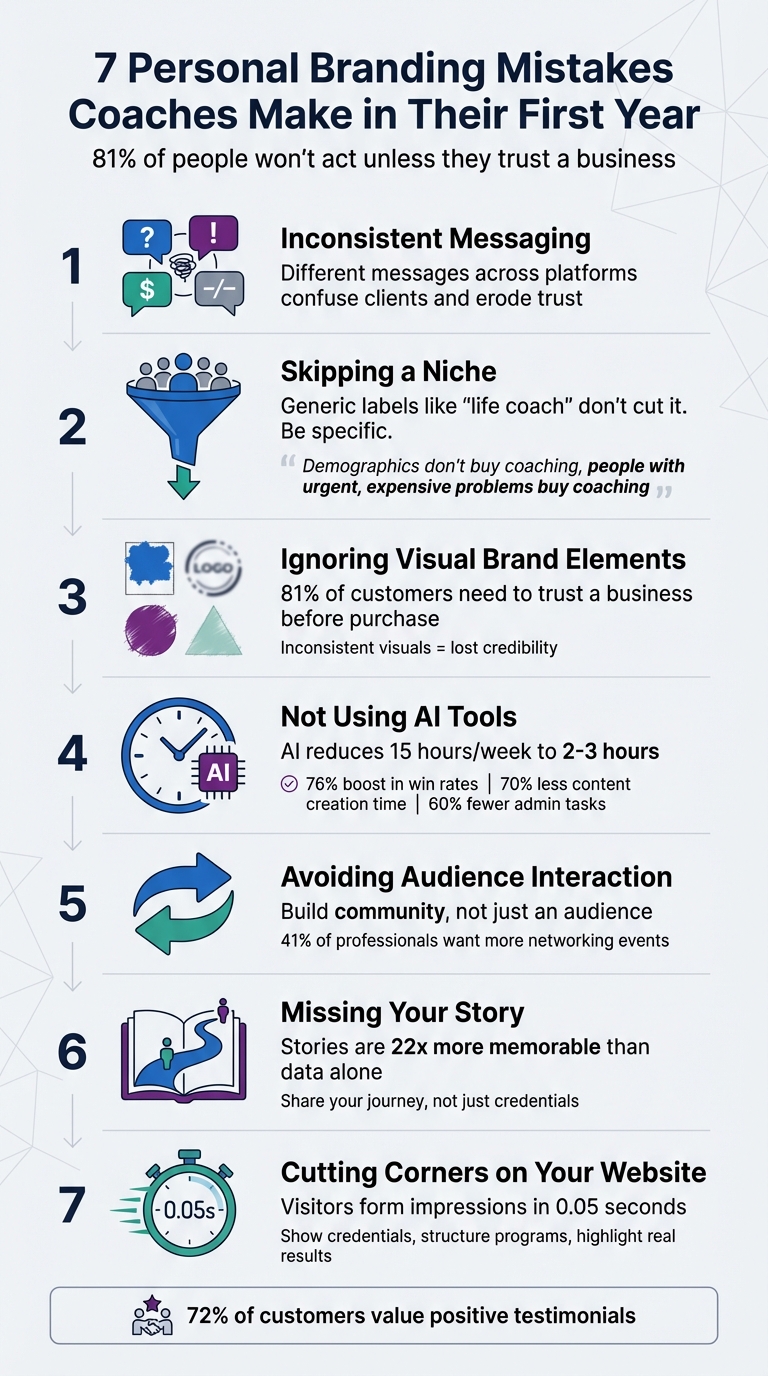
Your first year as a coach can make or break your personal brand. It’s critical to establish trust quickly, as 81% of people won’t act unless they trust a business. Many new coaches unintentionally weaken their brand by making avoidable mistakes. Here’s a quick rundown of the seven most common pitfalls:
- Inconsistent Messaging: Conflicting messages across platforms confuse potential clients and erode trust.
- Skipping a Niche: A vague or broad audience focus makes it harder for clients to connect with your services.
- Overlooking Visuals: Poor design choices (like mismatched colors or blurry logos) can make your brand seem unprofessional.
- Not Using AI Tools: Avoiding AI can lead to wasted time and missed opportunities for efficiency.
- Ignoring Audience Engagement: Treating your audience as passive observers instead of building a community weakens connections.
- Failing to Share Your Story: A lack of personal storytelling makes it harder to stand out and connect emotionally.
- Cutting Corners on Your Website: A poorly designed or unclear website can deter potential clients in just seconds.
7 Personal Branding Mistakes Coaches Make in Their First Year
The #1 Personal Branding Mistake Coaches Keep Making
sbb-itb-f7e72a6
1. Using Different Messages on Different Platforms
Imagine this: your LinkedIn headline says you're a "leadership coach for executives", your Instagram bio calls you a "mindset and wellness guide", and your website claims you help "entrepreneurs scale their businesses." This kind of mixed messaging across platforms doesn’t just confuse potential clients - it erodes trust. When your brand tells different stories, people struggle to remember or rely on you.
Paula Graziani, CEO of The Standout Founder, explains it perfectly:
"Inconsistent messaging creates friction. Even if each piece of content is good on its own, the overall picture feels fragmented. This makes it harder for people to trust and remember you." [3]
The goal isn’t to copy-paste the same content everywhere. Instead, it’s about alignment. For instance, your LinkedIn posts can lean professional, while Instagram stories feel more casual. What matters is that both reflect the same core message: who you help and the problem you solve. Without this alignment, your authority weakens, and your brand becomes forgettable.
To fix this, start with a clear positioning statement. In one or two sentences, define your niche and the specific problem you address. Use this as the foundation for all your platforms. Next, audit your digital presence - check that your LinkedIn "About" section, website homepage, and social media bios all share a cohesive story. Identify three to five key content pillars that directly support your coaching offer, and make sure every piece of content ties back to your core message.
Think of your personal brand as a mental shortcut for your audience. When people can immediately understand what you stand for - no matter where they find you - you’ve already built trust and shortened the path to conversion before even speaking to them. Up next, we’ll dive into another mistake that can disrupt your brand consistency.
2. Skipping the Step of Choosing a Specific Niche
Generic labels like "life coach" or "business coach" don’t cut it. Instead, aim to target a specific intersection, like "newly qualified solicitors struggling with client management." Why? Because this kind of clarity helps potential clients immediately recognize your expertise. Many new coaches think avoiding a niche keeps their opportunities broad, but in reality, it creates confusion. If people can’t figure out why they should hire you, they simply won’t.
Clear messaging builds trust. On the flip side, a vague or undefined niche makes your brand feel scattered. Sarah Short, Founder of The Coaching Revolution, puts it perfectly:
"Demographics don't buy coaching, people with urgent, expensive problems buy coaching." [5]
This isn't just about being too broad - it’s also about being hard to find. For example, saying you help "women in transition" doesn’t tell you where to find these potential clients or what specific communities they belong to. A teacher going through a divorce, a solicitor returning from maternity leave, and a retail manager adjusting to new pressures are all "women in transition", but their challenges are vastly different.
Instead, focus on solving a specific problem for a specific group. For example, "newly qualified solicitors struggling with client management" or "retail store managers dealing with head office pressure." This approach doesn’t limit you - it makes your expertise crystal clear. When someone reads your message and thinks, "That’s me", you’ve already captured their attention.
Want to test your niche? Try the "Grandma Test": if you can’t explain what you do in one sentence to someone outside your industry, your niche needs more work [2].
3. Ignoring Visual Brand Elements
Your visuals do a lot of the talking before you even get a chance to. A poorly chosen color scheme, a blurry logo, or inconsistent fonts across platforms like Instagram, LinkedIn, and your website can make your business look unprofessional. In fact, 81% of customers say they need to trust a business before they make a purchase [1].
When someone checks out your LinkedIn profile, hops over to your website, and then scrolls through your Instagram, any lack of visual consistency can create confusion and erode trust. On the flip side, a cohesive visual style strengthens your credibility and shows that you're serious about your coaching business. Liam Austin, Co-founder of Entrepreneurs HQ, puts it perfectly:
"Visual design matters. Be intentional with how you prepare your logo, brand colors, content marketing materials, and profile picture." [1]
To get started, create a detailed style guide that outlines everything - your brand’s color codes (HEX values), fonts, logo variations, and even the kinds of images you prefer. Design tools like Canva or Adobe can help you stick to this guide, and platforms like Unsplash or Pexels offer high-quality visuals to elevate your content [6]. Incorporating professional photography can also give your brand an extra polished look.
Your visual branding should match your vibe. Think of it as an extension of your coaching style. As Visuable explains:
"Your visual branding, including colors, typography, imagery, and layout, tells a story before you say a word." [6]
Make it a habit to regularly review your online presence. Ask yourself, "Does this feel like me?" If your answer is no - or if your platforms don’t feel connected - it’s time to fine-tune your visual identity [6]. A strong and consistent visual presence is just as important as clear messaging when it comes to building a solid, trustworthy brand.
4. Not Using AI Tools for Brand Building
First-year coaches often dedicate over 15 hours each week to creating content, managing emails, and staying active on social media. With the help of AI tools, this workload can shrink dramatically to just 2–3 hours [10]. That extra time could be better spent focusing on what really matters - coaching and building stronger relationships with clients.
The results speak volumes: coaches who incorporate AI report a 76% boost in win rates [7]. The goal isn’t to replace your unique voice but to amplify it. Tools like ChatGPT or Claude can draft blog posts and social media updates tailored to your personal style and frameworks. Meanwhile, meeting assistants like Fathom (which offers a free plan with unlimited recordings) can turn coaching sessions into neatly organized action items and summaries [11].
As Tim Brownson, Founder of The Fully Booked Coach, wisely points out:
"AI can amplify what you're already doing well, but it can't fix fundamental problems with your coaching business" [8].
To ensure AI reflects your unique perspective, train it using your own materials - whether that’s books, articles, or session transcripts [9][11]. Start small by focusing on one or two tools that solve your biggest challenges, whether it’s content creation or administrative tasks.
The benefits go beyond just saving time. AI can reduce content creation efforts by 70%, cut administrative tasks by 60%, and boost client engagement rates by 45% [7]. For example, one solo life coach saw a staggering 180% jump in monthly revenue after using AI for content and communication [7]. However, it’s essential to maintain authenticity. As Christina Minshull reminds us:
"AI is a great tool for efficiency, but a terrible tool for authenticity" [12].
Consider building a "Three-Layer AI Stack" to balance efficiency with personal touch. Start with foundation models like ChatGPT for content creation, add automation platforms, and round it out with specialized coaching tools for session analysis [7]. This approach allows you to offload repetitive work while staying true to your brand’s voice and values. By using AI wisely, you can strengthen your personal brand without compromising its integrity.
5. Avoiding Audience Interaction and Feedback
Some coaches fall into the trap of treating their audience as passive observers, which can weaken the connection to their brand. This one-sided approach often makes the brand feel distant and unapproachable. Laura Agar Wilson, Business Coach at Wholeheartedly Laura, puts it best:
"I feel like 'audience' is quite one sided... I actually prefer thinking of my 'audience' as a 'community'. That feels much more aligned with... a conversation than me simply talking at people!" [13]
Engagement is key to building trust. For example, 81.8% of virtual event planners now incorporate live-polling tools to make their sessions more interactive [14]. Additionally, around 41% of professionals express a desire to attend networking events more often, highlighting the importance of fostering connections [14]. Regular interaction with your community strengthens the trust and consistency that are essential to a personal brand. On the flip side, neglecting this interaction can make your brand feel disconnected from potential clients.
To keep your audience engaged, try incorporating icebreakers into workshops or live sessions [14]. Platforms like Instagram Stories are great for real-time Q&A, Facebook Groups can nurture a sense of community, and LinkedIn is perfect for professional networking [13][15]. Even something as simple as adding a "reply to this email" call-to-action in newsletters can open the door to meaningful conversations [13][15]. The goal is to create a dialogue, not just a monologue.
Commit to engagement strategies for 12 weeks before evaluating the results [13]. Focus on metrics like live participation rates, session durations, and how often your free resources are downloaded [14]. This feedback loop helps you identify what your audience enjoys and what might need tweaking, giving you the insights you need to refine your messaging based on real data rather than guesswork.
Today's audiences value authenticity more than perfection. They can quickly spot anything that feels forced or insincere. They’re looking for presence and personality, not a flawlessly polished image [2]. Without regular interaction and feedback, you’re essentially operating in the dark - making assumptions about what your audience wants instead of truly understanding their needs.
6. Missing the Opportunity to Tell Your Story
Focusing solely on credentials and services might seem like the logical first step for new coaches, but it often leaves out one of the most powerful tools for connection: storytelling. Research shows that presentations incorporating stories are 22 times more memorable than those relying only on data [16]. In a competitive market, being memorable isn't just helpful - it’s critical.
Your story is what creates a human connection with potential clients. As Michelle Kuei, Coach For Coaches & Speakers, explains:
"Storytelling connects your coaching business to the heart of your audience" [16].
A compelling brand story doesn't just list accomplishments; it builds trust by revealing your values, personality, and the person behind the business.
How to Structure Your Story
An effective story includes five elements: a character, a conflict, a turning point, a resolution, and a call to action [16]. The goal is to illustrate transformation, not just outline services. For example, instead of saying, "I help executives improve their leadership skills", describe the journey your clients experience. Share what it feels like to work with you and how their lives change as a result. This approach not only clarifies your mission but also resonates deeply with your audience.
Authenticity Over Perfection
Perfection isn’t the goal - authenticity is. As Kuei emphasizes:
"Failure to share your values, ideals, and perspectives with your audience will make it challenging to form real genuine connections with your prospect" [16].
One way to refine your story is by using empathy mapping, which helps you understand your clients' perspectives and craft narratives that truly resonate with their experiences.
Your brand story should explain why your coaching business exists, what drives you, and who you are. It’s not about presenting a flawless image - it’s about showing up as your true self. When you share your journey honestly, you create a consistent, trust-building foundation that helps attract the right clients during your first year and beyond.
7. Cutting Corners on Your Website and Online Presence
Once you've refined your messaging, your website and online presence need to reflect that same level of clarity and trustworthiness.
Here’s the reality: in just 0.05 seconds, visitors form an impression of your online presence [2]. That's less time than it takes to blink, but it's enough for someone to decide if your coaching brand feels credible - or not. Many new coaches make the mistake of treating their website as an afterthought, tossing up a basic "Contact Me" page with vague descriptions. This approach leaves potential clients guessing and forces them to trust you without any real proof.
Take unverified claims, for example. Statements like being the "world's number one coach" fall flat because there’s no universal ranking system in the coaching industry [4]. Corporate clients and senior leaders don’t buy into such empty declarations. Instead, they look for real credentials - evidence of completed training, logged coaching hours, and certifications from respected organizations like the International Coaching Federation [4]. As NMS Consulting explains:
"Certification does not guarantee that a coach will be effective, yet it signals investment in learning and structure and can make it easier for clients to compare offers" [4].
Another common misstep is listing hourly rates instead of offering structured programs. Executive coaching is rarely sold by the hour; it’s typically packaged as a series of sessions - spanning six to twelve months [4]. To present yourself as a professional, clearly outline your program structure, delivery methods, tracking mechanisms, and any extra benefits. Without this level of detail, your brand may come across as incomplete or unprepared.
Your website also needs to show how you actually coach. If your content is filled with generic advice or motivational speeches, you risk being seen as more of a mentor or trainer than a coach. Coaching is about the client - following the 70/30 rule, where clients do 70% of the talking and coaches just 30% [4]. Your online presence should reflect this by highlighting real client stories and tangible results, rather than focusing solely on your methods or philosophies.
To test the clarity of your website, try the "Grandma Test":
"If your grandma doesn't understand your pitch, it's probably not clear enough." – Ethos [2].
Your site should immediately explain what you do, who you help, and why your work matters - without making visitors dig for answers. At its core, a professional online presence isn’t about flashy design. It’s about creating a space where potential clients can quickly determine if you’re the right fit for their leadership challenges. Nail this, and you’ll reinforce the trust you’ve worked hard to build, setting the stage for meaningful connections.
Conclusion
Building your personal brand doesn't have to feel like an uphill battle. The seven pitfalls we’ve covered - inconsistent messaging, skipping niche selection, overlooking visuals, avoiding AI tools, neglecting audience interaction, missing storytelling opportunities, and cutting corners on your website - are entirely avoidable. The key is to take intentional, focused steps.
To simplify the process, follow this 8-step checklist:
- Choose a niche
- Define your unique value propositions
- Craft your brand story
- Write your coaching bio
- Create a mission-vision statement
- Establish your visual identity
- Develop a copywriting guide
- Publish client testimonials
These steps will create a strong foundation for a brand that resonates with your ideal clients. As Liam Austin, Co-founder of Entrepreneurs HQ, aptly says:
"Think of branding for coaches as a calling card. It's a straightforward way to introduce yourself to a new audience." [1]
Trust is the cornerstone of any successful brand. Studies show that 81% of customers need to trust a business before making a purchase [1], and 72% place high value on positive testimonials [1]. This trust stems from a cohesive brand strategy where everything - from your visuals to your client stories - works together seamlessly. Tools like Canva can help refine your design, while platforms like Testimonial.io simplify gathering client feedback. Regularly auditing your brand strategy ensures you stay aligned with your goals, especially when launching new initiatives.
However, it’s crucial to remember that AI can’t replace your authentic voice. Christina Minshull from The Brand Audit emphasizes this point:
"AI is a great tool for efficiency, but a terrible tool for authenticity." [12]
Use technology to handle repetitive tasks, but let your personal experiences and stories drive genuine connections. Striking the right balance between efficiency and authenticity is essential for long-term success.
Ultimately, the coaches who thrive in their first year aren’t the ones with the flashiest websites or the biggest budgets. They’re the ones who prioritize clarity, consistency, and connection. By applying these lessons, you can create a brand that not only attracts clients but also builds lasting credibility.
FAQs
How do I pick a niche without losing clients?
Choose a niche that matches both your skills and interests while solving a specific need for your audience. By clearly defining and consistently showcasing your niche, you’ll attract clients who connect with your expertise. This strategy not only keeps your current clients engaged but also brings in new ones. A well-defined focus reduces the chances of losing clients due to vague or overly restrictive positioning.
How can I use AI without sounding generic?
To make AI-generated content feel more personal and less generic, you need to shape its output to match your style. Start by embedding your specific tone, voice, and messaging frameworks directly into the prompts you provide. Be clear about the kind of language, structure, and examples you prefer. Sharing detailed examples of your desired tone or style can help the AI align its responses with your personal brand. The secret lies in steering the AI actively - don’t settle for default outputs. Tailor it to reflect your authentic voice.
What should my coaching website include to build trust fast?
To establish trust on your coaching website quickly, make sure to include these essential elements:
- Social proof: Display testimonials and client reviews to highlight the impact of your services.
- Professional branding: Use consistent and polished visuals to convey authority and reliability.
- Security features: Implement SSL certificates to protect visitor data and signal safety.
- Clear contact details and policies: Make it easy for visitors to reach you and understand your terms, fostering transparency.
- Credentials and awards: Showcase certifications, credentials, or recognitions to emphasize your expertise.
These elements help reassure potential clients and make them more likely to engage with your services.
Related Blog Posts

Blog title heading will go here
Blog title heading will go here