

How AI Helps Personal Brands Stay Consistent

Want your personal brand to stand out and feel consistent everywhere? AI can help. Here's the deal: maintaining a consistent voice across platforms is tough, especially as you scale. But staying consistent matters - brands with unified messaging see up to 23% more revenue and 2.5x higher engagement rates.
AI tools simplify this by analyzing your best content, learning your style, and helping you create on-brand posts, emails, and more. However, it’s not perfect - AI can’t replicate your perspective or emotional depth. The key? Use AI as an assistant, not a replacement. Let it handle drafts and repetitive tasks while you refine the final product.
Key Takeaways:
- Consistency Builds Trust: 81% of consumers need to trust a brand before buying.
- AI as a Helper: AI tools can maintain tone and style but need your input to stay true to your voice.
- Human-AI Collaboration Works Best: Teams using AI alongside human oversight perform 85% better than those working solo.
AI can save time and reduce effort, but your personal touch is still what keeps your brand memorable and trustworthy.
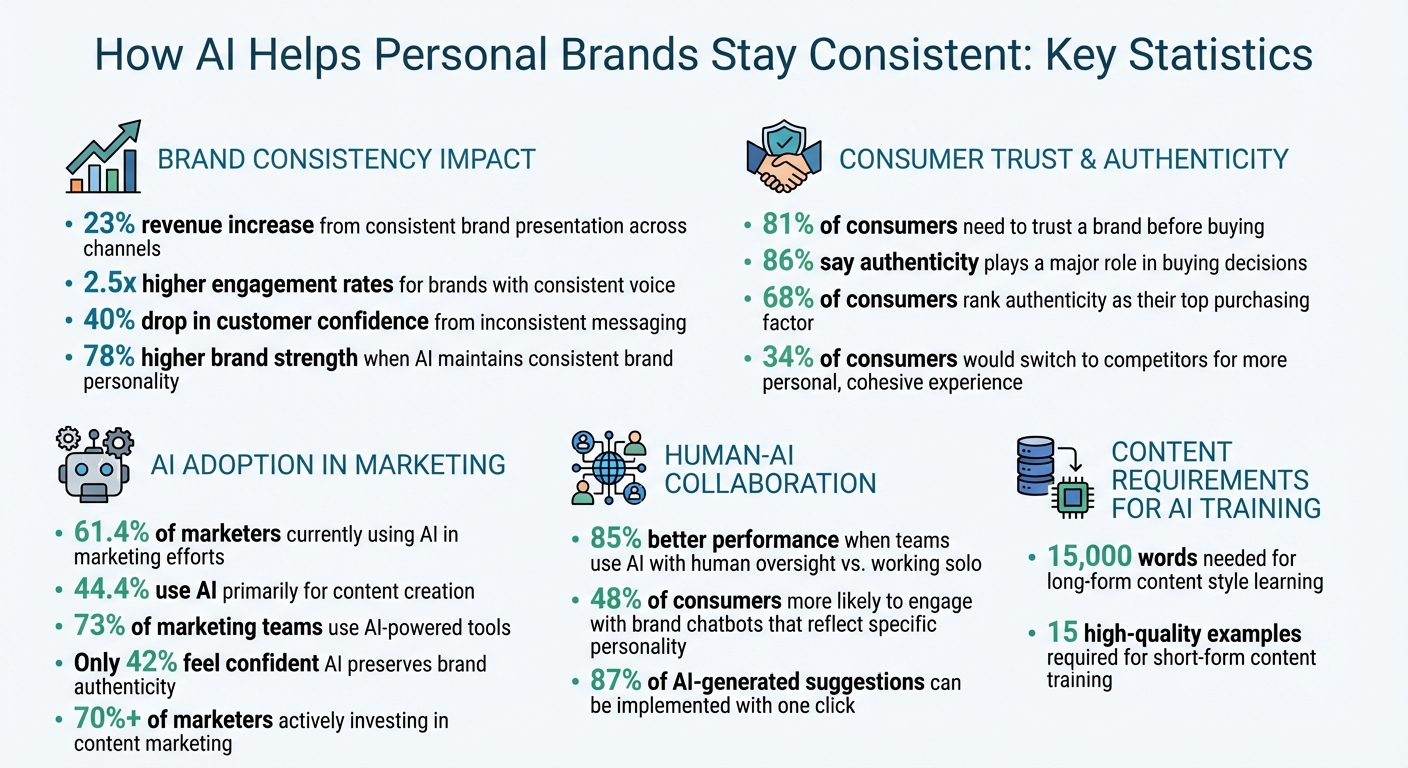
AI and Brand Consistency: Key Statistics for Personal Brands
Why Brand Voice Consistency Matters
What Brand Voice Consistency Means
Your brand voice is the core personality of your business - the unchanging character that reflects your values and mission everywhere your audience interacts with you [5]. Think of it like your own personality: whether you're at work, home, or out with friends, your essence stays the same. That’s exactly how your brand voice should work.
Now, let’s talk about tone - it’s different from voice. Tone is the emotional layer you add depending on the situation. Amanda Pressner Kreuser, Co-founder of Masthead Media, breaks it down perfectly:
"Voice is the consistent (non-changing) personality or character of your brand across communications... Tone is the emotional inflection or style of communication that varies based on the platforms, audiences, and contexts" [5].
For example, your tone might be polished and professional on LinkedIn but light and playful on Instagram. The key is that your voice - your business’s values, perspective, and unique way of communicating - remains steady. For service professionals managing multiple platforms, this distinction is critical: your voice ensures you're recognizable, while tone allows you to connect in the right way for the moment.
Research on Consistency's Impact
Maintaining a consistent brand voice isn’t just a nice-to-have - it’s a revenue driver. Studies show that consistent brand presentation across all marketing channels can increase revenue by up to 23% [9]. On the flip side, inconsistency can erode trust, with customer confidence dropping by as much as 40% when a brand’s messaging feels scattered [9].
Trust is everything in the service industry. 81% of consumers say they need to trust a brand before making a purchase [12], and 86% say authenticity plays a major role in their buying decisions [12]. If your messaging feels disconnected - say, professional on your website but overly casual in emails - people notice. That disjointedness can create doubt about your reliability.
The benefits of consistency go beyond trust. AI tools designed to ensure a cohesive brand personality have been shown to enhance perceived brand strength by 78% [11]. Additionally, brands with a strong, consistent voice enjoy a 2.5x higher engagement rate across touchpoints [11]. And when 34% of consumers say they’d switch to a competitor for a more personal and cohesive experience [10], it’s clear that consistency isn’t just important - it’s a competitive edge.
For U.S. service professionals, these numbers highlight why a consistent brand voice is essential to building trust, boosting engagement, and staying ahead of the competition.
Why This Matters for U.S. Service Professionals
In a crowded market, doing great work isn’t always enough to stand out. Solopreneurs, consultants, real estate agents, and contractors all face the same challenge: how do you differentiate yourself when so many others offer similar services? The answer often lies in your brand voice. It’s what potential clients notice first, and it’s what makes you memorable.
Daniel Rozin doesn’t mince words:
"In today's crowded digital landscape, a generic or inconsistent brand representation is a death sentence" [2].
With over 70% of marketers actively investing in content marketing [2], the internet is overflowing with material. The professionals who succeed aren’t necessarily the ones churning out the most content - they’re the ones whose voice stands out as distinct and dependable.
Consistency also builds stronger relationships. Grammarly Business puts it best:
"Consistency fosters connection in business relationships as it does in personal ones" [12].
When your proposals, social media posts, emails, and website all reflect the same voice - one that feels unmistakably like you - clients gain confidence in your professionalism and reliability. That trust is what turns leads into loyal, long-term clients. In fact, with 77% of consumers engaging more with personalized content [13], maintaining a consistent voice isn’t just a strategy - it’s how you win in today’s market.
How AI Improves Brand Voice Consistency
AI as a Content Assistant
AI is proving to be a game-changer for professionals grappling with the ever-growing demand for content. With over 70% of marketers investing in content marketing [2], the need to deliver consistent messaging across various platforms is more pressing than ever. AI tools are stepping in to handle tasks like drafting LinkedIn posts, reformatting blog content for social media, and ensuring messaging aligns across channels. This frees up professionals to focus on higher-level strategies and building client relationships.
Currently, 61.4% of marketers are using AI in their marketing efforts, and 44.4% rely on it primarily for content creation [6]. But don't think of AI as a replacement for human creativity - it’s more like an assistant that helps avoid burnout. It drafts content, suggests headlines, and tailors messaging for different platforms, all while leaving the final decisions in your hands. Beyond simply automating tasks, AI learns from your best work, helping to refine and maintain your unique style.
How AI Reinforces Brand Patterns
One of AI's standout abilities is its knack for analyzing your top-performing content to capture your specific tone, language, and rhythm [1][2][4]. Essentially, you're teaching the AI to recognize your "fingerprint" in writing. Technologies like Retrieval-Augmented Generation (RAG) enable AI to reference your style guide and brand documents, ensuring your content stays on-brand [6].
For long-form content, platforms typically require at least 15,000 words of your writing to effectively learn your style. For shorter formats, like social media posts, 15 high-quality examples usually do the trick [14]. The payoff? Users report 78% higher brand strength - measured by consumer preference and distinctiveness - when AI maintains a consistent brand personality [11]. Even better, 48% of consumers are more likely to engage with brand chatbots that reflect a specific personality rather than a generic one [11].
AI and Authenticity Issues
Despite AI's ability to create consistency, it has its limits when it comes to replicating your personal touch. While 73% of marketing teams are already using AI-powered tools, only 42% feel confident that these tools are preserving their brand’s authenticity [9]. That’s a significant gap. AI can mimic your style, but it can’t replicate your unique perspective or lived experiences.
Brand Voice Strategist Justin Blackman sums it up well:
"The biggest limitation of AI copywriting is that even if you can get it to write like you, it can't think like you. So it's on you to make sure it knows your perspective" [4].
The solution lies in a human-in-the-loop model. Let AI handle the initial draft, but enrich it with your personal insights. Research shows that collaboration between humans and AI can boost performance by up to 85% compared to working solo [9]. Think of AI as a junior writer - it can help with the heavy lifting, but it still needs your input to truly capture your voice.
Proven AI Methods for Maintaining Consistency
Style Guides and Tone Models
AI takes traditional style guides to the next level by turning them into dynamic models. It does this by analyzing your best-performing content - whether it’s a detailed blog post or a snappy social media update - to capture the essence of your language, rhythm, and tone [1][2]. To get the most out of this, you’ll need to provide plenty of examples of your strongest work for the AI to learn from [14].
Once trained, AI offers real-time suggestions to ensure your content stays true to your brand’s voice. This consistency can directly impact your bottom line, as brands with a unified voice across platforms report 20–25% higher engagement and a 15% boost in conversions [15].
A helpful tool for this process is a Brand Voice Chart. This chart typically includes four columns: Voice Attribute, Attribute Definition, Do’s, and Don’ts. It’s a simple way to turn abstract brand values into actionable guidelines for AI [1]. Another option is creating "Say This, Not That" lists. For instance, you might prefer "customers" over "users" or "help" instead of "assist" [4].
These models not only maintain your tone but also make it easier for AI to adapt your content for different platforms.
Repurposing Content Across Platforms
With dynamic style guides in place, AI can also reshape your content for various platforms while keeping your brand’s personality intact. A standout method for this is Retrieval-Augmented Generation (RAG). This approach enriches the AI with your trusted data and brand documents before generating content, ensuring your voice remains consistent whether you’re crafting a LinkedIn post or an Instagram caption [6].
Platform-specific training is key here. For example, LinkedIn content leans toward professional thought leadership, while Instagram thrives on casual, visually engaging posts [14]. AI can take a single blog post and transform it into tailored pieces for each platform, all while staying true to your brand. A great example is Spotify’s annual "Wrapped" campaign, which uses AI to create millions of personalized stories that still reflect its quirky and celebratory tone [2].
L'Oréal demonstrates another level of this capability, using AI to keep its messaging consistent across thousands of product descriptions and regional websites. Whether adapting for different languages or cultural contexts, the brand stays true to its core themes of "elegance, science, and empowerment" [2]. Impressively, over 87% of AI-generated suggestions for content improvement can be implemented with just a single click [6].
AI for Client Communication
Consistency isn’t just about the content you publish - it extends to how you interact with clients. AI-powered messaging tools make it easier to maintain your brand’s voice in client communications, even when juggling numerous conversations. By using sentiment analysis, these tools can adjust tone automatically, ensuring responses are empathetic in support scenarios or enthusiastic in promotional messages [16].
To train the AI effectively, upload 5–10 of your top-performing client messages. This helps the system learn your specific style and cadence [4]. As Ana Mendes from MeetEdgar puts it:
"AI can be incredibly helpful, especially for small or busy teams, but only when it's trained properly and paired with thoughtful prompts" [4].
Real-time guidance tools take it a step further by analyzing outgoing messages, comparing them against your style guide, and flagging inconsistencies before they’re sent [6]. This feature is especially useful for teams dealing with staff turnover, as it ensures new members have a clear framework to follow [7]. That said, for high-stakes communications like crisis management, human writers are still the best choice to handle complex emotional nuances [8].
sbb-itb-f7e72a6
Risks and Best Practices for AI in Branding
Common AI Branding Risks
AI’s ability to generate content comes with its pitfalls, especially when it comes to preserving a brand’s unique identity. One major issue is the tendency for AI to produce repetitive or overly generic content, which can water down your brand’s distinct personality [8][3]. Another challenge is the "AI-authorship effect" - a term describing consumers' negative reactions to emotional messages created by AI. This phenomenon often leads to decreased loyalty and less word-of-mouth promotion [18]. As Professor Colleen P. Kirk from the New York Institute of Technology explains:
"AI-authored emotional communications are seen as morally inauthentic... generating moral disgust and negatively affecting PWOM and loyalty" [18].
In short, when AI tries to mimic human emotions, it can feel insincere, creating a sense of moral unease and reducing trust in the brand.
Another risk is identity dissonance - a mismatch between your brand’s authentic voice and the tone generated by AI. This disconnect can make your messaging feel off-brand and even lead to what some describe as "imposter syndrome" for the organization [17]. Compounding this issue is voice drift, where AI models begin to stray from your established brand guidelines as they adapt to new data over time [9]. A prime example occurred in August 2024 when Lionsgate had to retract a trailer for the film Megalopolis after it included fake, likely AI-generated quotes attributed to film critics [3].
Statistics highlight a confidence gap in AI usage. While 73% of marketing teams rely on AI-powered tools, only 42% feel confident in maintaining their brand’s authenticity [9]. AI also struggles with high-stakes messaging, such as addressing crises, sensitive social issues, or customer complaints - situations where human empathy is essential [8][9].
Best Practices for AI-Driven Consistency
To use AI effectively, think of it as a junior writer that needs clear instructions and constant supervision [4]. Start by training your AI on your top-performing content. For long-form material, aim for at least 15,000 words to ensure the system captures the right tone and nuances [14].
Develop "Do’s and Don’ts" guidelines with specific examples - at least 15 for short-form content - to help the AI stay aligned with your brand’s voice [8][14][1]. When it comes to emotional messaging, it’s better to use AI for editing rather than for creating content from scratch. This approach can help avoid the pitfalls of the AI-authorship effect [18]. Marketing consultant Josh Weaver sums it up well:
"In a world where any marketing team can use artificial intelligence tools, your humanity becomes your ultimate differentiator" [9].
One standout example of balancing AI and human input is The Trevor Project. They use a multi-layered AI system where the technology handles initial triage and resource recommendations, but human counselors review every interaction. This method has allowed them to increase the number of young people they assist by 40% without sacrificing quality [9].
These strategies emphasize the importance of maintaining a human touch, even in AI-driven processes.
How Brandbase Applies These Practices

At Brandbase, these best practices form the backbone of a thoughtful, human-first AI strategy. The company’s approach ensures that your brand’s authentic voice is preserved through a structured voice-capture process.
This process begins with in-depth interviews to understand your brand’s unique personality and values [4][2]. From there, Brandbase introduces your specific brand context into the AI system by uploading your best-performing content. The AI’s output is then refined through iterative feedback, ensuring it aligns with your voice. To address risks like voice drift, Brandbase incorporates ongoing retraining, adapting the system as your brand evolves [8][9].
Bring Consistency to Your Brand Voice with AI
Conclusion
AI is reshaping how U.S. service professionals maintain a consistent brand voice across digital platforms. The numbers speak volumes: 61.4% of marketers are already incorporating AI into their workflows [6], while 68% of consumers rank authenticity as their top factor when making purchasing decisions [19]. AI stands out by translating your unique voice into actionable guidelines and scaling content reviews to ensure consistent messaging across channels [1][2].
The key to success lies in how you guide AI. Think of it as an eager junior writer rather than a creative replacement. As Brand Voice Strategist Justin Blackman explains:
"AI can learn how you sound. But it can't decide what you believe. You still have to teach it your perspective, your values, and your take on what matters most." [4]
This process involves sharing your best-performing content, crafting detailed "Say This, Not That" lists, and offering continuous feedback to fine-tune AI's output.
For businesses, the stakes are clear: every $1 cut today requires a $1.92 investment in the future, and high brand trust can elevate predictive sales metrics by 8 points [19]. For professionals managing multiple platforms, coordinating freelancers, or scaling their operations, AI delivers the consistency that manual efforts often struggle to achieve. A human-first AI strategy becomes essential in such scenarios.
Take Brandbase as an example. Their structured approach captures your voice through interviews, trains AI with your top-performing content, and continuously refines the system to prevent drift. This ensures your brand remains efficient and true to its identity, even in a marketplace increasingly influenced by AI. With this balance of automation and authenticity, your brand can stand out without losing its unique character.
FAQs
How does AI help keep my personal brand's voice consistent across platforms?
AI helps keep your personal brand's voice consistent by studying your past content to capture your tone, phrasing, and style. With this understanding, it creates content that aligns with your unique voice - whether it’s a LinkedIn post, an Instagram caption, or an email - so your messaging feels genuine across every platform.
To get started, you can provide AI tools with examples of your best work and define clear guidelines for tone and vocabulary. The AI then drafts content that mirrors your style, giving you the option to tweak it as needed. This approach ensures your brand remains recognizable and cohesive, no matter where your audience engages with you.
What challenges come with using AI to maintain brand consistency?
AI can be incredibly useful for generating content quickly, but it has its shortcomings - especially when it comes to maintaining a brand's unique voice. Since AI doesn’t naturally grasp a brand’s personality, it depends heavily on clear guidelines and proper training to create content that feels aligned. Without these, the result can come across as generic or even off-brand.
Another challenge is that AI can unintentionally magnify inconsistencies in a brand’s messaging if the overall strategy isn’t clearly defined. Over-relying on AI might also strip away some of the authenticity and creativity that audiences value, as AI-generated content often feels less personal or genuine. To sidestep these issues, combining AI with human oversight and a strong, well-thought-out strategy is key.
Platforms like Brandbase tackle these hurdles by capturing a brand’s true voice through interviews and turning it into AI-driven assets. This approach ensures that the technology enhances the creative process without replacing it.
How does AI help personal brands build trust and stay consistent?
AI plays a pivotal role in shaping personal branding by delivering consistent, personalized communication that builds trust. By analyzing audience data - like personality traits and sentiment - AI tools help creators adjust their tone and messaging to better connect with their followers. The result? Content that feels tailored and relatable, leading to stronger engagement.
Beyond messaging, AI ensures a unified visual and verbal identity across all platforms. Whether it’s social media posts or newsletters, AI applies consistent styles, reinforcing the brand’s reliability and trustworthiness. It also simplifies workflows by auditing drafts, suggesting edits, and formatting content for different platforms, making it easier to maintain high-quality output while scaling up efforts.
Take Brandbase, for example. They use AI to capture a client’s distinct voice and transform it into polished digital assets - like custom landing pages, media placements, and LinkedIn outreach campaigns. This ensures every interaction feels professional yet personal, helping U.S. audiences connect with the brand on a deeper level.
Related Blog Posts

Blog title heading will go here
Blog title heading will go here