

Landing Page Checklist for Coaches and Consultants

Your landing page needs to do one thing: convert visitors into clients. Whether that's getting them to book a call, sign up for your program, or download a resource, every element on the page should guide them toward that action. Here’s how to make it work:
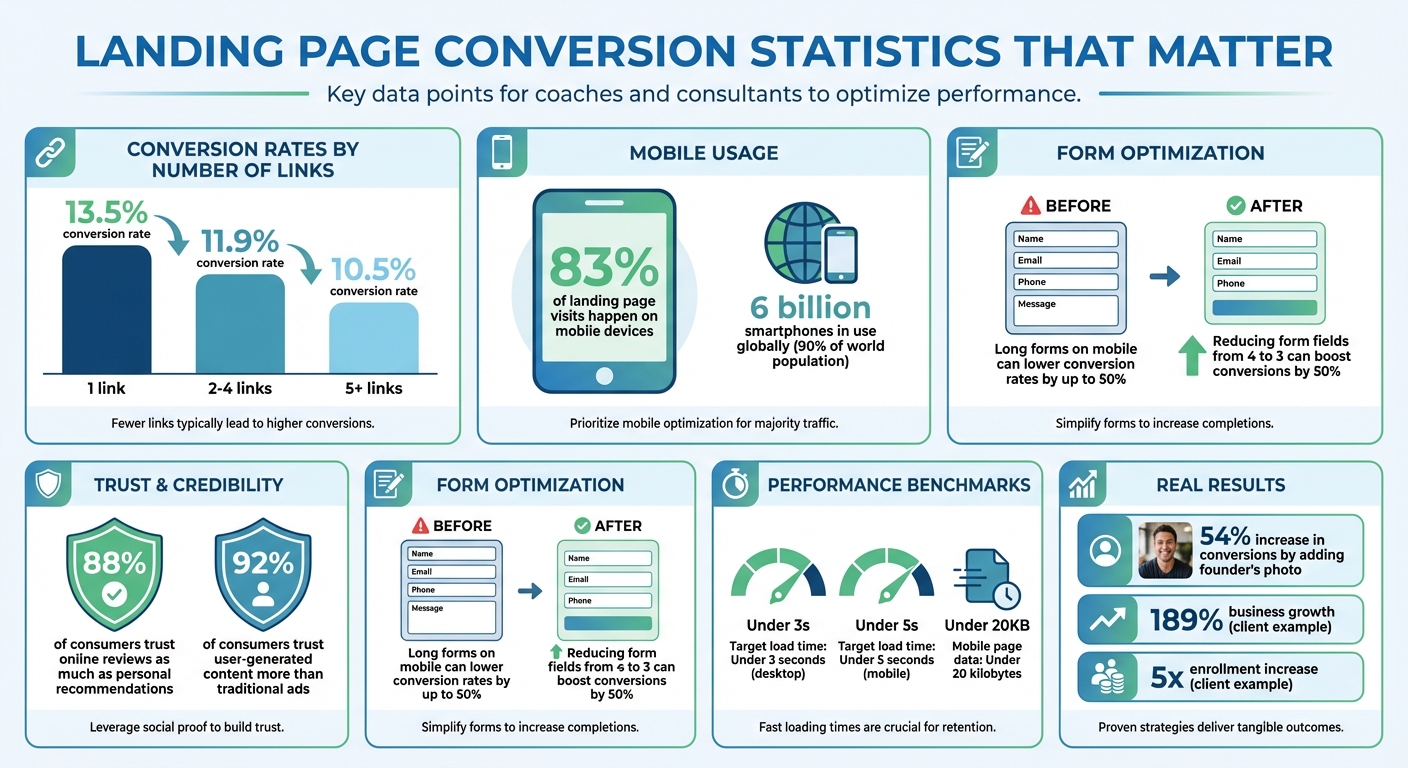
- Set a clear goal: Focus on one action (e.g., booking a call). Pages with fewer links convert better - one link can boost conversion rates to 13.5%.
- Know your audience: Identify their challenges and goals so your messaging resonates with them.
- Craft a strong offer: Highlight results they’ll achieve, not just the service you provide (e.g., "Land your next promotion in 90 days").
- Optimize above the fold: Use a clear headline, a descriptive subheadline, and a bold call-to-action that stands out.
- Show proof: Use testimonials, specific results, and credentials to build trust.
- Ensure mobile performance: Over 83% of visits happen on mobile. Test load speeds, simplify forms, and make buttons easy to tap.
Landing Page Conversion Statistics for Coaches and Consultants
How I Built a $124K Coaching Landing Page [FULL GUIDE]
Set Your Goals and Define Your Audience
When creating a landing page, start by answering two essential questions: What is the one action you want visitors to take? and Who exactly are you trying to reach?
Choose One Clear Goal
Pick a single, specific action you want visitors to take. Whether it’s booking a discovery call, downloading a free guide, signing up for an email list, or registering for a webinar, keeping the focus on one goal prevents confusion. Adding too many links or competing calls-to-action can tank your conversion rates. For example, landing pages with just one link convert at 13.5% on average. Add 2–4 links, and that number drops to 11.9%. With 5 or more links, it falls even further to 10.5% [6].
Ryan McHugh, Director of CRO at NP Digital, explains: "One of the biggest mistakes site owners make when building landing pages is not having a clear, single focus for the page. Landing pages should have one primary objective, whether it's capturing email addresses, getting sign-ups, or making a sale. When a page has too many distractions, including links, navigation options, or too much information, it can confuse visitors and decrease conversions. Keep the content blocks concise and relevant. Focus on a clear value proposition and be sure to place a consistent and action-oriented call to action prominently on your pages." [2]
Describe Your Target Client
Know your audience inside and out. Who are they, and what challenges are they facing? Are they course creators overwhelmed by tech? Business owners struggling with email list growth? Professionals feeling stuck in their careers? Clearly defining your ideal client helps you craft messaging that truly connects.
Dive into client feedback, emails, or surveys to uncover recurring pain points and goals. This research is invaluable for shaping headlines, subheadlines, and body copy that speak directly to their needs.
Create a Results-Focused Offer
Your offer should highlight the results your clients can expect - not just the services you provide. For instance, instead of saying "business coaching", try framing it as "land your next promotion in 90 days." Instead of "marketing consulting", go with "double your qualified leads without increasing ad spend." The key is to focus on outcomes that resonate with your audience.
Think about how their lives will change after working with you. Translate features into real-world benefits. For example, rather than saying you offer "weekly coaching calls", explain that those calls provide "a clear action plan each week so you’re never stuck or unsure of your next step." When your offer solves a specific problem your audience is dealing with, it becomes far more compelling.
Use these insights to build a landing page that speaks directly to your audience’s core needs and motivates them to take action.
What to Include Above the Fold
The top section of your landing page - the part visitors see before they scroll - is your chance to make a powerful first impression. This is where you need to immediately answer the question: "Why does this matter to me?" [1]. If visitors can't quickly grasp what you're offering and why it’s relevant to them, they'll move on.
Write a Clear Headline
Your headline is the first thing visitors notice, so it needs to communicate the key benefit or transformation you provide. Skip the vague language and get straight to the point with something like: "Land Your Next Promotion in 90 Days" or "Double Your Client Base Without Burning Out." These examples directly address either a pain point or an aspirational goal, which helps create an emotional connection [3]. Think of your headline as the core of your unique value proposition - it should highlight the result that makes you stand out [5].
Add a Descriptive Subheadline
Support your headline with a subheadline that explains who your service is for and the specific problem it solves. For example: "Attract premium health and wellness clients without endless social media hours." This gives visitors more clarity about what to expect and sets the stage for the next step [5]. Together, the headline and subheadline should provide a clear and compelling reason for visitors to stay on the page.
Place a Visible Call-to-Action
Your call-to-action (CTA) is the bridge between curiosity and commitment. Make it stand out with a bold, high-contrast button and use actionable text like "Let's Chat", "Send Me the Guide", or "Reserve My Spot." The CTA should tell visitors exactly what to do next. For example, when Trevor, an international food and fragrance consultant, revised his CTA to be more specific and enticing, he went from receiving no responses to generating 5-7 strong leads from ideal clients within just 24 hours [1][7][8][9].
How to Present Your Services and Value
Once you've crafted your headline, subheadline, and call-to-action (CTA), it's time to dive into the specifics of how your services address client challenges and deliver results. This is a critical step that many coaches and consultants overlook, often losing potential clients by being too vague. The key is to clearly connect your services to the problems your audience is facing and the outcomes they’re seeking. Think of this as building a bridge between grabbing their attention and demonstrating the value you bring.
Address Client Problems and Goals
Speak directly to the challenges or aspirations your target clients are dealing with - using their own words. If you’re a career coach, for example, you might say: "Working hard but still being overlooked for promotions? Feeling stuck in a role that no longer excites you?" By mirroring their language, you show that you truly understand their struggles. When clients feel seen and heard, they’re much more likely to trust that you can help them overcome these issues.
Describe Your Method
Lay out your process in simple, clear steps that show exactly how you guide clients from where they are now to where they want to be. For instance, a business consultant might explain:
"Step 1: We start by auditing your current client acquisition strategy. Step 2: We pinpoint three high-impact changes to improve results. Step 3: We implement and test these changes over a 60-day period."
This level of clarity builds trust because it helps prospective clients visualize the journey and the results they can expect. Don’t just explain the steps - highlight the benefits of each one. Instead of simply saying, "We’ll conduct an audit", explain how this audit will uncover the exact points where they’re losing potential clients. This approach makes your process feel purposeful and results-driven.
List What Clients Get
Be specific about what’s included in your service. Swap vague phrases like "ongoing support" for concrete details, such as:
"Six 60-minute coaching sessions over three months, weekly email check-ins, and access to a resource library packed with templates and guides."
When listing deliverables, include pricing details in a clear and transparent format. For example: "$2,500 for a 90-day program" or "12 sessions at $200 each." By being precise, you eliminate any guesswork, making it easier for potential clients to understand the value and commit. Use "you" and "your" language throughout to help them picture themselves benefiting from your services.
This level of specificity not only clarifies what they’re paying for but also builds confidence in the results they’ll achieve [5] [10].
sbb-itb-f7e72a6
Add Proof and Build Credibility
To earn trust and establish authority, back up your claims with solid evidence. Studies reveal that 88% of consumers trust online reviews as much as personal recommendations [6]. This means that showcasing proof can play a big role in boosting your conversion rates. By reinforcing your value and expertise, you make it easier for potential clients to choose you.
Show Client Results
Highlighting client success stories, especially with measurable outcomes, can make a lasting impression. Focus on testimonials that include specific numbers and timeframes rather than vague compliments. For example:
- Jennifer Gilchrist, Founder of Soul Success Unleashed, shared that she achieved "5 times the enrollment" after collaborating with a consultant [4].
- Alex Cantaboni, Owner of Safe Pro Pest Control, experienced a 189% business growth through strategic guidance [4].
- Emily Harrison, Founder of The Akashic Academy, stated her weekly customer volume "has already doubled and working on tripling" thanks to automation [4].
Whenever possible, include the client’s name, photo, and even video testimonials. Video adds a personal touch that written text simply can’t replicate [13].
Display Your Credentials
Pair your client success stories with your own qualifications to reinforce your expertise. Highlight certifications, awards, and professional memberships that validate your skills. Media mentions can also lend credibility. For instance, Neil Patel emphasizes his achievements by mentioning that The Wall Street Journal called him a "top influencer on the web", and Forbes named him "one of the top 10 marketers" [2]. Position your most impressive credentials prominently - either near the top of your page or alongside your introduction - so they’re immediately visible.
Include Visual Trust Elements
Visuals can make trust-building even more effective. Use a professional headshot to add a human element to your page [13]. If you’ve worked with well-known companies, display their logos to create instant recognition and credibility [1][6]. Place badges, certifications, or trust seals near your call-to-action to reinforce your authority [2]. For industries like wellness or transformation coaching, before-and-after photos (with client consent) can showcase tangible results and help potential clients visualize the impact [13].
Technical Setup and Mobile Performance
Once you've established credibility, the next step is making sure your site performs well technically. A smooth mobile experience is especially critical - it can either boost or sink your conversion rates. With over 6 billion smartphones in use globally - covering about 90% of the world's population - mobile optimization is no longer optional [16]. The technical quality of your site determines whether visitors stick around or bounce within seconds.
Test Mobile Display and Load Speed
Your site should load quickly and look great on every device. Aim for load times of under 3 seconds on desktops and under 5 seconds on mobile devices [15][16]. Fast-loading, responsive pages keep users engaged, while slow ones drive them away before they even see your content. Tools like Google PageSpeed Insights and Google Lighthouse can help you pinpoint and resolve performance issues [14][15]. To maintain speed, compress images, simplify your code, and keep mobile page data under 20 kilobytes [15][16].
Responsive design is key. Use device simulation tools to check how your site appears across various screen sizes [16]. Test both portrait and landscape views on smartphones and tablets [16]. Tools like Google's Mobile-Friendly Test Tool can evaluate how well your page adapts to mobile formats [14][15]. Stick to single-column layouts for better readability on smaller screens, and design buttons with thumb-friendly tap areas between 38x38 and 44x44 pixels to avoid accidental clicks [16].
Test All Forms
Every form field and button should be tested on multiple devices to ensure they work seamlessly. Reducing the number of fields can have a big impact - cutting fields from 4 to 3 can boost conversions by nearly 50% [17]. Keep it simple by asking only for essential information, like a name and email address, during initial contact. Long forms are particularly problematic on mobile devices, where they can lower conversion rates by up to 50% [16]. If more details are needed, consider breaking the form into two pages to make it less intimidating.
Include Privacy Information
Transparency builds trust. Place a clear privacy statement near your forms and link to a detailed privacy policy in the footer [1][15]. A simple statement like "We value your privacy and will never spam you" can reassure visitors [13]. Many landing pages also include cookie consent banners to inform users about data collection practices [11][13]. If you're collecting personal information, finalize all privacy statements before launch [12].
Conclusion
Creating a landing page that drives conversions is entirely achievable when you focus on one clear goal. Whether that goal is booking a discovery call, downloading a resource, or building your email list, every design element should revolve around encouraging that single action. Remove distractions, highlight your compelling offer, and strategically place your call-to-action (CTA) throughout the page to guide visitors toward taking the next step.
Your expertise is a powerful tool. For instance, Consulting Success experienced a 54% increase in conversions simply by adding the founder's photo to their coaching offer page [9]. Use testimonials, results, and credentials to strengthen your message. Let your clients' success stories work for you - especially since 92% of consumers trust user-generated content more than traditional ads [7].
Don't forget the technical aspects we discussed earlier. Ensure your page loads quickly, works seamlessly on mobile devices, and has forms that are easy to use. Keep input fields to a minimum and clearly display privacy policies to build trust.
Finally, embrace A/B testing to refine your landing page over time. Test different headlines, offers, and CTAs to see what resonates most with your audience [18]. With consistent optimization, your landing page can become a powerful tool for attracting and converting clients.
FAQs
How can I make sure my landing page connects with my target audience?
To craft a landing page that resonates with your audience, focus on addressing their needs while building trust quickly. Start with a headline that’s clear and centered on the benefits you offer. For example, something like "Achieve Career Growth with Expert Coaching" works because it directly highlights the problem you solve or the result you deliver. Use straightforward, relatable language throughout the page to reflect their goals and challenges.
Boost credibility by featuring testimonials, real-world success stories, or recognizable client logos prominently near the top. A strong call-to-action (CTA) is essential - whether it’s "Book a Free Consultation" or "Download Your Free Guide". Make sure it’s easy to find and click, especially on mobile devices. Speaking of mobile, ensure your page is optimized for smaller screens with fast load times and buttons that are easy to tap.
By keeping your message focused, relatable, and visually appealing, your landing page will feel approachable and engaging to your target audience.
What are the best ways to optimize a landing page for mobile users?
To make your landing page mobile-friendly, the goal is to deliver a seamless and engaging experience for users on the go. Start by ensuring the design is fully responsive, so it adjusts perfectly to any screen size - smartphone, tablet, or anything in between. Speed is crucial, so compress images and trim down heavy scripts to ensure fast loading, even on slower cellular networks.
Your call-to-action (CTA) should stand out and be easy to interact with. Place it prominently above the fold, using large, touch-friendly buttons that are impossible to miss. Stick with fonts that are easy to read and give plenty of space between text and other elements, making navigation smooth and frustration-free on smaller screens.
Finally, test your page across multiple devices and browsers. This ensures that everything not only functions as it should but also maintains a polished and professional appearance for all visitors.
How can I use testimonials to build trust and boost conversions on my landing page?
Testimonials are a fantastic way to build trust and boost conversions by highlighting real client success stories. To make a strong first impression, feature a standout quote in a prominent spot - like the hero section of your landing page - so it’s one of the first things visitors notice. Include the client’s name, photo, and a brief description of their results, such as “Increased revenue by $12,500 in 30 days.” Personal details and measurable outcomes make these testimonials feel more relatable and believable.
Place testimonials strategically across your page to maximize their impact. You could use a carousel to display multiple quotes, dedicate a “What Clients Say” section, or position them near call-to-action buttons for added influence. If you have video testimonials, include short clips - video brings an extra level of authenticity and keeps visitors engaged. Keep the design clean and easy to read by limiting quotes to just one or two sentences. For returning visitors, rotating content can keep things fresh.
Prioritize concise, specific testimonials that emphasize clear, measurable outcomes. When possible, link these quotes to detailed case studies for visitors who want a deeper dive into the success stories. Thoughtfully integrated testimonials create a compelling narrative of trust and achievement, helping turn visitors into loyal clients.
Related Blog Posts

Blog title heading will go here
Blog title heading will go here