

How to Get Featured in Online Publications as a Coach or Consultant (Without a PR Agency)

Getting featured in online publications can elevate your authority as a coach or consultant, opening doors to new clients, speaking gigs, and collaborations. You don’t need a PR agency to make it happen. Here’s how you can do it yourself:
- Choose the right publications: Focus on outlets your target audience reads, such as broad business platforms (Forbes, Entrepreneur) or niche industry blogs.
- Craft effective pitches: Write concise, tailored emails with a strong hook, specific data, and actionable insights.
- Leverage AI tools: Use AI to personalize outreach, analyze journalist preferences, and streamline your process.
- Build relationships: Engage with editors on social media and provide value over time to establish trust.
- Follow up strategically: Submit polished work, follow submission guidelines, and send timely, relevant follow-ups.
You can start seeing results like media placements and client inquiries in 60–90 days with consistent effort. This guide breaks down each step to help you secure features and grow your personal brand - all without hiring a PR agency.
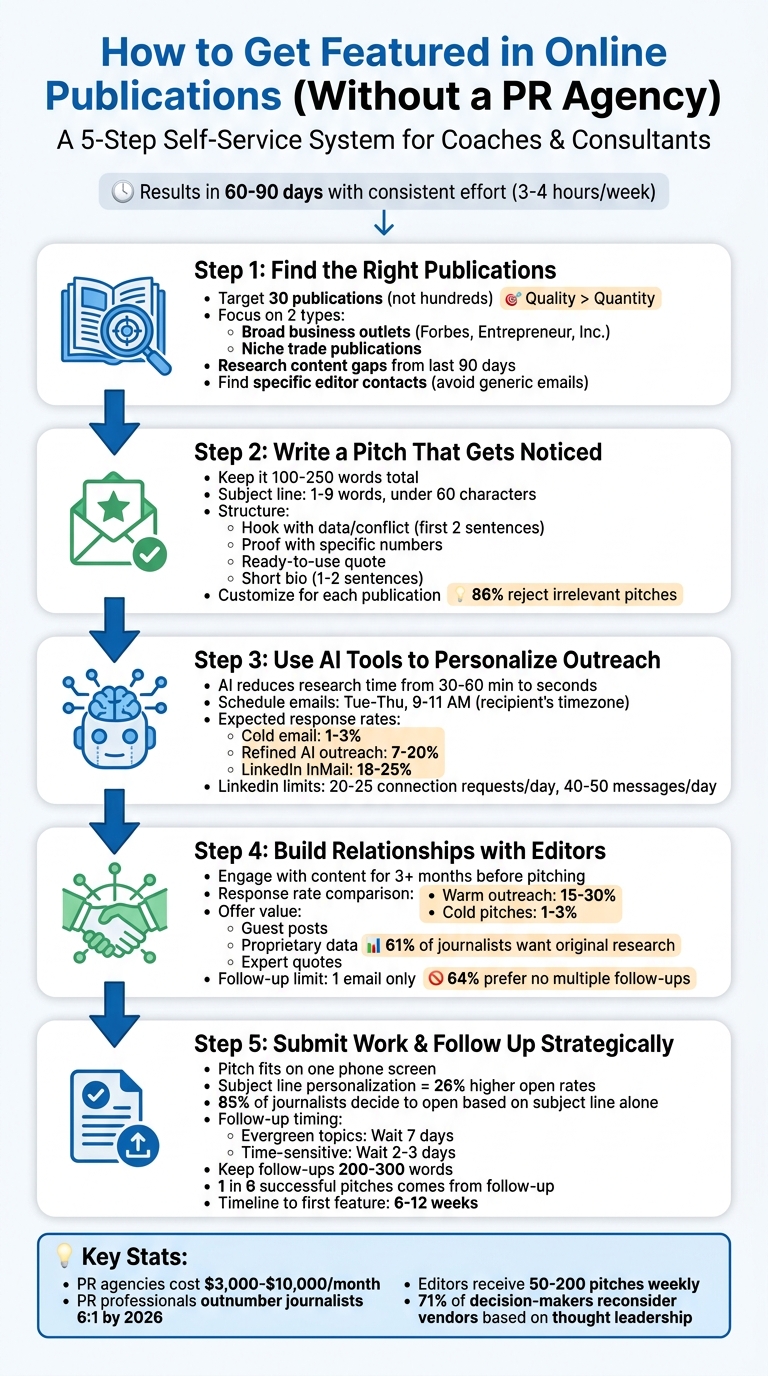
5-Step Process to Get Featured in Online Publications Without a PR Agency
How to Pitch a Story Idea and Get Media Coverage as a Coach. Interview with Janice Mandel
sbb-itb-f7e72a6
Step 1: Find the Right Publications for Your Niche
Targeting the wrong publications is a common pitfall. You don’t need to be featured everywhere - what matters is showing up in places your ideal clients already trust and read [2].
Focus on two types of publications: broad business outlets (like Forbes, Entrepreneur, Inc., or Fast Company) to build credibility and niche trade outlets to attract more qualified leads [2]. For instance, if you're a SaaS consultant, getting featured in a specialized SaaS growth blog will likely generate better inquiries than an article in Business Insider.
Where to Look for Publications in Your Field
Instead of blasting hundreds of contacts, aim for a targeted list of about 30 publications [5]. Start with Google searches using terms like "best [your industry] publications" or "[your expertise] thought leadership sites." Another great resource is LinkedIn - check the "Featured" sections on competitor or peer profiles to see where they’ve been published.
Dive deeper into the content these publications have covered in the last 90 days. If a reporter has recently written about a competitor or someone in your space, they might be open to covering a similar topic again [5]. Look for content gaps - subjects they haven’t tackled recently that align with your expertise [4]. For example, if a business site has discussed AI productivity tools but skipped over AI security, that could be your opportunity.
When reaching out, avoid generic email addresses. Use the publication’s masthead (usually found in the footer or “About” page), search LinkedIn for editors (e.g., “[Publication Name] editor”), or check the bylines on recent articles [4]. For larger outlets like Forbes, staff reporters often follow predictable email formats, such as firstinitiallastname@forbes.com [5].
Once you’ve identified the right contacts, the next step is to understand their submission process and preferences.
Read Submission Guidelines and Editor Preferences
Editors receive 50–200 pitches weekly and often dismiss most in under 10 seconds [4][5]. Following submission guidelines isn’t just courteous - it’s essential. Look for a “Write for Us” page to understand their requirements and match the tone of the publication, whether it’s contrarian, data-focused, or motivational [4].
It’s also important to know the difference between staff-written editorials and contributor pieces. Staff-written content generally demands hard news, such as funding announcements or product launches, while contributor pieces focus more on expertise and actionable insights [5]. Staff editorials carry more weight but are harder to secure, whereas contributor sections are more accessible for consultants and coaches looking to establish authority.
| Publication Type | Ideal For | Content Requirement |
|---|---|---|
| Broad Business | Building trust signals, SEO, AI citations | High-level expertise or major news |
| Niche Vertical | Attracting direct leads, industry authority | Industry-specific data or case studies |
| Staff Editorial | Top-tier credibility, homepage visibility | Hard news, funding updates, or market shifts |
| Contributor Sites | Fast publishing, showcasing expertise | Actionable advice, quotes, or data-driven insights |
Step 2: Write a Pitch That Gets Noticed
With PR professionals outnumbering journalists six-to-one by 2026, standing out requires a pitch that cuts through the noise [6]. The key to getting noticed often lies in how well you structure your email and tailor it to the specific needs of the publication and its audience.
How to Structure Your Pitch
A successful pitch is concise - 100 to 250 words - and delivers value without wasting time [6]. Your subject line should be short (1–9 words) and under 60 characters. Starting with "Pitch:" can help editors quickly identify your email. Think of your subject line as a headline a reporter might use, rather than a vague teaser [5].
Begin with a strong hook - something that grabs attention right away, like a compelling statistic, a fresh idea, or an unexpected conflict. Skip overused openings like "I hope you're well" and dive straight into why your pitch matters. Follow this with two sentences of solid proof, such as revenue figures, user growth, or unique data from your work [5].
"Describe what you did in flat, factual language and let the numbers do the work."
- Joey Sendz, Founder, Instant Press Co. [5]
After establishing credibility, briefly outline what you're offering - whether it's a guest post, a quote, or exclusive data. Instead of saying, "I'm happy to provide a quote", include a ready-to-use, quotable paragraph directly in your pitch [5][2]. Wrap up with a short bio (just one or two sentences) that highlights your expertise without going overboard. Avoid buzzwords like "revolutionary" or "game-changing", which can turn editors off or trigger spam filters [5].
| Pitch Element | 2026 Best Practice |
|---|---|
| Subject Line | 1–9 words; headline-style; no emojis or all caps [6][5] |
| Total Word Count | 100–250 words [6] |
| First Sentence | Hook with data, novelty, or conflict; avoid "I hope you're well" [5] |
| Evidence | Specific revenue, user counts, or proprietary data [5] |
| Follow-up | Wait 7–14 days; limit to 2–3 follow-ups [6][1] |
Tailor your pitch to the publication's tone, audience, and focus for the best results.
Customize Each Pitch for the Publication
A staggering 86% of journalists reject pitches because they lack relevance [6]. Sending the same email to multiple editors is a quick way to be ignored - or worse, blocked. Instead, take the time to study the publication's tone and recent articles to understand what resonates with their audience.
"When your expertise clearly serves an editor's audience, the pitch stops feeling like a skippable email and starts feeling like a solution."
- Bonnie Brien, Author [6]
For broad business outlets like Forbes or Entrepreneur, focus on showcasing your business acumen and offering actionable advice [2]. For high-level editorial publications like Harvard Business Review or Fast Company, lean into corporate insights or present data-driven research [2]. For niche verticals such as healthcare leadership or SaaS blogs, use industry-specific language and address the challenges faced by decision-makers in that field [2].
Before sending your pitch, reference a specific article the journalist recently wrote to show you've done your homework [[7]](https://copywise.ink/Blog/Get-Featured-in-Top-Publications_with_a_Winning_Media Pitch.html). If they've covered a related topic, explain how your perspective adds a new angle [5]. Proven approaches include tying your pitch to a current trend (e.g., "How AI adoption is reshaping executive coaching"), offering a counterintuitive take (e.g., "Why leadership retreats might be overrated"), or sharing a data-backed insight from your work. With this level of personalization, your pitch shifts from being just another email to a well-crafted solution tailored to the editor's needs.
Step 3: Use AI Tools to Personalize Your Outreach
Once you've crafted a personalized pitch, AI tools can help you amplify your efforts significantly. Traditional PR outreach is time-intensive - researching and drafting personalized messages for just one contact can take 30–60 minutes [8]. If you're reaching out to 100 journalists, that's up to 100 hours of work [8]. AI tools can drastically reduce this workload while keeping the level of personalization editors expect. Here's how AI can streamline your outreach process.
Write Custom Emails with AI Assistance
AI tools can analyze a journalist's recent work - articles, podcasts, or newsletters - to identify their preferred topics, angles, and style. With this insight, they can generate personalized opening lines that directly reference specific pieces of their work, saving you from starting every email from scratch [8].
When crafting pitches, keep them under 150 words to respect the editor's time [8]. Use AI to brainstorm fresh angles or unconventional takes editors are more likely to appreciate, rather than sending out generic pitches [2][9]. For subject lines, try this formula: "[Your credentials] + [specific value] + [topic]" to establish credibility right away [9]. To maximize open rates, schedule emails to send between 9:00 AM and 11:00 AM (recipient's time zone) on Tuesday, Wednesday, or Thursday [8].
"Journalists want quotes they can immediately copy and paste into their articles, no changes needed."
While AI can write quickly and creatively, ensure your final quotes are polished and ready for direct use by editors [9]. Tools that integrate with email services like Gmail or Outlook can maintain a deliverability rate of 98%, even as you scale your outreach [8]. If you're new to this, expect a 1–3% response rate initially. However, with refined AI systems, this could rise to 7–20% [9].
Automate LinkedIn Outreach and Follow-Ups
AI-powered email personalization is just the start - LinkedIn InMail offers even higher response rates, ranging from 18% to 25% in 2026, compared to cold email's 1–5% range [11]. To stay within LinkedIn's safety limits, stick to 20–25 connection requests and 40–50 direct messages per day [11].
AI tools can scan a prospect's "About" section and recent posts to craft unique icebreakers or hooks [10]. Instead of relying on static lead lists, focus on signal-based triggers, like an editor engaging with a competitor's post or a publication hiring for a new position [11]. You can also set up automated sequences with pauses for replies, following a cadence like: Day 1 connection request, Day 4 value message, and Day 8 check-in [10].
For example, in early 2026, a leadership coach named Mark used LinkedIn filters to find individuals who had recently updated their job title to "Manager." He sent them congratulatory messages along with a free "First 90 Days" checklist, achieving a 40% connection acceptance rate and filling his coaching schedule within six weeks [10].
Warm LinkedIn outreach - such as engaging with a prospect's posts before messaging - can double conversion rates compared to cold calls [10][11]. However, if your connection acceptance rate falls below 20%, LinkedIn may restrict your account [11].
How Brandbase Simplifies Your Outreach
Brandbase offers a seamless way to implement the strategies outlined above. By capturing your voice through interviews, the platform creates ready-to-use pitches and automated outreach campaigns. Its AI assistant qualifies leads and tailors communication based on your expertise and the editor's recent work - not just their job title [12].
Brandbase also eliminates the need for hours of journalist research by identifying relevant contacts based on topical overlap and recent coverage [12]. With Brandbase Pro, you can run unlimited LinkedIn lead generation campaigns and receive six PR placements every two months. The platform handles everything from hosting and maintenance to analytics and unlimited edits, allowing you to focus on relationship-building instead of technical tasks. By combining interview-driven pitch creation with automated outreach, Brandbase can reduce drafting time from an hour to just seconds [8].
Step 4: Build Relationships with Editors
Once you've used AI to tailor your outreach, the next step is to focus on building long-term relationships with editors. While landing your first feature is a great start, maintaining those connections can turn a one-time opportunity into an ongoing strategy. Warm outreach to existing contacts yields a 15–30% response rate, while cold pitches only see about 1–3% success [17]. When editors are familiar with your work, you're no longer competing with the 50+ pitches they receive weekly [13].
"The best pitch is from someone whose next piece an editor was already planning to request. That status is earned over months, not manufactured in a single email."
- Tom Popomaronis, Founder & CEO, Phantom IQ [14]
The numbers back this up: 71% of decision-makers say thought leadership makes them reconsider vendors they hadn't previously considered, and 86% say consistent thought leadership builds trust in an organization [14]. For coaches and consultants, every feature boosts your credibility, often leading to even more opportunities. Building relationships complements targeted outreach and strengthens your media presence over time.
Connect with Editors on Social Media and Email
Start by engaging with an editor's content for at least three months before reaching out [14]. Follow them on platforms like LinkedIn or Twitter, and leave meaningful comments that show genuine interest. Skip generic phrases like "Great article!" and instead offer thoughtful insights, counterpoints, or questions that demonstrate you’ve read their work.
LinkedIn is particularly effective since many editors use it to share their articles and discuss industry trends. By consistently engaging with their posts, you build recognition without immediately asking for anything.
When you’re ready to pitch, keep your emails professional and concise. Editors value contributors who are reliable - those who meet deadlines, accept edits without conflict, and submit polished work that requires minimal revisions [14]. After your piece is published, follow up with a thank-you note, promote the article on your platforms, and share any positive feedback or metrics you receive [4][15]. Editors notice contributors who help drive traffic to their sites.
If you need to follow up on a pitch, limit yourself to one email, as 64% of journalists prefer not to receive multiple follow-ups [13]. Wait 5–7 business days before sending your first follow-up, and cap your total outreach at two or three attempts. If there's no response, move on to preserve the relationship [4][15].
Offer Guest Posts and Collaboration Opportunities
Instead of always pitching full articles, consider offering smaller contributions that require little effort from the editor [5]. For instance, you could provide a short, ready-to-use insight or two paragraphs of commentary on a topic they frequently cover. This positions you as a helpful resource rather than someone asking for a favor.
Another option is to share proprietary data or survey results exclusively with the publication [5]. Research shows that 61% of journalists are interested in original reports, and 55% value exclusive content [13]. If you’ve gathered unique insights from your work or analyzed niche trends, this data could form the basis of a collaborative piece.
Before pitching, use the "site:" search operator to ensure the publication hasn’t already covered your angle. For example, search site:publication.com "topic". Then, perform a keyword gap analysis to find topics the site hasn’t ranked for yet, particularly those with a difficulty score of 0–30% [15][16].
Focus on sharing compelling stories, counterintuitive insights, or specific transformations rather than generic company updates [2]. Mention your audience size or engagement metrics (e.g., "54% of my 11,000 followers are senior executives") to show your ability to drive traffic [15]. Finally, stay in touch by reaching out every few months with a brief update, a relevant data point, or a fresh idea to keep yourself on their radar without overdoing it [14].
Step 5: Submit Your Work and Follow Up
Once you've built strong connections and crafted attention-grabbing pitches, the next step is all about submitting your work and following up effectively. This stage is crucial - 86% of journalists reject pitches because they aren’t relevant, and with PR professionals outnumbering journalists six-to-one, your submission needs to grab attention immediately [6].
Format Your Article for Submission
Your pitch should be short and to the point - aim for 100 to 250 words [6]. Start with a strong hook in the first two lines. Whether it’s a statistic, a fresh perspective, or a conflict, make it enticing enough to keep the editor reading [5]. Focus on presenting a clear news angle in about 120–180 words, followed by a single, actionable call to action [18].
Keep subject lines under 60 characters to avoid being cut off on mobile devices [6]. Use subject lines that stand out, like ones based on data or that start with "Pitch:" to help editors quickly identify your email. Instead of attaching files, include links to a one-page press kit or relevant data [2][5]. Ideally, your entire pitch should fit on a phone screen [5].
"Describe what you did in flat, factual language and let the numbers do the work."
- Joey Sendz, Founder, Instant Press Co. [5]
To make your pitch even stronger, include expert quotes and proprietary data. Avoid overused marketing terms like "revolutionary" or "disruptive." Personalizing your subject lines can boost open rates by as much as 26%, and 85% of journalists decide whether to open an email based entirely on the subject line [18][20].
How to Follow Up with Editors
Timing is everything when it comes to following up. For evergreen topics, wait at least a week before reaching out again. For time-sensitive stories, follow up after 2–3 days. Keep follow-ups concise (200–300 words), offer a fresh angle, and include a direct call to action [20]. Mornings are the best time to send follow-ups, as nearly 70% of journalists prefer receiving pitches earlier in the day [20].
If you don’t hear back after your second follow-up, it’s best to move on to maintain the relationship. Interestingly, one in six successful pitches comes from a follow-up email [6].
When following up, don’t just check in - add value. Share a new data point, refine your angle, or tie your pitch to a timely news event. Mention something specific from an editor’s recent work to show you’re paying attention [20]. Always include a clear call to action, such as, “Are you available next Tuesday at 10 a.m. to discuss this?” Avoid vague phrasing like, “I hope to hear from you” [20].
Once you’ve established a routine for follow-ups, consider tools that can streamline your outreach process.
Scale Your Efforts with Brandbase Pro
Managing multiple pitches across various publications can quickly become overwhelming. You need to track which emails were sent, when they were sent, and to whom [6]. Brandbase Pro simplifies this process by managing your entire outreach workflow. It tracks email opens, monitors link clicks, and even schedules follow-ups automatically [12][19].
The Pro plan offers 6 PR placements every two months and 9 SEO blog posts monthly, turning your media outreach into a consistent, ongoing process. While traditional mass pitches often see response rates of just 1–3%, well-targeted, AI-personalized outreach can achieve rates as high as 10–15% [12]. Brandbase Pro uses AI to enhance research while keeping the human touch in relationship-building, ensuring your pitches remain relevant while you focus on other priorities.
From initial outreach to landing a feature in a major outlet like Forbes, the process typically takes 6 to 12 weeks [5]. With Brandbase Pro managing your pipeline, you can maintain momentum, secure placements across multiple publications, and build credibility with each success [2].
Conclusion
This guide gives you the tools to secure media coverage and establish lasting authority - all without hiring a pricey PR agency.
Review of the 5 Steps
You don’t need to shell out $3,000 to $10,000 a month for a PR agency to get media features [3]. Instead, the five-step process shared here equips you to handle it on your own. Here's a quick recap:
- Find the right publications that resonate with your target audience.
- Write pitches that focus on insights rather than just your bio.
- Leverage AI tools to scale and personalize your outreach.
- Build authentic relationships with editors and journalists.
- Follow up strategically when submitting your work.
Each step complements the others. Targeting niche publications connects you with the decision-makers who truly matter [2]. Crafting pitches that highlight unique ideas or data-backed insights provides journalists with exactly what they’re looking for [2]. And by blending AI tools with genuine relationship-building, you create a system that’s efficient and manageable, requiring just 3 to 4 hours a week [3].
"Your first media placement is not just a win - it is infrastructure. Each piece you publish increases the probability that the next opportunity finds you." - Vivek Sharma, Founder & CEO, TS Newswire [2]
By following these steps, you’re setting up a self-sustaining strategy that builds a strong foundation for ongoing success.
Tips for Continued Success
To keep growing your media presence, focus on consistency and maximizing the impact of your wins. Turn your early successes into lasting momentum.
Consistency matters more than perfection. Most coaches and consultants start seeing results - like inbound inquiries, follower growth, and new opportunities - within 60 to 90 days of steady outreach [2]. The real payoff becomes clear after 6 to 12 months, as each feature builds on the last, further boosting your credibility [2].
Don’t let your media mentions go unnoticed. Repurpose them across your social platforms and marketing materials to build trust with your audience [3]. With modern AI indexing systems, your media placements and author bios increase your chances of being cited in AI-generated content [2]. Think of every media feature as a long-term asset that keeps elevating your professional reputation.
FAQs
What should I pitch if I don’t have big-name credentials?
When pitching to journalists, the key isn't flashing big-name credentials. Instead, focus on crafting a story or angle that's timely, relevant, and interesting. Journalists are always on the lookout for fresh perspectives that tie into current trends or pressing issues.
What should you highlight? Emphasize your real-world experience, specialized expertise, or unique ideas. These elements can make your pitch feel authentic and grounded. If you have insights that come from hands-on experience or a niche area of knowledge, lead with that - it's what sets you apart.
Another strategy: target niche or industry-specific outlets. These platforms often prioritize practical insights and authentic voices over generalized commentary. By pitching to these outlets, you're more likely to connect with an audience that values your expertise.
How do I find an editor’s direct email fast?
To locate an editor's email quickly, try searching the publication's name along with the editor's name on platforms like Google, Twitter, or LinkedIn. Their social media profiles or professional pages often include contact information. This approach allows you to bypass generic contact forms and connect with the editor directly.
What do I do if my pitch gets no reply?
If your pitch goes unanswered, send a courteous follow-up to gently remind the journalist or editor about your message. Ensure your tone remains professional and respectful, avoiding any sense of pressure. Over time, maintaining regular and thoughtful interactions with journalists can help strengthen relationships, boosting your chances of responses in the future by building trust and reliability.
Related Blog Posts

Blog title heading will go here
Blog title heading will go here