5 Ways to Build Authority Online as a New Coach or Consultant in 2026

Building authority online as a new coach or consultant in 2026 requires standing out in a crowded, AI-driven digital space. Here's how you can establish trust, attract clients, and grow your business:
- Leverage AI branding platforms like Brandbase to create a professional digital presence optimized for AI systems like ChatGPT and Perplexity.
- Optimize LinkedIn profiles and use AI tools for targeted outreach, boosting visibility and engagement.
- Create niche-specific content using AI tools to demonstrate expertise and address specific client needs.
- Secure media placements to enhance credibility and get noticed by both clients and AI systems.
- Use AI assistants to qualify leads, saving time and focusing on high-value connections.
These strategies help you build trust, attract qualified leads, and position yourself as an expert in your field. With AI increasingly shaping online discovery, optimizing your digital presence is more important than ever.
5 AI-Powered Strategies to Build Online Authority as a Coach or Consultant in 2026
How To Build Authority Fast(AI Lead Generation System For Coaches).
sbb-itb-f7e72a6
1. Use AI-Powered Branding Platforms like Brandbase to Create Your Digital Presence
Building a strong online presence used to require a team of specialists. Now, platforms like Brandbase simplify this process, combining multiple functions into a single system that works around the clock to create a polished digital footprint.
How It Builds Credibility
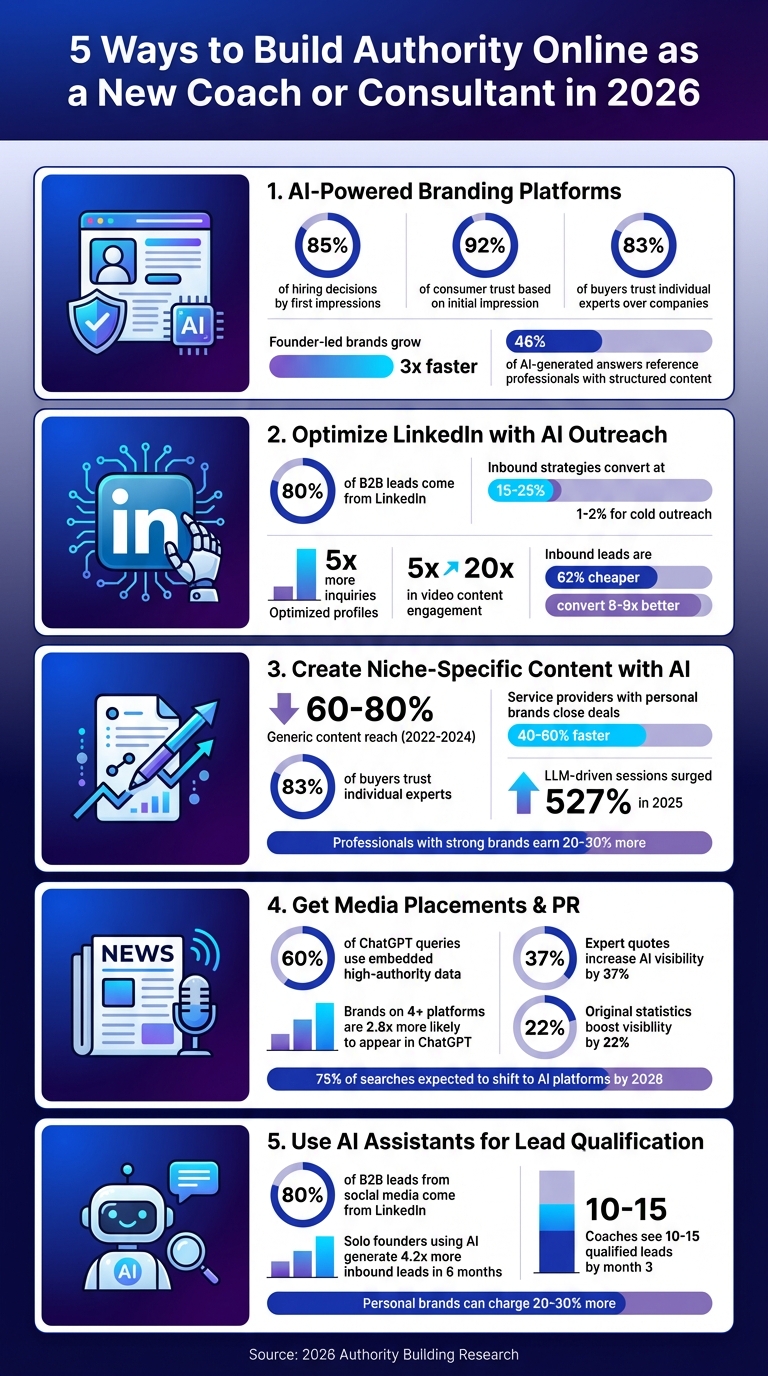
First impressions matter - a lot. Research shows that potential clients form opinions about your expertise within three seconds. In fact, 85% of hiring decisions and 92% of consumer trust are influenced by this initial impression. An outdated or incomplete online presence can cost you valuable opportunities[2].
Brandbase helps you stand out by creating a custom landing page, deploying an AI assistant to qualify leads 24/7, and securing media placements that establish you as a trusted expert. This is particularly powerful given that 83% of buyers are more likely to trust individual experts over companies, and founder-led brands grow three times faster than those without a strong personal presence[4].
Why It Matters in 2026's AI-Driven Market
AI tools like ChatGPT and Perplexity are now the first stop for many people searching for expertise. When someone asks, "Who's the best leadership coach for tech startups?" these systems rely on structured, indexable content to provide answers. If your expertise isn’t optimized for "Generative Engine Optimization" (GEO), you risk being overlooked. Notably, 46% of AI-generated answers now reference professionals with well-structured, published content[5].
Brandbase uses a five-layer system for content creation, distribution, image generation, analytics, and scaling engagement[4]. This approach allows you to generate a year’s worth of content in just two weeks[4], ensuring you maintain consistency and authority without needing a full-time content team.
How Easy It Is for New Coaches and Consultants to Start
Starting with Brandbase is surprisingly simple. The process kicks off with an interview where you share your methodology, client stories, and unique perspective. From there, the platform creates a custom landing page, an AI assistant trained to reflect your voice, and a content strategy tailored to your niche.
Take MEWR Creative as an example. By leveraging an AI-powered branding approach, they established authority in the AI automation space. Over four weeks, they created 260 LinkedIn posts using a structured framework and scheduled them across 12 months. Within six months, they gained 2,000 followers, 8,000 email subscribers, and over 50 inbound business inquiries. By the end of the year, they had 15,000 subscribers and hundreds of qualified leads[4].
Growth Potential Over Time
The long-term impact of AI-powered branding is impressive. Brands that maintain a consistent digital identity across platforms experience revenue growth of 10% to 20%[3]. Even more striking, customers who feel emotionally connected to a brand - drawn in by authentic and consistent messaging - offer a 306% higher lifetime value compared to those who are simply satisfied[3].
For coaches and consultants, investing in structured, AI-optimized branding not only boosts visibility but also positions you as a trusted expert that AI systems and clients recommend. With Brandbase, you can create a strong digital identity and expand your reach by tapping into AI-driven tools like LinkedIn for targeted outreach.
2. Optimize LinkedIn with AI-Driven Outreach Campaigns
After establishing a strong digital presence using AI-powered branding, fine-tuning your LinkedIn strategy can take your authority to the next level.
How It Builds Credibility
LinkedIn plays a massive role in B2B success, driving 80% of leads in the space [9]. However, with connection request limits now capped at 100 per week [7] and 79% of decision-makers ignoring cold messages [7], the game is shifting toward a smarter, inbound approach.
This new strategy focuses on showcasing your expertise to attract qualified leads. Why? Because it works. Inbound strategies convert at a rate of 15–25%, compared to just 1–2% for traditional cold outreach [7]. AI tools can help you strategically engage by adding insightful comments on posts where your ideal clients are already active [7]. Plus, an optimized LinkedIn profile can generate five times more inquiries [7], and professionals with active personal brands see 47% more inbound opportunities than their less active counterparts [8].
By using these tactics, you’re not just proving your expertise - you’re also setting yourself up to take full advantage of LinkedIn’s evolving features.
Why It Matters in 2026's AI-Driven Market
The landscape has shifted dramatically. For instance, video content on LinkedIn now gets five times more engagement and is shared 20 times more often than text-only posts [8]. AI tools have made it easier than ever to handle tasks like research, drafting, and distribution - tasks that used to require an entire team. This fuels what’s called the "Authority Flywheel", where consistent activity leads to wins, which then become case studies and more high-quality content. This cycle can shorten sales timelines from 3–6 months to just 2–4 weeks when prospects reach out to you based on your demonstrated expertise [7].
In this environment, targeted AI-driven outreach isn’t just helpful - it’s essential.
How Easy It Is for New Coaches and Consultants to Start
You don’t need a complex tech setup to get started. Tools like Waalaxy (starting at $16/month) and ConnectSafely.ai (at $39/month) can automate thoughtful commenting and connection sequences while staying within LinkedIn’s safety guidelines [7][9].
The process can be as simple as following a 3-step direct message (DM) sequence: after connecting, share something valuable, ask a quick question, and then invite further dialogue [9].
Your LinkedIn profile acts as your landing page, so make sure it’s optimized. Use a headline formula like this: [What you do] + [For whom] + [What outcome you create], rather than just listing your job title [8]. Stick to the 80/20 Rule for posting: 80% educational or value-driven content and 20% promotional [8].
Even dedicating just 10–15 minutes a day to commenting on 5–10 posts from industry leaders can dramatically increase your visibility while keeping your outreach efforts on the safe side.
Growth Potential Over Time
The payoff is worth it. Inbound leads are 62% cheaper than outbound ones and convert 8–9 times better, with a close rate of 14.6%, compared to just 1.7% for outbound methods [7]. Sales reps who send fewer than 25 connection requests per week see nearly double the acceptance rates, with 40% or higher [11]. On top of that, 83% of buyers trust individuals over faceless corporate brands [4], and founder-led brands are growing three times faster as of 2026 [4].
3. Create Niche-Specific Content with AI Tools
How It Builds Credibility
The shift in the market over recent years has been striking. Formal credentials have taken a backseat to demonstrated expertise. Between 2022 and 2024, generic "influencer-style" content saw its reach plummet by 60–80% [14]. This shift opens the door for coaches to use AI as a tool to enhance - not replace - their unique insights. AI can assist by summarizing reports, identifying trends, and drafting initial content, but the real value comes when you refine and personalize the output [2].
Your role is to fact-check, add your own insights, and ensure the tone reflects your expertise [2]. Why does this matter? Because 83% of buyers now trust individual experts more than faceless companies [4]. Even more compelling, service providers who build authentic personal brands close deals 40–60% faster than those relying on cold outreach alone [14].
By leveraging AI in this way, you can create content that not only builds your credibility but also reinforces your authority in your niche.
Why It Matters in 2026's AI-Driven Market
Search engines and AI assistants like ChatGPT and Perplexity have changed the game. Instead of focusing on keywords, they now prioritize recognized experts - entities that provide precise, niche-specific answers over vague overviews [1][10]. In fact, by early 2025, LLM-driven website sessions had surged by 527% compared to 2024 [10]. This makes it critical to produce content that AI systems can easily recognize and cite.
At the same time, the market is saturated with generic, AI-generated content, leaving many consumers feeling overwhelmed. Your niche-specific, experience-driven content stands out by offering the human touch that 92% of consumers trust when evaluating professionals [2]. While building topical authority takes time - typically 6–18 months of consistent effort [12] - the rewards are substantial. Professionals with strong personal brands often earn 20–30% more than their peers [4].
How Easy It Is for New Coaches and Consultants to Start
Start by defining your positioning: "I help [audience] achieve [outcome] through [method] to [result]" [2]. Once your niche is clear, use the AI Authenticity Framework. Begin with your own insights or experiences, let AI refine the structure, and then do a final pass to ensure the content reflects your personal voice [13].
Set up a simple weekly content routine. For example:
- Use AI for research on Mondays.
- Outline your ideas on Tuesdays.
- Draft content on Wednesdays.
- Adapt and repurpose that content across different platforms on Thursdays [2].
Balance your content with a mix of expertise, personality, and actionable advice [4]. To make AI even more effective, train it by providing examples of your best-performing content so it can better replicate your style [13].
Avoid content that merely teases insights. In 2026, your content should solve real problems upfront. This builds the trust necessary for high-ticket sales [14]. With one solid insight, AI can help you create multiple assets - like LinkedIn posts, newsletter segments, or video scripts - maximizing your reach [4][13].
With a clear system in place, the benefits of niche-specific content become apparent quickly.
Growth Potential Over Time
This strategy fuels what’s known as the Authority Flywheel. While the initial effort is significant, the rewards compound over time. Wins turn into case studies, which then become content that drives even more growth [2][15]. Founder-led brands are now growing three times faster than anonymous ones [4]. Consistently creating niche-specific content isn’t just a tactic - it’s one of the most effective long-term investments for growing your coaching or consulting business.
4. Get Media Placements and PR Through Managed Services
Once you’ve built a solid digital presence with engaging content, the next step is leveraging media placements to amplify your visibility. These placements provide external validation, which is crucial in today’s competitive digital world.
How It Builds Credibility
Media coverage offers a level of trust that self-published content simply can’t match. When third-party publications feature you, it sends a strong signal to both potential clients and AI systems that you’re worth their attention. This external validation creates a ripple effect, opening doors to opportunities like podcast invitations and speaking engagements [16].
Here’s why it matters: research shows that third-party endorsements significantly enhance the trust buyers place in experts. And by 2026, AI systems and search engines are prioritizing earned media - like features in respected publications - over paid ads and press releases when evaluating authority [17][18]. As Vivek Sharma, CEO of TS Newswire, explains:
"Reporters don't want your company's point of view. They want a human being with something worth saying" [16].
Managed services can help bridge the gap for those who lack the connections or expertise to pitch effectively. Instead of generic outreach, these services focus on your unique story and insights, positioning you as a thought leader rather than just another service provider [16]. This media validation also helps AI systems recognize and highlight your expertise.
Why It Matters in 2026's AI-Driven Market
The way people discover experts has evolved dramatically. Sixty percent of ChatGPT queries now rely on embedded high-authority data instead of real-time searches [18]. This means your media placements don’t just reach human audiences - they become part of the knowledge base that AI systems use to provide answers.
The stats are compelling: brands featured on four or more independent platforms are 2.8 times more likely to appear in ChatGPT responses compared to those with limited exposure [18]. Expert quotes can increase AI visibility by 37%, while original statistics boost it by 22% [18].
This shift has led to the rise of Generative Engine Optimization (GEO) - a strategy that ensures expert quotes and brand mentions are structured in a way AI models like ChatGPT, Perplexity, and Gemini can easily cite. Managed services are now incorporating GEO into their approach, treating media coverage as a long-term investment that builds a searchable digital identity over time [1][16].
How Easy It Is for New Coaches and Consultants to Start
Getting started doesn’t require a huge budget. Start with a one-sentence, data-backed claim that highlights your unique solution. This gives journalists a clear angle to work with [19].
Next, create simple but compelling micro-data. Conduct a 7–10 day poll or survey with 200–500 responses in your niche. Both journalists and AI systems prioritize original research, and this provides you with a citable asset [19][17]. For example, in early 2026, freelance editor Lina followed this strategy:
She conducted a 400-response survey on e-commerce conversion rates, which earned her a quote in a mid-tier tech publication, a guest podcast spot, and a co-branded newsletter feature. This resulted in a 42% increase in inbound DMs for paid work and led to her content being cited in AI answer panels for the query "product video editing tips for creators" [19].
When working with managed services, focus on publications frequently cited by AI systems, such as Forbes, Entrepreneur, and Fast Company [16]. Make sure your content includes clear headlines, bullet points, and properly attributed quotes (e.g., "Jane Smith, CEO of…") to help AI models recognize its authority [17][18]. A national press release distribution through a reliable newswire service can start at around $399, offering an affordable way for new consultants to gain immediate exposure [20].
Growth Potential Over Time
The value of media coverage grows over time. For example, one company boosted national visibility by sharing research on sustainability ROI with trade publications. Within a year, they secured features in six major industry outlets, driving a 40% increase in website traffic and a 28% rise in qualified leads directly linked to the media coverage [20].
Consistency is key. A single month of heavy coverage followed by inactivity is far less effective than a steady stream of 1–2 placements each quarter [18]. As your media footprint expands, you’ll find that opportunities start coming to you instead of the other way around. Professionals with strong personal brands can charge 20–30% higher rates for their services [4], and founder-led brands are growing three times faster than anonymous ones [4]. With 75% of searches expected to shift to AI-powered platforms by 2028 [17], building your media presence now is an investment in long-term visibility.
5. Use AI Assistants for Lead Qualification and Authority Building
How It Builds Credibility
AI assistants are a game-changer when it comes to streamlining lead qualification. These tools take care of the tedious task of filtering prospects, allowing you to focus on engaging with those who are genuinely interested. For example, AI can run a simple three-step direct message (DM) sequence: share a helpful resource, ask a low-effort question, and invite a conversation [9]. Once a lead responds, the AI pauses the sequence, ensuring your attention goes only to warm prospects.
By leveraging AI, you can maintain a consistent presence in your niche without exhausting yourself with manual efforts. Whether it’s commenting on relevant posts, sharing insights, or reaching out to potential clients, AI tools help you stay active and professional. This consistency not only reduces your workload but also reinforces your credibility within your industry.
Why It Matters in 2026's AI-Driven Market
In 2026, tools like ChatGPT and Perplexity act as gatekeepers, connecting experts with potential clients. To succeed, you need to ensure these systems recognize your expertise [3]. With LinkedIn generating about 80% of all B2B leads from social media [9], staying visible on this platform is essential - and AI-powered engagement tools make that possible.
The market is also shifting toward "data-driven authenticity." While AI handles tasks like research and drafting, your unique voice and insights remain critical to building trust in a sea of generic AI content [2]. Solo founders who dedicate just 45 minutes a day to AI-assisted brand building report generating 4.2x more inbound leads within six months compared to those relying solely on paid advertising [21]. This approach integrates seamlessly with broader AI-driven branding efforts, helping you establish comprehensive digital authority.
How Easy It Is for New Coaches and Consultants to Start
Starting with AI outreach doesn’t require a big investment. Affordable tools like Waalaxy ($16/month for outreach), Claude or Jasper ($20/month for content creation), and free CRMs like HubSpot make it accessible [9]. Before diving into AI outreach, update your LinkedIn headline to clearly communicate the value you offer - something like, "I help X achieve Y", rather than a generic job title [9].
To avoid account restrictions, stick to safe limits: 20 connection requests per day and 100 per week [9]. Tools like Linkmate ($29/month) can also help you consistently comment on posts from industry leaders and potential clients. These interactions drive traffic to your profile, where your optimized headline and content can do the heavy lifting of qualifying leads.
Take MEWR Creative as an example. In early 2026, they used AI to generate 260 LinkedIn posts in just four weeks, scheduling five posts per week for the entire year. Within six months, they had grown to 2,000 followers, 8,000 email subscribers, and received over 50 inbound business inquiries. By the end of the year, their following had reached 5,000, with 15,000 subscribers and a steady stream of speaking and partnership opportunities [4].
Growth Potential Over Time
The results of using AI tools compound with consistency. Coaches often see 1–2 leads in their first month, increasing to 10–15 qualified leads by the third month [9]. Founder-led brands also grow three times faster than anonymous ones, as 83% of buyers trust individuals over companies [4]. On top of that, professionals with strong personal brands can charge 20–30% more for their services [4].
The key is sticking with it. AI assistants cut daily effort to less than an hour while keeping your authority intact. Over time, the system builds momentum, and opportunities begin to find you - minimizing the need for constant outreach.
Conclusion
Let’s recap the five strategies that can help you stand out online: combining AI-powered branding, optimized outreach, and niche content can position you as an authority in your field. In 2026, success in building online authority requires balancing human authenticity with the efficiency of AI. The strategies we’ve discussed work together seamlessly: AI branding platforms lay the groundwork, optimized LinkedIn profiles and AI-driven outreach expand your reach, niche-specific content highlights your expertise, media placements add credibility, and AI assistants handle routine tasks like lead qualification - freeing you to focus on high-value connections.
Here’s the data to back it up: 83% of buyers trust individual experts, and strong personal brands can lead to 20–30% higher earnings [4]. While AI takes care of repetitive tasks - like formatting, research, and initial drafts - you get to focus on what really matters: sharing your unique insights, personal experiences, and strategic ideas [22][4].
Authority strategist Jaydeep Haria puts it perfectly:
"AI won't replace you, but a person who uses AI well might." [2]
The reality is, with AI systems increasingly shaping online visibility, content that isn’t optimized risks being overlooked. For instance, 46% of AI-generated answers now reference professionals who’ve published structured, searchable content [6]. Tools like ChatGPT and Perplexity are becoming gatekeepers between you and potential clients [3][6].
Take action this week: update your LinkedIn headline, use AI to draft a piece of niche content, and secure a media feature. These small steps can set the stage for bigger opportunities. Over time, consistent effort in building your visibility will naturally lead to more connections and growth. As mentioned earlier, personal brands that prioritize visibility grow faster - so don’t wait to get started.
FAQs
What is Generative Engine Optimization (GEO)?
Generative Engine Optimization (GEO) is all about fine-tuning your content so that AI tools like ChatGPT and Google AI recognize and recommend your brand or website as a trusted source in their responses. By focusing on this strategy, you can position yourself as a go-to authority in AI-driven search results by 2026.
How do I pick a niche if I’m just starting?
When you're just getting started, it's smart to focus on where your passions, skills, and market demand intersect. Picking a specific niche with strong demand can help you stand out, build credibility, and draw in clients more effectively. By specializing, you not only carve out a unique position in a crowded market but also create opportunities to charge higher rates for your expertise.
How can I use AI without sounding generic?
To make your content stand out and avoid a generic tone when using AI, think of it as a helpful assistant, not the main creator. Use AI for research and drafting, but always inject your own voice, experiences, and expertise into the final piece. Focus on crafting content tailored to your specific niche, supported by real-world results or case studies. Prioritize sharing insights that resonate with people, steering clear of overused or overly broad ideas. This approach ensures your content feels genuine and authoritative.
Related Blog Posts

Blog title heading will go here
Blog title heading will go here