
How To Start A Coaching Business Online in 2026: Your Complete Launch Framework
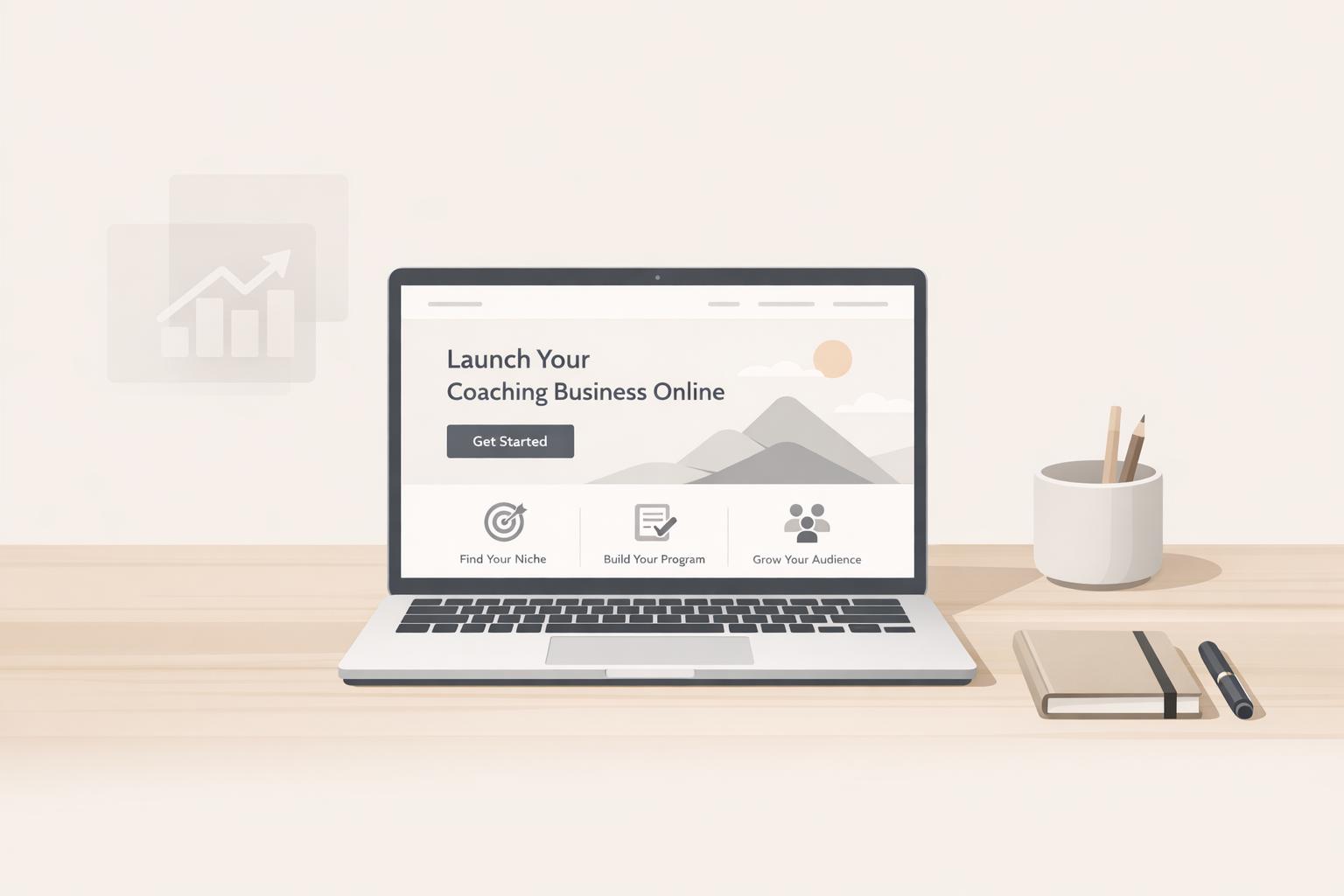
Starting an online coaching business in 2026 is simpler than ever. With low startup costs, AI tools, and a growing demand for specialized coaching, now is the time to launch. Here's a quick summary of the steps to get started:
- Find Your Niche: Focus on a specific audience and their problems. Specialization helps you stand out and charge premium rates.
- Build Your Online Presence: Create a landing page and active social media profiles. Use tools like Calendly for scheduling and lead capture.
- Leverage AI Tools: Automate lead qualification, client communication, and repetitive tasks to save time and focus on coaching.
- Grow Your Business: Use PR, SEO content, and LinkedIn outreach to build authority and attract clients.
- Streamline Operations: Track performance metrics and automate admin tasks to scale efficiently.
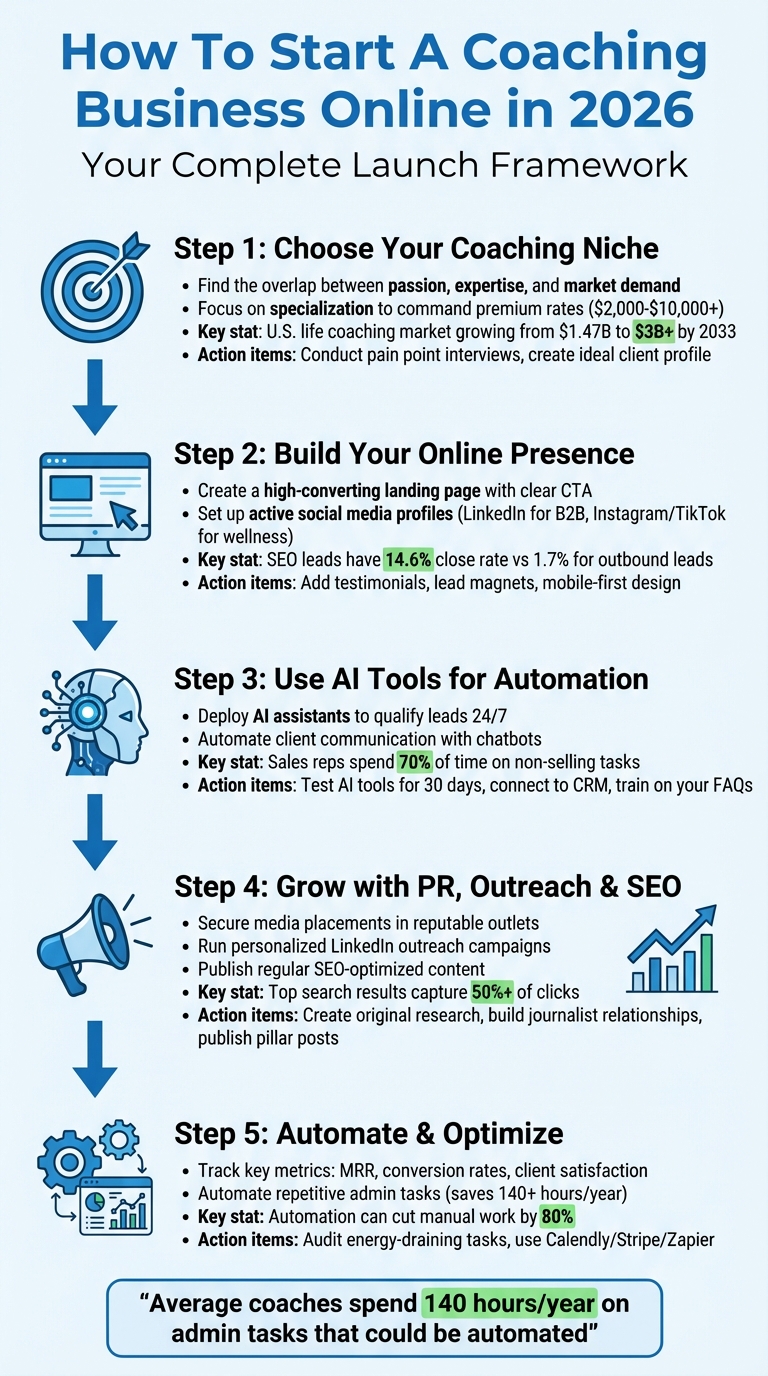
5-Step Framework to Launch Your Online Coaching Business in 2026
How to Start Online Coaching in 2026: Complete Step-by-Step Training
Step 1: Choose Your Coaching Niche and Define Your Voice
Your niche shapes everything - from your pricing to how quickly you attract clients. The key is finding the overlap between what you’re passionate about, what you excel at, and what people are willing to pay for [5]. In 2026, general coaching won’t cut it. Clients want specialists who can offer targeted solutions and drive specific results. That’s why narrowing your focus can help you command premium rates, ranging from $2,000 to $10,000 or more [2][6].
The U.S. life coaching market is set to grow from $1.47 billion to over $3 billion by 2033 [4]. Some of the most in-demand niches include AI coaching, aging and longevity (like menopause-specific coaching or vitality routines), remote work leadership, and burnout recovery [2]. Health and wellness coaching is also booming, with projections showing it will jump from $20 billion in 2025 to nearly $38 billion by 2034 [4]. With this in mind, let’s figure out who your audience is and how to craft your unique coaching voice.
Find Your Target Audience and Their Problems
Start by looking at challenges you’ve personally overcome. Often, the best coaching niches come from your own transformation story [4]. To refine your focus, conduct "pain point" interviews with at least three potential clients. Ask them about their biggest struggles and pay attention to the exact words they use to describe their issues [3]. These phrases will become the foundation of your messaging.
Next, research where your ideal clients spend time online. If you notice others offering similar services, that’s a good sign - it means there’s a demand [3]. Create a detailed "Ideal Client" profile to keep your messaging sharp and personal. For example, you might define your target as "Sarah, a 38-year-old marketing director transitioning into consulting" [8]. Once you’ve clarified your audience, it’s time to develop a brand voice that resonates with them.
Develop Your Brand Voice Through Interviews
Your brand voice is what makes you stand out. Tools like the "5 Whys" exercise or "Clarity Calls" can help you uncover your core mission and capture the language your audience naturally uses [5][7]. In 2026, polished, corporate-sounding content is losing ground to authentic storytelling - think voice notes instead of press releases [1]. Lori Young highlights how AI can handle structural tasks, but human connection remains essential for strategy and storytelling [1].
To make your brand relatable, share glimpses of your personal life - your hobbies, daily routines, or even your pets [10]. Develop a signature framework that turns your unique process into a repeatable system. This framework becomes your "secret sauce", clearly showcasing your unique approach and setting you apart in the coaching space [8].
Step 2: Build Your Online Presence
After defining your niche and voice, it's time to create digital assets that highlight your expertise. In 2026, your online presence functions like a storefront - it's where potential clients decide if they trust you with their journey. The coaching industry brought in over $4.6 billion in revenue in 2022, marking a 60% jump since 2019 [12]. Instead of overwhelming yourself with a sprawling website, start with a Minimum Viable Online Presence: a high-converting landing page paired with active, consistent social media profiles. This is where your unique brand voice comes to life.
Set Up a Custom Landing Page
Your landing page is your coaching business's most crucial digital tool. It’s the first stop for prospects who discover you through social media or online searches. A well-designed landing page doesn’t just inform - it persuades. It should clearly showcase how you solve problems and guide visitors toward booking a call.
Here’s how to make your landing page stand out:
- Headline with Impact: Use a headline that focuses on results, like "Transform Your Career in 90 Days."
- Client Testimonials: Include quotes or video success stories to build credibility.
- Clear Call-to-Action: Make it easy for visitors to book a call using tools like Calendly.
- Lead Magnet: Offer something valuable, like a free checklist or mini-course, to capture email addresses from those not ready to commit yet.
- Visuals That Connect: Use professional, personalized photos instead of bland stock images.
- Mobile-First Design: Make sure your page looks great on phones, as many clients will visit from mobile devices.
As Alexandra Cote, SaaS Growth Marketer, puts it:
A successful coaching website won't just tell. It'll show how you solve client problems and clearly outline the next steps for visitors to become clients.
For example, a platform managed to build a complete online academy in just seven days, enrolling over 1,500 learners and achieving impressive growth [11]. Another compelling stat? SEO-generated leads boast a 14.6% close rate compared to just 1.7% for outbound leads [11]. A well-optimized landing page, combined with a clear offer, can deliver serious results. Once your landing page is ready, drive traffic to it through your social media channels.
Set Up Your Social Media Profiles
Your social media presence acts as a powerful extension of your landing page. To make the most of it, align your profiles with your niche and target audience. For example, LinkedIn works best for B2B, executive, and career coaching, while Instagram and TikTok are ideal for life, health, and wellness coaching. Pick one or two platforms where your ideal clients are most active, and commit to posting consistently with authentic, relatable content.
An example of this in action? In early 2025, a coach named Stephanie landed a high-ticket client after reconnecting with a high school friend through Instagram. Her genuine, unpolished posts built trust, prompting the friend to reach out after 30 years [12]. Rob Dial, Founder of The Mindset Mentor, emphasizes this approach:
Real content builds real trust. Connection always beats perfection. Showing up imperfectly is still better than not showing up at all.
In 2026, people are drawn to originality and personality more than polished, AI-generated content. Share your daily routines, coaching philosophy, and personal insights on social media. This builds awareness, nurtures leads through email, and ultimately drives conversions on your landing page.
Step 3: Use AI Tools for Marketing and Client Engagement
Once your landing page and social media are up and running, the next big task is managing inquiries effectively. In 2026, AI-powered tools are making it easier than ever to handle lead qualification and client communication. With sales reps spending about 70% of their time on non-selling tasks [17], and 32% of marketing organizations fully adopting AI by late 2025 (with another 43% testing it) [15], the key to success lies in letting AI handle repetitive tasks. This allows you to focus on what truly matters - delivering the expertise your clients value. Here's how you can use AI tools to streamline lead qualification and client communication.
Use AI Assistants to Qualify Leads
Not every visitor to your site is ready to commit. AI assistants can help you spot the serious prospects, saving you from wasting time on those who aren’t ready to invest. By analyzing visitor behavior, these tools can identify high-value leads [13]. Predictive lead scoring takes this a step further, using historical data, website activity, and email interactions to assign scores based on conversion likelihood [15]. This approach can increase sales productivity by up to 20% [16].
Start by reviewing your weekly tasks to pinpoint repetitive activities, like answering FAQs or scheduling calls. Then, test one AI tool for a 30-day trial. For instance, you could deploy an AI assistant trained on your coaching methods to engage with prospects 24/7. It can identify their challenges and qualify them before you even need to step in [14]. Make sure to set the assistant’s role-based context - for example, as a productivity coach specializing in ADHD entrepreneurs - so its interactions align with your brand's tone and messaging [14]. The goal isn’t to replace your expertise but to ensure you’re only spending time with prospects who are genuinely ready to work with you.
Automate Client Communication with Chatbots
After qualifying leads, the next step is keeping them engaged with personalized, automated communication. AI chatbots can handle routine tasks like responding to inquiries, scheduling appointments, and nurturing leads around the clock. Train your chatbot with your FAQs, coaching philosophy, and methodology [14], and connect it to your CRM and email tools using platforms like Zapier or Make for instant follow-ups [14][18].
Take Coachvox as an example - it offers a 14-day free trial to create an AI coaching version of yourself. This virtual assistant can manage initial inquiries and guide prospects toward the right programs [14]. Additionally, AI can analyze chat logs to detect emotional shifts, recurring issues, or signs of waning motivation, allowing you to address problems before they escalate [14][18]. Always be transparent when using AI by including a note like, "This summary includes AI-generated insights" [14]. It’s worth noting that 80% of consumers are more likely to buy from brands that deliver personalized experiences, something AI makes possible on a large scale [15]. Your chatbot isn’t replacing you - it’s extending your reach, ensuring no lead is overlooked and every prospect feels valued.
sbb-itb-f7e72a6
Step 4: Grow Your Business with PR, Outreach, and SEO
In 2026, building authority is key to growth. This means focusing on media placements, targeted LinkedIn outreach, and SEO content. With AI Overviews now appearing in over 60% of searches, organic click-through rates have dropped by an average of 24% [19]. This shift makes visibility more important than ever, as authority and search visibility are now closely tied to long-term success. Let’s break down how you can strengthen your authority using these strategies.
Get Media Placements to Build Authority
Getting featured in reputable outlets like Forbes or Business Insider establishes trust and credibility - not just with potential clients but also with search engines [20]. These features act as proof points that humanize your business and showcase your expertise [19].
One way to secure these placements is by creating original research tailored to your niche. For example, if you coach tech executives, conduct a survey about their biggest leadership challenges and publish your findings. Promote these insights through press releases and build relationships with journalists who cover your industry [21]. Paula Graziani, founder of The Standout Founder, highlights the value of this approach:
Trust scales when people feel like you know them - even if you've never met [20].
To make this process easier, Brandbase offers plans designed to help you maintain a consistent presence in the media. The Essential plan provides one PR placement every six months, while the Pro plan offers six placements spread out over the year, so you don’t have to constantly pitch yourself.
This strategy aligns perfectly with leveraging digital tools and AI to scale your coaching business.
Run Targeted LinkedIn Outreach Campaigns
LinkedIn remains the go-to platform for professional coaching services, but success in 2026 requires a more thoughtful approach. Forget generic messages - personalized engagement is the name of the game. Start by creating an "engagement list" that includes thought leaders, competitors, and potential clients. Spend time interacting with their content to build familiarity and trust [23].
Your LinkedIn profile should function like a landing page for potential clients. Make your headline clear and benefit-driven (e.g., "I help tech executives lead without burnout") and use the Featured section to highlight lead magnets or client testimonials. For outreach, begin with a personalized connection request referencing their content, then follow up with a helpful resource or insight. Gradually build the relationship before suggesting a quick chat.
This method works - 76% of social media users say that content influences their purchasing decisions, with that number climbing to 90% for Gen Z and 84% for Millennials [22]. Charlene Boutin, a content strategist, puts it best:
The fastest way to land new coaching clients is to have genuine conversations with people... LinkedIn is ripe with automated outreach message blasts that suck the humanity out of the DMing experience [23].
Brandbase’s Pro plan can handle this for you, offering LinkedIn lead generation campaigns that reflect your authentic voice. They conduct interviews to ensure your messaging feels personal while scaling your outreach.
Pair this with consistent, optimized content to further enhance your online presence.
Publish Regular SEO Content for Search Visibility
Publishing high-quality, optimized content is essential for improving your rankings and establishing authority [24][25]. In fact, the top spots on search results capture over 50% of clicks, making SEO a critical component of success [25]. But SEO in 2026 isn’t just about keywords - it’s about Search Task Accomplishment (STA). This means creating content that fully addresses the user’s needs, encouraging them to spend more time on your page and signaling value to search engines [25].
Focus on creating pillar posts that link to related subtopics, reinforcing your relevance in search results [24][25]. Before you write, think about the intent behind a user’s search. Are they looking for information, trying to navigate to a specific site, or ready to make a purchase? Tailor your content to match their intent and include related keywords so AI-driven search engines can better understand your niche [25].
Original research and case studies are particularly effective for earning backlinks, which further boost your authority [21][24]. Structuring your content to answer common questions in a clear, concise way can also increase your chances of appearing in Google’s featured snippets [25]. Leigh McKenzie, SEO Strategy and Growth Leader at Backlinko, emphasizes this point:
People want a human perspective. They don't want SEO trash content [21].
Brandbase’s Pro plan simplifies this process by providing nine blog posts per month, helping you maintain a steady publishing schedule without the time drain of writing everything yourself.
Step 5: Automate and Improve for Long-Term Growth
To grow your business sustainably, it's essential to streamline operations and focus on automation. Did you know the average coach spends 140 hours a year on administrative tasks that could easily be automated? That's valuable time that could be spent coaching or scaling your business. For small business owners, inefficiencies eat up about 1.5 hours daily, adding up to over 500 hours annually [26]. The key isn't to work harder but to work smarter - by measuring what matters and automating the rest.
Track Your Performance Metrics
You can't make progress if you don't measure it. Start by tracking metrics that give a clear picture of your business's health, like Monthly Recurring Revenue (MRR), average client value, and conversion rates. For example, organic leads convert at 14.6%, compared to just 1.7% for outbound leads [11]. As Alexandra Cote, a SaaS Growth Marketer, explains:
"SEO leads (those coming in organically) alone have a 14.6% close rate versus a 1.7% close rate for outbound leads" [11].
But don't stop at sales numbers. Keep an eye on your lead magnet opt-in rates (typically between 4–10%) [11], email subscriber growth, and social media engagement. On the client side, monitor satisfaction scores, session attendance, and goal completion rates. These insights help you understand whether your coaching programs are achieving results or if clients are dropping off before finishing.
Use tools like Google Analytics and Google Search Console to see which content topics attract the most qualified leads. Then, adjust your coaching services to align with what your audience is actively searching for [26]. This data-backed approach ensures you're not guessing - you’re making decisions based on real evidence.
| Metric Category | Key Performance Indicators (KPIs) |
|---|---|
| Financial | MRR, Average Client Value, ROI, ROAS |
| Client Success | Satisfaction Score, Goal Completion, Attendance Rate |
| Marketing | Unique Visitors, Lead Magnet Opt-in Rate (4–10%), Email Growth |
| Sales | Conversion Rate, Close Rate (14.6% for SEO), No-show Rate |
| Operations | Hours spent on admin, Task energy impact (1-5 scale) |
Once you've identified these metrics, the next step is to automate the repetitive tasks that take up too much of your time.
Automate Repetitive Tasks
After tracking your metrics, focus on automating the tasks that drain your time and energy. Start by auditing your activities over a few days and rating each one on a scale of 1–5 based on how much energy it consumes [26]. Tasks that are low-value and energy-draining should be the first to go.
For example, scheduling and payment processes can be automated with tools like Calendly, Stripe, and Zapier. These tools can handle appointments, billing, and follow-ups, cutting manual work by up to 80% [26]. Inefficient onboarding causes 23% of client churn [26], so automation can also improve client retention. When a client signs up, automated tools can send contracts via Dropbox Sign, intake forms through Typeform, and welcome emails - all without you lifting a finger [26].
A simple automation setup using tools like Calendly, Google Drive, and ChatGPT costs about $20/month and can eliminate up to 80% of manual admin work [26]. As your business grows, consider advanced tools like Otter.ai to record coaching sessions and automatically file summaries into client folders, saving hours of manual note-taking [26]. Business coach Luisa Zhou sums it up well:
"Automation doesn't mean replacing your coaching. It means eliminating the repetitive tasks that prevent you from being fully present with your clients" [26].
Want to take it a step further? Brandbase's Pro plan can manage LinkedIn outreach and publish nine SEO blog posts per month, allowing you to focus entirely on coaching. Their Essential plan even includes a custom AI assistant to qualify leads around the clock, ensuring only serious prospects make it to your calendar.
Brandbase Plans for Your Coaching Launch
Once your coaching framework is ready, the next step is choosing a Brandbase plan that fits where your business is right now. Brandbase offers three options, each tailored to different stages of your coaching journey. All plans come with a one-time setup fee of $499, and monthly pricing adjusts based on your needs.
The Starter plan, priced at $18/month, provides a custom landing page built in Webflow and hosted on your account. This is a great option if you're comfortable managing your own website but want a polished, professional starting point. Keep in mind, this plan doesn’t include ongoing support or updates - you’ll handle those tasks yourself.
The Essential plan, at $99/month, is a popular choice for many new coaches. It includes a fully managed landing page with hosting, maintenance, and unlimited updates to save you from technical hassles. Plus, it features a custom AI assistant to qualify leads 24/7, contact and lead capture forms, detailed analytics to monitor visitor activity, and a PR placement every six months to boost your credibility. This plan allows you to focus on coaching while automating the time-consuming admin work.
For coaches aiming to scale quickly, the Pro plan, at $499/month, removes growth barriers. It includes everything from the Essential plan but adds unlimited landing pages for multiple offers, LinkedIn lead generation campaigns to keep your pipeline full, six PR placements every other month to establish your expertise, and nine SEO blog posts per month to drive organic traffic. This plan is perfect for coaches looking to expand without building a full marketing team.
The best plan for you depends on how you deliver your coaching and where you are in your growth. If you’re focused on 1:1 sessions, the Essential plan provides powerful automation and lead management tools. For coaches running group programs or offering multiple packages, the Pro plan offers the advanced features needed to maintain a steady stream of clients. Choose the plan that aligns with your goals and growth stage.
Conclusion
Starting an online coaching business in 2026 is about building momentum, not chasing perfection. The framework outlined earlier equips you with a clear niche, a polished online presence, AI-powered lead qualification, and effective PR, outreach, and SEO strategies. Together, these steps create a strong foundation for long-term growth.
The coaching industry thrives on delivering meaningful results. The secret to success lies in shifting from selling individual sessions to offering value-driven, outcome-focused solutions.
To get started, all you really need is a professional landing page, a scheduling tool, and a payment processor. Try using the "Taster Technique" - offer a free 15-minute session or an affordable starter package. This lets potential clients experience your coaching style before committing to a full program. It’s a simple way to build trust and distinguish serious prospects from casual browsers. Combine this with the tech tools and processes discussed earlier to start turning leads into clients today.
With your strategy in place, it’s time to take action. Successful coaches streamline repetitive tasks through automation, freeing up time for meaningful interactions. Keep an eye on your performance metrics to see which marketing efforts deliver the best ROI, and use that data to fine-tune your approach. As Simon Sinek famously said:
People don't buy what you do, they buy why you do it [9][27]
Lead with your mission, and let your framework support your goals.
Now that you’ve built a solid foundation, it’s time to take the next step. Choose your Brandbase plan to accelerate client acquisition, set up your landing page, and start connecting with prospects. The framework is ready - execution is the next chapter.
FAQs
How can I choose the best coaching niche for my online business?
Choosing the right coaching niche is a crucial step in building a thriving online business. Your niche determines who you serve and the specific problem you solve for them. To pinpoint the right fit, start by reflecting on your own journey. What topics light you up? What skills or experiences have shaped you? Think about challenges you’ve faced and overcome or areas where you’ve helped others achieve meaningful results.
From there, narrow your focus to your ideal client. Who are they? Consider details like their age, career stage, goals, and struggles. Once you have a clear picture of your audience, dig deeper to see if there’s demand for your niche. Check out online trends, dive into forums, or review industry reports to gauge interest.
Finally, put your idea to the test. Host a free webinar or offer discovery calls to gather feedback and fine-tune your approach. By matching your expertise with a need in the market, you'll create a solid foundation for long-term success.
What are the best AI tools to streamline and automate my online coaching business?
AI tools can make running your coaching business much smoother and more efficient. Take Microsoft 365 Copilot, for instance - it’s great for automating those time-consuming administrative tasks. Then there’s HubSpot AI, which simplifies lead management and keeps client communication flowing seamlessly. Need help with content creation? Jasper AI is perfect for crafting engaging material, while Synthesia takes the hassle out of video production. By using these tools, you can free up valuable time and concentrate on expanding your business.
How can I use SEO and PR to grow my online coaching business?
SEO and PR can work hand in hand to help grow your online coaching business by attracting clients and building your presence effectively.
SEO is all about crafting content that aligns with the questions and needs of your ideal clients. Think evergreen blog posts, in-depth guides, or case studies that showcase your expertise and bring in consistent traffic. Use AI-powered tools to uncover high-intent keywords - like "career coaching for professionals" - and make sure to optimize elements like titles, meta descriptions, and headings. Keep your content fresh by updating it regularly, which not only keeps your audience engaged but also helps improve your search rankings over time.
PR, on the other hand, focuses on boosting your visibility and credibility. Opportunities like podcast interviews, guest articles, or webinars allow you to connect with new audiences while positioning yourself as a trusted thought leader. Media mentions don’t just enhance your reputation - they also provide valuable backlinks that can strengthen your SEO. Share these PR wins on social media to maximize their impact and further expand your reach.
When you combine a well-planned SEO strategy with focused PR efforts, you create a loop where increased visibility and credibility feed into each other, driving steady growth for your coaching business.
Related Blog Posts

Blog title heading will go here
Blog title heading will go here