

Lead Gen for consultants & coaches in 2026: Less Funnels, More Conversations
Funnels are out. Conversations are in. In 2026, traditional lead generation methods like static landing pages and email drip campaigns are losing their edge. Why? Prospects demand instant, tailored interactions - not slow, outdated processes. With the coaching industry booming (122,974 active coaches by 2025 and $5.34 billion in global revenue), competition is fierce, and the need for fast, meaningful engagement has never been greater.
The solution? AI-driven conversations. By replacing static funnels with AI-powered systems, consultants and coaches can qualify leads, answer questions, and book appointments 24/7 - without lifting a finger. This approach doesn’t just save time; it ensures prospects feel valued and heard immediately.
Key Takeaways:
- Funnels are outdated: Buyer journeys are no longer linear, making traditional funnels ineffective.
- AI scales conversations: AI assistants can replicate your expertise, delivering real-time, personalized interactions.
- Replace PDFs with AI chats: Engage leads instantly with conversational AI instead of static downloads.
- Automate lead vetting and scheduling: AI pre-qualifies leads and books calls, saving time and boosting efficiency.
Ready to scale smarter? AI systems like Brandbase transform your expertise into a 24/7 lead-generation machine, helping you focus on what you do best: coaching.
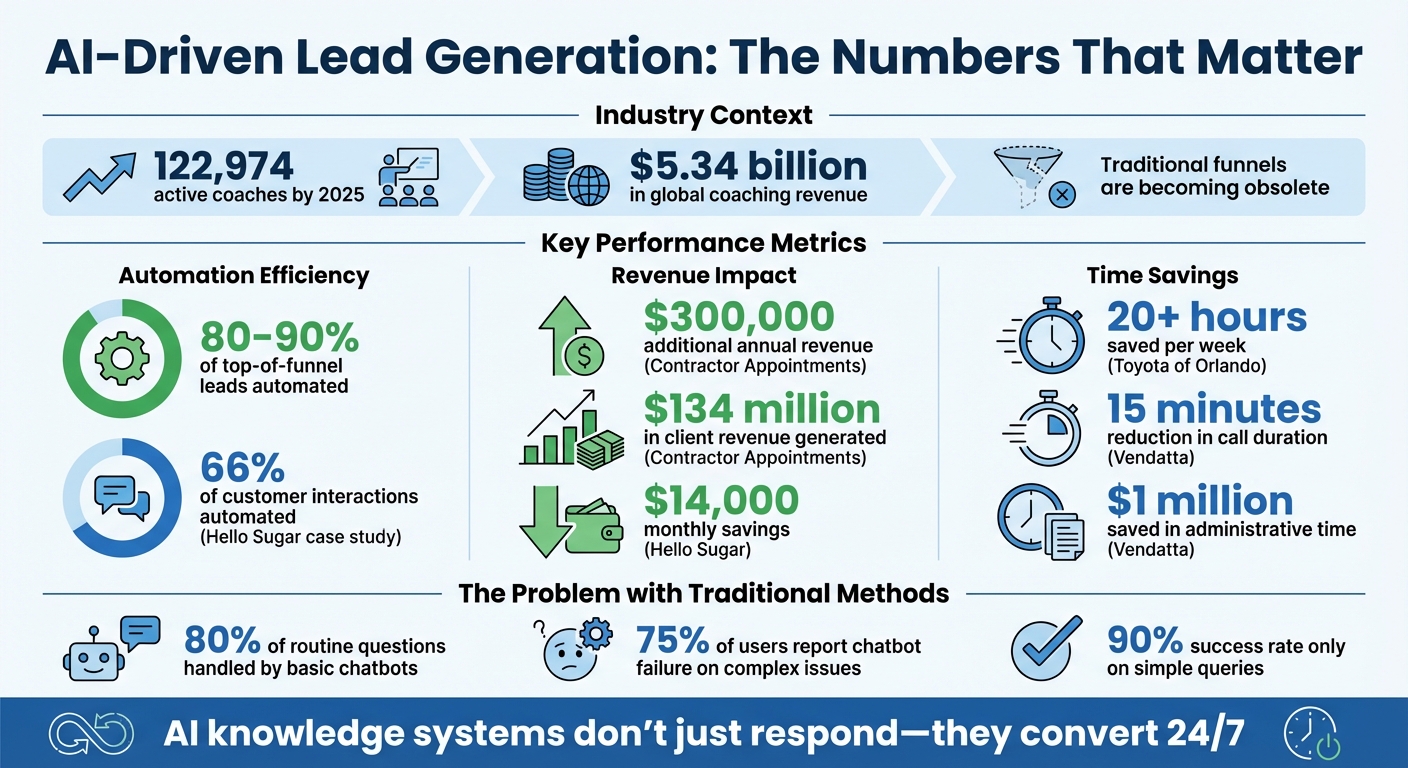
AI-Driven Lead Generation Statistics: ROI and Time Savings for Coaches and Consultants
How to use AI for Lead Generation
Creating Your AI Knowledge System
Building an AI knowledge system goes far beyond creating a simple chatbot. It's about developing an AI that reflects your expertise, methodology, and voice. This isn’t just about answering questions - your AI should coach, guide, and engage using your unique frameworks. To make this happen, the first step is transforming your expertise into actionable data.
Turning Your Expertise into AI
Start by uploading your core materials - these might include books, proprietary frameworks, internal documents, or blog posts. Supported file types include PDFs, PowerPoints, text files, and CSVs, with a limit of 20 sources (each under 2MB) [1][4]. For dynamic updates, you can connect live sources like Google Docs or Notion. These sync daily, weekly, or monthly, ensuring your AI reflects your most current ideas [2][4]. You can also input your website URL, allowing the system to crawl and extract relevant content from all associated pages [1][4].
For the best results, upload content in full paragraphs rather than fragmented bullet points - this gives the AI more context to work with [4]. Next, craft a clear "directive" that outlines the AI's role, its goals, and how it should communicate. Think of this as your AI's playbook. For example: “You are [Your Name]. Use my frameworks to respond. If someone’s a good fit, book a call. If not, direct them to my YouTube channel.”
This approach can deliver tangible results. In 2024, Contractor Appointments implemented such a system and automated 80-90% of their top-of-funnel leads, generating an additional $300,000 in annual revenue [10]. CTO Ben Leone demonstrated that when AI is deeply rooted in real expertise, it doesn’t just respond - it drives conversions.
While detailed uploads are essential, leveraging advanced AI models is what transforms your system from a basic chatbot into a dynamic knowledge asset.
Knowledge Systems vs. Basic Chatbots
Basic chatbots operate on rigid "if-then" rules, which means they struggle the moment a user goes off-script. Think of them like vending machines - limited options, pre-programmed responses [9]. AI knowledge systems, however, rely on Large Language Models that can understand context, reason, and adapt. Instead of just identifying keywords, they grasp intent [7][9].
Here’s the key difference: while chatbots can handle about 80% of routine questions with a 90% success rate, 75% of users report they fail when faced with more complex issues [6][8]. AI knowledge systems flip that script. For example, in 2024, Hello Sugar scaled its operations from 81 to 160 salons without hiring additional reception staff. They used a hybrid AI solution that automated 66% of their customer interactions, saving $14,000 monthly [6]. Chief Technology Officer Austin Towns showed that when AI is built on proprietary expertise rather than generic scripts, it can manage intricate inquiries - not just FAQs.
"AI agents are not just a step up from chatbots; they represent a paradigm shift in how we approach automated interactions." - Dr. Jane Smith, AI Research Lead, TechFuture Institute [6]
A well-designed AI system should do more than just react to queries. It should qualify leads, schedule appointments, and initiate workflows - all while maintaining your tone and style. This proactive approach turns your AI into a powerful knowledge asset that drives meaningful conversations, helping you convert leads and grow your business. And that's the game-changer.
Replace Static Downloads with AI Interactions
Static PDFs often end up overlooked or forgotten. AI interactions, on the other hand, provide immediate, personalized engagement. Instead of asking potential leads to download a lengthy guide and hoping they read it, why not offer them a quick, 5-minute chat with an AI trained on your expertise? This approach delivers instant, customized answers while naturally collecting contact details [1][4].
This method doesn’t just engage - it solves problems on the spot. As Dario de Guz, Head of Customer Support at Rebrandly, shared:
It's saved our team time and made the customer experience better. [Chatbots] have already become a core part of how we support users [3].
This transition paves the way for a more interactive, conversation-driven experience.
AI Coaching Sessions Instead of PDFs
Swap out the standard "Download our Guide" call-to-action with an "Ask our AI Expert" interface. By uploading your key content, you can let the AI deliver your insights in a conversational format [1][4]. Instead of presenting static text, the AI can answer specific questions, provide tailored feedback, and leave a stronger, more dynamic first impression than any PDF ever could.
Jonathan Long, Chief of Strategy and Innovation at Girlology, highlighted the benefits of this shift:
With this chatbot, we're able to provide high-quality conversations, which in turn create immediate value for prospects and qualified leads for our brand [3].
The real game-changer is training your AI on your unique approach rather than relying on generic advice. For instance, an "Editor Bot" trained on your style guide could offer personalized editorial feedback instead of directing someone to a bulky manual. While the AI delivers value, it also captures contact details and can even trigger actions like scheduling a meeting through Calendly [1][4].
Not only does this elevate the user experience, but it also opens doors to monetization.
Selling AI Access as a Subscription
Your AI doesn’t have to be free. You can package it as a subscription service, priced between $47 and $97 per month. This gives clients 24/7 access to your expertise without needing to book time with you. It’s especially handy for coaches who frequently get repeat questions - your AI can handle those late-night "crisis" queries while you sleep. This approach doesn’t just capture leads; it creates a steady revenue stream with zero additional effort on your part.
sbb-itb-f7e72a6
Automating Lead Vetting and Scheduling
Spending time answering pricing questions and managing client inquiries can take you away from what you do best - coaching. Automating your lead vetting and scheduling process is a natural next step after setting up your AI knowledge system. With AI, you can streamline the entire vetting process, assessing factors like budget, readiness, and compatibility before a lead even reaches your calendar.
Using AI to Filter Leads
You can configure your AI to act like a gatekeeper, using a clear set of guidelines that define your ideal client profile. These guidelines should include specific "must-haves" and "red flags" so the AI knows when to encourage a booking or redirect someone to your free resources, like a YouTube channel or downloadable guides. For instance, if your coaching is tailored to businesses generating over $500,000 annually, you can program the AI to ask about revenue upfront. If a lead doesn’t meet your criteria, the AI can still provide value by offering helpful content, avoiding any awkward rejections.
The AI gathers essential details like name, email, company size, and coaching goals, ensuring that only well-informed, qualified leads move forward. Once the AI confirms a lead meets your criteria, it transitions seamlessly into scheduling the next steps.
Auto-Booking Qualified Leads with Calendly
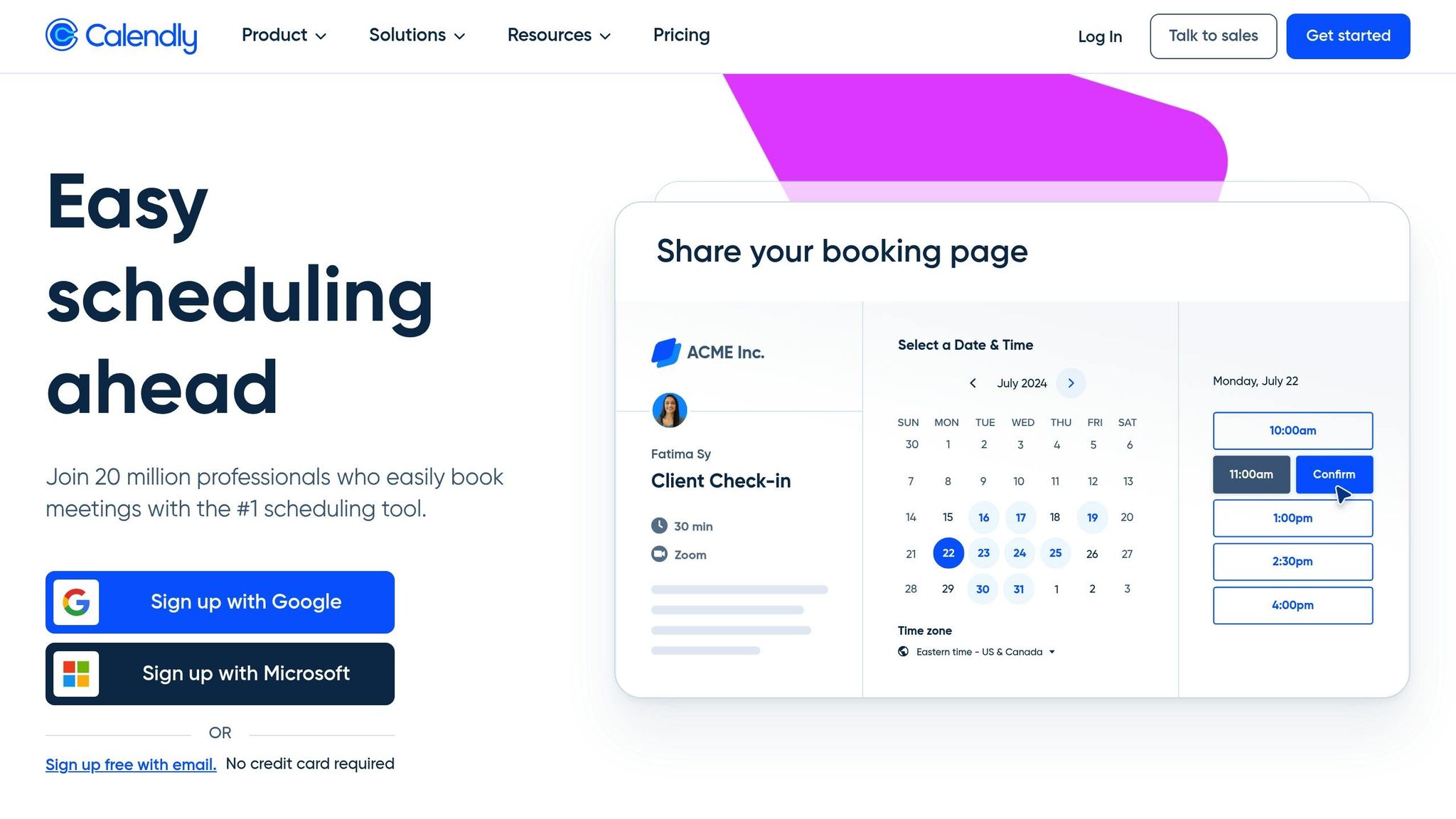
After filtering out unqualified inquiries, the system makes booking appointments effortless. When the AI identifies a qualified lead, it can display a "Schedule a Call" button linked directly to your Calendly or Clockwise calendar. To ensure your time is spent wisely, the booking option only appears when high-intent keywords like "pricing", "start", or "book" are detected. This prevents unqualified leads from filling up your schedule unnecessarily.
Once a conversation wraps up, the AI sends a detailed transcript, along with contact information and a lead score, to your CRM. It also notifies you via Slack, so you can quickly follow up with high-potential clients. Contractor Appointments implemented this system and managed to automate 80-90% of their top-of-funnel leads, resulting in an impressive $300,000 boost in annual revenue[10]. The outcome? Your calendar stays packed with meaningful, high-value conversations, and you focus only on leads who are ready to take action.
How to Set Up Your AI Assistant with Brandbase
Creating your AI assistant with Brandbase is straightforward and doesn’t require any technical expertise. The process involves three main steps: adding your content, setting up how your AI behaves, and integrating it with your existing tools. These steps turn your knowledge into a functional AI system, ready to assist.
Step 1: Add Your Content
Start by building your AI's "brain" in Brandbase. Head to the Knowledge tab, where you can upload up to 20 static files such as PDFs, PowerPoint slides, or Word documents. Think of this as the foundation of your assistant - include essential resources like books, frameworks, or worksheets [1][4]. If your materials are online, you can pull content from website URLs or connect live sources like Google Docs and Notion [1][4][2]. The system will automatically stay up-to-date when live sources are synced [1][4][2].
Focus on uploading high-quality content that represents your expertise. For example, include course transcripts, session notes, or detailed blog posts that reflect your coaching approach [11].
Step 2: Define Your AI's Personality
Next, move to the Instructions tab to shape your AI's personality. Decide how it should interact - should it be straightforward and challenging, or more gentle and supportive? Tailor its tone, ideal customer profile, and the key solutions it offers [1][11].
Test its responses by posing sample questions like, "How do I stay motivated?" Adjust the answers to ensure they align with your unique voice [11]. Go a step further by programming the AI to ask thought-provoking questions that encourage self-reflection rather than just providing answers [12]. You can also set up logic to collect contact details - such as name, email, and company - either at the beginning of a chat or after a few interactions [1][4]. To make things even smoother, add a scheduling button so leads can book appointments directly [1][4].
Step 3: Integrate with Your CRM and Tools
Finally, connect Brandbase to your CRM to automatically sync lead information and conversation histories [4][2][5]. You can also link tools like Slack or Microsoft Teams to get instant notifications when a lead qualifies or needs your attention [1][4][2]. For example, in 2025, Jacob Sirrs of Vendasta shared that AI automation saved his company $1 million in administrative time and cut call durations by 15 minutes [10]. Similarly, Spencer Siviglia at Toyota of Orlando used AI to manage over 30,000 lead records, saving more than 20 hours each week [10].
Set up regular updates for dynamic content so your AI always provides the most current information [4][2]. You can also configure fallback messages with your contact details - like a phone number or email - for any questions the AI can’t handle [4][2]. Once everything is connected, your system will seamlessly deliver qualified leads, making follow-ups efficient and effective.
Conclusion: Scale with Conversations, Not Funnels
Key Takeaways
The traditional funnel model is outdated. This isn’t just speculation - it’s a real shift in how businesses generate leads. Static PDFs and one-way emails can’t compete with instant, AI-powered conversations that respond to questions and qualify leads anytime, day or night. Success today hinges on leveraging AI, not on how many hours you work.
Here’s the proof: AI-driven conversations can manage 80-90% of top-of-funnel leads automatically [10]. Contractor Appointments used this method to help clients generate over $134 million in revenue, while increasing their own annual revenue by $300,000. Meanwhile, Toyota of Orlando saved more than 20 hours each week while managing over 30,000 lead records [10].
But this isn’t about simple chatbots - it’s about building knowledge systems. By uploading your key content, integrating with your CRM, and adding tools like scheduling buttons, your AI can qualify leads and book meetings automatically. It works nonstop, ensuring prospects are vetted and engaged while delivering real value.
How to Get Started
The results speak for themselves: AI-driven strategies outperform static funnels. With Brandbase, creating your AI system is quick and straightforward. Upload your content, set up how your AI interacts with users, and connect it to your tools. No coding is needed - just your expertise transformed into a system that operates 24/7, expanding your reach and impact.
It’s time to stop trading your hours for dollars. Start scaling your business with conversations that work for you.
FAQs
How can coaches use AI to replace traditional lead funnels?
Coaches can simplify the process of generating leads by leveraging AI-powered chatbots designed with their unique expertise. Forget about setting up complicated funnels - these chatbots can jump right in to engage potential clients, answer frequently asked questions based on your books or frameworks, and even qualify leads instantly.
What’s more, the AI collects contact information, identifies top-quality leads, and seamlessly integrates them into your CRM or calendar. This means you can dedicate your energy to impactful conversations while the chatbot takes care of the repetitive, time-consuming tasks.
How can I create an AI-powered knowledge system for my coaching business?
To build an AI-driven knowledge system, begin by setting up a chatbot and equipping it with clear, role-specific guidelines. Then, upload your proprietary resources - like internal documents, books, or frameworks - as its primary data source. Establish response rules to enable the AI to handle tasks such as qualifying leads, answering inquiries, and even scheduling meetings automatically. Finally, integrate the system with tools you already use, such as your CRM, email platform, or Slack, to streamline your workflow. This approach allows your expertise to operate around the clock, expanding your reach and saving valuable time.
How can AI streamline lead qualification and scheduling for consultants?
AI simplifies the lead qualification process by taking care of routine inquiries, such as those about pricing or budget, and determining whether a prospect aligns with your services. It also automates follow-up actions, ensuring a smooth workflow.
With this approach, only prospects who meet your criteria receive your scheduling link, while others are guided toward relevant resources or content. This not only saves time but also ensures your calendar is reserved for meaningful conversations with high-value leads.
Related Blog Posts

Blog title heading will go here
Blog title heading will go here