

How to Productize Your Coaching Without Watering It Down in 2026

If you're tired of repeating yourself in DMs or struggling to scale your coaching business, AI can help. By turning your expertise into an AI-powered system, you can grow your reach without sacrificing quality. Here's how:
- Train AI with Your Expertise: Upload your books, frameworks, and resources to create a knowledge base. Add interviews to capture your tone and style.
- Build AI Tools: Replace static PDFs with interactive AI that answers questions, qualifies leads, and syncs with your CRM.
- Offer 24/7 Access: Create subscription-based AI coaching that stays updated with your latest strategies.
- Track and Improve: Use analytics to monitor performance and refine your system over time.
AI lets you scale without losing your voice or methodology. You’ll save time, retain clients, and grow your business - all while focusing on what matters most.
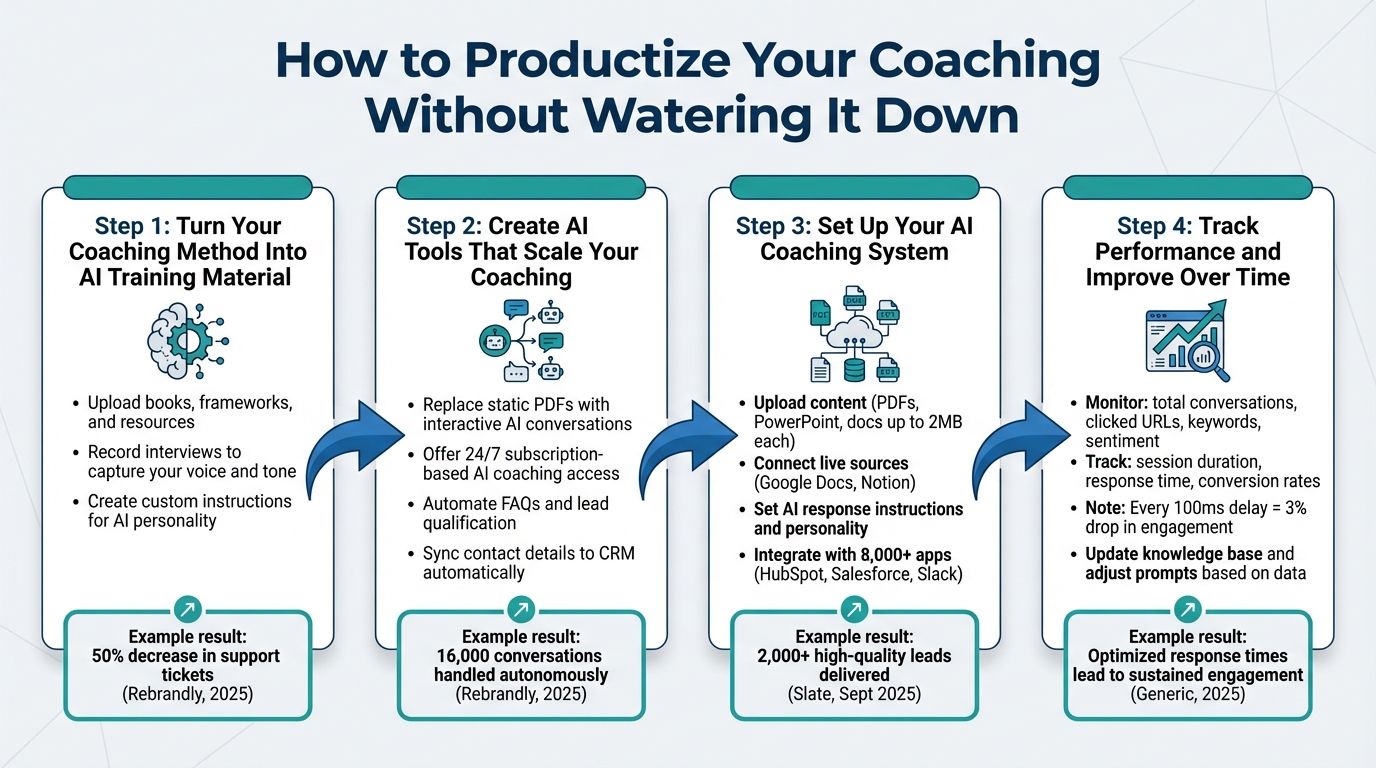
4-Step Process to Productize Your Coaching with AI in 2026
How Productizing My AI Services 10X'd My Revenue (Copy Me)
Step 1: Turn Your Coaching Method Into AI Training Material
To turn your coaching expertise into a scalable product, the first step is creating a strong foundation of AI training materials. The better the training, the more effective your AI will be. This isn't just about uploading a list of FAQs - it's about building a comprehensive resource that embodies your unique coaching style and methodology. Start by organizing and uploading your core materials.
Upload Your Books, Frameworks, and Resources
Begin by uploading your books, frameworks, workshop transcripts, and any other key coaching documents. AI systems typically work with standard file formats, so make sure your materials are complete and easy to process. Structure the information in clear, logical paragraphs to ensure the AI can interpret it effectively. If your resources are updated regularly, consider syncing live sources to keep the AI current.
For instance, in 2025, Dario de Guz, Head of Customer Support at Rebrandly, trained their AI on internal company documentation. This effort led to a 50% decrease in support tickets [3].
Capture Your Voice Through Interviews
While uploading documents captures your methodology, it's equally important to ensure the AI reflects your personal style and tone. Record interviews to showcase how you communicate and upload these along with any existing style guides. Use custom instructions to define the AI's "personality", including your professional background, tone, and preferences. For example:
"You are a straightforward, no-nonsense business coach. You use concise sentences, avoid corporate buzzwords, and always provide actionable advice."
Additionally, set parameters for how the AI should respond and include references like your brand’s style guide or past coaching transcripts. These materials help the AI maintain consistency in how it communicates [6][4][7].
Step 2: Create AI Tools That Scale Your Coaching
Once your coaching materials are ready, the next step is to transform them into AI tools that can operate around the clock. These tools can extend your unique coaching approach, engage clients, and qualify leads effortlessly, day or night.
Upgrade PDFs to Interactive AI Conversations
Static PDFs often get lost in someone's downloads folder, forgotten and unused. Instead of relying on these, consider training an AI coach using your materials. This allows potential clients to interact with your framework, ask personalized questions, and receive tailored responses. Plus, their contact details can sync directly to your CRM, streamlining your lead management.
In 2025, Jonathan Long, Chief of Strategy and Innovation at Girlology, took this approach by creating a chatbot that delivered customized conversations for prospects while generating qualified leads.
"With this chatbot, we're able to provide high-quality conversations, which in turn create immediate value for prospects and qualified leads for our brand."
– Jonathan Long, Chief of Strategy and Innovation, Girlology
To maximize its impact, embed the chatbot on your website and add clear prompts to help users navigate the most valuable aspects of your methodology.
Offer 24/7 Access to Your Coaching Model
Turn your AI into a subscription-based service, offering affordable, on-demand coaching that stays up-to-date with your latest insights. This is a great middle-tier option for those who may not be ready to commit to one-on-one coaching but still want tailored guidance rooted in your expertise. Ensure the AI syncs regularly with live documents so it always reflects your most current strategies.
Equip AI to Handle FAQs and Qualify Leads
Your AI can also take on routine tasks, like answering frequently asked questions and qualifying leads. By collecting essential details - such as budget, timeline, and specific challenges - it can determine whether a prospect fits your criteria. If they do, the AI can provide a scheduling link for further engagement. If not, it can direct them to free resources or other helpful content.
In 2025, Dario de Guz, Head of Customer Support at Rebrandly, introduced chatbots to handle repetitive customer inquiries. The result? The system managed 16,000 conversations and cut manual support tickets by 50% [3].
"It's saved our team time and made the customer experience better. [Chatbots] have already become a core part of how we support users."
– Dario de Guz, Head of Customer Support, Rebrandly
sbb-itb-f7e72a6
Step 3: Set Up Your AI Coaching System With Brandbase
Now that you've got your AI tools ready, it’s time to put them to work with Brandbase. By 2026, scaling your coaching business means having an AI assistant that operates around the clock - even while you sleep.
Upload Your Content to Train the AI
Start by uploading your coaching materials into Brandbase. The platform supports a variety of static files, including PDFs, PowerPoint presentations, and text documents (up to 2MB each). It can also pull information from public webpage URLs. If you prefer dynamic updates, connect live sources like Google Docs or Notion to ensure your frameworks stay current and reflect any changes automatically [5].
For example, syncing a frequently updated Google Doc ensures your AI assistant always uses your latest strategies and insights. Once your content is in place, you can focus on shaping how the AI reflects your unique coaching style.
Set Instructions for How the AI Should Respond
Define the AI's role and personality to mirror your coaching approach. Specify its objectives, audience, tone, and formatting rules. For instance, you might set guidelines like: "You are a high-performance business coach" and provide instructions such as "Always ask a clarifying question before offering advice" or "Stick to topics within my coaching framework." You can even adjust the AI’s creativity level to strike the right balance between consistency and flexibility [5].
Additionally, you can program trigger actions for specific keywords. For example, the AI could display a scheduling button whenever words like "book" or "schedule" are mentioned. These settings ensure the AI aligns seamlessly with your workflow, making it easier to integrate with your existing systems.
Connect to Your CRM and Communication Tools
Brandbase works with over 8,000 apps, allowing you to sync your AI assistant with tools like HubSpot, Salesforce, Slack, or Microsoft Teams [3][5]. Automated workflows can send transcripts and contact details directly to your CRM, saving you time and keeping your data organized [5].
You can also set up real-time alerts to notify you via Slack or email whenever a high-value lead shares their contact information [2]. For streamlined tracking, Brandbase’s "Collect leads" feature automatically compiles names, emails, and phone numbers into a secure table, making follow-ups a breeze [5].
Here’s an example of how effective this can be: In September 2025, the team at Slate used similar automation to deliver over 2,000 high-quality leads directly to their sales team. This approach significantly cut down the time spent on manual research and boosted their efficiency [2].
Step 4: Track Performance and Improve Over Time
To keep your AI coaching system running smoothly and effectively, you’ll need to monitor its performance and make adjustments as needed. The most successful coaches in 2026 will be those who keep a close eye on what works and tweak what doesn’t. Let’s break down the key metrics and strategies that can help you fine-tune your system over time.
Monitor Engagement and Conversion Data
Start by tracking the metrics that matter. Tools like Brandbase provide insights into total conversations, clicked URLs, top keywords, and sentiment distribution [5]. These numbers help you understand whether users are engaging with your AI or leaving after a single question. For instance, if you notice a surge in pricing-related questions but no increase in booking link clicks, it might mean your AI needs better instructions to address objections.
Focus on what leads to conversions. If specific responses or conversation patterns consistently turn prospects into clients, lean into those strategies [9]. Keep an eye on metrics like session duration, feature adoption rates, and response time. Even small delays can have a big impact - every additional 100ms in response time can reduce user engagement by 3% [10][11][8]. A great example comes from Rebrandly, which in 2025 implemented AI chatbots trained on their internal content. By closely monitoring interaction data, they reduced support tickets by 50% and autonomously handled over 16,000 conversations [3].
Adjust Prompts and Update Your Knowledge Base
When the data shows areas for improvement, it’s time to refine your AI’s responses. Review conversation logs to pinpoint recurring gaps or weak answers [1][5]. With Brandbase, you can use keyword searches to quickly assess how the AI handles specific topics [5]. For instance, if the same question pops up multiple times a week, that’s a clear sign of a knowledge gap that needs addressing.
Make updates to your AI’s instructions based on real-world data. Add new rules, steps, or guardrails to enhance accuracy [5][2]. For example, if your AI tends to give generic advice, you could add a directive like: “Always reference a specific framework from my book before offering a solution.” You can also tweak creativity settings - lower the temperature for straightforward FAQs, or raise it for more dynamic, conversational coaching [5].
Keep your AI’s knowledge base up to date by uploading new PDFs, syncing updated Google Docs, or linking fresh webpage URLs whenever you release new content [5][4]. If you rely on live data sources like Notion, set up automated syncs (daily, weekly, or monthly) to ensure your AI always pulls the latest information [1][5]. This way, your coaching system stays current without requiring constant manual updates.
"It's saved our team time and made the customer experience better. [Chatbots] have already become a core part of how we support users." - Dario de Guz, Head of Customer Support, Rebrandly [3]
Conclusion
By 2026, scaling your coaching business no longer means compromising on quality. With AI tools like Brandbase, you can create a digital version of your expertise, built from your own books, frameworks, and methodologies. This ensures that every AI-generated response aligns with your coaching style, steering clear of generic advice[1]. By uploading your proprietary content and setting clear guidelines, you can maintain consistency and uniqueness in every interaction.
The real game-changer? AI takes over the repetitive tasks - handling pricing inquiries, qualifying leads, scheduling meetings, and updating your CRM. This frees you up to focus on what truly matters: delivering impactful, strategic coaching.
The top coaches in 2026 won’t be those grinding the hardest - they’ll be those who use AI to amplify their efforts. With your expertise working around the clock, you move beyond trading time for money and start building a scalable, lasting impact. It’s about transforming your coaching into a powerful, ever-growing personal brand.
FAQs
How can I use AI to keep my coaching style and tone authentic?
AI can replicate your personal coaching style by learning directly from your own materials. Instead of relying on standard FAQs or templates, you can upload your books, frameworks, case studies, and internal notes - anything that reflects your unique methodology. By doing this, the AI gets a clear sense of how you communicate, including your phrasing, metaphors, and tone.
To take it a step further, you can use a system prompt to instruct the AI to respond as if it were you. Want it to sound supportive yet direct? Or maybe mirror the analogies you use in workshops? Simply include those guidelines. By anchoring the AI in your proprietary content and fine-tuning its tone, it delivers advice that feels like an authentic extension of your voice. This approach allows you to scale your coaching style without losing the personal connection that makes it effective.
What are the advantages of offering your coaching as a subscription-based AI service?
Transforming your coaching into a subscription-based AI service can open up some exciting opportunities. For starters, it establishes a steady stream of recurring revenue while giving your clients round-the-clock access to your knowledge and methods. This means your expertise is always available, even when you're not.
On top of that, this model takes care of time-consuming tasks like lead qualification and administrative work, so you can focus on what truly matters - delivering value and growing your business. Plus, it lets you scale your coaching to countless users without demanding extra hours from you. This not only makes your services more efficient but also extends your reach to a broader audience. It's a smart way to grow your impact while keeping your business sustainable.
How can I keep my AI coaching system updated with my latest strategies?
To keep your AI coach aligned with your latest expertise, make it a habit to upload your most recent materials - things like updated frameworks, case studies, or fresh content. Think of these as your "knowledge assets." By adding them directly to the AI’s knowledge base in formats like PDFs or DOCX, you ensure the system always references the most current version of your work.
If you’re looking for a more automated solution, consider syncing a cloud folder where you store your coaching resources. You can set up an automation that pushes new or updated files into the AI’s knowledge base. Pair this with a regular retraining schedule - whether weekly or after significant updates - to make sure the AI stays in sync with your latest strategies. This consistent cycle ensures your AI coach provides advice that matches your evolving expertise.
Related Blog Posts

Blog title heading will go here
Blog title heading will go here