
10 Repetitive Client Questions Every Coach Gets (And How to Answer Them Once)
Coaches lose hours every week answering the same client questions. Whether it's pricing, timelines, or what makes your services different, these repetitive tasks can drain your time and energy. Here's how to fix that:
- Top 10 Questions: Common inquiries like "How long until I see results?" or "What's your pricing?" are predictable and manageable with the right systems.
- Save Time with Tools: Use AI assistants, pre-written templates, and detailed FAQs to handle repetitive questions efficiently.
- Focus on Outcomes: Clients care about transformation, not logistics. Craft responses that highlight results and build trust.
- Clear Communication: Be transparent about pricing, timelines, and expectations. Avoid vague promises and focus on measurable milestones.
By implementing these strategies, you can reclaim up to 6+ hours weekly while ensuring clients get the answers they need.
Want to know the most common questions and how to respond effectively? Let’s dive in.
How Coaches Save 6+ Hours Weekly by Automating Client Questions
5 Automations Every Coaching Business Needs in 2025
sbb-itb-f7e72a6
10 Questions Coaches Answer Most Often
Coaches often field the same questions repeatedly. These inquiries are more than just routine - they’re a critical step for prospects deciding whether to move forward. Clear, concise answers not only save time but also help build trust and set expectations.
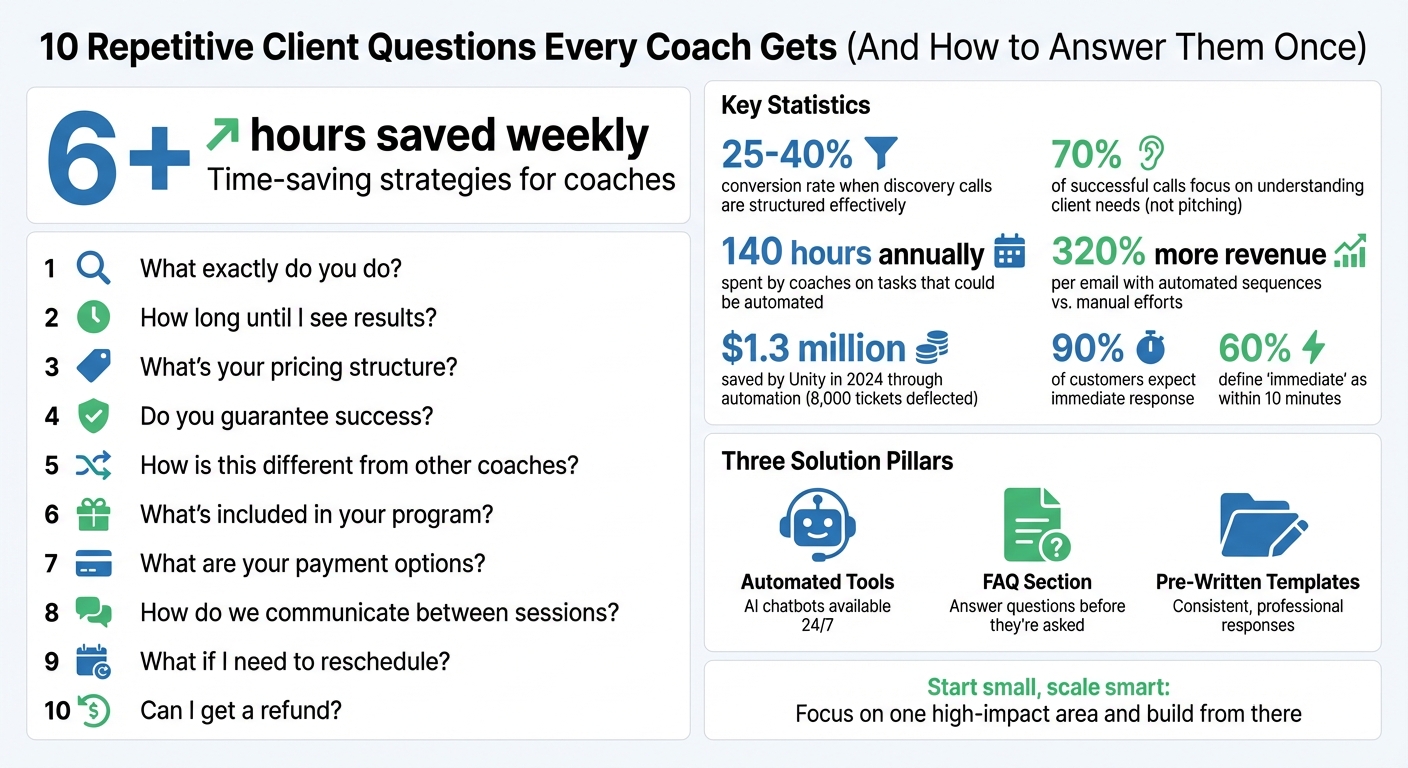
These common questions reveal what potential clients care about most: the value you provide, the cost, and whether your services align with their goals. Structuring discovery calls to address these priorities can lead to conversion rates of 25–40% when done effectively [5]. Interestingly, the most successful calls dedicate about 70% of the time to understanding the client’s needs, rather than simply pitching services [5].
Here’s a breakdown of some of the most frequently asked questions, along with strategies to answer them efficiently.
Question 1: What Exactly Do You Do?
Potential clients are less interested in the logistics of your sessions and more focused on the transformation you can deliver. To answer this, focus on the outcomes you help clients achieve. For example, instead of saying, "I offer 12 weekly sessions", say, "I help mid-level managers transition into executive leadership roles within six months." This approach makes it clear whether your services align with their goals [9].
"Hourly billing treats expertise like a commodity, measured by the clock rather than transformation created." – Coachvox AI [9]
AI tools can help streamline this process. For instance, an AI assistant on your website can share your core value proposition and pre-qualify leads, even outside of business hours [7][8].
Question 2: How Long Until I See Results?
When answering this question, break down the timeline into immediate, short-term, and long-term outcomes. For example, clients might notice psychological shifts, such as increased confidence and clarity, within a few weeks. More tangible results, like promotions or business growth, typically take several months [5][1]. A clear response might be: "Most clients gain clarity and actionable strategies in the first month, with major milestones reached within 3–6 months."
To make progress even more transparent, tools like Brandbase can provide real-time updates, showing clients exactly how they’re tracking toward their goals [6]. This shifts the conversation from vague timelines to measurable milestones.
Question 3: What's Your Pricing Structure?
Pricing is often a make-or-break factor for prospects. Be transparent and frame your fees around the transformation you offer. Instead of quoting an hourly rate like "$500 per session", present value-driven packages such as "Leadership Transition System: $6,000 for a complete career repositioning program" [9].
For accessibility, many coaches offer payment plans tied to program milestones [1]. High-ticket programs (over $3,000) often include free discovery calls, while lower-priced options may charge a consultation fee of $100–$250 to ensure prospects are serious [5]. Embedding a comparison table in your FAQ or AI assistant responses can make pricing clear and easy to understand.
Question 4: Do You Guarantee Success?
This question is tricky because success depends on the client’s effort and circumstances. Be honest: no coach can guarantee results. Instead, emphasize the collaborative nature of the process. For example, say:
"I provide proven frameworks and my full expertise, but your success depends on your commitment. Clients who fully engage with the program often see significant progress toward their goals."
This approach filters out those looking for quick fixes and attracts clients ready to invest in their own growth.
Question 5: How Is This Different from Other Coaches?
With so many options available, prospects want to know why they should choose you. Avoid vague claims like being "better" or "more experienced." Instead, highlight the specific aspects of your approach that directly address their needs. For instance:
"I use a strategic intake process to map out your challenges and goals before we even start. From there, I create a customized roadmap with exercises tailored to your unique situation" [1][5].
By focusing on your personalized methods and adaptability, you can demonstrate how your coaching aligns with their specific goals and learning style.
Answering these questions effectively not only builds trust but also reduces the time spent on repetitive administrative tasks, allowing you to focus on delivering impactful coaching.
How to Answer Questions Efficiently
Answering the same questions over and over can drain your time and energy. The key isn't to work harder - it's to create systems that can handle these inquiries for you. By combining automated tools, a detailed FAQ section, and ready-to-use templates, you can cut down on repetitive tasks while still delivering the personal touch your clients value.
Using Automated Tools
AI chatbots are a game-changer for answering common questions 24/7. Tools like Brandbase's AI assistant can be customized to reflect your coaching methods, pricing details, and onboarding process, delivering accurate responses instantly. A real-world example? In 2024, Unity implemented automation and managed to deflect nearly 8,000 support tickets, saving around $1.3 million in operational costs [12].
To get the most out of automation, feed your AI with reliable content - think email drafts, proposals, and onboarding documents. This ensures the AI mirrors your expertise and tone instead of sounding generic [2]. During setup, configure automated email responses to "Create Draft" rather than "Send Email." This way, you can review and tweak the message for tone and accuracy before it goes out [11].
Automation works best when paired with a well-thought-out FAQ section, which we'll dive into next.
Building an FAQ Section
An FAQ section is your front line for answering questions before they even land in your inbox. To create one, comb through past emails, call notes, and support tickets to identify the most frequent questions [13][2]. Organize these into clear categories like "Pricing & Billing", "Coaching Process", and "Policies", making it easy for users to find what they need [1][14].
For layout, an accordion-style design - where questions expand or collapse - keeps the page clean and user-friendly [1][15]. Write answers in a conversational tone, using simple, everyday language rather than corporate jargon. Aim for answers to be 40 to 60 words long, as this length tends to perform well in Google's featured snippets [15].
"Having an FAQ page is a way to be more proactive and predictive with what your customers or clients are going to need help with. It's also an opportunity to point people in the direction you want them to go." – Maddie Hoffman, Director of Self-Service and Automation, Zendesk [12]
Make your FAQ section easy to find. Add links to it in your website's footer, main navigation menu, and even your email signature [12][14]. For complex topics, consider including short video explanations - 72% of customers prefer learning through video over text [13].
When used alongside automation, a strong FAQ section can take your client communication to the next level.
Creating Pre-Written Templates
Pre-written templates are another way to save time while keeping your communication polished and consistent. Templates work particularly well for common scenarios, like answering pricing questions or addressing scheduling conflicts. Use placeholders (e.g., [Client Name], [Specific Goal]) to make them adaptable [16][18]. Keep sentences short - under 25 words - and avoid passive voice for clarity [17].
Store these templates in a shared document or use text expansion tools to speed up responses. For example, typing "csship" could trigger a full response about shipping delays [16]. To keep things personal, customize at least the opening and closing lines of each template so it doesn’t feel like a generic copy-paste.
Quick responses matter - 90% of customers expect an immediate reply, and 60% define "immediate" as within 10 minutes [16][17]. Templates help you meet these expectations without compromising quality. However, for sensitive issues like complaints or celebrations, skip the automation and respond manually to maintain that personal connection [4].
Sample Responses You Can Use
Clear and structured communication is key when addressing common coaching questions. Below are three examples that highlight how to respond with clarity and professionalism. Each response leverages Brandbase's tools - like automated email triggers, personalization tokens, and AI-driven analytics - to deliver timely, consistent answers while maintaining a human touch.
Example: Answering Pricing Questions with Transparency
When potential clients ask about pricing, they’re essentially asking, “Is this worth it?” Your reply should be direct, outlining package details and next steps. Automated email triggers can help by instantly sending a pricing guide after a discovery call or inquiry.
Sample Response:
"Hi [Client Name],
Thank you for reaching out about pricing. I offer two coaching packages tailored to different needs and budgets:
| Feature | Basic Package | Premium Package |
|---|---|---|
| Sessions | 5 One-on-One Sessions | 12 One-on-One Sessions |
| Support | Email Support | Voxer & Email Support |
| Resources | Personalized Plan | Plan + Video Recordings |
| Price | $2,500 | $6,000 |
| Payment Plan | Not Available | 3 Installments |
Payments can be made via credit card, PayPal, or bank transfer. For the Premium Package, you have the option to split payments into three installments aligned with key milestones in the program.
Next Step: Ready to get started? [Book your first session here] or reply if you have any questions.
Best,
[Your Name]"
By using personalization tokens like [Client Name] and [Package Name], you can make automated responses feel individualized. Now let’s look at how to address questions about timelines.
Example: Setting Realistic Expectations for Results
When clients ask, “How long until I see results?” they’re seeking trust and predictability. Your response should be honest and collaborative, emphasizing that results require effort from both sides. AI tools can help ensure this message is delivered consistently.
Sample Response:
"Hi [Client Name],
That’s a great question! Results depend on a few factors: your starting point, the time you can dedicate, and how actively you apply what we work on together. Most clients start noticing measurable progress within 4 to 6 weeks, but the real transformation happens with consistent effort throughout the program.
Here’s a general timeline:
Week 1: We’ll define your goals and create a personalized plan during our clarity call.
Weeks 2-6: You’ll implement actionable strategies, and we’ll track your progress using analytics tools.
Weeks 7-12: We’ll refine what’s working and celebrate your wins.
I’m here to guide you every step of the way, but your commitment is just as important as mine. If something isn’t working, we’ll adjust the plan together.
Important: I don’t offer refunds once we start, so let’s ensure this is the right fit before moving forward.
Let me know if you’d like to schedule a quick call to discuss your specific goals!
Best,
[Your Name]"
Automated onboarding sequences can send this response immediately after a purchase, complete with intake forms and communication guidelines. This sets clear expectations and helps establish a professional relationship from the start. Now, let’s explore how to articulate your value proposition effectively.
Example: Explaining Your Value Proposition
When clients ask, “How are you different from other coaches?” they want to know why you’re worth their time and investment. Your answer should highlight your unique approach, focus on outcomes, and show how Brandbase’s tools amplify your work.
Sample Response:
"Hi [Client Name],
What makes me different is how I combine personalized coaching with data-driven insights. While many coaches rely on intuition alone, I use Brandbase’s AI-powered analytics to track your progress in real time and identify patterns that help us fine-tune your plan as we go.
Here’s what you can expect:
Your Expertise Meets AI: I use AI to handle repetitive tasks like scheduling and progress tracking, so we can focus on strategic work that drives real change.
Clear, Measurable Outcomes: Each session is tied to a specific goal, and we’ll use reporting tools to track your progress. No vague promises - just actionable steps and tangible results.
24/7 Support: My AI assistant is available anytime to answer your questions, drawing on insights from past sessions and success stories. It’s like having me in your pocket.
"You are the expert. Let AI be the echo." – June Aye, Intergreat AI [2]
Next Step: Let’s schedule a 15-minute call to see if this approach aligns with your goals. [Book here].
Best,
[Your Name]"
On average, coaches spend about 140 hours annually on tasks that could be automated. Tools like Brandbase free up your time so you can focus on what you do best: coaching [10].
Store these templates in Brandbase’s knowledge base so your AI assistant can access them for similar inquiries. This ensures consistent, high-quality responses every time. These templates not only save time but also help build trust as you refine your strategy and strengthen your personal brand.
Conclusion
Streamlining how you handle responses can completely change both your workflow and how clients experience your services. Instead of spending hours answering the same questions, try using reusable responses, an FAQ section, or even AI tools. These strategies could save you over six hours every week [2].
Consistency is the secret ingredient here. By ensuring every client gets the same accurate, high-quality information - whether it's about your pricing, timelines, or coaching methods - you build trust and reliability right from the start.
Here’s a compelling stat: automated email sequences generate 320% more revenue per email compared to manual efforts [3]. These techniques are perfect for coaches who want to maintain meaningful, consistent interactions without sacrificing their time.
Start small - focus on a high-impact area like onboarding or pricing questions. Then, develop your system with well-documented responses and personalization tokens to handle repetitive tasks automatically.
Your time and expertise are far too valuable to spend on routine tasks. Put these strategies into action today to create better client connections and reclaim your schedule.
Related Blog Posts

Blog title heading will go here
Blog title heading will go here