

9 Things That Make a Coaching Brand Look Legit Online in 2026

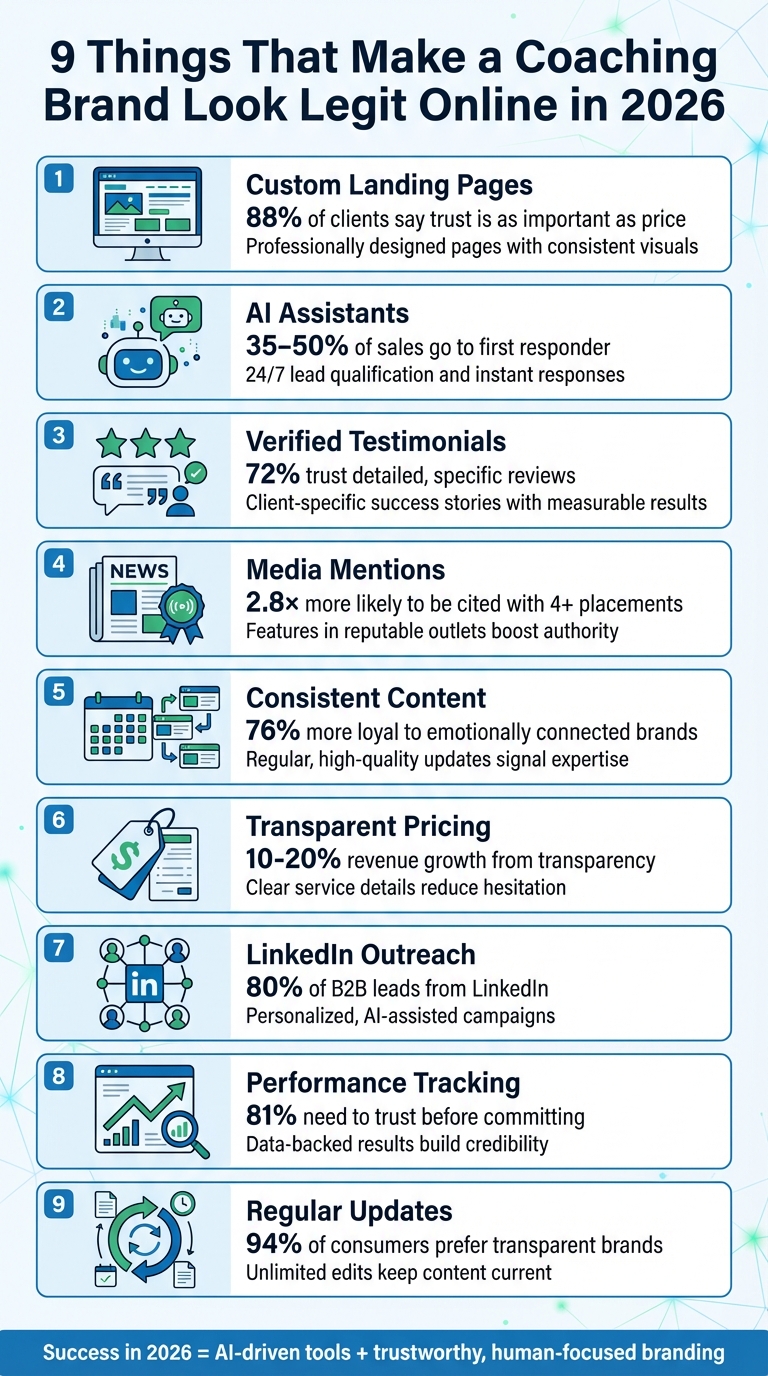
In 2026, building trust online is critical for coaching brands to stand out in a crowded market. With AI tools influencing how clients discover services, your brand must establish credibility quickly. Here’s how:
- Custom Landing Pages: Professionally designed pages with consistent visuals and advanced AI tools create strong first impressions.
- AI Assistants: Chatbots qualify leads 24/7, improving response speed and reducing time spent on unqualified prospects.
- Verified Testimonials: Detailed, client-specific success stories build trust and resonate with potential clients.
- Media Mentions: Appearances in reputable outlets enhance authority and visibility, both for humans and AI systems.
- Consistent Content: Regular, high-quality updates signal expertise and keep your brand relevant.
- Transparent Pricing: Clear service details and pricing reduce hesitation and simplify decision-making.
- LinkedIn Outreach: Personalized, AI-assisted campaigns boost engagement and connection quality.
- Performance Tracking: Analytics tools show measurable results, reinforcing your credibility.
- Regular Updates: Unlimited edits and visible update policies keep your content current and trustworthy.
Takeaway: Success in 2026 requires blending AI-driven tools with clear, trustworthy, and human-focused branding. Each element works together to build a professional, reliable presence that attracts and retains clients.
9 Essential Elements That Make Coaching Brands Look Legitimate Online in 2026
How To Build A Legit Coaching Business (Works in 2026)!
sbb-itb-f7e72a6
1. Custom Professional Landing Pages
A well-crafted landing page is the cornerstone of an AI-powered personal branding strategy. It’s your first chance to make an impression, and potential clients form opinions about your expertise within seconds. A custom-designed page sends a clear message: you're offering premium, credible services [1]. This isn’t just about aesthetics. 88% of potential clients say trust is as important as price or quality when selecting a coach [2], and visual design plays a crucial role in forming those first impressions [3].
Consistency in visuals is one of the quickest ways to establish trust. When your site uses uniform colors, typography, and imagery, it creates a cohesive experience that makes clients more comfortable investing in high-value services [4]. On the flip side, a poorly designed site can make you appear unreliable [7]. Sosai Studio sums it up perfectly:
"If your visual identity does not match the quality of your work, your business will keep paying the price." [1]
Integration of Advanced Technology (e.g., AI Tools)
Once you've built trust, integrating advanced tools can elevate your digital presence even further. By 2026, AI technology is transforming how landing pages are created. Platforms like AttractWell use "Build It For Me" tools to craft custom pages based on your brand story, tone, and audience insights [9]. These AI-driven builders ensure your brand elements are seamlessly integrated, providing a polished look right out of the gate [9].
Savvy professionals use AI to handle the heavy lifting - going from a blank canvas to a nearly finished page - then fine-tune details like headlines and calls to action themselves [9]. For added functionality, you can incorporate AI assistants or digital twins (such as BuddyPro or Rocky.ai) directly into your page. These tools, trained on your unique expertise, offer visitors 24/7 personalized support, even when you’re unavailable [8][10].
By combining personalization with cutting-edge technology, your landing page can make every visitor feel seen and understood.
Personalization and Client-Focused Approach
Generic landing pages won’t cut it anymore. In 2026, personalization is all about creating a sense of connection - making visitors feel like your services are tailored specifically for their needs [6]. This means using niche-specific language, like "burnout recovery for healthcare founders", instead of broad, generic promises.
The most effective pages focus on the client, shifting the narrative from "Look at what I can do" to "Here’s how I can help you" [3]. They also include trust-building elements like case studies, verified testimonials, and measurable achievements to ease any doubts potential clients might have [5][3]. Founder-led storytelling adds another layer of authenticity. As Reasonate Studio explains:
"Founder-led storytelling creates trust faster than any paid advertising campaign because it reveals the human behind the brand." [4]
Clear Service Offerings
Clarity is key in 2026. A well-structured services page with transparent pricing and package details helps potential clients determine if you’re the right fit, cutting down on hesitation and speeding up the decision-making process [4]. When visitors know exactly what you offer and how much it costs, it builds trust and simplifies their journey.
Make sure critical information is accessible within three clicks [4]. Your page should also load quickly and function flawlessly on mobile devices, as more than half of web traffic now comes from mobile [4]. Every design choice and technological feature should work together to create a seamless, AI-driven experience that sets you apart in the competitive coaching landscape.
2. AI Assistants for Lead Qualification
Integration of Advanced Technology (e.g., AI Tools)
AI chatbots have revolutionized how coaching brands handle lead generation. Available around the clock, they ensure potential clients are engaged no matter the time. Ruben Buijs, Founder of Boei, sums it up perfectly:
"AI chatbots have become the #1 lead generation tool for coaching businesses in 2026. Why? Because they work around the clock, instantly responding to potential customers the moment they land on your website." [12]
Speed is critical in sales. 35-50% of sales go to the vendor that responds to a lead first [12], and AI ensures those responses happen within seconds. These assistants do more than just chat - they ask specific questions about budgets, readiness, and commitment levels before scheduling calls. As a result, the time spent on unqualified leads drops dramatically, from as much as 15 hours to just 1-2 hours per week [14].
Personalization and Client-Focused Approach
Beyond constant availability, AI assistants excel at creating personalized experiences for potential clients. For example, AI-powered quizzes adjust their questions based on a prospect's previous answers. High-intent leads are directed straight to your booking calendar, while others might be invited to join email lists or group programs [14]. This tailored approach significantly boosts discovery call conversion rates, increasing them from 15-25% to 45-65% when paired with AI qualification tools. Plus, the data gathered during these interactions helps you prepare for more meaningful conversations [14].
When a prospect schedules a call, you'll already know their challenges, business stage, and goals. This preparation fosters immediate trust. As Marcus Chen, AI Automation Strategist, explains:
"AI-generated quizzes ask thoughtful, personalized questions that adapt based on previous answers. Prospects feel heard and understood." [14]
Such interactions not only strengthen client relationships but also enhance your brand’s reputation.
Credibility and Trust
AI assistants also play a key role in building credibility by ensuring the right fit. By clearly defining who you can and cannot help, you establish trust with potential clients. At the same time, AI reduces operational costs while improving response quality. For instance, AI chatbots can cut customer service costs by up to 30% while delivering more effective answers [12].
For coaching brands, this translates into more time spent on high-impact work with clients and less time handling repetitive inquiries about availability or frameworks. By filtering out unqualified leads, AI-driven systems not only save time but also solidify your reputation as a professional who values both your time and your clients' needs.
3. Verified Testimonials and Client Success Stories
Credibility and Trust
Once you've set up strong landing pages and AI-powered lead tools, the next step is showcasing authentic testimonials. These aren't just add-ons - they're the backbone of trust that can make or break whether a prospect sticks around or clicks away [15]. But here's the thing: generic, overly polished endorsements don’t cut it anymore. People can spot insincerity from a mile away.
What resonates now are testimonials that dive into the real journey - what challenges a client faced, how they overcame them, and the measurable results they achieved. Think of these as your "proof of delivery." When testimonials address the core question in every prospect's mind - "Will this work for someone like me?" - you'll see a noticeable boost in conversions. In fact, 72% of clients say they trust a coach more when the reviews are detailed and specific [3]. By crafting testimonials that appeal to both human emotions and AI algorithms, you create a seamless blend of trust and innovation.
Integration of Advanced Technology (e.g., AI Tools)
AI tools like ChatGPT and Perplexity are becoming critical gatekeepers between you and potential clients. These systems rely on testimonials as authority signals to determine which coaches or services to recommend [2]. If your testimonials lack specifics - like measurable outcomes or clear success stories - AI assistants might skip over your brand entirely. And with 24% of people already using AI shopping assistants to find services, this could be a missed opportunity [2].
To stay ahead, many coaches are turning to Generative Engine Optimization (GEO). This involves structuring testimonials with clear language and schema markup so AI can easily identify and reference them. Tools like Profound, AthenaHQ, and Evertune can help track how often your brand appears in AI-driven results and whether the sentiment aligns with your actual client outcomes [2]. Platforms like Testimonial.io and VideoAsk also make collecting video or audio testimonials simple, and these formats often carry more weight than plain text [3]. By optimizing your testimonials for AI discoverability, you ensure your brand remains visible in this evolving digital landscape.
Personalization and Client-Focused Approach
While technology ensures your testimonials are seen, personalization makes them relatable. Prospects need to see themselves in the stories you share. A great way to do this is by categorizing your testimonials based on specific client pain points - like "Busy Schedule", "Emotional Eating", or "Self-Doubt" - so visitors can immediately connect with experiences that mirror their own [15].
The most effective testimonials are concise but detailed. They highlight the client's struggle, the method that brought change, the results achieved, and even a helpful tip at the end [15]. For example, instead of a vague statement like "I lost weight", a stronger testimonial would say, "Using the meal-prep template saved me 5 hours a week and helped me lose 22 pounds in 3 months." This focus on the "how" is what builds trust.
Interestingly, testimonials that acknowledge challenges - like hitting a "mid-program slump" - often feel more authentic and trustworthy. Stories that show how clients overcame obstacles resonate deeply, and 76% of consumers say they feel more loyal to brands they connect with emotionally [2]. To keep these stories flowing, ask clients one simple question at the end of each session: "What's one thing that's easier this week?" This approach captures fresh, emotional insights that can fuel your testimonial library [15]. Combined with advanced landing pages and AI tools, these personalized success stories create a well-rounded, trust-driven strategy for your brand.
4. Media Placements and PR Mentions
Credibility and Trust
Media placements can instantly boost your credibility, especially when offering high-value services or products [16]. Seeing "As Seen In" logos from outlets like Forbes, Entrepreneur, or niche industry journals on your website reassures potential clients and reduces hesitation. This is crucial, as 88% of potential clients say trust in a brand is just as important as price or quality when making a decision [2].
"Your first media placement is not just a win - it is infrastructure. Each piece you publish increases the probability that the next opportunity finds you." - Vivek Sharma, Founder & CEO, TS Newswire [16]
Even one guest post or feature can act as social proof, paving the way for podcast invites, speaking opportunities, and higher-level media features. Each placement compounds your reputation, building trust not only with human audiences but also with AI-driven systems.
Integration of Advanced Technology
AI models like ChatGPT and Claude rely heavily on media mentions as part of their pre-trained data, known as parametric knowledge, to generate responses. Around 60% of ChatGPT's answers are drawn solely from pre-trained data [17]. Being featured on four or more platforms can increase your chances of being cited in ChatGPT responses by 2.8×. Additionally, with Wikipedia contributing approximately 22% of training data for major language models, consistent media coverage can eventually elevate your brand's visibility [17].
To measure the impact of media placements, tools like Profound (starting at $400+/month), LLMrefs ($50–$400/month), and Otterly.AI ($30–$50/month) can help track AI-driven mentions. Including verifiable statistics and direct quotations in your media appearances can further enhance AI visibility by 22% and 37%, respectively [17]. These insights not only strengthen your presence but also create a narrative that connects with your audience on a deeper level.
Personalization and Client-Focused Approach
While leveraging technology is key, crafting a PR narrative that feels personal and client-centered is just as important. Journalists are drawn to authentic, engaging stories. Focus on pitching unique insights, tying your expertise to current trends, or sharing data-backed narratives to quickly capture their interest [16].
When reaching out to media outlets, consider angles like:
- Trend Tie-Ins: Linking your expertise to timely news or industry shifts.
- Counterintuitive Takes: Offering a fresh perspective that challenges conventional wisdom.
- Data-Backed Insights: Using real-world results or client data to support your claims.
For instance, instead of saying, "I’m a leadership coach with 10 years of experience", you might pitch, "Why the 'authentic leadership' trend is actually making executives less effective - and what works instead."
Don’t underestimate the value of niche publications. While a feature in Forbes builds broad credibility, a piece in a specialized journal - whether focused on healthcare leadership or finance - can attract higher-quality leads because the audience aligns closely with your target market [16]. If you appear on podcasts, make sure to publish full transcripts. AI systems can extract and cite text, but they struggle to reference raw audio effectively [17].
5. Consistent High-Quality Content
Credibility and Trust
Publishing content regularly shows that you're actively engaged and committed to your field. An outdated digital presence can make potential clients question whether you're still in business[3]. Maintaining a consistent online presence not only builds trust but also drives conversions[2].
High-quality content isn't just about filling up your website - it's an opportunity to demonstrate your expertise and highlight your coaching approach. Sharing real, relatable stories, including your struggles and setbacks, helps humanize your brand in ways traditional advertising can't. Emotional connections matter, and 76% of consumers are more loyal to brands they feel connected to on a personal level[2]. To strengthen this connection, consider using technology to enhance your unique voice and storytelling.
Integration of Advanced Technology
By 2026, your content will need to serve both people and AI systems. With 24% of users relying on AI tools like ChatGPT and Perplexity to guide their purchases[2], it's essential to ensure these tools can interpret and recommend your services correctly. Using clear language and structured data, such as schema markup, will help AI understand your content. Tools like Jasper AI and Claude can assist in maintaining your brand's voice[25, 13].
"AI can hold the structure so you can hold the soul... Used well, AI gives us time back, not heart away." - Lori Young, Certified Business Coach and Offer Strategist[6]
Voice-to-text plugins make it easier to create content naturally, while AI meeting assistants can summarize client insights for personalized follow-ups[9, 13]. This combination of AI-friendly structure and authentic storytelling strengthens your digital presence. Remember, AI should amplify your efforts, not replace them - you bring the strategy and personality, while AI takes care of repetitive tasks[6]. By leveraging technology this way, your content can both inform and resonate with your audience.
Personalization and Client-Focused Approach
Generic messages about "transformation" no longer hit home. Your content needs to address specific challenges like burnout, loneliness, and inconsistent habits. Using clear frameworks, case studies, and proven strategies helps establish your credibility. Clients want actionable, evidence-based solutions[5].
"If you stopped creating for the algorithm and started creating for truth, what would you share?" - Lori Young, Certified Business Coach and Offer Strategist[6]
As mentioned earlier, genuine storytelling builds trust. Your content strategy should tackle recurring client pain points - focus on ten key challenges to ensure your content remains relevant and valuable[5]. Develop pillar articles that showcase your frameworks to establish yourself as a thought leader. Additionally, use milestone testimonials as powerful trust-building tools for prospects facing similar obstacles. Transparency matters - 94% of consumers are loyal to brands that prioritize honesty, which means raw, authentic storytelling often outshines overly polished content[2, 7].
6. Clear Pricing and Plan Comparisons
Credibility and Trust
Hiding your pricing details can create unnecessary friction. By 2026, the era of "easy trust" is over - clients demand clear ROI and often compare multiple options before making a decision [5]. Displaying transparent pricing and detailed service packages on your website allows prospects to self-qualify, reducing hesitation and making the buying process smoother [4].
In fact, a large number of clients see transparency in pricing as key to building trust. Companies that consistently provide clear pricing and service descriptions across all touchpoints have reported revenue growth ranging from 10% to 20% [2]. Transparency isn't just about doing the right thing - it's also a smart business move.
"In a noisy market, trust compounds faster than charisma." - Safwan Azeem, ANHCO [5]
Clear Service Offerings
Vague or generic coaching packages no longer meet the expectations of today's clients. Your pricing should focus on the specific outcomes you deliver rather than simply charging by the hour. Transitioning to value-based pricing - where fees are tied to the results you provide - positions you as a results-driven professional rather than someone selling time [5][11].
Using comparison tables is a great way to help potential clients identify the plan that suits their needs. Clearly outline the features of each tier, such as asynchronous communication, access to resource libraries, online portals, or one-on-one coaching sessions. This level of detail sets you apart from competitors offering only generic services [5]. Address pricing concerns head-on by adding an ROI section to your sales page. This section can detail the structured value you provide and highlight the potential return on investment [5]. Additionally, leveraging advanced technology can ensure your pricing and service details are both compelling and optimized for AI systems.
Integration of Advanced Technology
AI shopping assistants are reshaping how people discover and select coaches. Currently, 24% of clients use tools like ChatGPT or Perplexity to guide their purchasing decisions [2]. If your pricing and service comparisons aren't easily readable by these AI tools, you risk being overlooked by a growing segment of buyers.
To stay visible, implement structured data and schema markup (such as Organization, FAQ, and Product schema) so AI systems can easily interpret your service tiers and pricing [18][2]. AI tools also favor pricing pages that display freshness, such as last-updated dates, when summarizing search results [18]. Regular updates to your pricing page ensure that AI tools recommend your services accurately. By maintaining clarity and up-to-date information, you not only build trust but also strengthen your position in a competitive, AI-driven marketplace.
7. Personalized LinkedIn Outreach Campaigns
Using AI to personalize your LinkedIn outreach is a smart way to strengthen your digital branding efforts. It complements elements like custom landing pages, verified testimonials, and transparent service details, all of which help establish trust.
Integration of Advanced Technology
LinkedIn accounts for around 80% of all B2B leads from social media, making it the go-to platform for coaching brands to engage with potential clients [20]. However, generic outreach doesn’t cut it anymore. By 2026, the most effective strategy involves an "AI-Drafted, Human-Refined" workflow. Here’s how it works: AI scans prospect profiles and drafts highly tailored messages. You then step in to approve or tweak these drafts, ensuring they feel authentic and personal [19].
These AI tools can even learn your communication style by analyzing your past messages and posts [19]. They track behavioral triggers, like when someone views your profile multiple times or comments on your posts, and use this data to send timely, relevant messages [19]. This approach lets you scale outreach efforts without losing the personal touch that builds trust.
Once AI handles the groundwork, your role is to add a layer of genuine personalization to make your outreach truly impactful.
Personalization and Client-Focused Approach
AI tools are just the starting point. To make a real connection, you need to personalize your messages. Generic greetings won’t get you far. Instead, AI can help by analyzing a prospect’s profile, recent activity, and work history to craft thoughtful openers. For instance, instead of a bland "Hi there", your message might say, "I saw your post on scaling group coaching. Your point about client retention really stood out to me" [19].
A simple yet effective three-step sequence works best: start by sharing something valuable, follow up with a low-effort question, and then invite the prospect to a deeper conversation [20]. This value-first approach respects their time while positioning you as a helpful resource. It's a way to show that personal, thoughtful outreach can build trust just as much as clearly defined service offerings.
Credibility and Trust
Your tailored messages will only go so far if your LinkedIn profile doesn’t back them up. To maximize credibility, optimize your profile to reflect authenticity and value. For example, your headline should focus on specific outcomes, like "I help executives reclaim 10 hours a week", rather than simply stating your job title [20]. This type of clarity helps prospects quickly understand your value and decide if they want to connect with you.
Keep in mind LinkedIn’s 2026 limit of 100 connection requests per week [20]. A good daily pace is 15 to 20 connection requests and 20 to 30 direct messages [20]. If you’re using automation tools, configure them to pause immediately when someone replies [19][20]. This balance of efficiency and authenticity ensures you’re building genuine relationships, not spamming strangers. It’s about using technology to enhance, not replace, human connection.
8. Built-In Analytics and Performance Tracking
Integration of Advanced Technology
Analytics now play a key role in measuring AI visibility and brand recognition. By 2026, coaching brands will need to monitor how often AI assistants like ChatGPT and Gemini mention their names when users search for coaching recommendations. Tools such as Profound, AthenaHQ, and Evertune are designed to track these AI citations, offering a clear view of how your brand is perceived within the AI ecosystem [2][18]. Staying visible in these AI-driven spaces is critical for ensuring potential clients can find you.
Modern coaching platforms also leverage AI to analyze client engagement during sessions. They track patterns like habit formation and goal achievement while providing automated session summaries and tailored follow-up suggestions based on conversational data [13]. These insights not only enhance your visibility but also help establish trust with clients by delivering measurable outcomes.
Credibility and Trust
Data-backed results are essential for building trust. With 81% of customers stating they need to trust a business before committing [3], showcasing measurable outcomes becomes a must. Built-in analytics allow you to present data-driven case studies, highlighting metrics like habit completion rates, goal achievement percentages, and engagement trends [13].
"In 2026, leading digital coaching platforms use AI to analyze engagement patterns and present meaningful progress data. This allows coaches to personalize sessions with precision and clearly demonstrate value." - CoachBase [13]
Additionally, monitoring AI sentiment ensures your brand is accurately represented. When someone asks an AI assistant about coaches in your niche, keeping an eye on how you're portrayed helps you address any inconsistencies or misalignments [2].
Personalization and Client-Focused Approach
Analytics not only validate your methods but also empower your clients. Real-time dashboards allow clients to track their habits, milestones, and engagement metrics in one private, user-friendly portal [13]. This transparency fosters accountability and keeps clients motivated between sessions.
Performance data also helps refine your strategy. By analyzing metrics like qualified lead percentages, you can assess whether your messaging attracts the right audience. Other indicators, such as win rates, average deal sizes, and sales cycle lengths, provide actionable insights to fine-tune your high-ticket offers for better results [2].
This combination of personalized dashboards and performance tracking strengthens your ability to deliver tailored, impactful coaching while optimizing your business for growth.
9. Unlimited Edits with Continuous Support
Credibility and Trust
Regular updates to your content do more than just keep things fresh - they solidify your brand's trustworthiness. Without consistent updates, your digital presence can quickly lose relevance. In fact, AI search systems deprioritize content that hasn't been refreshed in over three months [21]. Imagine launching a coaching website in January 2026 - by April, its visibility could already be slipping if left untouched. This is where unlimited edits and ongoing support come into play, keeping your brand relevant and authoritative.
Visible update policies are a game-changer for building trust. When visitors see a "last updated" date or a clear corrections policy, it signals that you're actively maintaining your content's accuracy and relevance. This transparency aligns with what 94% of consumers look for when choosing brands [2].
"Trust is the fastest-decaying E-E-A-T signal: one factual retraction handled badly undoes months of authority building. One corrections page, handled well, builds more trust than a dozen new backlinks." - Rohit Sharma, Technical SEO Specialist, IndexCraft [21]
Integration of Advanced Technology
Advanced tools like Profound, AthenaHQ, and Evertune play a crucial role in ensuring your updates are recognized by AI systems like ChatGPT and Perplexity [2]. For instance, if you tweak your coaching methodology or showcase new client successes, these updates will be seamlessly reflected across platforms. This ensures that AI assistants can access and recommend the latest version of your content.
Structured data, such as schema markup, is another critical piece of the puzzle. By implementing Article, HowTo, and FAQ schemas, you make your updates machine-readable, boosting AI selection by 73% [21]. This means your content isn’t just easier for AI to process - it also ensures that potential clients see the most up-to-date and relevant expertise when searching for services in your niche.
Personalization and Client-Focused Approach
Continuous support isn't just about keeping your content current; it’s about putting your clients first. Allowing clients to request updates at no extra cost creates a sense of value and strengthens emotional connections. This client-first approach can increase lifetime client value by an impressive 306% [2].
Beyond that, regular updates ensure consistency across all touchpoints - landing pages, LinkedIn profiles, email templates, and more. This alignment prevents confusion and reinforces your brand's positioning. Consistency across these channels has been shown to boost revenue by 10%-20% [2].
"Inconsistency dilutes your positioning. Consistency amplifies it." - Lori Young, Brand Positioning Strategist [2]
Pricing and Service Plan Comparison
Clear pricing is a cornerstone of building trust and credibility for your coaching brand. It's one of the nine key elements that can strengthen your online presence. In fact, transparency is a loyalty driver - 94% of consumers stick with brands that are upfront about their costs [2]. When potential clients visit your site, they should immediately understand what your services cost and what they’ll gain. No guessing games.
Leading coaching brands in 2026 often use a "Positioning Ladder" with three distinct tiers to cater to different client needs and budgets. Here's how it works:
- Tier 1 (Light Touch): Free resources, like toolkits or webinars, that introduce your approach without requiring a financial commitment.
- Tier 2 (Strategic Support): Group programs or workshops at accessible price points, designed for clients seeking actionable results.
- Tier 3 (Full Partnership): High-end, one-on-one coaching or intensive programs aimed at delivering complete transformation [2].
This tiered approach allows potential clients to choose based on their goals and financial readiness, while also minimizing the time you spend qualifying leads.
Service Plan Breakdown
To give you a better idea of how structured plans look, here's a comparison of three popular options:
| Plan | Monthly Price | Setup Fee | Key Features | Best For |
|---|---|---|---|---|
| Starter | $18 | $499 | Landing page transferred to your Webflow account | Coaches testing their offer |
| Essential | $99 | $499 | Landing page, AI assistant, hosting, analytics, unlimited edits, 1 PR placement every 6 months | Solo coaches building credibility |
| Pro | $499 | $499 | Everything in Essential, plus unlimited landing pages, LinkedIn campaigns, 6 PR placements bi-monthly, 9 SEO blog posts/month | Coaches scaling beyond referrals |
Aligning Costs with Results
When comparing service plans, it’s important to think about the timeline for results alongside the price. For example:
- A professional website, costing between $2,000 and $10,000, typically delivers SEO benefits within 3–6 months.
- Visual branding, ranging from $500 to $3,000, often starts showing results in just 1–2 months [4].
A smart approach is to prioritize your investments. Start with authentic storytelling to build your brand's voice, then work on visual consistency, and finally, establish a robust digital presence [4].
"The clearest brand wins, not the loudest." - Lori Young, Brand Positioning Strategist, On A Mission Brands [2]
Conclusion
Building a coaching brand for 2026 combines advanced AI tools with a genuine human approach. AI and data analytics form the backbone, while high-quality content and personalized outreach bring the brand to life, creating a well-rounded client experience [6].
When potential clients evaluate your services, they often engage with at least three touchpoints before making a decision [2]. For instance, a polished landing page won’t compensate for an inconsistent LinkedIn presence, and verified testimonials won’t outweigh unclear pricing. These inconsistencies can create subtle doubts that hurt conversions. On the flip side, brands that maintain uniformity across platforms can boost revenue by 10% to 20% [2].
The competition is intense. With the coaching market expected to exceed $6 billion by 2026 [6], standing out takes more than expertise. It requires clear positioning, transparent pricing, and results clients can measure.
To succeed, define your niche and unique offer. Use authentic storytelling, maintain visual consistency, and invest in digital tools as you grow [4]. Emotionally connected clients are 306% more valuable over their lifetime [2], so every aspect of your brand should address both logical needs (like clear pricing and proven results) and emotional ones (like compelling stories and personalized communication).
The coaching brands that will thrive in 2026 are those that are clear, consistent, and trustworthy. By following these strategies, you can stand out in the crowded market and build lasting trust with your clients.
FAQs
What should I fix first to look more legit online?
To make your website stand out, focus on presenting a polished and user-friendly experience. Start by refining your messaging - ensure it clearly communicates your brand's purpose and values. Pair this with strong calls to action that guide visitors toward taking the next step, whether that's making a purchase, signing up, or contacting you. A well-designed, professional website not only grabs attention but also helps build trust and credibility with your audience.
How can I use AI without sounding fake?
To integrate AI into your coaching in a way that feels natural and genuine, focus on personalization, honesty, and balance. Start by training AI tools to reflect your unique coaching style and methodologies, ensuring that their responses align with the tone and approach your clients expect from you.
Be open about incorporating AI into your process - clients value transparency. Make it clear that while AI can assist, your expertise and judgment remain at the core of your coaching.
Leverage AI to handle repetitive or time-consuming tasks, such as scheduling or summarizing notes. This frees up your energy for what truly matters: connecting with your clients on a deeper level, offering empathetic support, and building trust through meaningful interactions.
What proof builds trust fastest for coaches in 2026?
The quickest way for coaches to earn trust in 2026 is by emphasizing integrity, credibility, and delivering clear, measurable results. These qualities highlight a dependable approach that draws in the right clients and builds trust rapidly. By showcasing proven successes and maintaining a professional demeanor, you can create a solid trust-based relationship with your audience.
Related Blog Posts

Blog title heading will go here
Blog title heading will go here