5 Ways Coaches Are Scaling Beyond 1:1 Sessions (Without Launching a Course)
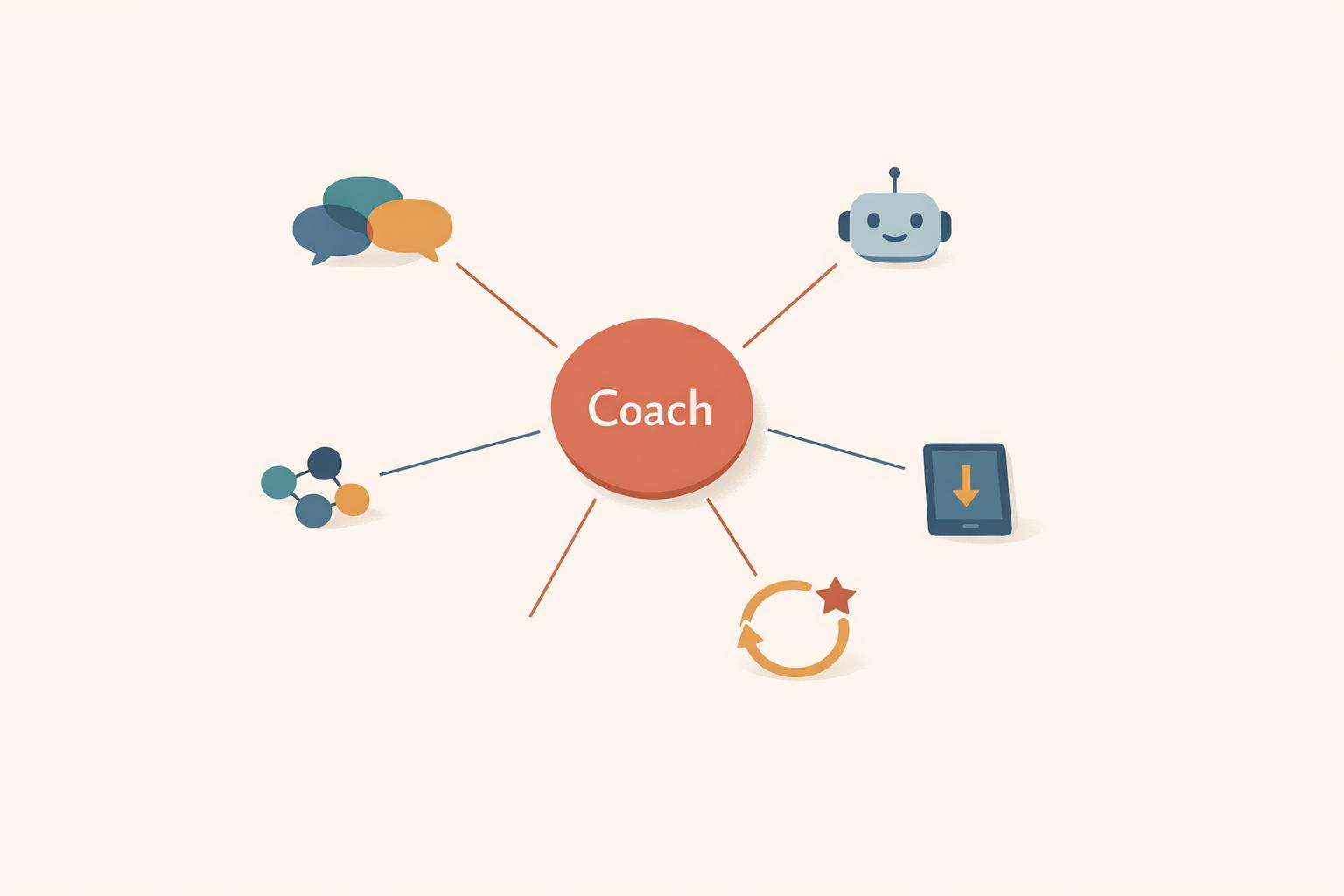
If you're a coach, scaling your business beyond time-consuming one-on-one sessions is possible without creating a full course. Here are five proven strategies to help you grow your income and impact:
- Group Coaching: Serve multiple clients simultaneously, reducing hours while maintaining or increasing revenue.
- AI Tools: Automate tasks like scheduling and client follow-ups, saving time and enhancing engagement.
- Digital Products: Sell templates, guides, or other resources that generate passive income.
- Subscription Models: Offer ongoing access to your expertise through memberships, creating consistent monthly revenue.
- LinkedIn Outreach: Build a strong digital presence to attract leads and convert them into paying clients.
These methods allow you to scale effectively, save time, and provide value without losing the personal touch. Let’s explore how each can work for you.
The Secret to Building a Scalable Coaching Business
sbb-itb-f7e72a6
1. Group Coaching Models
Group coaching offers a way to expand your reach and make a bigger impact with less time. Imagine this: instead of spending hours on individual sessions, you work with 15 clients in the same amount of time it takes for one 1:1 session. This approach not only saves time but also boosts your earning potential. For example, a coach conducting six 1:1 sessions per month at $750 each earns $4,500 while working 48 hours. Shift to a group model with 15 clients paying $300 each, and you still earn $4,500 - but in just 12 hours. That’s an hourly rate increase from $93 to $375 [5].
Scalability Potential
Switching to group coaching can cut your hours by 75% while maintaining the same revenue [5]. Start small with 8–10 participants to create an intimate and engaging environment. Once you're comfortable, you can scale up to 12–20 participants or even larger groups. Some coaches manage groups of 100+ by blending self-paced materials with live sessions [5][10].
Client Engagement and Outcomes
Group sessions bring benefits that 1:1 coaching simply can't replicate. Peer accountability and diverse viewpoints help clients grow in unique ways. In one workplace coaching study, participants in group settings scored 48% higher on knowledge tests than those in individual sessions [5]. Clients gain fresh perspectives, feel less isolated in their challenges, and often motivate each other to achieve more than they might individually.
"Scaling coaching doesn't mean watering it down. It means being intentional about how people engage, learn, and grow together." – Stephanie Licata, Senior Learning Strategist, Cloverleaf [7]
Ease of Implementation
Transitioning to group coaching doesn’t have to be overwhelming. Review your 1:1 session notes to identify common themes and questions, then create an 8–12 week curriculum [5][2]. Start with a pilot group of 8–10 participants at a discounted "founding member" rate to test your ideas and collect feedback. Use the 70/30 rule during sessions: dedicate 70% of the time to group discussions and peer learning, and 30% to direct teaching [2].
Revenue Generation Opportunities
While individual pricing for group coaching is typically 30–60% lower than 1:1 sessions, the overall revenue potential is higher [5][2]. Short programs (4–6 weeks) can cost $500–$1,500 per client, while longer programs (6–12 weeks) range from $2,000–$5,000 per client. Premium masterminds targeting seasoned professionals can fetch $10,000–$25,000 annually [8]. The secret lies in pricing based on the transformation you deliver rather than the hours you work.
Group coaching not only increases efficiency but also opens the door to new opportunities for growth and income. It’s a model that combines scalability with meaningful client outcomes.
2. AI-Driven Client Engagement Systems
AI tools are reshaping the way coaches connect with clients, making it easier to maintain engagement without increasing the hours spent. These tools take care of routine tasks, allowing you to dedicate your time to more impactful coaching moments. With 72% of companies already using AI in at least one area of their operations, it’s clear that this technology is becoming a key part of delivering services effectively [12]. Here’s a closer look at how AI can boost scalability, client engagement, and efficiency.
Scalability Potential
AI systems work tirelessly, providing support and answering client questions 24/7. This constant availability not only enhances client satisfaction but also saves significant time - up to 25–35 hours weekly and 2–3 hours for every new client [4][13]. Tools like sentiment analysis help identify recurring themes in client interactions, offering valuable insights for coaches [11]. The payoff? Coaches who integrate automation report a 279% return on investment within a year [4].
"Your expertise remains irreplaceable, but AI amplifies your impact in ways that manual processes never could." – Coachvox [11]
Client Engagement and Outcomes
AI-powered micro-coaching tools deliver small, actionable tips directly to clients through platforms like email, Slack, or calendar notifications. When these nudges are customized using assessments like DISC or Enneagram, they feel highly relevant and impactful [6][7]. Personalized outreach also performs better, with tailored emails achieving 29% higher open rates and 41% higher click-through rates compared to generic messages [12]. Automated onboarding is another game-changer, as poor onboarding practices account for 23% of client churn [13].
Ease of Implementation
To get started, track your time over a week to pinpoint repetitive tasks - like scheduling or email follow-ups - that take up at least 10 hours per month [11]. Begin by testing an AI tool on a single task for 30 days to gauge its effectiveness. Many AI coaching tools offer free trials, such as 14-day pilots [11]. Basic systems for scheduling, CRM, and email automation generally cost between $100 and $300 monthly [13]. Be sure to include clear clauses about AI usage and data handling in your coaching agreements to maintain trust with clients [11].
Revenue Generation Opportunities
AI tools don’t just save time - they can also open doors to new revenue streams. For example, you could create tiered offerings that combine live coaching with automated support. A basic tier might include individual coaching and AI-driven tools, while a mid-tier could add team workshops and access to dashboards. A premium tier might bundle retainer services with personalized automated nudges [6]. This approach shifts your pricing model from hourly rates to outcome-focused packages, enabling scalable income while keeping your coaching highly personalized. With AI handling routine touchpoints, you can concentrate on delivering transformative results.
3. Digital Products and Micro-Offerings
Digital products offer a fantastic way for coaches to scale their businesses while reducing the need for constant one-on-one sessions. By packaging your expertise into products like workbooks, templates, or pre-recorded meditations, you can create resources that sell repeatedly without requiring additional time. With the average hourly rate for online coaches now at $244 [9], these products can supplement your income significantly.
Scalability Potential
One of the biggest advantages of digital products is their ability to reach a global audience without demanding more live sessions. The coaching industry has seen a 54% growth since 2019, with around 109,200 practitioners worldwide [9]. Micro-offerings - like a $17 "Daily Empowerment Checklist" or a $27 "10-Minute Stress-Release Audio Pack" - are particularly appealing. They provide quick, actionable value to clients and can be delivered automatically through platforms like Teachable or MemberPress. These small, accessible products not only build trust with potential clients but also introduce them to your coaching style.
Client Engagement and Outcomes
Digital products do more than just expand your reach - they also enhance client engagement. Tailoring these products to address specific client challenges can make a big difference. For instance, if your clients struggle with taking action, a step-by-step checklist or action plan could be incredibly helpful. For those needing time to reflect, guided journals or prompts can provide the space they need. By offering these tools asynchronously, you keep clients engaged between sessions without requiring live interaction. Products designed for specific situations - like a "Before the Tough Conversation" meditation or a "Morning After a Big Decision" guide - add a personal touch that resonates deeply, complementing your live coaching sessions.
Ease of Implementation
Creating digital products doesn’t have to be overwhelming. Start by reviewing recordings of your 1:1 sessions (with client permission) to identify recurring challenges that could inspire product ideas. Repurpose your existing coaching materials into standalone resources like worksheets, toolkits, or modules using simple tools like Canva. Begin small by testing your ideas with individual clients, then refine them before scaling into full-fledged digital products. Entry-level items like PDFs and templates typically sell for $7–$49, mid-tier offerings like mini-courses range from $50–$199, and flagship programs can command $200–$999+ [14].
Revenue Generation Opportunities
Digital products not only create passive income but also serve as an excellent introduction for clients who aren’t ready to invest in high-ticket coaching. Offering tiered options is a smart strategy - for example, a $27 workbook can lead to a $197 mini-course, which can then guide clients toward your premium 1:1 program. You can also explore offering products with Private Label Rights (PLR), allowing buyers to rebrand and use the content themselves, which increases its appeal. By combining digital products with group coaching and AI-driven systems, you can build a scalable coaching model that maximizes both impact and income.
4. Subscription-Based Coaching Services
Subscription-based coaching offers a fresh way to generate revenue by providing clients with ongoing access to your expertise for a predictable monthly fee. Instead of charging by the hour [9], you can create a membership model where clients pay between $47 and $297 per month for continuous support, resources, and community access [16]. This approach breaks away from the "time-for-money" limitation, allowing your income to grow without being tied to the hours you spend coaching [16]. It also complements other scalable strategies by turning your services into a consistent revenue stream.
Scalability Potential
This model allows you to serve a large number of clients simultaneously by using repeatable resources like video libraries, templates, and Q&A sessions [15][16]. These tools free you from the need to trade your time for every dollar you earn. For example, a single member paying $97 per month generates $1,164 annually - far more than a one-time $497 sale [16]. With this setup, you can build predictable monthly recurring revenue (MRR) that increases as more members join.
Client Engagement and Outcomes
Subscriptions keep clients engaged over a longer period, giving them the time and resources they need to achieve meaningful results. Rather than limiting clients to a set number of sessions, this model provides continuous access to valuable tools, resources, and community support, which often leads to better long-term outcomes [16]. The community aspect also fosters peer support, reducing the amount of individual attention required from you while enhancing accountability [16][17]. This collaborative environment offers clients a wealth of perspectives and shared knowledge.
Ease of Implementation
Implementing a subscription model is relatively simple. Start by reviewing your existing coaching materials to identify repeatable frameworks that solve common client challenges. Platforms like Circle, Teachable, and Membership.io can help you manage content delivery, community interaction, and automated payments [16]. Kelsea Warren, Founder of The Seamless Coach, highlights the benefits of this setup:
"Circle has been instrumental in creating a safe community... the automations I have set up make it easy when someone joins to find everything they need without any manual input from me!" [5]
To ease the transition, maintain a small roster of 2–3 one-on-one clients for financial stability while building your membership revenue over 6–12 months [16].
Revenue Generation Opportunities
Tiered pricing can help you appeal to different budgets while increasing your overall revenue. For instance:
- A basic tier at $47–$67 per month could include core content and community access.
- A mid-level tier at $97–$147 per month might add live group coaching calls.
- A premium tier at $197–$297 per month could offer priority support and monthly one-on-one strategy calls [16].
When setting your prices, focus on the value of the transformation you deliver - like helping clients "book 20+ discovery calls monthly" - rather than the number of hours or resources included [16]. Even small improvements in retention can make a big difference in profitability, so consistently provide value that keeps clients subscribed.
5. LinkedIn Outreach and Digital Presence
A strong LinkedIn presence can help you attract clients effortlessly, even while you’re off the clock. By tailoring your LinkedIn profile to address your target audience's needs, you turn it into a powerful marketing tool. For instance, swap out vague titles like "Executive Coach" for something more specific, such as "I help tech executives lead high-performing teams without burnout" [18][20]. This approach works hand-in-hand with other scalable strategies, drawing in high-quality leads consistently.
Scalability Potential
LinkedIn stands out as a lead-generation platform. Its visitor-to-lead conversion rate is 2.74% - almost three times higher than Facebook or Twitter. Plus, it generates 277% more leads for professional services than those platforms combined [20]. With over 1 billion members actively pursuing professional development [19], LinkedIn allows you to connect with a global audience without being tied to one-on-one sessions. For example, a single recorded coaching session can be repurposed into 10–20 short LinkedIn videos to keep your content pipeline flowing [19]. Automation tools can further reduce the time you spend on content creation, cutting down the usual 10–15 hours per week to almost nothing, leaving you free to focus on your clients [19][4].
Ease of Implementation
Optimizing your LinkedIn profile builds on your existing systems to amplify your digital presence. Start by enhancing your Featured section to include three key elements: a client testimonial video (to highlight your expertise), a case study (to show results), and a free resource (to encourage action) [18]. Then, dedicate 20 minutes a day to engaging with accounts that are 3-6 times larger than yours but align with your ideal client profile. This increases your visibility and builds meaningful connections [18]. As the quso.ai Editorial Team explains:
"The content gets you visibility; the engagement builds relationships." [19]
For content creation, consider batching your insights into a single afternoon and use scheduling tools like quso.ai ($49/month) [19] to stay consistent without the daily grind. Stick to the 70-20-10 rule: 70% of your content should focus on educational tips and frameworks, 20% on personal stories and client successes, and only 10% on promotional offers [20].
Revenue Generation Opportunities
An optimized LinkedIn presence can deliver 3-5 qualified leads each month [20]. These leads tend to convert more effectively because your thought leadership content pre-qualifies them. In fact, 75% of buyers rely on thought leadership content when deciding which vendor to shortlist [20]. Video content, in particular, is a game-changer - it generates five times more engagement than static posts [20]. This allows you to showcase your coaching style and personality in a way that resonates with prospects.
Since most LinkedIn profile viewers - 90%, to be exact - don’t take immediate action [18], it’s crucial to include an interactive lead magnet, like an AI-powered demo or a free trial, to capture their interest and guide them toward paid services [18]. If managing LinkedIn feels overwhelming, virtual assistants can take over tasks like admin or specialized coaching support for $15-$25/hour and $25-$40/hour, respectively [4]. This way, you can focus on what you do best while still growing your business.
Strategy Comparison Table

5 Coaching Scaling Strategies Comparison: Time, Engagement & Revenue
These five strategies balance time commitment, client interaction, and revenue opportunities. The table below breaks down how each approach aligns with scaling beyond one-on-one coaching sessions.
| Strategy | Scalability | Client Engagement | Coach Time Required | Income Potential |
|---|---|---|---|---|
| Group Coaching | High | High (Peer support) | Moderate (Live calls) | High ($40,000–$100,000/cohort) |
| AI-Driven Systems | Very High | High (Personalized nudges) | Very Low (Post-setup) | High (Value-add/Standalone fee) |
| Digital Products | Very High | Low (Self-paced) | Low (Upfront build, then passive) | Medium (Volume-based, $497–$997) |
| Subscription Services | High | Moderate to High (Community) | Moderate (Ongoing content) | High (Recurring, $97–$297/month) |
| LinkedIn Outreach | High Reach | Moderate (Marketing) | Moderate (Content creation) | Lead generation |
Let’s break these down a little more:
- Group Coaching: This option boosts your hourly rate from $93 to $375 while reducing your working hours by up to 75% [5]. It also fosters collaboration among participants, making it a highly interactive format.
- AI-Driven Systems: Once set up, these systems require minimal ongoing effort. They deliver personalized coaching nudges directly into your clients' workflows, making them an efficient way to scale [7].
- Digital Products: These are ideal for generating passive income. However, since clients engage with these at their own pace, completion rates tend to be lower [3][21].
- Subscription Services: Offering consistent cash flow through recurring payments, subscriptions require regular updates to keep members engaged. They also build a sense of community among participants [22].
- LinkedIn Outreach: This strategy focuses on generating leads by connecting with warm prospects and directing them toward your scalable offerings [22][23].
Interestingly, only 40% of coaches earning over $100,000 depend solely on one-on-one sessions. Most incorporate a mix of these scalable strategies to grow their businesses sustainably [22].
Conclusion
Expanding beyond one-on-one sessions doesn’t mean you have to dive straight into launching a full-blown course. Instead, you can keep your personal touch intact by leveraging five key strategies: group coaching, AI-driven systems, digital products, subscription services, and LinkedIn outreach. These approaches can stand alone or work together as part of an "Ascension Ladder", guiding clients from low-commitment options (like a $27 workbook) to premium, high-touch experiences (such as a $5,000 group program).
The beauty of these methods lies in their flexibility - you can adapt them to match your style. For example, group coaching and subscription models are ideal for live interaction, while digital products and AI systems suit those who prefer working behind the scenes. Take a page from business coach Ramit Sethi, who built a $10M+ business by combining digital products with automated email funnels, converting 1–3% of his email list into high-ticket clients [3][22].
Start small by piloting your scalable offer with your existing one-on-one clients. Once you’re consistently generating $8,000–$10,000 in monthly income, consider expanding your offerings [4]. Hiring a virtual assistant (VA) can also help reclaim valuable time - this move often results in a 279% return on investment within a year [4].
Test your chosen strategy with a small group of clients, and refine it based on their feedback [1]. Automation can handle repetitive tasks like reminders and onboarding, freeing you to focus on the moments that truly matter - like tackling client breakthroughs and unique challenges [24]. As Tara Bryan wisely points out:
"Scaling doesn't have to mean sacrificing the personal touch. In fact, when done right, a scalable approach can offer even deeper, more meaningful interactions" [24].
FAQs
Which scaling strategy should I start with first?
The right approach will vary based on what you have to work with, what you're aiming for, and how much you can handle. A smart place to begin is group coaching. This allows you to work with multiple clients simultaneously, expanding your reach and earnings without significantly adding to your workload. Another solid option is creating scalable digital products or leveraging AI-powered tools to build streams of passive income. These methods are practical starting points, giving you room to experiment and improve before diving into more advanced scaling strategies.
How do I price a group program or membership?
To determine the pricing for a group program or membership, start by identifying your primary goals. Are you aiming to serve more clients, save time, or boost your income? Once your objectives are clear, think about the value your program delivers. This includes the outcomes your clients can achieve and the level of support you provide. Rather than focusing on undercutting competitors, set a price that truly reflects the worth of your offering.
Experiment with different price points and gather feedback to see what resonates with your audience. You might also explore options like tiered pricing or recurring payment models. These approaches can help you meet client expectations while staying aligned with your overall business goals.
What should I automate with AI without losing trust?
Automate tasks that save time and improve workflow - like scheduling appointments, sending follow-up emails, or generating reports. These types of automation help free up your schedule for more meaningful, personalized client interactions, ensuring you maintain a hands-on, high-quality experience. However, steer clear of automating personal aspects, such as initial assessments or one-on-one coaching sessions. Instead, use AI as a tool to assist rather than replace the human connection, and always be upfront about its use. This transparency helps maintain trust and keeps your client relationships authentic.
Related Blog Posts

Blog title heading will go here
Blog title heading will go here