
The New Coaching Stack: Why AI Support Is No Longer Optional

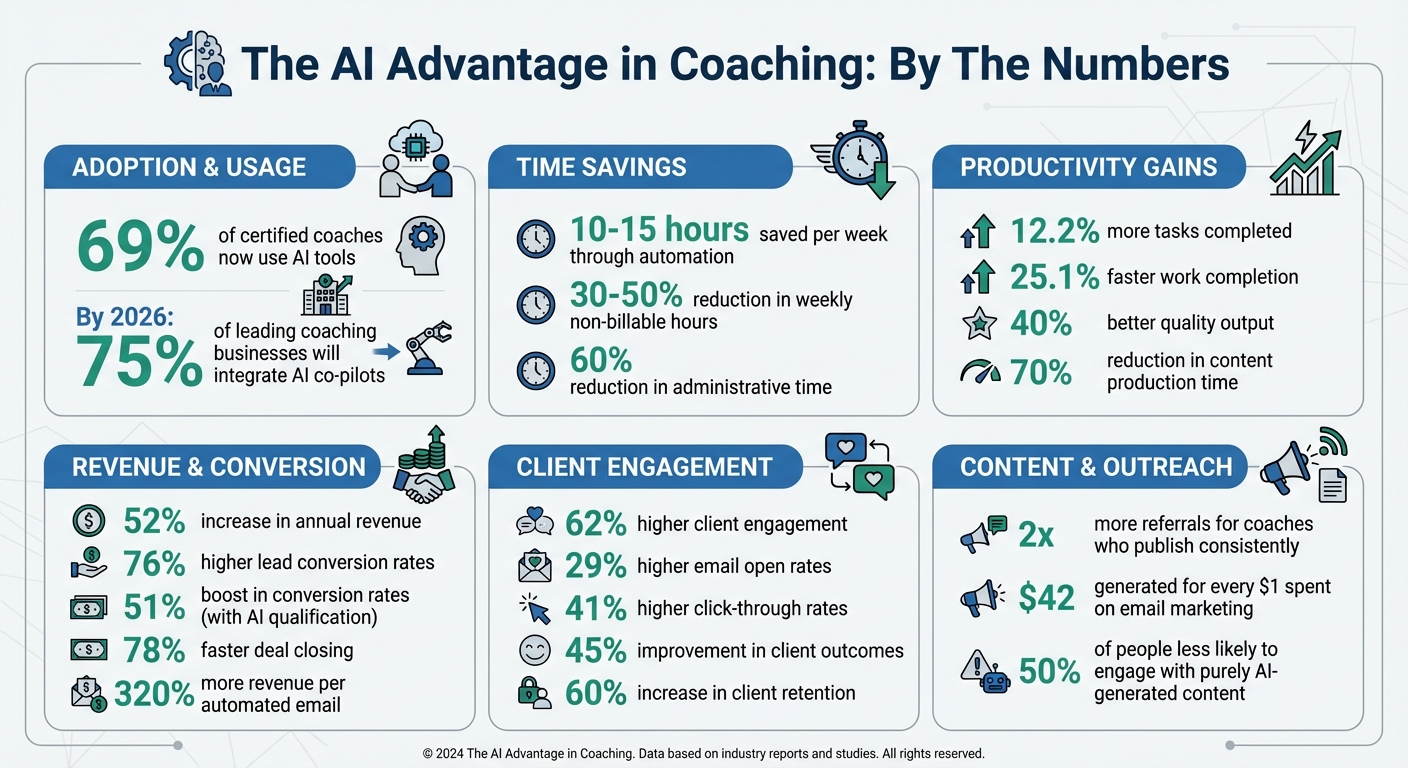
AI is reshaping the coaching industry, helping professionals save time, grow revenue, and meet client demands more effectively. With over 69% of certified coaches now using AI tools, those who rely on manual methods risk falling behind. Here’s what you need to know:
- Time Savings: AI automates tasks like scheduling, email follow-ups, and content creation, reclaiming 10–15 hours per week.
- Revenue Growth: Coaches using AI see a 52% increase in annual revenue and 76% higher lead conversion rates.
- Client Engagement: AI tools personalize outreach, streamline lead qualification, and maintain a consistent online presence.
- Practical Tools: Platforms like Brandbase offer AI assistants, automated LinkedIn outreach, and media placements to simplify operations.
AI isn’t replacing the human touch - it’s helping coaches focus on what matters most: delivering impactful sessions and scaling their businesses. Start small by automating repetitive tasks, then expand as you see results. The future of coaching is here, and AI is at its core.
AI Impact on Coaching Business: Key Statistics and Benefits
5 Automations Every Coaching Business Needs in 2025
sbb-itb-f7e72a6
How AI Changes the Coaching Business
AI has reshaped the way coaches work by taking over time-consuming administrative tasks that once bogged them down. With these duties off their plate, coaches can focus on what truly matters: delivering impactful client sessions and building their personal brand. Without the help of AI, however, these advantages remain out of reach, leaving coaches stuck in a cycle of repetitive, manual work.
The benefits of AI are clear in the numbers. Coaches and consultants using AI report completing 12.2% more tasks, working 25.1% faster, and achieving 40% better quality in their output. These improvements lead to an average 52% boost in annual revenue[3][6]. For many, this marks the difference between simply managing their business and seeing it thrive.
Common Problems Coaches Face Without AI
Without automation, coaches often find themselves overwhelmed by routine tasks. Writing emails, scheduling appointments, and documenting sessions eat up hours that could be better spent elsewhere. On top of this, creating fresh content and manually qualifying leads make scaling nearly impossible. Every new client adds to the workload, creating a growth ceiling that’s hard to break through.
Another hurdle is maintaining an online presence. Without tools to streamline engagement, coaches struggle to juggle serving current clients while attracting new ones. These challenges make it difficult to grow sustainably, leaving many coaches feeling stuck in their business.
How AI Improves Personal Branding for Coaches
AI doesn’t just streamline operations - it also helps coaches build a stronger digital presence. By transforming a single piece of content into multiple formats, AI drastically reduces production time. For example, a workshop recording can be turned into YouTube shorts, Instagram carousels, LinkedIn updates, and even newsletter material - all while keeping the coach’s voice authentic. This process cuts production time by about 70%[1]. Tools like ChatGPT and Claude provide draft content that coaches can easily tweak to reflect their unique style and expertise[2][8].
AI also makes personalization easier. By analyzing language patterns from intake forms or discovery calls, AI can craft follow-up emails and onboarding materials tailored to each client. Automated systems can even send timely reminders or motivational messages based on a client’s goals and personality, keeping them engaged between sessions[10].
"The coaching industry is splitting into two groups: those who embrace AI tools to amplify their impact, and those who stick to traditional methods while watching their competitive advantage erode."
This divide is becoming more apparent as 69% of certified coaches now use AI tools, leaving those relying on manual methods at a growing disadvantage[3]. Clients today expect prompt responses, consistent content, and around-the-clock availability. However, while AI can handle many tasks, purely AI-generated content often feels impersonal - 50% of people are less likely to engage with it[8]. That’s why the most successful coaches use AI to handle the heavy lifting while ensuring their unique expertise shines through in every interaction.
Brandbase: AI Tools Built for Coaches
Brandbase tackles the common challenges faced by coaches by offering a streamlined, all-in-one solution. Through a single interview, it delivers a full brand system - including a custom website, AI assistant, and media placements - within just 7 days[12]. Let’s dive into how its features simplify the coaching process.
What Brandbase Offers
Brandbase focuses on four key features designed to save time and enhance efficiency for coaches. First, custom landing pages are crafted to showcase your expertise and capture leads effectively. Next, an AI assistant works around the clock, handling inquiries, screening prospects, and ensuring you're only engaging with leads that are genuinely interested and financially capable.
The platform also automates LinkedIn outreach, helping you expand your network and connect with potential clients without the hassle of manual effort. To further boost credibility, Brandbase secures press features in relevant publications, which can elevate your authority and support premium coaching rates. These features are ready to go from day one, with hosting, maintenance, and analytics included, making it easy to monitor performance. Together, these tools create a well-rounded solution for busy coaches.
Brandbase Plans and Pricing
Brandbase offers three pricing tiers, each with a $499 setup fee that covers the initial brand-building process. Here’s what each plan includes:
- Starter Plan ($18/month): Ideal for new coaches who need a basic online presence. This plan includes a landing page built on Webflow, which you’ll manage on your own.
- Essential Plan ($99/month): Adds a custom AI assistant, hosting, maintenance, unlimited edits, and one media placement every six months. Perfect for coaches who want to automate lead qualification and keep their site updated.
- Pro Plan ($499/month): Designed for high-ticket coaches scaling their practice. This plan includes unlimited landing pages, LinkedIn lead generation, six bi-monthly media placements, and nine monthly SEO blog posts.
| Plan | Monthly Price | Setup Fee | Best For |
|---|---|---|---|
| Starter | $18 | $499 | New coaches who need a simple, self-managed online presence |
| Essential | $99 | $499 | Coaches automating lead qualification and maintaining their site |
| Pro | $499 | $499 | Coaches scaling with outreach and content marketing |
With coaches spending up to 60% of their time on non-coaching tasks[2], Brandbase’s automation tools can free up your schedule. Plus, considering email marketing can generate $42 for every $1 spent[13], the platform’s features can quickly justify their cost.
How Coaches Use AI in Their Daily Work
AI is no longer just a futuristic concept for coaches - it's already transforming how they handle daily tasks. From creating content to managing leads, AI takes on many of the repetitive jobs that used to consume hours of valuable time. Here’s how it plays out in real life.
Using AI to Create Content Faster
Coaches who publish consistently see double the referrals compared to those who post irregularly[14]. But maintaining a steady flow of content can be tough. AI steps in by taking a single idea and spinning it into multiple formats - like social media posts, newsletter intros, or even video scripts - saving time while keeping content fresh.
The secret lies in role-based prompts. Instead of vague instructions, coaches guide AI with specific roles, such as "act as a productivity coach for ADHD entrepreneurs", ensuring the output is both relevant and on-brand[1]. Many also transcribe coaching sessions to uncover recurring questions, which AI can then turn into blog post drafts[15].
"I like to think of AI as an assistant or staff member. I wouldn't ask an assistant to do all my work for me... But I would hire one to win back time and energy for doing the parts of my business that light me up." - Jennie Lakenan, Web Designer and Certified Life Coach[2]
While AI handles the framework and drafts, coaches enhance the content by adding personal stories and real-life examples to make it resonate. With content production streamlined, AI also steps up in another critical area: personalized outreach.
Automating Personalized Client Outreach
Scaling outreach manually is nearly impossible. AI tools now handle LinkedIn messages and email campaigns, maintaining a personal touch without requiring constant hands-on effort. Coaches can train AI to mimic their tone by feeding it writing samples, avoiding the risk of sounding robotic[13].
A popular approach is the 5-email welcome sequence: offering a lead magnet, sharing a personal anecdote, providing a bonus tip, addressing a common concern, and inviting a discovery call[13]. These automated email flows generate 320% more revenue per email compared to non-automated campaigns[15]. Coaches who use AI for outreach report 76% higher win rates and close deals 78% faster[16]. The efficiency ensures prospects receive timely responses and follow-ups, keeping the momentum alive.
AI Assistants That Screen and Qualify Leads
AI doesn’t just help with outreach - it also fine-tunes client engagement by pre-qualifying leads. AI assistants now conduct interactive "mini-sessions" with website visitors, asking tailored questions about their challenges and goals instead of relying on static forms[1][18]. These assistants work around the clock, ensuring prospects can learn about coaching programs anytime - even at 3 a.m.[17][1].
"Your expertise means nothing if prospects never get to experience it because you're too slow to respond or too busy to engage." - Coachvox[1]
The numbers back it up. One coaching business trained its AI chatbot with stricter qualification criteria, resulting in 32% fewer leads but a 51% boost in conversion rates[5]. Another replaced lengthy intake forms with interactive AI chats, cutting the drop-off rate from 42% to just 9%[5]. Coaches can review chat transcripts to understand a prospect's concerns and goals before a call, ensuring high-intent leads are directed to book an appointment, while others receive free resources or enter a nurture sequence[17][5]. With AI handling the sorting, coaches can focus on prospects who are ready to take the next step.
Adding AI to Your Coaching Practice
Previously, we looked at how AI can speed up content creation and improve client outreach. Now, let’s dive into how you can seamlessly bring AI into your daily coaching routine.
You don’t need to completely revamp your business to start using AI. Begin by auditing your current workflow. Track tasks that take over 15 minutes - things like scheduling calls, writing follow-up emails, or creating social media content - for a week[19][1]. This will help you spot areas where AI can make the biggest difference. Use these insights to integrate AI step by step, focusing on streamlining your daily operations.
Once you’ve identified your pain points, start small. Choose three to five tools to avoid feeling overwhelmed[19][21]. For example, you could use a scheduling tool like Calendly (free to $12/month), a transcription service such as Otter.ai or Fathom, and ChatGPT Plus ($20/month) for drafting content. Pair these with your existing CRM, like HubSpot or Salesforce, to automate follow-ups[19][7]. A Harvard University study even found that consultants using AI completed 12.2% more tasks, 25.1% faster, with over 40% better quality[6].
Automating Routine Tasks
One of the quickest wins with AI is automating repetitive tasks. Tools like Calendly or Acuity Scheduling (around $20/month) can handle appointment scheduling, cutting out the endless back-and-forth emails[7]. For meeting notes, transcription tools like Fathom or Fireflies automatically capture and summarize sessions in minutes[2][21].
AI can also transform your content creation process. For example, platforms like CastMagic or InVideo can take a single coaching video and repurpose it into social media posts, newsletter snippets, or video scripts[20][21]. This kind of automation can reduce admin time by up to 60% and even triple your client capacity[19]. Take David, a productivity coach, who trained an AI clone using Coachvox AI based on his coaching style. He launched a subscription model ($39/month for AI access) that brought in $15,000 in monthly recurring revenue with minimal effort[16].
"AI isn't the problem. Doing everything in your business yourself? That's the actual problem." - Michelle Sera, Coaching Business Growth Specialist, ElevatedMind[20]
Tracking Results with Analytics
To make AI work for you, it’s crucial to measure its impact. Before introducing new tools, set clear goals. For instance, aim to cut administrative time by 30%, boost lead generation by 25%, and increase revenue per client by 20%[11]. Use a simple red/yellow/green system to track these metrics weekly, so you can quickly identify which tools are effective and which need tweaking[5].
Conversation intelligence tools like Gong.io (starting at $100/month per user) can analyze coaching sessions for talk-to-listen ratios and sentiment trends[16][19]. In 2024, Sarah, an executive coach in Atlanta, used Gong.io to uncover patterns that drove client success. Within six months, her client success rates jumped by 65%, and her client capacity grew by 40% - all without adding extra hours[16]. Similarly, Jennifer, a career coach, used Fireflies.ai to track session engagement, improving client outcomes by 45% and retention by 60%[16].
It’s also smart to conduct quarterly audits to ensure your AI tools are delivering value and align with your growth goals[18]. On top of that, AI-driven personalized emails can achieve 29% higher open rates and 41% higher click-through rates[5]. Keep an eye on email performance and website analytics to see what’s driving conversions. These insights don’t just validate your AI investments - they also help you fine-tune your approach for ongoing improvements in your coaching practice.
Conclusion
By 2026, 75% of leading coaching businesses will integrate AI co-pilots into their hybrid-first models, making AI-augmented support the standard expectation[9]. If you're still handling everything manually, you're not just overworking yourself - you’re losing ground to competitors who are using AI to streamline operations and boost their impact while you’re stuck in administrative overload.
The data speaks volumes: coaches who adopt AI save 30–50% of their weekly non-billable hours, experience a 51% increase in revenue, and achieve 62% higher client engagement[4][22]. This isn’t about replacing the personal connection that defines coaching. It’s about reclaiming your time so you can focus on what you excel at - helping clients transform their lives.
"AI adoption isn't optional anymore – it's table stakes for staying competitive." - Coachvox.ai[1]
These stats highlight why adapting now is critical. Start by assessing your workflow to pinpoint areas where time is being wasted. Then, test one or two AI tools for 30 days to see the impact. You don’t need to overhaul everything at once. Begin with straightforward automations like scheduling or transcription, and expand as you experience the benefits. The coaches thriving in 2026 won’t necessarily be tech experts - they’ll be the ones who saw AI as a tool to enhance performance, not a replacement[4].
Today’s clients expect personalized, round-the-clock support. Without AI, meeting these demands becomes nearly impossible. The question is: will you embrace the tools that can keep you ahead, or will you risk being left behind? The choice is yours.
FAQs
Which coaching tasks should I automate first with AI?
Start by tackling those repetitive, time-consuming tasks that eat up your day but don’t necessarily need your personal touch. For instance, you can automate administrative work like scheduling appointments, managing follow-ups, and handling email correspondence. This alone can free up 10–15 hours of your week!
Beyond that, streamline content creation for your social media and marketing efforts. Automation here helps you consistently engage your audience and attract potential clients without constant effort. Tools like AI-powered chatbots are also great for managing client interactions and onboarding. They provide instant, personalized responses, which not only saves you time but also aligns with clients’ expectations for quick and tailored support.
How do I keep my content personal when using AI?
To make your content feel more personal when using AI, focus on tailoring prompts and training the AI to reflect your distinct voice. You can upload your own resources, interviews, or other materials to help the AI understand and mirror your tone. By using carefully crafted prompts, you can refine the AI's outputs to better align with your style and values. This method ensures your content stays true to you, helping to build trust and deeper connections with your audience.
How can I measure ROI from AI in my coaching business?
To gauge ROI effectively, keep an eye on metrics that reflect tangible outcomes like increased revenue, time savings, and better client engagement. For instance, implementing AI strategies might lead to a 25% revenue increase or cut administrative tasks by 70%. By focusing on measurable results tied directly to your AI initiatives, you can clearly evaluate their overall impact.
Related Blog Posts

Blog title heading will go here
Blog title heading will go here