

3 Ways Top Coaches Are Using AI to Scale Without Hiring in 2026

In 2026, many coaches are turning to AI tools to handle repetitive tasks and save time, rather than hiring additional staff. These tools help with client engagement, content creation, and lead generation, allowing coaches to focus on their core work. Here’s how:
- AI Chatbots: Provide 24/7 responses to client inquiries, qualify leads, and save hours by automating scheduling and follow-ups.
- AI Content Creation: Turn coaching sessions into social media posts, videos, or blogs, cutting content creation time significantly.
- AI Outreach: Automate lead generation with tailored email sequences, lead magnets, and CRM integrations.
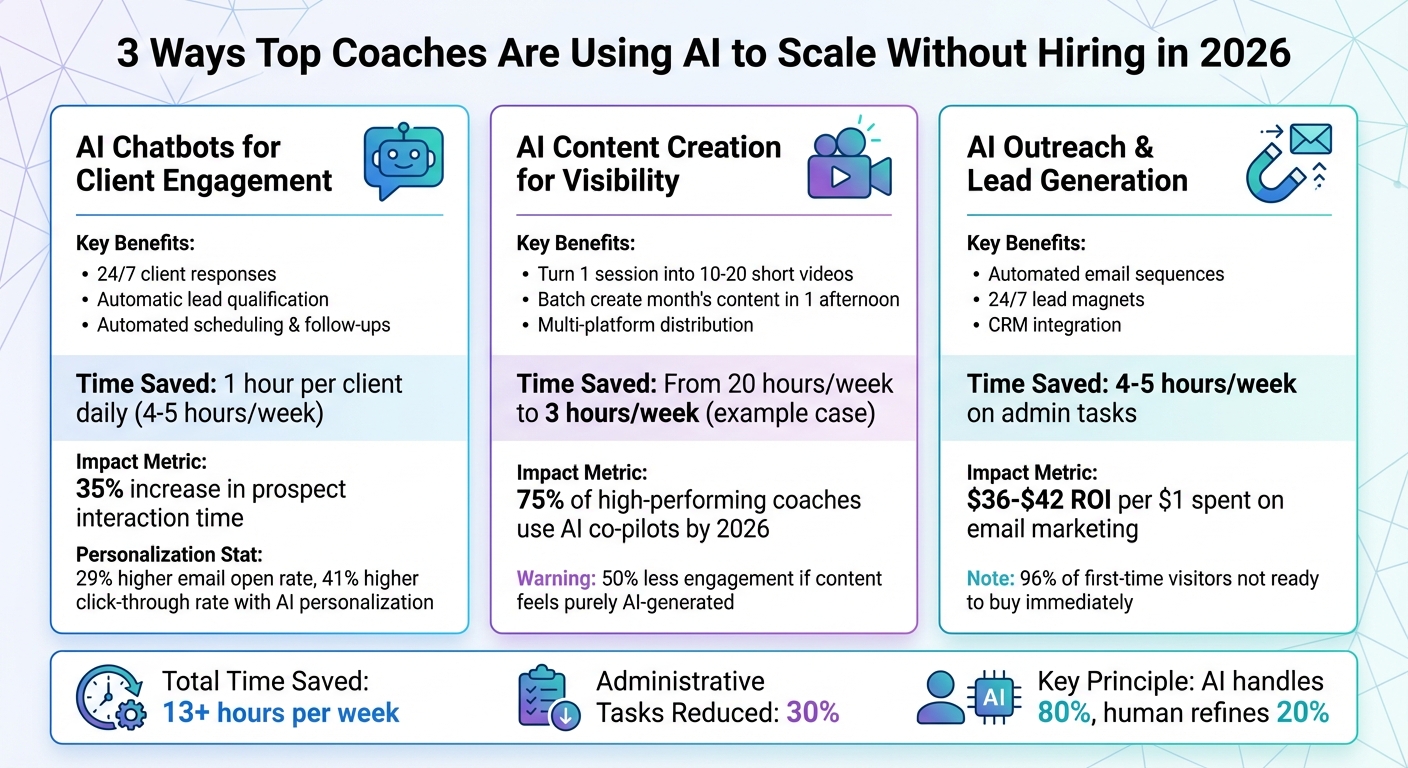
3 AI Tools Coaches Use to Scale: Chatbots, Content Creation & Outreach Comparison
1. AI Chatbots for Client Engagement
Scalability and Automation Benefits
AI chatbots are like having an assistant that never clocks out. They handle routine questions about your services, pricing, or availability 24/7, allowing you to connect with multiple prospects at once - even while you're busy coaching or catching up on sleep [1].
What makes these chatbots particularly effective is their ability to qualify leads automatically. By analyzing conversation data, they can pick up on subtle cues that suggest someone is ready for high-ticket coaching [1][11]. They ask targeted questions, collect key details about goals and challenges, and weed out less serious inquiries before they reach your calendar. For example, education-focused coaching businesses reported a 35% increase in prospect interaction time after implementing AI chatbots tailored to their curriculum [1].
Time-Saving Potential for Coaches
AI tools don’t just answer questions - they give you back your time. Coaches using AI for tasks like scheduling, note-taking, and follow-ups save about one hour per client daily. That adds up to 4–5 hours per week, freeing you to focus on what you do best: coaching [4][10].
Take Liz Morrison, founder of LM Strategic Storytelling, as an example. In January 2026, she introduced "Story Explorer", a custom ChatGPT-based tool. This tool guides potential clients through a coaching exercise to uncover a narrative they can use for networking or social media. It acts as a lead magnet, sparking meaningful coaching conversations without requiring Morrison to spend hours on discovery calls [4]. Tools like these don’t just save time - they can also echo your unique coaching style, as discussed below.
Maintaining Personalization and Authenticity
A common concern for coaches is: "Will AI make me sound robotic?" The answer lies in how you train it. Off-the-shelf AI can sound generic [9][3]. But when you train it with your specific frameworks, methods, and language, it becomes a natural extension of your voice [1][3].
"When you take the time to teach AI how you speak, how you think, and how you coach, it becomes a powerful extension of your mind, not a replacement for it." - Michelle Sera, Founder, ElevatedMind [3]
The secret is in the data you provide. By feeding your chatbot past emails, session transcripts, and transformation examples, you ensure it responds in a way that feels like you - even if someone reaches out at 11:00 PM on a Saturday. This approach works: AI-driven personalized emails see a 29% higher open rate and a 41% higher click-through rate compared to generic ones [1].
This level of personalization not only helps you scale but also ensures your coaching retains its unique identity, even as you integrate AI into more aspects of your practice.
sbb-itb-f7e72a6
2. AI Content Creation for Regular Visibility
Scalability and Automation Benefits
Coaches who have already boosted client interaction with chatbots are now taking things further by turning their sessions into a variety of digital content. AI tools make this transformation seamless. For example, platforms like OpusClip and quso.ai can convert a single 30–60 minute coaching session into 10–20 short-form videos, ready to share on LinkedIn, TikTok, and Instagram Reels [13][12]. This approach lets you create once and share everywhere - without spending the 10–15 hours per week that many coaches dedicate to manual content creation [12].
Take Ellen Decker, the founder of the fitness business "Fit in Twenty", as an example. By 2025, she cut her content creation time from 20 hours a week to just 3 hours using AI tools. This efficiency allowed her, as a solopreneur, to manage a business generating over $570,000 annually with more than 250 active subscribers. She used AI to produce months’ worth of workout plans, social media content, and marketing strategies - all in a single afternoon [5]. The result? A streamlined, batch-oriented workflow that saved time and kept her business thriving.
Time-Saving Potential for Coaches
Batch creation is the game-changer here. With AI, you can brainstorm, draft, and schedule an entire month’s worth of posts in just one afternoon [5][12]. The process is straightforward: record your thoughts once, and let AI handle the formatting and scheduling. This efficient system not only boosts your online presence but also aligns with a broader AI-driven growth strategy. By 2026, 75% of high-performing coaching businesses were using AI co-pilots for exactly this purpose [2]. However, while automation saves time, maintaining your unique voice is crucial to ensure your content resonates.
Maintaining Personalization and Authenticity
The key to standing out in a sea of AI-generated content is personalization. The difference between generic AI output and content that feels truly "you" lies in how you train the tool. By feeding AI examples of your high-engagement emails, social posts, and signature frameworks - what Michelle Sera refers to as "Michelle-isms" - you can ensure the output reflects your distinctive tone [14][3]. Let AI handle the structure, but always add your personal touch for that final polish [3][15].
"Think of AI as your team member who does 80% of the heavy lifting, but you're still the visionary, the boss, the person who refines, and has the final say." - Michelle Sera, Coaching Business Growth Specialist, ElevatedMind [3]
Refining AI-generated content to match your voice is essential. This human element keeps your audience connected, as 50% of people are less likely to engage with content that feels purely AI-generated [15]. Balancing efficiency with authenticity is the secret to maintaining trust and engagement.
Best AI Tools Online Coaches NEED to Try in 2026!
3. AI Outreach and Lead Generation
Coaches are finding new ways to simplify their outreach and lead generation efforts by integrating AI into their strategies. This shift is helping them save time and scale their efforts without compromising quality.
Scalability and Automation Benefits
Manually researching prospects is time-consuming and hard to scale. AI, on the other hand, can instantly sift through massive data sets to identify key opportunities and craft tailored messages [16]. This allows coaches to move from one-on-one outreach to a broader, more efficient approach while maintaining a personal touch [16].
One standout approach is the 3-Stage "Peaceful" System: Create (develop searchable blog content), Capture (offer quick-win lead magnets), and Connect (set up automated email nurture sequences) [7]. This system works around the clock, ensuring your outreach continues even while you sleep. For example, long-form blog posts can remain relevant for nearly two years, compared to the fleeting lifespan of social media posts [7]. When AI tools like Perplexity or ChatGPT search for answers to client questions, they often cite these blog assets, effectively becoming a 24/7 referral source [7]. This strategy not only expands your reach but also establishes a solid foundation for automated client engagement.
Time-Saving Potential for Coaches
Email marketing delivers an impressive return - between $36 and $42 for every $1 spent. However, most first-time visitors (around 96%) aren’t ready to make a purchase right away [7][11]. That’s where AI-driven lead magnets and automated nurture sequences come in handy.
Tools like Coachvox can immediately engage website visitors, respond to FAQs, and qualify leads [9][11]. The platform even offers a 14-day free trial [9][11]. Similarly, automation services like Zapier (which has a free plan) can link intake forms to CRMs, triggering welcome emails automatically [11][6]. Coaches who use these tools report saving 4–5 hours per week on administrative tasks, freeing up time for more personalized coaching sessions [10].
Balancing Personalization and Authenticity
While AI can handle much of the heavy lifting, outreach can feel impersonal if it lacks your unique voice. So how do you keep it authentic? Try the "late-night search strategy." This involves identifying the specific, anxiety-driven questions your prospects search for late at night and creating a blog post for each one [7]. By doing this, you position yourself as the go-to expert AI tools recommend.
To ensure AI-generated content aligns with your brand, provide it with your writing samples, transcripts, and proprietary frameworks before letting it create anything [7][3].
"AI is only weird, generic, typical, and meh…when you don't train it." - Michelle Sera, Coaching Business Growth Specialist, ElevatedMind [3]
Finally, always keep a human involved in the process. While AI excels at research and drafting, your strategic guidance and final review ensure everything stays on-brand [16][8].
"AI isn't here to replace your sales process. It's here to refine it." - Kaleigh Moore [8]
How to Keep Your Voice Authentic While Using AI
Personalization is key when using AI, but without proper guidance, the results can feel bland or impersonal. A recent survey found that 92% of U.S. knowledge workers want AI tools capable of adapting to their brand guidelines and personal style [17]. Your clients value your distinct perspective, and automation should enhance - not erase - that individuality.
Start by identifying what makes your voice unique. Think about your tone, signature phrases, and the values that define your communication style [17][3]. For instance, if you frequently use creative analogies or have a specific way of simplifying complex ideas, jot those down. To train your AI tool effectively, provide it with 5–15 examples of your best work that reflect your tone and style [17][19][6]. This step ensures the AI produces content that aligns with your voice and feels just as personal as your own writing.
"AI is only weird, generic, typical, and meh…when you don't train it. Untrained AI is the out-of-the-box AI. You need to shape it and make it your own." - Michelle Sera, Coaching Business Growth Specialist, ElevatedMind [3]
A great approach is to follow the 80/20 rule: let AI handle the initial draft, then spend time refining the final 20% yourself [3][6][7]. This is where you can weave in personal anecdotes, adjust the tone, and ensure the piece reflects your expertise. Another tip? Create a list of overused or clichéd words - like "unlock", "skyrocket", or "in a world where" - and avoid them to keep your content fresh and relatable [18][19].
Lastly, make it a habit to review AI-generated content monthly, comparing it to your brand's style guide to avoid drifting away from your authentic voice [17]. When clients sense that your content is just a copy-paste job from AI, it can damage trust. And as a coach, trust is one of your most important assets [6].
Conclusion
AI chatbots, content creation tools, and outreach systems work best when combined. Together, they help build lasting authority and keep clients engaged around the clock with automated, personalized follow-ups [2].
Think of AI as a collaborator, not a replacement. When aligned with your voice and style, these tools can expand your reach and free up your time to focus on making a real difference [3]. Coaches who fully embrace AI strategies report saving over 13 hours per week [6] and cutting administrative tasks by as much as 30% [20]. This perspective is shared by leading voices in the industry.
A better system can outperform a bigger team:
"You don't need a bigger team. You need a better system. And AI is the smartest, simplest system you'll ever use." - Michelle Sera, Founder of ElevatedMind [3]
Start small to get results. Identify one repetitive task that eats up more than 10 hours a month - whether it's crafting social media posts, answering FAQs, or following up with leads - and test a single AI tool for 30 days [9]. Measure the time saved and assess the results. Once you see the benefits, add another tool. This gradual approach is the secret to growing your impact without burning out. The coaches thriving in 2026 won't be working harder - they'll be working smarter by building systems that scale their expertise while protecting their energy [5].
Throughout this journey, AI proves to be a bridge between growth and personal connection. The future of coaching isn’t about choosing one over the other - it’s about using AI to achieve both, seamlessly. The next step is yours.
FAQs
Which AI task should I automate first?
Start by automating time-consuming administrative tasks such as scheduling, processing payments, sending reminders, and managing client onboarding. These tasks, which follow predictable patterns, can save you anywhere from 20 to 35 hours a week. Not only does this free up your time, but it also helps cut down on stress and operational costs. By automating these processes first, you’ll see immediate improvements in efficiency, laying a solid groundwork for growth. This lets you shift your focus to personalized client interactions and other tasks that deliver greater impact.
How can I train AI to sound like me?
To make AI reflect your voice, you can upload your personal content - like books, articles, or interviews - to build a knowledge base tailored to your style. This helps the AI understand your tone and way of communicating. You can also use specific prompts to guide the AI, ensuring it produces responses that align with both your methodology and unique voice. This approach makes the AI-generated content feel more like it came directly from you.
How can I use AI without losing trust?
To make the most of AI while maintaining trust, it’s important to integrate it in a way that supports your genuine voice and core values. AI can handle repetitive tasks, allowing you to focus on more meaningful interactions with your clients. Being open about how AI fits into your processes can actually build trust rather than diminish it. When applied responsibly, AI can simplify workflows while still keeping that personal, human connection intact - helping clients feel appreciated and understood.
Related Blog Posts

Blog title heading will go here
Blog title heading will go here