
7 Ways Coaches Are Using AI to Get More Leads Without Working More Hours

Coaches often lose time juggling client sessions and lead generation, leaving their pipeline empty. AI solves this by automating tedious tasks like lead qualification, LinkedIn outreach, and content creation. Here's how AI is helping coaches attract more leads while reducing workload:
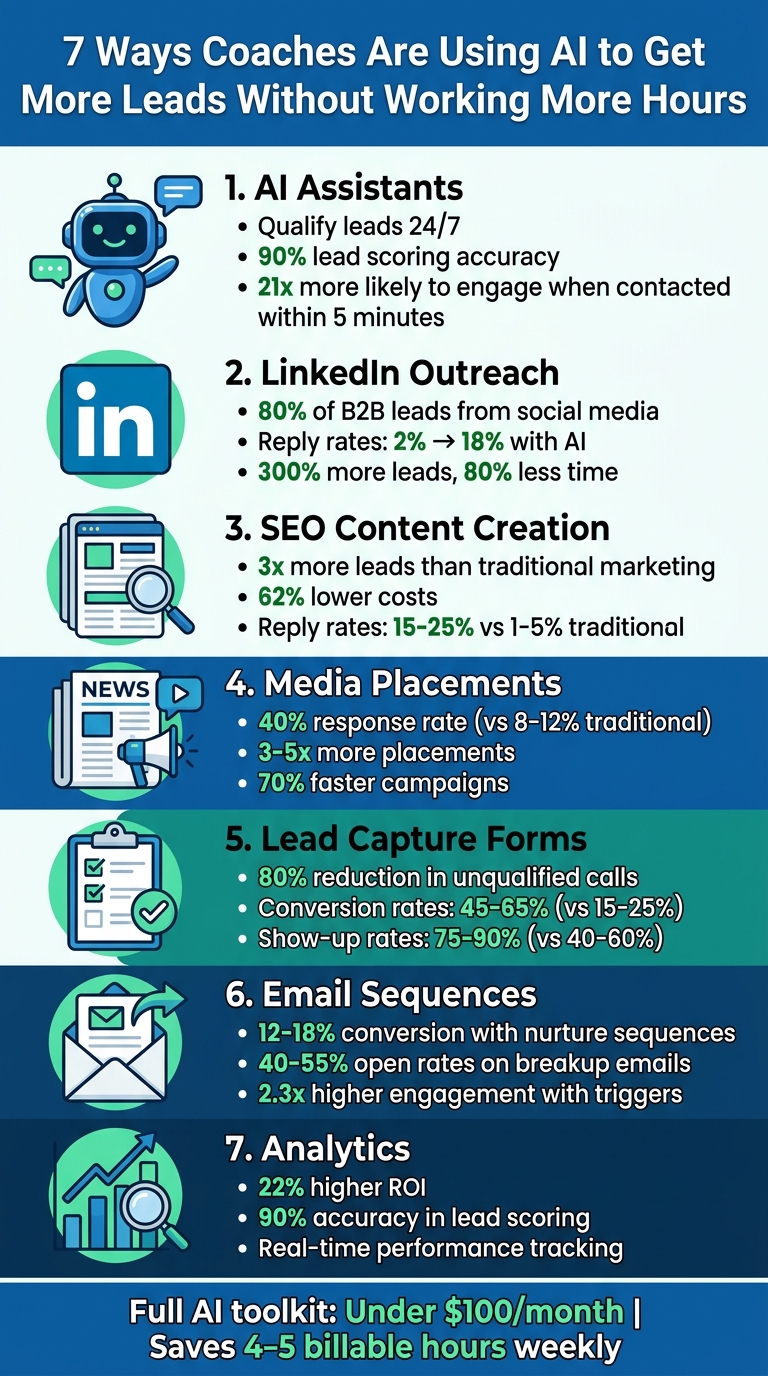
- AI Assistants: Qualify leads 24/7, route high-priority prospects, and boost conversions by responding instantly.
- LinkedIn Outreach: Automate hyper-personalized campaigns, saving up to 80% of prospecting time.
- SEO Content Creation: Generate blog posts that drive 3x more leads at lower costs.
- Media Placements: Use AI tools to pitch journalists faster and secure more coverage.
- Lead Capture Forms: Instantly evaluate prospects and reduce unqualified calls by up to 80%.
- Email Sequences: Automate follow-ups with dynamic personalization, improving conversion rates by 12–18%.
- Analytics: Track performance, refine strategies, and focus on high-potential leads for a 22% higher ROI.
With AI tools costing as little as $100/month, you can automate lead generation and free up hours for coaching clients. Let AI handle the repetitive tasks so you can focus on growing your business.
7 AI Tools Coaches Use to Generate More Leads While Working Less
1. Using AI Assistants for Round-the-Clock Lead Qualification
Automation capabilities for reducing workload
AI assistants are game-changers when it comes to handling leads. They automatically evaluate incoming leads against your Ideal Customer Profile (ICP), scoring them based on factors like industry, budget, and buying signals. The best part? They don’t just stop there - they route high-priority leads directly to your calendar while placing less urgent ones into nurture sequences for future follow-up [5].
What makes AI stand out is its unwavering consistency. Unlike humans, who might let fatigue or mood influence their decisions, AI applies the same criteria across the board. For example, Brandbase’s AI assistants work tirelessly around the clock, engaging with visitors, answering questions, and collecting contact details - even when you’re offline.
Effectiveness in lead generation and conversion
This level of automation doesn’t just qualify leads; it actively boosts conversions.
AI-powered lead scoring has an impressive accuracy rate of about 90% [3]. Plus, timing is everything in sales - leads contacted within 5 minutes are 21 times more likely to engage in a sales conversation compared to those reached after 30 minutes [7]. AI assistants ensure you never miss that critical window by responding instantly. They also capture valuable insights through conversation transcripts, helping you better understand a prospect’s challenges and goals [6][4].
Here are some real-world examples of success:
Leadership coach Damian K. ten Böhmer booked two discovery sessions within just 8 days of launching his AI assistant through Coachvox, recording nearly 100 interactions [8].
Business coach Rose Radford saved more than 5 hours every week by using her "Rose Bot" to manage webinar FAQs and client inquiries [8].
Ease of integration into existing workflows
Integrating AI assistants into your current setup is easier than you might think. They connect effortlessly with CRMs like HubSpot, Salesforce, and Pipedrive through native integrations or tools like Zapier [5]. This two-way sync ensures that sales feedback continuously improves the AI’s lead-scoring accuracy. To get started, test your AI assistant against at least 100 historical leads to fine-tune its ability to identify top prospects [5].
sbb-itb-f7e72a6
2. Running Automated LinkedIn Outreach Campaigns
Automation Capabilities for Reducing Workload
LinkedIn is a powerhouse for B2B lead generation, responsible for about 80% of all B2B leads sourced through social media [1]. But let's face it - manual prospecting can eat up 10–15 hours every week [11]. That's where AI tools step in to save time and effort.
These tools go beyond just scanning job titles. They analyze profiles, summaries, and even recent posts to spot high-intent leads. For example, they can identify founders discussing challenges like burnout, helping you pinpoint prospects who might need your services [9]. AI also handles the heavy lifting of creating hyper-personalized icebreakers, a task that usually takes 5–10 minutes of manual research per lead, in mere seconds [9].
Once you've identified the right audience, AI can manage multi-touch sequences automatically. This includes sending connection requests and follow-ups at 3–5 day intervals - pausing the sequence as soon as a prospect responds [9][2]. Importantly, this process keeps you in the loop by drafting messages that you can quickly review or tweak, ensuring your voice remains authentic [10]. This blend of automation and human touch makes it easier to nurture high-intent leads without losing the personal connection.
Effectiveness in Lead Generation and Conversion
AI-assisted LinkedIn outreach isn't just about saving time - it delivers results. Reply rates jump from 2% to 18% with AI [9], and warm outreach on LinkedIn converts at double the rate of cold calling or generic messages [9]. By streamlining workflows, AI can generate 300% more leads while cutting prospecting time by 80% [10].
"The biggest growth bottleneck for creators and coaches isn't content creation - it's the time-consuming, repetitive outreach required to turn engagement into revenue." - quso.ai Editorial Team [10]
To keep your LinkedIn account safe, stick to about 100 connection requests per week and 20–30 direct messages daily [1]. Tools that mimic human behavior - like adding random delays - help you avoid triggering LinkedIn's security algorithms.
Integrating AI-driven tools into your workflow not only simplifies outreach but strengthens your overall marketing strategy.
Ease of Integration into Existing Workflows
Getting started with LinkedIn automation doesn’t require a complex setup. A lean tech stack can include:
- An outreach automation tool (starting at around $16 per month),
- A prospecting solution with flexible pricing (free to about $49 per month), and
- A CRM system like HubSpot for organizing leads.
Many LinkedIn automation tools connect directly with CRMs or work with affordable integration bridges (as low as $9 per month) [1][2]. To make the most of these tools, define a focused Ideal Customer Profile (ICP). Use a formula like: "[Role] in [Industry] engaging with [Topic] facing [Pain Point]" to refine your targeting [9].
Finally, leverage message templates with customizable variables to scale outreach while keeping it personal [9]. The key is to guide the intent and build genuine relationships, ensuring your outreach feels meaningful - not robotic.
Coaches Are Generating 300+ Leads A Month With This AI Tool
3. Creating SEO-Optimized Blog Posts to Attract Leads
Coaches are now leveraging AI not just for lead qualification and outreach, but also for creating content that captures more leads.
Automation Capabilities for Reducing Workload
Writing blog posts often gets pushed down the to-do list. But AI tools like Claude and Jasper make it easier to produce quality content consistently - something that would typically require a dedicated writer [2]. You can even train these tools on your own materials, like books or transcripts, to ensure the content reflects your voice.
AI platforms go a step further by analyzing audience conversations and transcripts. This helps identify common challenges and relevant search terms, giving you actionable ideas for SEO-friendly blog topics [8]. They can also outline content, structure lessons, and clarify outcomes, making the process feel less overwhelming [3]. Tools like Coachvox offer specialized blog post creators, allowing you to generate content for LinkedIn or your website in just a few minutes [8]. This approach not only simplifies content creation but also ties seamlessly into AI-driven lead generation strategies, helping to attract organic traffic.
"I used the blog writer today to put something out on LinkedIn about my topic, personal leadership. Brilliant and so easy to use." - Mark Tonks, Leadership & Development Coach [8]
Effectiveness in Lead Generation and Conversion
Content marketing is a powerful tool, generating three times more leads while cutting costs by 62% [2]. When paired with AI, the results can be even more impressive - AI-assisted content often achieves reply rates of 15–25%, compared to the 1–5% seen with traditional outreach methods [3]. A proven strategy is the "Content to Lead Magnet" funnel. By using AI to regularly produce blog posts, you can guide readers toward valuable lead magnets, like free resources, to capture their email addresses [2].
Ease of Integration into Existing Workflows
You don’t need to be tech-savvy to get started. Many AI content tools integrate directly with CRMs like HubSpot or automation platforms, ensuring that leads from blog posts are captured and nurtured seamlessly [8]. Begin by uploading your existing materials to create a "digital twin" that drafts posts in your unique style [8]. Focus on tasks you tend to put off, such as drafting outlines or summarizing long-form posts for social media [3]. And with a range of options - from ChatGPT Plus at $20 per month to Coachvox at $99 per month - you can find a tool that fits your budget [12] [8].
4. Getting Media Placements for Increased Credibility
Being featured in well-known publications can build trust faster than most other marketing strategies. While traditional PR involves time-consuming research and repeated pitching, AI tools now streamline these processes.
Automation Capabilities for Reducing Workload
AI tools can scan thousands of articles across numerous publications to find journalists whose recent coverage aligns with your story, replacing outdated database tags with real-time insights[15]. What used to take 2–3 hours - like building a media list - can now be done in just 5 minutes[15]. These platforms also monitor journalists’ work and social media activity, enabling them to craft personalized pitches. They even automate follow-ups, sending revised pitches 3–5 days after a journalist opens your email but doesn’t reply[14]. This automation can free up 60–70% of your time, allowing you to focus on strategic planning[15].
The result? Less manual effort and better engagement metrics.
Effectiveness in Lead Generation and Conversion
The numbers speak for themselves. AI-driven, personalized pitches boast a 40% response rate, far outperforming traditional "spray-and-pray" methods, which average just 8–12%[15]. PR agencies using AI tools report 3–5 times more media placements and execute campaigns 70% faster[15].
For example, in 2025, a SaaS PR client used AI to track the impact of a single Forbes article. The AI revealed that the article generated 487 referral visits and matched 12 existing opportunities in their CRM, directly contributing $420,000 in closed revenue within 60 days[15]. Similarly, a B2B tech company used AI to refine a CEO op-ed. When the AI flagged a generic angle as having only an 8% pickup rate, the company shifted to a data-driven story about zero-day vulnerabilities. This change led to placements in Wired, The Hacker News, and 12 other industry outlets[15].
These examples highlight how AI can turn media placements into measurable business outcomes.
Ease of Integration into Existing Workflows
AI-driven PR tools easily integrate with CRMs like HubSpot, making it simple to track media-driven leads. Affordable options include platforms like Prowly ($300–$800 per month for media database access and AI recommendations) and Brand24 ($49–$399 per month for real-time monitoring)[15]. For those just starting out, even ChatGPT Plus at $20 per month can assist with drafting and refining pitches.
A smart approach combines AI and human effort. Let AI handle research and initial drafts for secondary publications while keeping human input for your top 10–15 priority journalists. This hybrid strategy helps you maintain genuine relationships while dramatically cutting down on your workload.
5. Setting Up Lead Capture Forms with Automatic Qualification
AI-powered lead capture forms are changing the game for coaches and businesses by turning the time-consuming process of screening leads into quick, actionable results. Many coaches spend 10–15 hours each week talking to prospects who either can’t afford their services or aren’t ready to move forward. These AI-driven forms address that issue by instantly evaluating prospects as they fill out the form, eliminating the need for manual screening.
Automation Capabilities for Reducing Workload
Think of AI-powered forms as your tireless assistant. They assess responses in real time, scoring prospects based on factors like budget, timeline, and company size. Using natural language processing, these systems can analyze open-ended answers (like “What’s your biggest challenge?”) to pick up on urgency and intent that simple checkboxes might miss. They even track subtle behavioral patterns, such as how long someone spends on specific questions or if they revise their answers, to gauge genuine interest.
When a prospect enters their email, the system pulls in additional data from external sources, such as company revenue, recent funding rounds, or job titles. If a lead is flagged as a strong prospect, you’ll get an instant notification - via Slack or SMS - so you can respond right away. Meanwhile, unqualified leads are automatically added to a nurture sequence or directed to self-service resources. One coach reported cutting down unqualified discovery calls by 80% after using an AI-powered intake funnel [16]. This real-time evaluation helps boost conversion rates significantly.
Effectiveness in Lead Generation and Conversion
The results speak for themselves. Traditional intake processes typically convert 15–25% of discovery calls into paying clients, with show-up rates of 40–60%. By contrast, AI-qualified funnels can increase conversion rates to 45–65% and improve show-up rates to 75–90% [16].
"Every hour you spend on unqualified discovery calls is an hour you could spend coaching paying clients" - Marcus Chen, AI automation strategist [17].
For example, one online strength coach saw their conversion rate jump from 30% to 65% after implementing an AI intake system. Not only that, but client onboarding became two to three times faster since all the necessary details were collected upfront. Plus, the system continuously updates lead scores as new behavioral data comes in, keeping your sales pipeline accurate and up-to-date.
Ease of Integration into Existing Workflows
These AI solutions are designed to fit seamlessly into the tools you already use. They integrate easily with CRMs like HubSpot, Salesforce, and Pipedrive, ensuring your sales data stays current. Leads are automatically routed based on their scores - those scoring above 80 might receive an instant link to schedule a call, while those scoring between 40 and 79 are directed into email nurture sequences. Setting up a complete AI lead stack, including forms, CRM integration, and email automation, typically costs between $230 and $272 per month [2].
To get started, focus on your busiest lead capture form. Define the key traits of your ideal clients - like industry, revenue, and pain points - and let the AI use those as a baseline for scoring. Use progressive profiling to ask the most important qualifying questions first, while keeping returning visitors’ forms short by hiding previously answered questions. This way, the AI handles the repetitive work, leaving you free to close deals with prospects who are ready to take action.
6. Sending Personalized Email Sequences Based on Lead Data
It’s common for coaches to stop following up too early, even though most conversions happen between the 5th and 8th touchpoint [20]. AI-powered email sequences fill this gap by handling repetitive follow-ups while making each message feel personal and relevant.
Automation Capabilities for Reducing Workload
AI tools do more than just schedule emails - they bring personalization to a whole new level. These systems can research prospects’ LinkedIn profiles, pull in recent company updates, and populate dynamic fields that go far beyond a simple first-name greeting. For example, they can reference specific challenges a prospect’s company is facing or mention mutual connections seamlessly [18][20].
Take the case of an executive coach who used n8n and Claude AI: she cut 10 hours of admin work per week, doubled her client base from 18 to 35, and increased her revenue from $180,000 to $420,000 in just eight months [19].
Behavioral triggers are another game-changer. If a prospect clicks on a pricing link, the system can automatically send a follow-up tailored to that action. Tools like Reply.io or HubSpot even remove leads from sequences once they reply, ensuring no redundant messages are sent [20]. What once required over 10 hours of manual outreach each week can now be managed with just 15 minutes of monitoring [18][19]. This targeted, automated approach not only saves time but also improves conversion rates significantly.
Effectiveness in Lead Generation and Conversion
AI email sequences leverage behavioral triggers and dynamic personalization to deliver measurable results. For instance, a structured 21-day nurture sequence can convert 12–18% of leads into clients, compared to the modest 2–4% conversion rate of single follow-up emails [21].
"The issue was never a lack of leads. It was the follow-up." - Akash Upadhyay, Founder, Modern Outreach [20]
Even a simple "breakup email" like “Should I close your file?” can achieve 40–55% open rates and recover 8–12% of previously silent leads [21]. Effective sequences typically consist of 4–6 touchpoints over 2–3 weeks, providing the consistent follow-up that manual efforts often lack [18][20].
Ease of Integration into Existing Workflows
Integrating AI tools into your existing workflow is straightforward and cost-efficient. Platforms like n8n/Make, HubSpot, and Instantly can form a complete email stack for $230–$500 per month [19][2]. For added personalization, tools like Smartwriter.ai (starting at $49/month) handle the research and content creation [20][2].
To maximize reply rates, keep your first email concise - under 150 words. While AI handles the logistics of scheduling and follow-ups, it’s crucial to keep your actual coaching conversations personal to maintain trust [19].
Scalability for Future Business Growth
AI-powered sequences are built to scale with your business. Smart CRMs automatically update segments as lead properties change, ensuring campaigns stay relevant without requiring manual updates [22]. Dynamic email modules can even adjust entire sections - like swapping value propositions or case studies - based on a lead’s lifecycle stage or industry [22].
For example, if a prospect visits your pricing page, the system can skip ahead to address price-related objections. If they download a case study, it moves them to the next logical touchpoint [21]. This trigger-based approach not only saves time but also delivers 2.3x higher engagement [21], keeping your lead nurturing efforts effective while you focus on coaching clients who are ready to take the next step.
7. Using Analytics to Improve Lead Generation Performance
Automation Capabilities for Reducing Workload
Once you've automated lead capture and personalized follow-ups, the next step is analyzing your campaigns to fine-tune your strategy. AI analytics takes the guesswork out of this process by providing real-time performance tracking. From monitoring email opens and link clicks to website visits and content downloads, AI eliminates the need to manually sift through spreadsheets or track prospects yourself [7][13].
Where AI shines is in uncovering engagement patterns. It identifies which offers consistently get positive responses and reveals where prospects hesitate in the sales funnel [3]. For instance, if leads frequently drop off after visiting your pricing page, the system flags this as a key issue, helping you address pricing concerns earlier. These insights work hand-in-hand with your automated lead nurturing systems, creating a seamless and effective strategy.
"AI helps to remove some of that emotional weight and instead shows patterns, rather than opinions." - Darryll Rapacon, Creative Director, Nas Company [3]
Take coach Bryan Lemos as an example. In early 2026, he struggled with a low 12% consultation-to-client conversion rate. After adopting AI tools for analytics and lead qualification, he boosted his conversion rate to 37% in just three months. This case shows how data-backed insights can elevate lead quality and improve conversion outcomes [13].
Effectiveness in Lead Generation and Conversion
AI-driven lead scoring is highly accurate, with about 90% precision in identifying prospects most likely to convert [3]. This allows you to focus your efforts on high-potential leads instead of spreading your attention too thin. Businesses using AI for marketing report a 22% higher ROI compared to traditional approaches [13].
Timing is another area where analytics prove invaluable. Data shows that contacting a lead within five minutes of their inquiry makes them 21 times more likely to engage in a sales conversation compared to waiting 30 minutes [7]. Additionally, since 80% of sales require five or more touchpoints, AI ensures no lead is overlooked. Coaches also find AI helpful during discovery calls, as it can analyze sentiment in real time and help address hidden objections [13].
Ease of Integration into Existing Workflows
Integrating AI analytics into your current CRM setup is straightforward. Tools like HubSpot, which many businesses already use to track metrics, make the process seamless [7]. For added convenience, automation platforms like Make.com (starting at $9/month) help ensure smooth data flow between systems [2].
To get started, consider a three-week optimization cycle: connect your tools, gather baseline data, and then make adjustments based on the analytics [7]. Start by auditing for lead leakage - track how many leads receive at least three follow-ups and how quickly they're contacted. These metrics can highlight areas where you're losing potential revenue. Aim for benchmarks like a 55–70% open rate and a 10–20% reply rate for inbound follow-ups within the first 30 days [7].
Scalability for Future Business Growth
One of the best parts about AI analytics is how easily it scales with your business. Whether you're handling 10 leads or 1,000, the system seamlessly tracks engagement, scores prospects, and triggers follow-ups [7]. This makes it a practical solution for businesses at any stage of growth.
AI tools also identify your most effective lead sources - whether that's LinkedIn, email campaigns, referrals, or SEO - so you can focus on what delivers the best results [2]. They even help you discover which price points and offer structures drive the highest client commitment [3]. These scalable insights allow you to refine every step of your lead generation process, improving lead quality without adding to your workload.
Conclusion
These seven AI strategies can keep your lead generation running on autopilot, freeing up your time to focus on what truly matters - coaching. Instead of trading hours for clients, you’ll have a system working for you around the clock. AI takes care of the repetitive tasks like qualifying leads, sending follow-ups, creating content, and tracking performance. This means you can dedicate your energy to the coaching conversations that only you can deliver.
AI tools have shown impressive results, boosting reply rates to 15–25% [3] and tripling lead volume at a fraction of the cost [2]. The best part? Most coaches can implement a full AI toolkit for under $100 per month, which often ends up paying for itself by saving 4–5 billable hours [23].
"The coaches who thrive in the next decade will be those who learned to leverage AI as a force multiplier for their human expertise." - Coachli Blog [23]
These strategies are designed to set you up for success. By incorporating AI into your workflow, you can strengthen your personal brand and simplify how you bring in new clients. Start by automating the task you’ve been neglecting the most - whether it’s follow-ups, content creation, or scheduling [3]. Platforms like Brandbase make this easy by offering an integrated system that combines custom landing pages, AI-driven lead qualification with Cora AI, LinkedIn outreach campaigns, and media placements. Their Essential plan starts at $99/month and includes hosting, maintenance, unlimited edits, and automated lead capture forms that work non-stop.
Success isn’t about working harder - it’s about building a system that works smarter. With AI, you can create a lead generation process that identifies prospects, captures their attention, and follows up until they’re ready to convert [2]. It doesn’t replace the human touch in coaching; it protects it by taking care of everything else.
FAQs
Which AI workflow should I automate first to get leads fastest?
Start by automating your follow-up sequences. With AI-driven tools, you can reach leads across various channels effortlessly, ensuring consistent engagement. This not only increases interaction and conversion rates but also simplifies your lead generation process, saving you valuable time in the long run.
How can I prevent AI outreach from sounding robotic or harming my brand?
To ensure AI-driven outreach feels natural and stays true to your brand, focus on personalization and keeping a human-like tone. Tailor AI-generated messages to match your brand’s voice and steer clear of generic, cookie-cutter responses. Use AI as a helpful assistant for tasks like qualifying leads, but always add real, personal touches. This approach makes your communication feel more genuine and strengthens your brand’s connection with your audience.
What metrics should I track to prove AI is improving my lead quality?
To understand how AI improves lead quality, keep an eye on key metrics like conversion rates for qualified leads, engagement levels, success rates of follow-ups, and accuracy in lead scoring. Additionally, evaluate details like validated contact information and accurate company data to gauge how effective your AI-powered strategies are. These indicators can offer valuable insights into the performance of your approach.
Related Blog Posts

Blog title heading will go here
Blog title heading will go here