

'But My Coaching Is Personal': Why AI Support Makes You MORE Human, Not Less

AI won’t replace coaches - it will make them better. By handling repetitive tasks like scheduling, note-taking, and progress tracking, AI frees up your time and energy to focus on what matters most: building deeper connections with your clients.
Here’s why AI support enhances your coaching practice:
- More Time for Clients: Coaches spend up to 60% of their week on admin work. AI reduces this burden, giving you back 20–25 hours weekly.
- Improved Client Outcomes: AI tools boost goal achievement by 25% through personalized follow-ups, insights, and accountability reminders.
- Stronger Preparation: Session summaries and progress reports generated by AI help you focus on key client challenges.
- 24/7 Support: AI assistants provide timely nudges, reflection prompts, and answers when you’re unavailable.
Instead of replacing your role, AI acts as your assistant, helping you deliver a more tailored and impactful experience. The key? Start small - test tools for tasks like scheduling or transcription - and always review AI outputs to ensure they align with your coaching style. AI isn’t here to take over; it’s here to help you do what you do best.
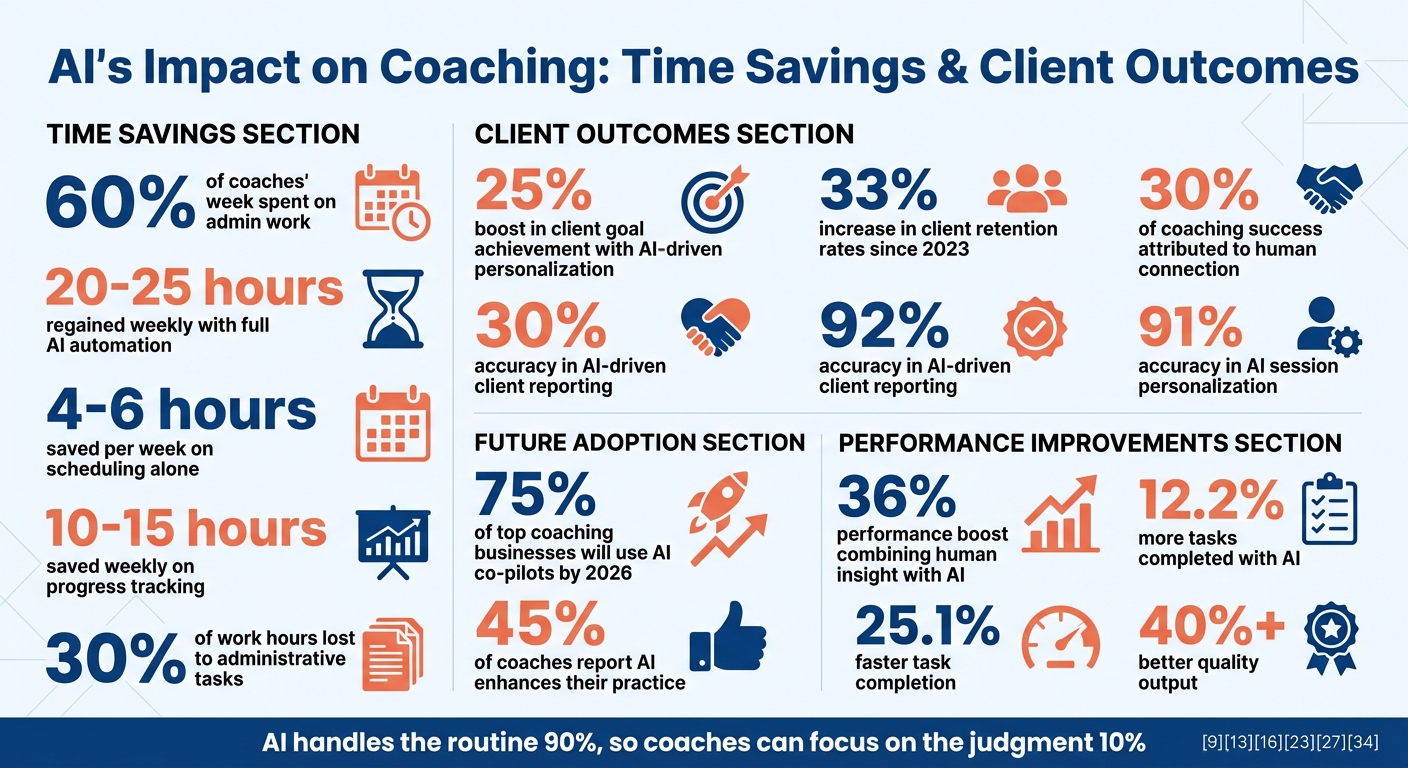
How AI Saves Coaches Time and Improves Client Outcomes: Key Statistics
Process Over Prompts: How Coaches Use AI to Increase Their Impact
sbb-itb-f7e72a6
Why Automation and Personalization Work Together
Let’s dive into how automation and personalization complement each other to enhance your coaching business. At first glance, automating parts of your work might seem like it would create a cold, impersonal experience for clients. But the truth is, automation actually paves the way for deeper personalization.
Here’s why: automation takes care of the repetitive, time-consuming tasks - like scheduling, invoicing, and session notes - that don’t require your personal touch. Experts often refer to these as the "routine 90%" of your operations. With those tasks out of the way, you can focus on the "judgment 10%" - the part that demands your empathy, intuition, and insight. When you’re not bogged down by admin work, you can be fully present with your clients.
The stats make it clear. Coaches lose about 30% of their work hours to administrative tasks that could easily be automated [9]. Some even report spending up to 60% of their week on non-coaching activities like managing emails, creating content, and taking notes [10]. That’s a huge chunk of time that could be redirected toward what you do best: coaching.
AI Supports Your Work, It Doesn’t Replace You
AI isn’t here to take over your role as a coach - it’s here to act as your assistant. Think of it as a tool that handles the logistical tasks draining your energy. For example, if an AI transcribes your session and generates a summary, it’s not replacing you. Instead, it’s freeing you to stay fully engaged in the conversation, without worrying about jotting down every detail.
"The goal is not removing the human element; it is protecting your capacity to deliver it." – Business Coach VAs Team [9]
Take scheduling as another example. AI tools can handle the back-and-forth emails about time zones and availability, eliminate double bookings, and prevent missed appointments. With automated scheduling alone, you could save 4 to 6 hours each week. That’s extra time you can use to prepare for sessions, engage meaningfully with clients, or even take a breather [9].
Remember, human connection is a key driver of coaching success - it accounts for 30% of client outcomes [4]. AI doesn’t change that. What it does change is how much energy you have to invest in building those connections. By lightening your administrative load, AI helps you show up as your best self for your clients.
How Automation Creates More Time for Personal Touch
Here’s where automation gets even more exciting: it doesn’t just save time; it helps you deliver a more personalized experience. AI can analyze patterns in session notes, client feedback, and progress data, uncovering trends you might not notice during live interactions. It’s like having an extra set of eyes to deepen your understanding of each client.
Coaches who fully embrace automation often regain 20 to 25 hours a week [9]. Imagine what you could do with that time. You could offer more tailored follow-ups, create customized resources, or research new strategies for specific client challenges. Automation also enables tools like automated nudges, reflection prompts, and accountability check-ins, which keep clients engaged between sessions. These aren’t one-size-fits-all messages - they’re tied directly to the goals and discussions you’ve had with each client.
The impact is real: AI-driven personalization boosts client goal achievement by 25% [6]. It’s not because AI is doing the coaching - it’s because the technology handles the behind-the-scenes work, giving you more bandwidth to focus on your clients. AI takes care of the "back of the house" operations, like scheduling and transcription, while you shine in the "front of the house" where the real coaching happens.
Picture this: a client gets a personalized check-in message at just the right moment, or you start a session already keyed into the themes from their journal entries that week. Far from feeling disconnected, your client feels more understood, more supported, and more valued. That’s the magic of automation and personalization working together. It lets you stay authentically human while amplifying the impact you have on your clients.
Automating Administrative Tasks to Focus on Clients
Automating repetitive tasks gives you more time to focus on personalized coaching and building meaningful client relationships. By leveraging AI for tasks like scheduling, follow-ups, and progress tracking, you can shift your attention to what truly matters - your clients.
Automated Scheduling and Follow-Ups
Coaches often spend 4–6 hours a week on scheduling alone [9]. Think about all the back-and-forth emails, time zone confusion, and the hassle of resolving double bookings. AI schedulers can handle this seamlessly by syncing client preferences directly with your calendar.
Take Reclaim ($8/month), for example. It not only schedules appointments but also adjusts recurring meetings when conflicts arise and reserves "Focus Time" for uninterrupted work. Another option, Motion ($29/month), organizes your calendar based on priorities you set, ensuring your schedule aligns with your goals [12].
Beyond scheduling, tools like Fathom and Hedy simplify follow-ups. They transcribe sessions, generate summaries, and outline action steps almost instantly [8][14]. Clients then receive personalized emails with their commitments and next steps. AI can also trigger automated welcome emails, session reminders, and post-session check-ins tailored to each client’s journey [9].
These tools don’t just save time - they ensure no detail slips through the cracks, allowing you to focus on delivering impactful coaching.
Automated Progress Tracking and Reports
Manually tracking client progress can be time-consuming and may overlook patterns like recurring challenges or shifts in motivation. AI steps in by analyzing transcripts from multiple sessions, identifying trends, tracking sentiment, and flagging unresolved issues [7][14].
For instance, AI tools can create weekly or monthly progress reports that combine session highlights, completed goals, and key metrics into one easy-to-digest summary [7]. Some tools even use sentiment analysis to monitor emotional cues, helping you spot dips in energy or motivation early [7]. Coaches using AI for tracking save an average of 10–15 hours per week [15].
AI-driven dashboards are highly accurate - up to 92% in client reporting [15]. They surface insights that might otherwise go unnoticed, like recurring obstacles, so you can enter sessions prepared to address key issues head-on.
That said, always review AI-generated summaries before sharing them with clients. While the technology excels at organizing data, your personal touch is essential to ensure the insights reflect the unique relationship you have with each client [8][13]. This balance of automation and human connection allows you to deliver a coaching experience that feels both efficient and deeply personal.
Using AI to Understand Your Clients Better
AI doesn't just streamline administrative tasks - it also helps you understand your clients on a deeper level. By analyzing client behavior and personalizing sessions, AI turns coaching into a data-informed practice. Tools like session transcript analysis and journaling insights uncover patterns that might otherwise go unnoticed. This allows you to combine your expertise with concrete, actionable data, creating a more tailored and impactful coaching experience.
Data-Driven Client Personalization
Natural Language Processing (NLP) tools are particularly powerful here. They can analyze session notes in real time, identifying emotional cues, recurring themes, and actionable insights. For instance, NLP can detect subtle patterns in syntax, pacing, or word choice - like moments of hesitation or breakthrough - that might slip by during live coaching sessions [16][11]. Rather than replacing your expertise, these tools enhance it, offering data-backed insights to guide your decisions with greater precision.
Predictive analytics also play a crucial role in keeping clients engaged. For example, if a client starts missing check-ins or their journal entries show signs of "emotional flattening", AI can alert you to re-engage before the situation escalates [16]. Since 2023, this proactive approach has boosted client retention rates by 33%, as coaches can intervene before clients lose momentum [15]. AI dashboards further enhance personalization by consolidating data from habit tracking, journaling, and reflection notes, enabling you to adapt strategies to each client’s unique journey [15].
Some platforms even use goal recognition engines to dynamically adjust objectives based on sentiment analysis and progress data [16]. For instance, if a client's confidence is improving or they’re recovering from stress more effectively, the AI might suggest recalibrating their goals to match their current state. These tools achieve up to 91% accuracy in session personalization, ensuring your coaching aligns with each client’s needs and progress [15]. This level of insight makes session preparation more focused and effective.
Better Session Preparation with AI
AI tools can transform how you prepare for sessions, saving time while enhancing the quality of your coaching. For example, transcription solutions can generate smart summaries of past sessions, highlighting emotional blind spots and recurring themes [16]. Instead of sifting through extensive notes, you receive concise reports that pinpoint critical insights - like which coaching framework is best suited to your client’s current behavior [16].
Activity reports compiled by AI provide a long-term view of client progress, tracking everything from portal logins to milestone achievements [11]. These detailed summaries make it easier to identify trends, such as improvements in stress recovery or confidence growth, offering tangible proof of transformation. This not only builds trust but also strengthens the coach-client relationship. On average, coaches using AI for preparation save 10–15 hours per week, freeing up more time for direct client interaction [15].
"AI isn't replacing coaches - it's enhancing human insight." - Safwan Azeem, Written By [15]
AI’s role is to provide a foundation, not the final say. By reviewing AI-generated summaries and combining them with your intuition, you can ensure every session is not only data-informed but also deeply personal. It’s this balance of technology and human connection that elevates the coaching experience.
Scaling Your Personal Touch with AI Assistants
Once you've developed a deeper understanding of your clients, the next step is scaling that personal connection. For coaches, one of the biggest challenges is being available when clients need you most. Life doesn’t operate on a 9-to-5 schedule - moments of clarity, doubt, or curiosity can strike at any hour. While you can’t be on call 24/7, AI assistants can fill that gap. They don’t replace you; instead, they extend your presence beyond live sessions. By 2026, 75% of top coaching businesses will use AI co-pilots, with 45% of coaches reporting that AI enhances their practice [11].
24/7 Client Support Through AI
AI assistants act as an extension of your support system when you’re unavailable. They can answer client questions, provide motivational boosts, or even help clients rehearse difficult conversations - like negotiating a raise - in a judgment-free space [3][7]. This creates a safe environment for clients to practice vulnerable skills before applying them in real-world situations [3].
The benefits are tangible. BetterUp, which has facilitated over 3 million coaching sessions since 2013, uses AI-powered "Smart Messaging" to send personalized follow-ups and reflection prompts tailored to each session [3]. Coaches who use these tools often see higher client engagement and more frequent session bookings [3]. Importantly, the AI doesn’t take over decision-making for clients. Instead, it keeps the momentum alive by delivering journaling prompts, accountability reminders, and resources that align with the goals discussed in your last session [1][11].
"If we can create technology that understands human language, we have a window at better understanding people. Then, we can create personalized solutions that are actually helpful for people." - Moritz Sudhof, Vice President of AI, BetterUp [3]
Even small interventions can make a big difference. For example, giving clients a five-to-eight-minute pre-session chat with an AI assistant helps them organize their thoughts and significantly boosts their satisfaction after the session [3]. This preparation ensures that your live sessions are as impactful as possible.
Training AI to Sound Like You
AI doesn’t just extend your availability - it can also replicate your unique coaching style. Tools like Coachvox and Delphi allow you to upload your content, such as books, podcasts, session notes, and blog posts, to create a "digital voice" that reflects your methodology [7][17]. This ensures that when the AI interacts with clients, it feels like a natural extension of your approach rather than a generic chatbot.
The process starts with role-based prompting. For example, you might instruct the AI, "You are a productivity coach specializing in ADHD entrepreneurs", and then refine its responses through feedback, a method known as "prompt chaining" [7]. If the tone feels off - too formal or too casual - you can adjust it to be "warmer" or "more motivational." Over time, you build a library of prompts that consistently deliver responses aligned with your brand [7].
Transparency is key here. Coaches should disclose AI usage in their agreements, explaining how it supports tasks like note-taking or between-session follow-ups [7][11]. This builds trust and sets clear expectations. As Charlene Boutin, a content strategy coach, explains:
"AI is your behind-the-scenes assistant, not your replacement. You still build relationships and provide human insight" [8]
How to Add AI to Your Coaching Practice
Once you've streamlined your administrative tasks, the next step is integrating AI to enhance how you personalize coaching. The good news? You don’t need to completely change how you work. Start small, test thoroughly, and expand on what works. Begin by auditing a week’s worth of tasks to identify repetitive activities like email management, scheduling, or content creation - tasks that demand your input but not your physical presence [7]. This simple step helps you figure out where AI can make an immediate difference while keeping your client relationships intact.
Selecting AI Tools for Your Practice
When choosing AI tools, focus on solving specific challenges. Test one tool at a time for 30 days, starting with internal tasks like drafting emails or summarizing sessions. For example, if transcription eats up hours every week, try tools like Otter.ai or Fathom to automate session notes. If creating content is draining, tools like ChatGPT or Jasper can help draft blog posts or social media captions [7][18]. For coaches, platforms like Brandbase offer AI assistants tailored to your needs, managing lead qualification and client support while integrating seamlessly with tools you already use - like your CRM, calendar, and contact forms.
Once your AI tools are up and running, you might consider introducing tiered service models. For instance, a lower-cost option could include AI-supported habit tracking and chatbot access, while your premium tier focuses on one-on-one coaching sessions. This way, you can reach more clients without losing the personal touch that defines your practice [5].
After selecting a tool, the next step is ensuring it reflects your unique coaching voice.
Customizing AI to Match Your Voice
Generic AI outputs often fall flat because they lack your unique tone and methodology. To fix this, use role-based prompts like, "Act as a business strategist for service companies", and feed the AI your session notes, blog posts, or transcripts. This allows the AI to align with your coaching philosophy [7][13]. Build a prompt library to store tried-and-true formulas for tasks like sales emails, session summaries, or content ideas. This ensures the AI consistently produces work that feels aligned with your brand.
That said, AI-generated content should never be sent or published without your review. Add your personal stories, insights, and that "human touch" that makes your coaching irreplaceable [13][18]. Research shows that consultants using AI completed 12.2% more tasks, 25.1% faster, and with over 40% better quality. However, errors increased by 19% when AI was used for tasks it wasn’t built to handle [18]. Your input is essential to maintaining high-quality results and keeping your voice authentic.
Once your AI reflects your style, regular testing and fine-tuning will help maintain that authenticity.
Testing and Refining Your AI Tools
Testing isn’t a one-and-done process - it’s something you’ll revisit regularly. During client sessions, ask questions like, "Did the chatbot give you any advice that didn’t feel right?" [5]. Their feedback will highlight areas where adjustments are needed.
Use prompt chaining to refine AI outputs over time. For example, take an AI-generated response, feed it back into the system, and ask for specific improvements. If the tone feels too formal, request something "warmer" or "more conversational." If it’s vague, ask for "three actionable steps." This iterative process helps the AI consistently produce on-brand results. And don’t forget to ensure any tool you use is compliant with GDPR, CCPA, or HIPAA to safeguard client data [20][11]. Transparency is key - include AI usage in your agreements, explaining how it supports tasks like note-taking or follow-ups between sessions [7][11].
"AI is your smart assistant, not your replacement. Automations create bandwidth; your deepest impact comes from human connection." - Ria Aichour, Business Coach [19]
Conclusion
AI isn’t here to take over coaching - it’s here to enhance it. By managing time-consuming tasks like scheduling, note-taking, and habit tracking, AI allows you to focus on what truly matters: understanding and responding to the subtle cues that lead to meaningful transformation [1][2]. By 2026, 75% of top-performing coaching businesses will regularly use AI tools, and nearly half of coaches will report that AI strengthens their practice rather than replacing their role [11]. The numbers tell the story: AI-driven personalization improves client goal achievement by 25%, while combining human insight with AI support boosts basic performance by 36% [6][21].
What makes coaching irreplaceable is your empathy, intuition, and ability to connect on a deep level. While AI can identify patterns and provide data-driven insights, only you can offer the kind of genuine care that fosters real change [6]. As Daniel Goleman aptly said:
"AI can recognize emotions, but only humans can deeply empathize and respond in a meaningful way" [6].
The future of coaching isn’t about choosing between technology and human connection - it’s about leveraging AI to create more space for the relationship-building that makes coaching so impactful.
Start small: try one AI tool for 30 days to save time on routine tasks [11]. Use that extra time to focus on what sets you apart - your presence, your compassion, and your ability to guide clients through their most challenging moments. AI isn’t here to replace you; it’s here to work alongside you [1][2].
The coaches who will excel in 2026 aren’t those who avoid AI - they’re the ones who embrace it to amplify their humanity. By integrating AI into your practice, you can strengthen the human connection at the heart of every coaching session.
FAQs
Will AI make my coaching feel less personal?
AI doesn't replace the personal touch in coaching - it can actually strengthen it. By taking care of tasks like monitoring progress and providing detailed insights about your clients, AI gives you more time to focus on what truly matters: building genuine connections, tailoring your methods to individual needs, and bringing more empathy into every interaction.
How do I use AI without risking client privacy?
To ensure safe use of AI, focus on platforms that prioritize privacy and security. Look for features like data encryption, data isolation, and clear governance policies. Avoid sharing sensitive or personal information unless you’re confident the platform guarantees privacy and complies with relevant regulations. Always verify if the platform stores or uses your data for training purposes, and establish clear guidelines for how your data is handled. Opt for AI tools specifically designed for coaching that emphasize confidentiality and foster trust.
What’s the best first AI task to automate?
The ideal first step in automating with AI is tackling administrative work - things like scheduling, taking notes, and tracking progress. These tasks often eat up valuable time but don’t require the human touch that client interactions do. By automating these processes, you free up time to focus on what matters most: building authentic relationships and delivering tailored coaching experiences.
Related Blog Posts

Blog title heading will go here
Blog title heading will go here