
9 LinkedIn Moves Coaches Are Using to Get Clients Without Sending Spammy Messages
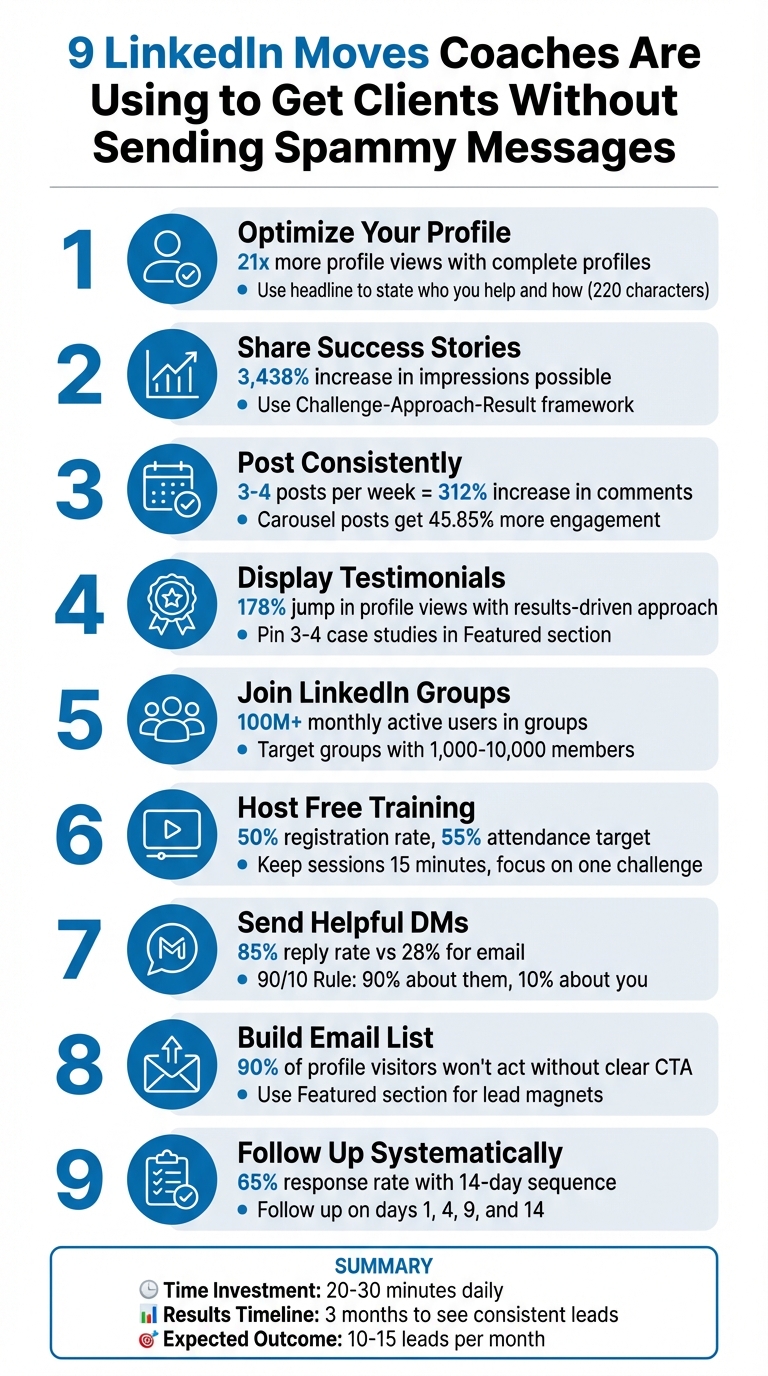
LinkedIn is a goldmine for coaches looking to attract clients without resorting to spammy tactics. Instead of cold pitches, focus on strategies that build trust and showcase your expertise. Here are 9 proven moves to grow your coaching business on LinkedIn:
- Optimize Your Profile: Use your headline to clearly state who you help and how. Highlight client results and success stories in the About and Featured sections.
- Share Success Stories: Post specific client outcomes using numbers and timelines to make your impact clear.
- Post Consistently: Aim for 3–4 posts per week. Share tips, personal stories, and industry insights to stay visible and relevant.
- Leverage Testimonials: Showcase measurable client results in your profile and posts to build credibility.
- Engage in LinkedIn Groups: Join active groups where your ideal clients are present, and contribute meaningful insights to discussions.
- Host Free Training or Q&A Events: Use LinkedIn Live to demonstrate your coaching style and provide immediate value.
- Send Helpful Direct Messages: Personalize your outreach by addressing specific challenges or goals without pitching.
- Turn Connections Into Email Subscribers: Use lead magnets in your Featured section and follow up with tailored DMs to grow your email list.
- Follow Up With Prospects: Create a 14-day follow-up sequence to stay top of mind and turn interest into action.
These strategies are about connecting with the right people, sharing value, and building relationships - not chasing leads. Dedicate 20–30 minutes daily, and you’ll see results in just a few months.
9 LinkedIn Strategies for Coaches to Attract Clients Without Spam
LinkedIn for Coaches: How to Attract Clients Without Going Viral
sbb-itb-f7e72a6
1. Build a LinkedIn Profile That Shows What You Do and Who You Help
Your LinkedIn profile is more than a digital resume - it's a tool to convert visitors into clients. Many coaches make the mistake of focusing on job titles and credentials, but the real magic lies in addressing your audience's challenges and showing how you can help.
Start with your headline. You’ve got 220 characters to grab attention, yet many people don’t use this space effectively [7]. Instead of generic titles like "Executive Coach" or "Leadership Consultant", focus on a formula that speaks directly to your ideal client: "I help [specific audience] achieve [specific outcome] through [unique method]" [3]. For instance: "I help tech executives lead high-performing teams without burnout through leadership frameworks."
"When you list your job title and company name in your headline, you are providing identification rather than differentiation. In a search result... differentiation is everything." - SocialLions Blog [7]
The About section gives you 2,600 characters to tell your story, but only the first 270 to 310 characters show before the "see more" link [7][1]. Those opening lines are critical - they need to immediately connect with the pain points of your target audience. For example: "Scaling a business while managing a team is exhausting. You're working 60-hour weeks, your team needs constant direction, and you're still the bottleneck."
The Featured section is your chance to shine. Use it to showcase case studies, testimonials, or booking links [2][1]. This is where you provide proof that you deliver results. A complete profile can generate 21x more profile views and 36x more messages [9]. Don’t leave any section blank - it’s an opportunity to stand out.
Once your profile is optimized, you’ll be in a strong position to connect with your audience through content and conversations.
2. Share Client Success Stories That Show Real Results
Success stories are more than just proof of your skills - they help potential clients picture the kind of success they could achieve with your help. To make these stories impactful, skip vague statements and focus on specifics like numbers, timelines, and clear outcomes.
One effective way to tell these stories is by using the Challenge-Approach-Result framework [2]. Start by explaining the problem your client faced, describe the methods you used to address it, and wrap up with hard data that highlights the results. This format makes your case studies both structured and convincing.
Take this example: Meredith Farley, founder of Medbury, saw a staggering 3,438% increase in impressions between January and March 2026. Her secret? Swapping out corporate jargon for personal stories about hiring struggles and entrepreneurship. This shift not only eliminated her need for outbound prospecting but also shortened her sales cycle by 40% [10]. Another example features a B2B SaaS consultant with fewer than 300 followers. By posting just four high-intent posts each month about reducing churn, they generated over 15,000 targeted impressions and closed three five-figure contracts via LinkedIn DMs - all within 90 days [10].
"In 2026, people buy from humans, not logos. But those humans must be visible. Authentic content combined with algorithmic optimization is the ultimate leverage."
- Meredith Farley, Founder of Medbury [10]
To make your LinkedIn profile stand out, pin your best success stories in the Featured section. Whether it’s a PDF case study, a testimonial video, or a carousel post, these pinned highlights can instantly demonstrate your results [1][2].
3. Post Regularly With Helpful Content
Once you've shared client success stories, the next step is to solidify your presence by consistently posting content that's genuinely useful. But don't go overboard - posting 3–4 high-quality posts a week is ideal. Overposting can lead to a 40% drop in reach [12][13][14].
Focus on creating posts that offer immediate value. Share before-and-after transformations from your coaching sessions, break down your frameworks into actionable tips, or challenge common industry practices with fresh perspectives. Take Sarah, a fractional CMO, as an example: she posted four times a week - two posts on frameworks, one personal story, and one contrarian opinion. The result? A 312% increase in comments, 47 leads in 90 days, and three closed deals worth $38,000 [16]. Pairing valuable insights with smart formatting can significantly boost engagement.
Choose Formats That Engage
Certain formats naturally perform better. For instance:
- Carousel posts generate 45.85% more engagement and encourage viewers to spend 2–3 times longer on your content.
- Short videos (15–90 seconds) with captions consistently grab attention and drive interaction [11][16][18].
No matter the format, make sure your main takeaway appears early in the post to grab attention. And here's a pro tip: respond to comments within the first 60–90 minutes. This small action can dramatically increase your post's reach [11][15].
"LinkedIn's algorithm now identifies subject-matter experts and boosts their content to relevant audiences. Consistent posting within your expertise area builds that recognition."
- Postking Editorial [17]
Keep It On-Brand and Self-Contained
Every post should tie back to your brand's core promise. Avoid including external links - they can slash your reach by 60% [18]. Instead, aim to deliver complete value within the post itself. Treat each one like a mini-training session, solving a specific problem for your audience. This approach keeps your content engaging and positions you as a go-to expert in your field.
4. Display Client Testimonials and Results on Your Profile
Your LinkedIn profile needs to establish trust quickly [21]. Testimonials and results, strategically placed, act as a form of "trust currency" that can encourage prospects to take the next step, like booking a call [21].
Start by focusing on your Featured section. Pin 3–4 posts that work as mini case studies, showing specific client successes with real, measurable outcomes. Use testimonial videos (ideally 60–90 seconds long) or case study PDFs that demonstrate clear transformations [2][21]. For instance, a marketing agency owner who revamped their profile with a results-driven approach saw a 178% jump in profile views and 22 qualified inbound inquiries within 90 days [21].
Next, transform your About section into a mini sales page. Include a "Proof Points" section that highlights 2–3 specific client achievements, such as percentages, dollar amounts, or timeframes [21]. For example, saying "Assisted 12 executives in securing promotions within six months" is far more impactful than a generic claim like "extensive experience." Concrete numbers build trust, while vague statements often lead to doubt [19][20].
In the Experience section, format your achievements as success stories. Use bullet points to outline client wins and measurable outcomes [21]. To keep your profile fresh, gather "micro-proof" weekly by asking clients, "What’s improved this week?" These small wins can showcase the immediate impact of your work [19].
"Client testimonials aren't 'nice to have' in 2026 - they're the trust currency that decides whether a prospect books a call or bounces in 9 seconds."
- Safwan Azeem, Dual Health & Life Coach [19]
5. Join Conversations in LinkedIn Groups Where Your Clients Spend Time
LinkedIn Groups have made a comeback, drawing over 100 million monthly active users as of 2026 [22]. The key is to join groups where your ideal clients are already active. Think of spaces like "SaaS Founders", "CFO Forum", or "Austin Tech Executives."
Focus on groups with 1,000 to 10,000 members. This size strikes a balance: big enough to expand your reach but small enough to avoid getting lost in the noise or overwhelmed by spam [23]. Before diving in, check for recent and meaningful activity - skip groups filled with generic comments like "Great post!" [24].
Spend 3–7 days observing the group. Pay attention to the culture, key contributors, and recurring challenges. This will help you craft responses that resonate and add value. By engaging thoughtfully, you’ll build credibility and strengthen your personal brand. A good rule of thumb? Follow the 10:1 approach: for every original post you share, contribute 10 insightful comments. This keeps the focus on genuine interaction rather than self-promotion [23].
When you engage, follow a simple formula: acknowledge the discussion, share your perspective, and end with a question to keep the conversation going [23]. Don’t shy away from sharing lessons learned from your failures - these often spark meaningful discussions and foster deeper connections [24].
"The strategy isn't to join any group - it's to find the 3-5 groups where your ideal clients actively participate."
One major perk of group membership? You can message members directly, even if you’re not connected [22]. When reaching out, reference a specific group discussion that caught your attention. Offer a helpful resource before suggesting a meeting - this approach feels more personal and less transactional [28, 30].
Engaging in these groups sets the stage for more targeted and effective outreach down the line.
6. Run Free Training Sessions or Q&A Events on LinkedIn
LinkedIn Live sessions are a fantastic way to let potential clients experience your coaching style before they commit to a paid service. Picture this: a quick 15-minute session focused on solving a single challenge. It’s just enough time to showcase your expertise, energy, and approach without overwhelming your audience. Plus, most LinkedIn users are already in a growth mindset, actively seeking ways to improve professionally or solve business challenges [2]. This kind of live interaction builds on the trust you’ve already established through your profile and content.
Keep it short and impactful. Instead of lengthy webinars, stick to concise Live sessions that tackle one specific issue. For instance, back in April 2026, MavX London hosted a 3.5-hour live workshop called "WIN Your Next Client on LinkedIn." They used the Five Ones Framework and offered tiered pricing options (Standard: $165, Premium: $655, VIP: $1,315). Attendees walked away with practical tools like workbooks and live coaching, making the session both engaging and actionable [25].
Promote your event strategically. Start spreading the word a few days in advance. Use LinkedIn’s Featured section to link directly to your registration page [8]. To maximize visibility, engage with 5–15 posts in your niche before announcing your event [2]. During the session, include 2–3 polls to better understand your audience’s needs. This not only boosts engagement but also helps you tailor your follow-up conversations [26].
"If you want to attract high-paying coaching clients, look at speaking at other people's virtual summits or in-person conferences or host your own virtual workshop or virtual summit." - Liam Austin, Co-founder, Entrepreneurs HQ [8]
After your event, it’s time to dive into the data. Aim for a 50% registration rate and 55% attendance to gauge success [26]. Use LinkedIn’s Event admin panel to download the attendee list, including names, headlines, and companies. This information is gold for crafting personalized follow-ups with top prospects [26].
7. Send Direct Messages That Offer Help, Not Sales Pitches
When reaching out on LinkedIn, focus on the recipient's needs to spark meaningful conversations. LinkedIn messages have an impressive 85% reply rate, far surpassing the 28% typical for email. However, about 90% of users ignore messages that kick off with a sales pitch [28]. So, what's the key? Many experts recommend the 90/10 Rule: dedicate 90% of your message to addressing the prospect’s challenges, goals, or industry trends, and only 10% (or less) to yourself.
Start with research, not a template. Before sending a message, take the time to review the recipient's recent posts, achievements, or shared articles. This helps you craft a message that feels personal. For example, opening with something like, "I found your recent post on remote team scaling insightful…" demonstrates you’ve done your homework. Then, offer something genuinely helpful - like a relevant case study, a simple framework, or a thoughtful question that might uncover a challenge they’re facing [28][29]. This kind of personalized outreach sets the stage for a thoughtful follow-up strategy.
"LinkedIn direct messages aren't email... Think of them as walking up to someone at a conference - except you can check their entire professional background first." - AIFreeForever Team [28]
Keep it short and conversational. Messages under 100 words tend to perform best, especially since many people check LinkedIn on their phones [27]. Instead of jumping straight to a meeting request, try asking open-ended questions like, "Is this something you're exploring?" or "Would a quick exchange of ideas be helpful?" Timing also matters - send messages between 9:00 AM–11:00 AM or 1:00 PM–3:00 PM (Tuesday through Thursday) for better results. After a connection request is accepted, wait 2–3 days before following up to avoid coming across as automated [27][28][29].
Think beyond a one-and-done approach. A single message won’t cut it. Develop a sequence of 3–4 personalized follow-ups, spaced 7–10 days apart, to increase your chances of a response [27][28]. Each follow-up should bring something new to the table, whether it’s a useful resource, a fresh perspective, or a targeted question about their current challenges. And to stay compliant with LinkedIn’s messaging limits in 2026, keep your manual outreach within 20–40 new connection requests and 40–60 total direct messages per day [29][1].
8. Turn LinkedIn Connections Into Email Subscribers
Once you've started personalized conversations on LinkedIn, the next step is to strengthen those relationships by turning connections into email subscribers. LinkedIn is a great platform for generating high-quality leads, but email is where you can nurture those leads effectively. Since inbound leads tend to convert better, this follow-up process is essential.
Use the Featured Section to highlight lead magnets. This prime spot, located just below your profile summary, is ideal for showcasing free resources like checklists, mini-guides, or case studies. When people visit your profile after seeing your content or accepting your connection request, these resources are front and center. According to Coachvox, 90% of people who view your LinkedIn profile won’t take any action unless you provide a clear and valuable reason to [4]. A strategically placed lead magnet can make all the difference.
Send a value-packed DM sequence. After connecting, wait 2–3 days before sending a message that shares a resource tailored to their interests. For instance, if they’ve posted about challenges in team management, send them a helpful article or framework - no sales pitch. A few days later, follow up with a simple, low-pressure question like, "Is this something you’re currently working on?" In your third message, you can gently invite them to join your email list for deeper insights [1]. This approach stays within LinkedIn’s safety limits of 20–30 DMs per day and builds trust without overwhelming your new connections [1][5].
"Once a lead moves from LinkedIn DMs to email, hand them directly into the inbound follow-up sequence, the full 7-touchpoint email follow-up that runs from there." - Akash Upadhyay, Modern Outreach [1]
Automate the process. Use tools like Make ($9/month), Reply.io ($49/month), or HubSpot (free to start) to automate the transition from LinkedIn to your CRM. Once there, prospects can be enrolled in a 7-touchpoint email sequence. This ensures that no lead gets overlooked while maintaining the personal connection you built on LinkedIn. By combining automation with the rapport you’ve already established, you can scale your follow-up efforts without losing that personal touch.
9. Create a System for Following Up With Interested Prospects
Turning initial interest into commitment often hinges on having a reliable follow-up system. Many coaches miss out on potential clients simply because their follow-up process lacks consistency. A 14-day follow-up sequence helps you stay visible without overwhelming your prospects. Spacing messages strategically - on days 1, 4, 9, and 14 - ensures each touchpoint provides value rather than feeling like a generic check-in [30].
Start by sending your first message 2–4 hours after your connection request is accepted. This timing helps your message feel personal, not automated. On day 4, share something genuinely helpful, like a short video (under two minutes) or a one-pager addressing a challenge they’ve mentioned. By day 9, make it easy for them to respond by offering a simple choice: "Would a 10-minute call help, or should I send over a case study?" [30].
Real-world success stories highlight how effective this system can be. For example, in early 2026, Anton Titov, the founder of Archway.Finance, achieved a 65% response rate from 400 agency owners using this method. His campaign generated 148 replies and helped secure over $1 million in funding [6]. Similarly, Alex Galbreath of Flying V Group saw a 41% response rate, averaging 36 replies per month, by implementing a nine-to-ten message follow-up sequence [6].
Persistence often makes the difference, as Akash Upadhyay from Modern Outreach explains:
"Someone who accepted your connection request and went quiet is not uninterested. They were busy, they got distracted or your first message did not land at the right moment." - Akash Upadhyay, Modern Outreach [1]
If you still haven’t heard back by day 14, send a short closing message that keeps the door open: "I know the timing isn’t right - feel free to reach out when priorities shift." [30]. For those who remain unresponsive, set a reminder to reconnect in 90 days. Circumstances change, and a well-timed follow-up could make all the difference.
Conclusion
Growing your LinkedIn coaching practice doesn’t mean resorting to pushy sales tactics. Instead, it’s about fostering genuine connections. The nine strategies outlined here - like transforming your LinkedIn profile into a compelling landing page and creating a thoughtful follow-up system - all center on one key idea: offering value and building relationships, rather than chasing quick wins.
The results speak for themselves. Helping potential clients first, without expecting anything in return, proves to be a winning strategy. As Akash Upadhyay from Modern Outreach explains:
"LinkedIn isn't about luck. It's about doing the right things, consistently." - Akash Upadhyay, Modern Outreach [1]
Consistency is the secret ingredient. Most coaches find that their LinkedIn efforts start yielding steady results within three months. The first month is all about laying the groundwork, the second month builds momentum, and by the third month, many report generating 10 to 15 leads per month [1]. The key? Dedicate 20 to 30 minutes daily to meaningful engagement, post 3 to 5 times a week, and follow up with prospects in a way that feels helpful and authentic. This regular effort creates a ripple effect, leading to long-term success.
With over 65 million active decision-makers on LinkedIn and 4 out of 5 members influencing business decisions [3], the platform is packed with opportunities. By showing that you understand your audience’s challenges and consistently sharing value, you can create a system that attracts clients naturally. Start applying these strategies now, and you’ll build a practice where clients come to you - no chasing required. It’s all about cultivating trust through consistent, value-driven interactions.
FAQs
What should I put in my LinkedIn headline?
Your LinkedIn headline should be clear and specific about your role or expertise while emphasizing the value you bring. Steer clear of vague job titles or language that feels overly promotional. For instance, rather than just saying "Strategic Advisor", clarify the area you specialize in and the results you help achieve. This approach demonstrates your awareness of what potential clients are looking for and boosts your credibility, making it easier to connect with the right audience.
How do I turn LinkedIn connections into email subscribers?
To turn your LinkedIn connections into email subscribers, start by building trust and offering genuine value. Begin with an optimized profile that resonates with your target audience. Share informative and engaging content that demonstrates your expertise, and actively participate in conversations by leaving thoughtful comments and responses. Once you've established a connection and trust, encourage them to subscribe by including a clear call-to-action - like a free resource or a link to your newsletter.
What should my LinkedIn follow-up sequence look like?
When crafting a LinkedIn follow-up sequence, the goal is to build trust and offer value, not to dive straight into pitching. Here's how you can approach it:
-
Start with a Personalized Connection Request
Mention something specific, like a shared interest, mutual connection, or their recent post. This shows you’ve taken the time to understand their profile and makes your request feel genuine. -
Engage with Their Content
Spend a few days interacting with their posts - leave thoughtful comments, react to updates, or share their content if relevant. This helps you stay on their radar without being pushy. -
Send a Value-Driven Message
Once you’ve established some familiarity, send a message that offers something helpful. This could be a resource, an article, or insights related to their field. The key is to make it about them. -
Build Rapport Before Making an Offer
After some meaningful interactions, you can suggest a discovery call or share a free resource. Keep it low-pressure and focused on solving their problem or adding value. -
Follow Up Gently
If you don’t get a response, wait about a week before sending a polite follow-up. Space out your messages to avoid coming across as intrusive or overly persistent.
By focusing on connection and value, you can create a follow-up sequence that feels natural and encourages meaningful conversations.
Related Blog Posts

Blog title heading will go here
Blog title heading will go here