
7 Things Every Coach Needs Online Before Spending a Dollar on Ads
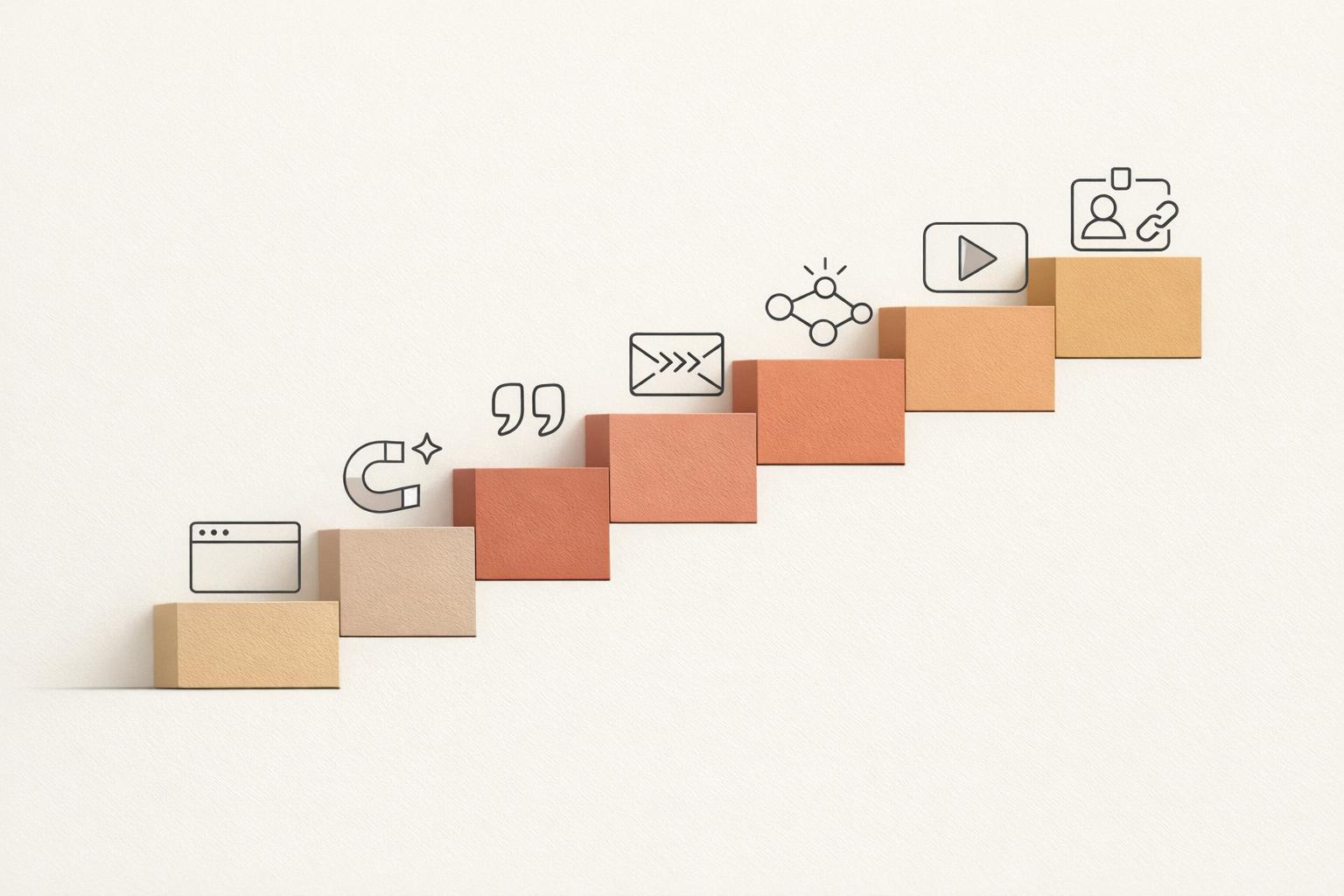
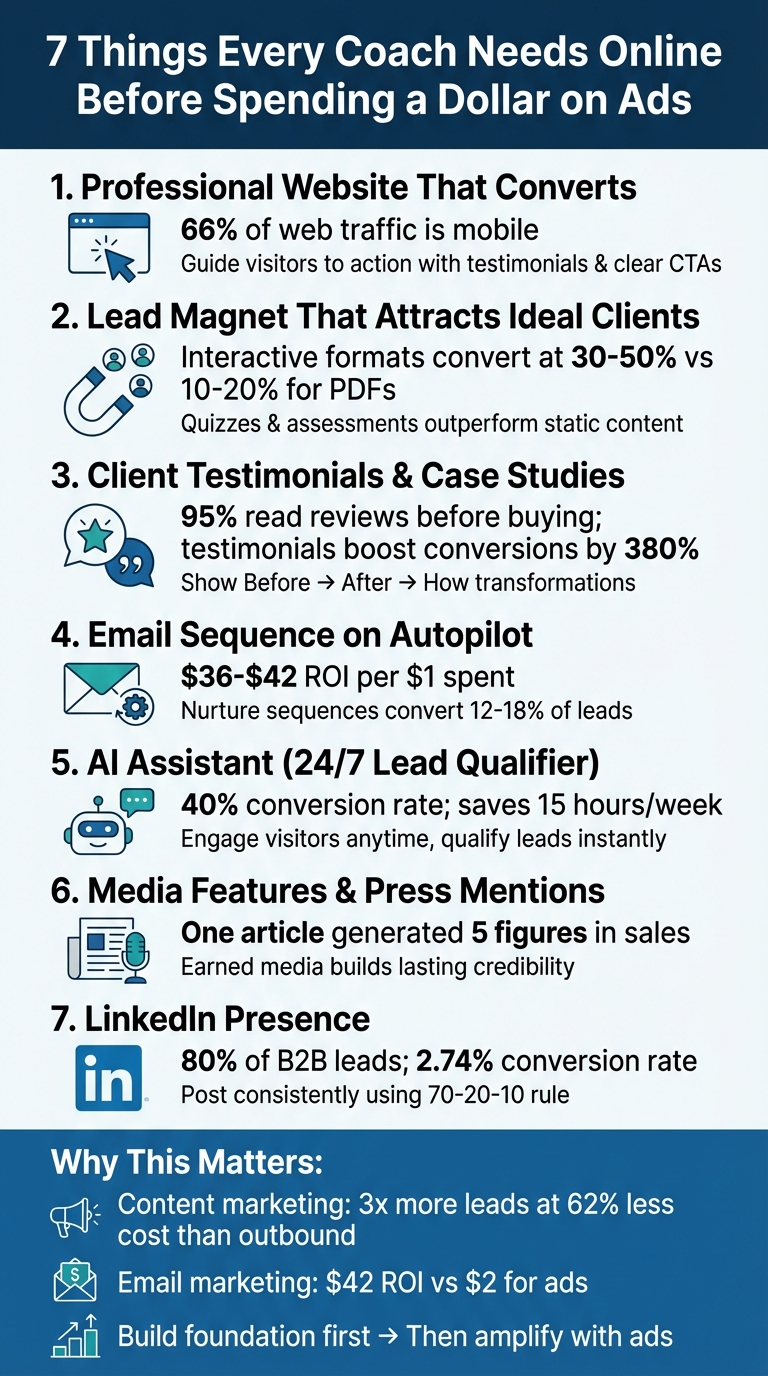
Want to make your coaching business thrive before investing in ads? Here’s the deal: Ads can’t fix a weak foundation. Before spending money, focus on these seven must-haves to attract clients organically and build trust.
- Professional Website: Your website should guide visitors to take action, showcase your expertise, and work seamlessly on mobile devices. Use testimonials, updated headshots, and clear service pages to build trust.
- Lead Magnet: Offer a free resource (like a quiz or guide) to collect emails and engage potential clients. Interactive formats convert better than static ones.
- Client Testimonials: Share real success stories to prove your coaching delivers results. Highlight "before → after → how" transformations.
- Email Sequence: Use automated emails to nurture leads, share insights, and address objections. A structured sequence can turn curiosity into paying clients.
- AI Assistant: Engage visitors 24/7 with an AI tool to answer questions, qualify leads, and save time.
- Media Features: Earned media (like podcasts or articles) boosts your credibility and continues to work long after publication.
- LinkedIn Presence: Optimize your profile and post consistently to connect with your ideal audience. Share valuable content and success stories to generate leads without ads.
Why this matters: Organic strategies like these cost less and deliver long-term results. Ads should only amplify what’s already working. Start with these tools, then scale with ads when your foundation is rock-solid.
7 Essential Online Assets Coaches Need Before Running Ads
How to Get Coaching Clients Without Paid Ads (The $0 Strategy That Fills Your Calendar)
sbb-itb-f7e72a6
1. A Professional Website That Converts
Your website is the heart of your online presence. It's where potential clients decide whether to trust you or move on. Without a site that effectively turns visitors into clients, even the best marketing campaigns - whether organic or paid - won't deliver results. A successful website doesn’t just look good; it guides visitors seamlessly from curiosity to action.
How it builds trust and credibility
The trust-building process starts the moment someone lands on your homepage. Your unique selling proposition (USP) should immediately communicate what sets you apart from other coaches and why that matters to potential clients [3]. For example, Hush Blankets turned a modest $4,000 investment into $48 million in revenue by using founder-led storytelling to establish trust [4].
"Founder-led storytelling creates trust faster than any paid advertising campaign because it reveals the human behind the brand" [4].
Your "About Us" page is another key trust-builder. Use this space to share your personal journey, mission, and core values instead of just listing credentials. While certifications and professional affiliations are important, pairing them with authentic storytelling helps clients connect with the person behind the expertise. Also, keep your professional headshots updated every two years to ensure your online presence reflects your current appearance [3][4]. And don’t overlook mobile optimization - over 66% of web traffic now comes from mobile devices, so your site needs to look polished on any screen size [3].
Once trust is established, the next step is turning interest into action.
How it captures and nurtures leads without paid ads
After building credibility, your website should focus on converting visitors into leads. This is where well-placed, personalized calls-to-action (CTAs) come in, guiding users to book consultations or sign up for newsletters [3]. A "Get Started" page can act as a roadmap for first-time visitors, making it easy for them to navigate your site. Ensure that any piece of information is no more than three clicks away - this prevents frustration and reduces the chances of visitors leaving your site [3][4].
Your blog is another powerful tool. By sharing expert insights, you not only establish authority but also boost your search engine rankings [3].
"Individuals are not merely purchasing services; they are investing in relationships, stories, and experiences" [3].
Client testimonials and case studies are essential here. Showcase stories that detail the challenges your clients faced, the coaching process, and the positive outcomes. This helps prospects visualize their own potential transformation [3].
How it supports long-term brand authority
A well-optimized website does more than drive immediate conversions; it supports your long-term growth by capturing users actively searching for solutions [5]. To enhance your SEO, create dedicated pages for each coaching niche or service you offer. This structure not only improves visibility but also helps prospects quickly find what they need [4].
Consistency is another hallmark of professionalism. Document your brand colors (hex codes), fonts, and logo variations in a style guide to ensure your visuals are cohesive across all platforms. This attention to detail reinforces your professionalism [4].
For high-ticket services like coaching, the decision-making process can take months - especially for B2B buyers [4]. To support this, your website should include transparent service pages with clear pricing or package details, allowing prospects to self-qualify and move forward with confidence [3]. By building this strong foundation, your website primes your marketing efforts, ensuring that any future investment in ads amplifies an already effective system.
2. A Lead Magnet That Attracts Your Ideal Clients
Once you’ve got a website optimized for conversions, the next step is setting up a lead magnet to build trust and start engaging with potential clients. A lead magnet is essentially a freebie - a resource that solves a specific problem for your audience in exchange for their email address. Why is this so important? Because only about 5% of your audience is ready to buy right now. The other 95%? They need time, nurturing, and trust-building. Without a lead magnet, that 95% could slip away forever [6].
How It Builds Trust and Credibility
A good lead magnet builds trust by delivering an immediate, tangible solution to a real problem your audience is facing [10]. Think of it as a preview of your coaching style. If someone sees results - even small ones - from your free resource, they’re much more likely to trust you with bigger challenges [7].
The format of your lead magnet can make or break its effectiveness. Static PDFs, like eBooks or guides, typically convert around 10-20%. But interactive formats, like quizzes and assessments, can boost conversion rates to 30-50% [6]. For example, in 2025, a career coach replaced a generic “10 Tips for Your Job Search” PDF (which had a 4% conversion rate) with a “Career Readiness Assessment” quiz. The result? A 38% conversion rate. By using quiz responses to tailor follow-up emails - sending interview tips to those struggling with interviews and resume advice to others - the coach doubled email open rates and booked more discovery calls in three months than the entire previous year [6].
How It Captures and Nurtures Leads Without Paid Ads
Your lead magnet isn’t just about collecting emails - it’s about attracting the right people. For example, a business coach offering a "Revenue Goal Planner" will naturally draw in entrepreneurs focused on growth, not hobbyists. This means the leads you capture are already aligned with your services [7].
Interactive lead magnets do double duty: they engage visitors while gathering valuable insights about their challenges. Quizzes, for instance, keep users on your page up to three times longer than static content [8]. Even more, AI-powered lead magnets generate leads that are 25% more likely to book discovery calls [8]. Once someone downloads your lead magnet, you can set up an automated email sequence to nurture them over time - keeping the relationship warm without lifting a finger [10].
"The goal isn't to collect leads. The goal is to attract future clients." - Heather Stephens, Founder, WiseOwl Marketing [6]
This kind of automation doesn’t just save time; it grows with your business, ensuring you stay connected with potential clients as you scale.
How It Scales as Your Business Grows
A well-thought-out lead magnet doesn’t just work today - it evolves alongside your business. Start simple, with something like a checklist or mini-assessment, and build from there [9]. Tools like Interact ($17-$79/month), Typeform ($25-$83/month), or Outgrow ($14-$95/month) make it easy to create interactive quizzes or calculators that adapt to users’ responses [8].
3. Client Testimonials and Case Studies
Once you have a well-designed website and an effective lead magnet, the next step to solidifying your credibility is showcasing real client results. Let’s face it - self-promotion only goes so far. People want proof, and the best way to provide it is through testimonials and case studies. These act as powerful tools of trust, often determining whether a potential client books a call or moves on [12]. When done right, they serve as essential social proof, helping your business grow organically and ensuring your marketing efforts pay off.
How It Builds Trust and Credibility
Hearing about your success from someone else carries far more weight than hearing it from you [11]. When a former client shares their story of transformation, it’s not just inspiring - it’s evidence that your approach delivers results. For example, between late 2024 and early 2025, a mindset coach working with corporate women saw her monthly revenue skyrocket from $2,000 to over $20,000 in just six months. How? By weaving real client success stories into her email campaigns. Her subscriber list expanded from 500 to 6,200, and her monthly client roster grew from 4 to 18 [13].
The most effective testimonials follow a simple structure: "Before → After → How". They outline the struggles a client faced before working with you, the improvements they’ve experienced, and the specific aspects of your process that made those changes possible [12]. Consider this: 95% of people read online reviews before committing to a service, and 42% trust those reviews as much as personal recommendations [14]. That’s how powerful a well-crafted testimonial can be.
How It Captures and Nurtures Leads Without Paid Ads
Testimonials don’t just build trust - they also attract the right audience while weeding out those who aren’t a good fit. Take the example of a business coach who generated $30,000 in high-ticket sales (six clients at $5,000 each) within 90 days. How did she do it? By sharing client success stories on LinkedIn instead of relying on cold outreach. This strategy resulted in 15 qualified sales calls - all without spending a dime on ads [13].
To make testimonials even more effective, organize them by the specific challenges your clients overcame, like confidence or consistency. This ensures prospects can quickly find stories that resonate with their own struggles [12]. Featuring testimonials prominently, especially for premium offerings, can significantly impact your bottom line. For instance, showcasing reviews for high-ticket packages has been shown to boost conversion rates by up to 380%, while prominently placed testimonials can increase signups by over 64% [14].
How It Scales as Your Business Grows
Don’t wait until a program ends to start gathering proof of your success. A growing trend in 2026 is capturing "micro-proof" - small, consistent wins like a breakthrough moment or a habit streak. These bite-sized success stories demonstrate progress early on and help build momentum [12]. A simple tactic is to ask clients a weekly question, such as, “What’s one thing that felt easier this week?” Over time, these small wins add up to a robust collection of testimonials [12].
Keep your testimonials current by refreshing them every 6–12 months. As your coaching model evolves, so should the stories you share [11].
"Client testimonials aren't optional in 2026 - they determine if a prospect takes the next step." - Safwan Azeem, Author [12]
4. An Email Sequence That Nurtures Leads on Autopilot
You've got a sleek website, a tempting lead magnet, and glowing testimonials. But there's one missing piece: an automated email sequence to turn casual interest into paying clients. What happens after someone downloads your free resource? Without follow-up emails, those potential clients could lose interest - and you could miss out on revenue[16].
How It Builds Trust and Credibility
Emails have a unique advantage - they land in a personal space. Unlike social media posts battling for attention with memes and vacation photos, emails sit next to messages from family and coworkers. This makes recipients more likely to engage[17]. A well-crafted sequence allows you to guide the conversation, taking subscribers from curiosity to trust. Plus, automation ensures every lead gets the same consistent introduction to your coaching style[18].
And the stats? They're pretty convincing. Email marketing delivers an average return of $36–$42 for every $1 spent, with 87% of businesses calling it essential for growth[17][15]. Welcome emails, the first in your sequence, boast open rates between 50–80%, making them the perfect starting point[19]. Over time, nurture sequences can convert 12–18% of leads into clients, compared to just 2–4% with a single follow-up email[19].
How It Captures and Nurtures Leads Without Paid Ads
Think of your email sequence as a bridge. On one side, you’ve got people who downloaded your lead magnet but aren’t ready to commit. On the other, your paying clients. Bridging that gap manually is tough - especially since 67% of leads need at least five touchpoints before they’re ready to buy[19].
A proven structure for email sequences includes three phases:
- Phase 1 (Days 1–3): Deliver the lead magnet, introduce your approach, and offer a quick win.
- Phase 2 (Days 5–10): Share case studies, frameworks, and testimonials to build value.
- Phase 3 (Days 12–21): Address objections around price, time, or trust, and invite them to book a call[19].
This phased approach removes doubts without overwhelming subscribers with constant sales pitches.
"The inbox is intimate territory... A prospect who reads your email is in a fundamentally different mental state than one who scrolls past your LinkedIn post." - HighTicketHQ[17]
By automating this process, you’re not just nurturing leads - you’re creating a system that grows your business over time.
How It Scales as Your Business Grows
Once your sequence is set up, it runs 24/7. Trigger-based automation takes things to the next level by tailoring emails to a lead’s behavior. For instance, if someone clicks on your pricing page but doesn’t book a call, they’ll automatically receive an email addressing price concerns[19]. This kind of personalization - once reserved for one-on-one conversations - is now scalable thanks to AI.
And the best part? You can hand off the day-to-day management to a virtual assistant, letting you focus on closing deals with qualified leads[20].
"The biggest takeaway: it wasn't a traffic problem. It was a nurture problem. [The client] had plenty of leads. They just didn't have a system to convert them." - Digital Applied[19]
5. An AI Assistant to Qualify Leads 24/7
Your website, emails, and testimonials might be spot-on, but timing matters. Potential clients often visit your site outside of regular business hours, which is where an AI assistant becomes a game-changer. By engaging prospects around the clock, this tool ensures no opportunity slips through the cracks, strengthening your conversion funnel and keeping your coaching business running smoothly.
How It Builds Trust and Credibility
People today expect quick responses. In fact, 73% of consumers say they’ll switch to a competitor if they don’t get answers promptly[23]. By training an AI assistant with your coaching methods, you can offer instant, personalized replies that showcase your expertise before any formal consultation.
AI-driven interactions outperform static content, with conversion rates climbing as high as 40%[8]. Personalized tools, like assessments, can keep visitors engaged up to three times longer than traditional content[8]. Take coach Bryan Lemos, for example. Over a three-month period, his consultation-to-client conversion rate skyrocketed from 12% to 37%, lead capture grew by 67%, and he saved 15 hours of admin work weekly[23].
"AI is a powerful ally for amplifying impact. Instead of replacing the coach's role, it tackles time-consuming tasks, allowing coaches and entrepreneurs to focus on building genuine connections with clients." - Ryan Brazzell, Founder, Assistant Launch[23]
How It Captures and Nurtures Leads Without Paid Ads
Think of your AI assistant as a virtual concierge. Instead of waiting for visitors to fill out forms, it can immediately start a conversation - asking about their challenges, goals, and timelines. This interactive approach not only keeps visitors engaged but also gathers valuable insights, so when you follow up, you’re already prepared to address their needs.
An AI assistant can also handle FAQs and initial screenings effortlessly[21]. Embedding interactive quizzes on your site is another way to provide instant value while identifying visitors' key obstacles. Leads generated through these AI-powered tools are 25% more likely to book discovery calls[8]. With 88% of marketers now using AI to attract and convert leads, it's clear this approach works[8].
By qualifying leads efficiently, you can focus on scaling your business without relying on paid ads.
How It Scales as Your Business Grows
Once implemented, an AI assistant works tirelessly in the background. As your client base grows, it handles repetitive tasks like answering common questions and managing initial intake. This frees you to focus on what really matters - coaching and program development. Businesses using AI report up to a 22% higher ROI and save 10–15 hours a week[23][24].
The beauty of an AI assistant is that it grows with your business. Whether your workload doubles or triples, the assistant ensures consistent, professional engagement without adding to your stress. By integrating these tools into your overall strategy, you’re setting the stage for steady, scalable growth.
6. Media Features and Press Mentions
Once you've established a strong website and effective lead magnets, earned media can take your credibility to the next level. When potential clients visit your site, they're looking for proof that you're not just another name in the crowd. Media features and press mentions offer that proof, giving you an edge that paid ads simply can't replicate. While ads disappear as soon as your budget runs out, earned media builds trust that keeps growing over time.
How It Builds Trust and Credibility
Media features work much like client testimonials - they validate your expertise. However, they go a step further by associating your name with respected outlets. For example, being quoted in a major publication or featured on a popular podcast doesn't just showcase your knowledge; it also transfers the audience’s trust in that outlet directly to you. This concept is often called "authority stacking" [25].
The distinction between earned and rented authority is crucial. Paid ads are temporary; they work only while you're paying for them. But earned media, like a guest article or an interview, continues to build credibility long after its initial release. For instance, in August 2025, business coach Luisa Zhou wrote a guest article for Business Insider about her coaching strategies. That one piece of earned media generated five figures in sales within a week - and it still enhances her brand's authority today [1].
How It Captures and Nurtures Leads Without Paid Ads
An earned media feature isn't just a one-time boost; it's a versatile content asset that can fuel your marketing efforts. Take a podcast interview, for example. You can transform it into over 30 pieces of content, including LinkedIn posts, short-form videos, email newsletters, and blog excerpts [26].
Smart coaches know how to weave these media features into their lead nurturing strategies. For instance, if someone downloads your lead magnet, your welcome email can include an "As Seen In" section featuring logos from the outlets you've appeared in. Before a discovery call, you might send a media clip that directly addresses a challenge your prospect is facing. This approach not only warms up leads but also helps justify premium pricing before the conversation even begins [26].
"Media coverage is not a moment. It's an asset. Earned media is third-party validation. And when you leverage it correctly, it keeps working for you long after the interview airs." - Pam Perry, PR Strategist [26]
To maximize the impact of earned media, display "As Seen In" logos on your homepage and email signature. Create a press page on your website, and pin your latest feature to the top of your LinkedIn profile [26]. These steps ensure your media appearances work continuously to enhance your credibility.
How It Supports Long-Term Brand Authority
Over time, media features create what some call "brand gravity" - the ability to naturally attract premium clients, speaking gigs, and partnerships [25]. The more media appearances you accumulate, the stronger this effect becomes.
"Authority that is rented through ads disappears when the budget stops. Authority that is earned organically compounds." - Jeremy, Founder, Command Your Brand [25]
The best way to start is by pitching smaller, niche-specific podcasts or publications with highly engaged audiences. Use these initial features as stepping stones to approach larger outlets like Forbes or Entrepreneur. Luisa Zhou followed this strategy, landing her first major media appearance on the So Money podcast with Farnoosh Torabi. By delivering in-depth, actionable insights rather than surface-level tips, she quickly earned the trust of a loyal audience - an important milestone for her brand [1].
Consistency is key. Each new feature adds another layer of authority, making it easier to secure even bigger opportunities down the line. Unlike viral content, which fades quickly, media features showcase your unique perspective and decision-making process, creating lasting credibility. In an age where AI can churn out endless generic content, human-led interviews stand out as proof of genuine expertise. Combined with your website, lead magnets, and email marketing, media features form a rock-solid system for building trust. From here, you can further expand your presence on platforms like LinkedIn to amplify your brand even more.
7. A LinkedIn Presence That Generates Leads
Once you’ve established your website, lead magnets, testimonials, email automation, AI tools, and media mentions, LinkedIn becomes the glue that ties everything together. It’s not just another platform - it’s a powerhouse for generating leads. In fact, LinkedIn accounts for 80% of all B2B leads, boasting a conversion rate of 2.74% [28]. For coaches, this is a game-changer because your target audience is already there, actively seeking professional solutions instead of aimlessly scrolling. By combining a professional presence with strategic engagement, LinkedIn becomes a vital piece of your brand-building puzzle.
How It Builds Trust and Credibility
Your LinkedIn profile is essentially your digital storefront. Within just 3–6 seconds, visitors decide whether to trust you [27]. By 2026, the identity verification badge (linked to government IDs or work emails) has become a critical trust signal, helping separate genuine professionals from fake accounts [27]. A fully completed profile can make a dramatic difference - 21 times more profile views, 36 times more messages, and a 40-fold increase in attracting opportunities [27].
"Identity verification is the new trust signal - verified profiles stand out in an environment of AI-generated content and fake accounts." - ConnectSafely.ai [27]
To turn your profile into a lead-generating machine, focus on specifics. Replace vague titles with outcome-driven headlines like, "I help B2B SaaS companies reduce churn by 35%" [27]. Your About section should tell a story: start with your client’s pain points, explain your approach, and close with a clear call to action. Don’t forget the Featured section - it’s the perfect spot to highlight case studies, media mentions, and lead magnets that convert profile visitors into subscribers [27].
How It Captures and Nurtures Leads Without Paid Ads
LinkedIn’s strength lies in its organic reach, making it possible to generate leads without spending a dime on ads. The key? Share valuable content consistently and engage strategically. Follow the 70-20-10 rule: dedicate 70% of your posts to educational content (like tips and frameworks), 20% to engagement (such as client success stories), and 10% to promotional offers [28]. Video content is especially powerful, drawing five times more engagement than static posts and being shared 20 times more often [30].
Spend just 15–20 minutes daily commenting on posts from your ideal clients and industry leaders. This builds familiarity and trust before you send connection requests [28]. It’s worth noting that 75% of buyers say thought leadership influences their vendor shortlisting decisions [28].
"Professionals with active personal brands receive 47% more inbound opportunities than those with dormant profiles." - LinkedIn 2025 Workplace Report [30]
To avoid running into LinkedIn’s restrictions, limit your connection requests to 100 per week and keep direct messages to 20–30 per day [29]. When reaching out, start with a personalized connection request, follow up with a helpful resource, and then propose a discovery call. This thoughtful, multi-step approach turns casual connections into warm leads, eventually guiding them to your email list, where nurturing sequences can deepen the relationship [29].
How It Supports Long-Term Brand Authority
An active presence on LinkedIn doesn’t just generate leads - it strengthens your brand authority over time. As LinkedIn founder Reid Hoffman puts it, "trust equals time plus consistency" [31]. Every post you publish contributes to your reputation, acting like passive income for your credibility [31].
Brandbase Pricing Comparison
Brandbase has crafted three pricing plans tailored to help coaches integrate the seven key tools needed before launching ads - without breaking the bank. These plans provide a streamlined way to put essential assets into action, making it easier for coaches to grow their online presence effectively. Here's a breakdown of what each plan offers.
The Starter plan ($18/month + $499 setup fee) is a great choice for coaches just starting out. It provides a professionally designed landing page, delivered straight to your Webflow account. This option is perfect for those who are comfortable managing updates themselves, as it skips ongoing support costs while still giving you a polished online presence.
The Essential plan ($99/month + $499 setup fee) takes things further by including hosting, maintenance, unlimited edits, and a custom AI assistant that qualifies leads around the clock. It also features analytics, contact and lead capture forms, and one media placement every six months. This plan is ideal for coaches who want a hands-off, managed setup and tools to build credibility and attract leads.
For those ready to scale, the Pro plan ($499/month + $499 setup fee) offers a complete solution. It includes everything in the Essential plan, plus unlimited landing pages, personalized LinkedIn lead generation campaigns, six media placements every two months, and nine SEO blog posts per month. This plan is built to turn your brand into a powerful, always-on lead-generation machine.
| Plan | Monthly Cost | Setup Fee | Best For | Key Features |
|---|---|---|---|---|
| Starter | $18 | $499 | Coaches launching their presence | Professionally designed landing page (transferred to Webflow account) |
| Essential | $99 | $499 | Coaches building a managed system | Landing page, AI assistant, hosting, maintenance, analytics, unlimited edits, 1 media placement every 6 months, contact and lead capture forms |
| Pro | $499 | $499 | Coaches aiming for rapid growth | Everything in Essential, plus unlimited landing pages, LinkedIn lead generation, 6 media placements bi-monthly, 9 SEO blog posts/month |
Conclusion
Spending on ads before establishing these seven key assets is like trying to fill a bucket with holes - it’s inefficient and costly [22]. Ads are meant to enhance effective strategies, not replace them. Without organic lead generation in place, ad budgets often lead to higher costs without meaningful returns [2].
The most successful coaches focus on building a strong foundation first. By mastering organic strategies, they ensure their marketing efforts deliver consistent results. These strategies include leveraging AI assistants to qualify leads around the clock, collecting testimonials to showcase results, securing media features to boost credibility, and using LinkedIn to drive steady lead generation. Ads only come into play once these systems are in place and working effectively.
Here’s why organic methods matter: content marketing generates three times as many leads as outbound marketing while costing 62% less [22]. Email marketing also outperforms paid ads, with an average ROI of $42 for every $1 spent, compared to just $2 for ads [1]. Organic strategies offer long-lasting benefits - they continue to drive results long after the initial effort, unlike ads, which stop as soon as the budget runs out. This approach doesn’t just attract clients; it builds trust and credibility that lasts.
Start by securing your first 3 to 5 clients through direct outreach within your network to establish social proof [2]. Once your organic strategies are delivering results - like documented outcomes, a clear understanding of your ideal client, and reliable systems for converting leads - you’re ready to amplify your success with ads. Before diving into paid campaigns, ensure your online presence is optimized to convert leads using these seven essential tools. Build a solid organic foundation first, then scale with ads when the time is right.
FAQs
How do I know I’m ready to run ads?
When it comes to running ads, timing is everything. You’ll know you’re ready when you’ve established trust and validated your offer through organic efforts. This means you have social proof, like testimonials, messaging that clicks with your target audience, and an offer that’s already gaining traction.
Before diving into ads, make sure you’ve nailed down a few essentials:
- A clear niche that defines who you’re speaking to.
- An online presence, such as an active social media profile and a well-designed landing page.
- Messaging that directly addresses the needs and pain points of your ideal clients.
These steps lay the groundwork for successful ad campaigns, ensuring your investment has the best chance to pay off.
What lead magnet should I create first?
The most effective first lead magnet is an interactive, problem-solving resource designed to address a specific need for your audience. Think along the lines of quizzes, assessments, or personalized guides powered by AI. These tools stand out because they deliver immediate, tailored value, fostering trust while also helping you qualify leads early in the process. Unlike static PDFs, interactive formats are far more engaging and give you an opportunity to showcase your expertise right from the start.
Do I really need an AI assistant on my site?
Having an AI assistant on your site can be a game-changer. It takes care of tasks like lead qualification, client communication, and content creation, freeing up your time for more impactful coaching activities. This doesn’t just save you hours - it helps grow your business by simplifying essential workflows.
Related Blog Posts

Blog title heading will go here
Blog title heading will go here