7 Reasons Your Coaching Website Isn't Getting Discovery Calls in 2026
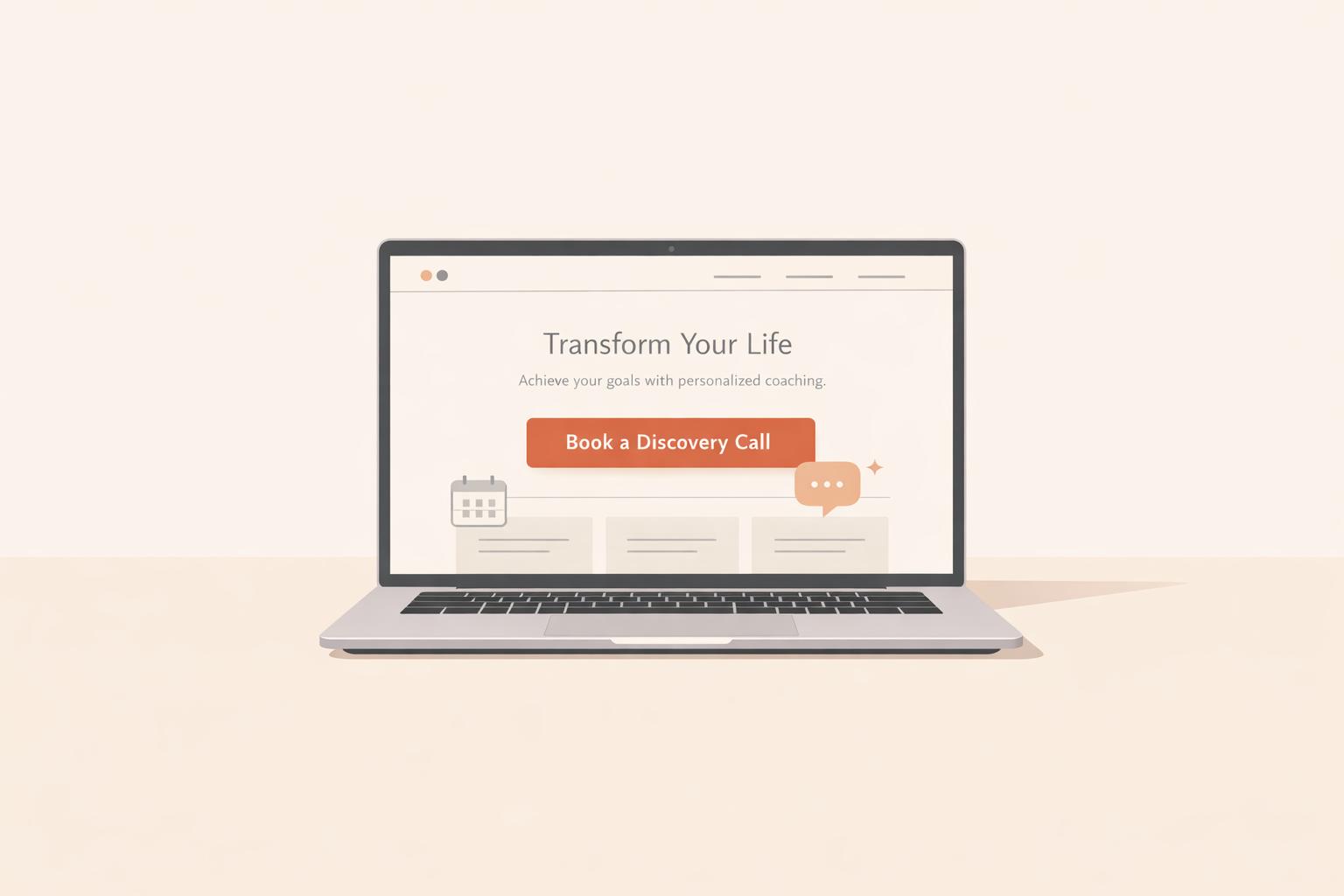
Your coaching website's main job is to turn visitors into discovery calls, but most sites fail due to outdated strategies and poor user experiences. In 2026, visitor expectations are higher than ever, with mobile traffic dominating and AI reshaping how websites perform. Here’s why your site might be struggling and how to fix it:
- Outdated Design: Static designs fail to engage users. AI-powered personalization boosts conversions by 42%.
- Weak CTAs: Generic "Book a Call" buttons don't work. Personalized, well-timed CTAs can perform 202% better.
- No Lead Qualification Tools: AI tools filter out unqualified leads, saving time and boosting efficiency.
- Poor SEO Targeting: High-traffic keywords often attract free advice seekers, not paying clients.
- No Conversion Analytics: Without tracking data, you can't fix drop-offs or optimize for better results.
- Static Content: Generic messaging doesn’t connect. Tailored content increases conversions by up to 30%.
- Ineffective Landing Pages: Lack of custom media (like video testimonials) hurts trust and engagement.
Key takeaway: To stay competitive, your website needs to load fast, feel personal, and guide visitors toward action with clear, data-backed strategies. Fixing these issues can significantly increase discovery calls and revenue.

7 Reasons Coaching Websites Fail to Get Discovery Calls in 2026
8 Must Haves For A Highly Converting Coaching Website | Visibility Marketing Coach
sbb-itb-f7e72a6
1. Outdated Design Without AI Personalization
A one-size-fits-all website design just doesn’t cut it anymore. By 2026, static designs are a thing of the past. Today’s users crave "Agentic UX" - websites that can predict what they need instead of waiting for them to click around aimlessly [4]. This level of personalization is a game-changer, especially for mobile users and those constantly on the move.
Here’s how it works: AI dives into real-time user behavior, figuring out whether someone is in "research mode" or "buy mode." Websites leveraging this tech enjoy a 42% boost in conversion rates compared to those sticking with traditional A/B testing [4]. Why? Because they’re addressing the individual, not some hypothetical "average" user. This adaptive approach doesn’t just improve conversions; it also refines messaging to fit different customer profiles seamlessly.
"The websites winning in March 2026 are those that feel like a conversation, not a catalog." - SiteInsight AI [4]
Static designs fail because they treat every visitor the same, overlooking the diversity of their needs. Modern sites, on the other hand, dynamically adjust elements like headlines, testimonials, and CTAs based on visitor behavior. Some even deploy "micro-guides" when they detect hesitation - say, if a user pauses over a complex feature for more than five seconds [4].
And let’s not forget speed. Load time is critical. A delay of just 100 milliseconds can slash conversions by up to 7% [1]. If your site is bogged down with flashy animations, you’re likely losing potential leads before they even get to see your pitch. The top-performing websites of 2026 ditch unnecessary frills in favor of interactive tools like ROI calculators and gap assessments. These features provide immediate value, making it clear why visitors should stick around [1].
2. Weak Call-to-Action Placement Ignoring User Behavior Data
Slapping a generic "Book a Call" button at the top of your homepage and hoping for results? That’s a recipe for inaction. In 2026, effective CTA placement requires aligning with how users behave - things like scroll depth, time spent on the page, and click patterns reveal when they’re ready to engage.
Here’s a fact: personalized CTAs perform 202% better than generic ones[6]. But personalization isn’t just about using the right words; timing is everything. CTAs should appear when visitors are emotionally primed to act, not just when it suits your page layout. AI tools can identify those pivotal moments, helping you present CTAs that truly connect. For example, content strategist Best Ecommerce Life shared a case study in March 2026 showing how aligning CTA placement with rhythm psychology - like placing CTAs at the end of reflective blog posts, mid-way in guides, or right after proof in case studies - helped reduce their website’s bounce rate by 30% in just four weeks[5].
A practical framework to consider is the 3:30:300 Principle: if you capture attention for 3 seconds, you earn 30 seconds; hold them for 30 seconds, and you could secure 3 minutes. And if a visitor stays for 3 minutes, there’s an 80% chance they’ll convert - but only if your CTA is visible at that crucial moment[2]. Heat mapping tools like Hotjar can help you track where users stop scrolling. Placing a CTA or a trust signal - like a testimonial - just before that drop-off point can make all the difference[2].
"Too many choices is the same as no choice. If your homepage has a 'Contact Us' button in the nav, a 'Learn More' button in the hero, a 'Schedule a Consultation' banner halfway down... you're creating paralysis." - James Webb, Founder, Firebrand Agency[2]
To simplify decision-making, limit each page to one primary CTA. Make sure it appears at least three times: above the fold, midway through, and at the bottom[2]. For mobile users, consider a sticky or floating CTA that stays within thumb’s reach as they scroll. And instead of using high-pressure language, opt for low-commitment phrases like "Watch a Demo" or "Start Free Trial" that offer immediate value without overwhelming the user[6].
Up next, we’ll look at how skipping AI-driven lead qualification can hurt your conversion rates.
3. No AI-Driven Lead Qualification Tools
Time is precious, especially when it comes to discovery calls. Spending hours on conversations with prospects who either can't afford your services or aren't ready to commit is frustrating and unproductive. Coaches who lack automated screening tools often lose 10–15 hours each week dealing with unqualified leads - time that could be better spent with clients who are a perfect fit for their offerings [10][14].
The traditional approach of qualifying leads after booking a discovery call is inefficient. It not only wastes time but also misses opportunities to engage with potential leads outside regular business hours [11][12]. This is where AI-driven lead qualification tools step in to make a difference.
AI tools work tirelessly, 24/7, to pre-screen visitors, answer basic questions, and ensure that only qualified leads make it onto your calendar [7][8]. Unlike manual methods, these tools use advanced scoring systems to evaluate prospects based on factors like budget, authority, and readiness to commit. By 2026, these systems will dynamically score leads, sending the best prospects directly to your calendar while nurturing less-ready ones [8][9]. The impact is undeniable: AI-driven qualification can reduce unqualified discovery calls by up to 80%, while businesses report a 28% increase in revenue per sales representative [13][14].
"Manual lead screening fails because humans miss 68% of buying signals." - Lucas Correia, AI Architect, BizAI [13]
Static forms are also becoming a thing of the past. By 2026, form completion rates are projected to drop to just 14%, as users increasingly prefer interactive, AI-assisted experiences. Leads sourced through AI tools convert at 2.3 times the rate of traditional cold form submissions [8]. Tools like Brandbase's AI assistant take this a step further by asking targeted questions, analyzing behavioral signals, and instantly scheduling ready-to-buy clients - all while you’re off the clock.
4. Poor SEO Keyword Mapping for Client Intent
After diving into AI-driven lead qualification, it's clear that effective SEO plays a major role in attracting clients who are genuinely interested in your services. The problem? Choosing the wrong keywords can drain your marketing budget. High traffic isn't helpful if your visitors are just looking for free advice instead of hiring a coach. In fact, there's a staggering 68% mismatch between user intent and the content provided[16].
Many coaches chase high-traffic keywords like "life coach" or "how to stop procrastinating" because they seem impressive. But these terms often attract users who aren't ready to pay for services. On the flip side, keywords with clear commercial intent - like "best executive coach for tech CEOs" - might have fewer searches, but they convert 3–4 times better. This is what’s known as the transactional volume paradox: low-volume keywords (often with just 50–100 searches per month) can deliver far better results[16].
"Volume without intent is traffic without revenue. A properly executed B2B keyword strategy balances both, with heavier weighting toward commercial intent as you move down-funnel." - SEO Webster Team[16]
The key is aligning your content with the buyer's journey. For instance, someone searching "signs of career burnout" is likely in the awareness stage and would benefit from an informative blog post. But a search like "executive coaching packages pricing" indicates they're ready to make a decision. This type of query calls for a dedicated landing page with a clear call-to-action, like a booking button, instead of a lengthy article. When content matches search intent, well-structured keyword clusters can achieve click-through rates that are 34% higher than random groupings[15].
A great way to refine your strategy is by using Google Search Console on a quarterly basis. It can help you uncover "hidden gem" queries - terms where your site already ranks but lacks focused content. These queries are high-value opportunities because Google already sees your site as relevant. By creating targeted content around these terms, you can draw in visitors who are more likely to book a discovery call[17]. This precise keyword mapping lays the groundwork for leveraging conversion analytics, which we’ll explore next.
5. Missing Conversion Analytics and Optimization Loops
You’ve nailed your keyword strategy and brought in the right visitors. But without proper tracking, you’re left in the dark about why those visitors aren’t booking calls. Many coaching websites face this exact challenge - they can’t tell if the issue lies in discoverability (not enough people finding the site) or in conversions (site visitors not taking action)[18].
Analytics tools can shine a light on where potential clients are dropping off. For instance, are visitors clicking your "Book a Call" button but abandoning the form midway? Or are they leaving your homepage after just thirty seconds, hinting at a gap in messaging or trust[3]? Without tracking these behaviors, you’re left guessing what changes might work - and that trial-and-error approach can waste both time and money.
"Your analytics tells you what is happening - where users drop off, which pages underperform - but it never explains why. This gap between data and action is where most growth strategies die." - Samuel J. Woods, Fractional Chief AI Officer[20]
Here’s a real-world example: Between February and May 2026, Coko Agency helped Jordan, a law firm owner in Maryland, tackle these exact issues. They rewrote the hero copy, reduced the number of form fields from six to four, and added a self-booking calendar. The result? Conversions jumped from 0.4% to 2.8%, monthly consultations soared from 6 to 41 (a 583% increase), and retainer revenue skyrocketed from $8,600 to $38,400[21].
The secret lies in optimization loops - a structured approach to improving your site. This involves weekly reviews of your top landing pages, running A/B tests on headlines or call-to-action buttons, and using tools like heatmaps to see how users interact with your site. Tools such as Microsoft Clarity (free) or Hotjar Business (starting at $99/month) let you track real user behavior[21]. With this data, you can make changes based on facts rather than guesses. And once you know what’s broken, you can fix it - leading to more discovery calls and better results overall. These insights also pave the way for tackling the challenges posed by static content and its impact on engagement.
6. Static Content Lacking Dynamic Personalization
Imagine landing on a homepage that greets every visitor with the same generic message - whether they're entrepreneurs battling burnout or professionals considering a career change. This cookie-cutter approach ignores the unique needs and challenges that brought each person to your site in the first place. And that oversight? It’s a conversion killer[3].
A one-size-fits-all homepage drives potential clients away. For example, someone clicking an ad for "executive burnout support" is likely to leave almost immediately if they’re met with a vague "Transform Your Life" headline[22]. On the other hand, dynamically personalized pages - ones that align closely with a visitor's search intent - can convert warm traffic at rates of 15–30%, compared to just 2–5% for static, generic pages[22]. Tailoring your content to match visitor intent isn’t just a nice-to-have; it’s a direct path to more discovery calls and client engagement.
"Relevance is the most powerful conversion lever that exists, and personalization is how you deliver relevance at scale." - Rob Palmer, Direct-Response Copywriter[22]
Your website should adapt to visitors in real time. For instance, if someone arrives from LinkedIn after searching for "coaching for tech executives", your headline should reflect that exact phrase - not a broad, uninspiring tagline[22]. Even better, swap out generic testimonials for case studies that resonate with their specific industry. Tools like Fibr AI (rated 4.9/5 on G2) can help create personalized landing pages at scale, while Geo Targetly offers simple location-based content adjustments starting at just $9/month[23][24].
But don’t stop at headlines. Interactive design elements can make your site feel more engaging and relevant. Instead of static stock images, consider adding tools like an ROI calculator or a self-assessment quiz that delivers tailored insights[1][22]. With 71% of consumers expecting personalized experiences and 74% feeling let down when they don’t get them, static content isn’t just outdated - it’s actively costing you potential bookings[23][24]. From here, it’s time to fine-tune how these personalized elements are presented across your landing pages.
7. Ineffective Landing Pages Without Custom Media Integration
A landing page might look sleek, but if it doesn’t include real media elements, you’re missing out on connecting with potential clients. Relying on generic stock photos or plain text testimonials just doesn’t work anymore. Visitors form their first impression in under 30 seconds, and static pages fail to build trust quickly enough[2].
Here’s an example: short video testimonials (15–45 seconds) placed near your booking button can increase conversion rates by 30–50% compared to written testimonials[22]. Landing pages that feature videos - like explainer clips or customer stories - see conversion boosts of 20–40%[22].
"Design your site around your best evidence, not your best copy." - James Webb, Founder, Firebrand Agency[2]
But it’s not just about videos. Other elements like client logos, press mentions, and industry certifications should be prominently displayed above the fold[2]. And with over 75% of landing page traffic expected to come from mobile devices by 2026, speed is critical. Media elements need to load in under two seconds, as every additional second of delay can cost you 7–12% in conversions[22].
The trend toward authenticity over polish is undeniable. Smartphone-captured customer videos often outperform polished corporate clips because they feel more genuine[22]. Prospects aren’t looking for perfection - they’re looking for someone who understands their needs. A case study that highlights your solution will resonate far more than a generic headline paired with a stock image[3][22]. By integrating custom media, you’ll not only enhance your personalization efforts but also build trust with your audience.
Conclusion
Your coaching website isn't struggling because you lack skills or expertise - it's struggling because it's stuck in outdated methods. The seven issues we've discussed aren't minor technical glitches; they’re major roadblocks preventing potential clients from ever booking a call.
This matters even more in a coaching industry that’s growing at an incredible pace. By 2025, it reached $7.31 billion and is expected to hit $10.1 billion by 2032. With 122,974 active coaches globally - a 54% jump in just six years - the competition is fierce [19]. Success isn’t just about having impressive credentials; it’s about having a website that does the hard work of selling your services before you even speak to a prospect.
"If you NEED to get on a Zoom call to close high-ticket clients, your brand isn't strong enough." - Lindsay Maloney, Business Coach [19]
Start by auditing your website. Check your Core Web Vitals and make sure your Largest Contentful Paint (LCP) is under 2.5 seconds. Rewrite your homepage copy to focus more on client challenges - aim for a 3:1 ratio of addressing their problems versus highlighting your qualifications. Add clear "starting at" pricing to build trust, and implement an AI chatbot to capture leads 24/7. These updates aren’t optional anymore - they’re critical to staying competitive in 2026.
When your site integrates AI-driven lead qualification, speaks directly to client needs, and offers interactive tools, prospects come to you already convinced. They’re not debating if they should work with you - they’re figuring out how soon they can start. Upgrade your site with precision tools and personalized features to turn discovery calls into effortless, high-conversion opportunities.
FAQs
What should I track to find where visitors drop off?
To understand where visitors might be dropping off on your coaching website, focus on tracking these key engagement points:
- Scroll depth: Check if users are reaching crucial sections, such as your call-to-action (CTA) areas.
- Click behavior: Monitor interactions with CTAs or clickable elements like phone numbers - this is especially important for mobile users.
- Form interactions: Look at how users engage with forms, including where they stop if they don't complete submissions.
- Page load times: Slow-loading pages can frustrate users and lead to higher exit rates.
- Visitor flow: Use analytics tools to map out where visitors enter and exit your site to pinpoint problem areas.
How do I choose keywords that attract paying coaching clients?
To bring in paying coaching clients, zero in on the keywords your target audience is searching for. Think about terms tied to your niche, the services you offer, and the results clients want to achieve. Weave these keywords naturally into your website’s service pages, headlines, and meta descriptions to boost visibility. Tools are available to help you gauge demand and competition for these terms. For instance, phrases like "career coaching for professionals" or "leadership development coaching" can resonate with potential clients and match their search intent.
What’s the simplest way to add AI lead qualification to my site?
The simplest way to incorporate AI into lead qualification is through an AI-powered chatbot. These chatbots interact with visitors, ask targeted qualifying questions, and evaluate leads in real time. By analyzing responses and understanding intent, they can weed out unqualified leads and forward high-potential prospects to your sales team. This method replaces outdated static forms with dynamic, conversational AI, making lead management more efficient and engaging.
Related Blog Posts
- How To Get More Coaching Clients: Proven Strategies That Actually Work - 2026 Guide
- How to Build Your Coaching Business Website: Complete 2026 Guide
- How To Start A Coaching Business Online in 2026: Your Complete Launch Framework
- Lead Gen for consultants & coaches in 2026: Less Funnels, More Conversations

Blog title heading will go here
Blog title heading will go here