
5 Ways to Make Your Coaching Website Sound Like You and Not a Template

Your coaching website should reflect your personality, not a generic template. Here's how to make your site feel more personal and engaging:
- Speak naturally: Record yourself answering simple questions to capture your conversational tone.
- Tell your story: Share relatable experiences that connect with your audience’s struggles.
- Use AI wisely: Train tools like ChatGPT to match your voice for faster, personalized copy.
- Focus on clients: Replace generic phrases with language that resonates directly with your audience's concerns.
- Consider tailored solutions: Platforms like Brandbase can build custom pages that match your style.
A personal, relatable tone helps build trust and connection with potential clients. Start small - rewrite your About page or record your coaching philosophy - and let your unique voice shine.
Generic vs Client-Focused Website Language for Coaches
Simple copywriting tips to attract more coaching clients
sbb-itb-f7e72a6
1. Use Interviews to Capture How You Actually Talk
When it comes to writing about your coaching practice, speaking naturally can make all the difference. A conversational tone helps you avoid the stiff, overly formal language that can make website copy feel bland. Website strategist Ana Lea Amelio sums it up perfectly:
"This will help you write like you talk and the pressure of the blank screen won't be there" [3].
Start by recording your answers to simple questions like "What do I do?" or "How do I help clients?" When you speak off the cuff, your natural voice shines through. Phrases like "here's the thing" or describing your style as "no-BS" reflect your personality and make your writing feel more genuine. It’s a great way to capture your rhythm, favorite expressions, and even those little quirks that make your voice unique.
For a deeper dive, try what copywriter Yolie Stephenson calls "heart to hearts." These are recorded conversations with a trusted colleague or copywriter who can ask thoughtful questions about your background, philosophy, and methods [2]. These chats often reveal the deeper motivations behind your work - details that can get lost when you're trying to write formally. This kind of insight not only adds depth to your story but also strengthens your brand identity.
Don’t stop with your own voice - interview past clients too. Their descriptions of your impact can provide valuable language for your copy. Use these insights to build a Brand Word Bank filled with your go-to phrases and expressions. It’s a handy resource for crafting future website content [3].
2. Write Copy That Tells Your Story
Once you've nailed down your natural voice, it's time to let your story take center stage in your messaging.
Your story is what makes you stand out from other coaches with similar qualifications. Here's something to think about: over 77% of coaching clients will visit a coach's website before deciding to book a session [8]. And they're not just scanning for your certifications - they’re looking for the "why" behind what you do.
The secret lies in linking your personal journey to the challenges your clients face. Share specific experiences - like how you overcame burnout or tackled career stagnation - to show that you genuinely understand their struggles. These details aren't just background information; they highlight your transformation from struggle to success. This kind of storytelling not only makes you memorable but also reflects the path your clients aspire to take.
This approach is especially powerful for your About page. Instead of listing credentials, craft a story that focuses on a problem–solution framework. Share how you faced and overcame challenges, showing a transformation that mirrors what your clients are hoping to achieve. This makes your About page less of a resume and more of a relatable, inspiring narrative [6][7].
Stay focused when crafting your message. Pick one or two themes that align with your clients' struggles and showcase your authentic coaching style. This storytelling method builds on the personalized tone from Section 1, creating trust through genuine connection rather than a polished, overly rehearsed narrative [1].
3. Train AI Tools to Write in Your Voice
AI can make website copywriting faster, but only if you teach it to match your actual voice. Without clear guidance, the AI’s output might need heavy editing to sound like you[9]. Here’s how to make the process work.
Start by giving the AI specific examples rather than vague instructions. Telling it to “write like me” or “sound casual” won’t cut it. Instead, show it how you structure sentences, the types of metaphors you use (like food versus sports comparisons), and the natural flow of your writing.
Gather 20–30 samples of your unedited work - emails, social media posts, or coaching transcripts are great options. These raw drafts capture your voice more accurately than polished blog posts that have been edited multiple times[9][11]. This step ensures that the AI reflects your genuine style, staying true to your unique coaching or communication approach.
Next, create a "Forbidden Dictionary" of words or phrases you dislike. For example, if you avoid terms like "leverage", "tapestry", or "shatter", add them to the list. This forces the AI to stick to vocabulary that aligns with how you naturally write[9][10]. Once you’ve prepared your samples, upload them into the AI and ask it to identify patterns - such as how you structure paragraphs, your go-to analogies, and your sentence rhythm.
"The biggest mistake I see is when people expect AI to find their voice. It won't. You have to hand it your rhythm."
– Riley Westbrook, Co-founder of Valor Coffee [11]
To avoid retraining the AI repeatedly, consider using tools like ChatGPT’s Custom GPTs or Claude Projects (around $20/month) to save your voice profile permanently[9]. Research backs this up: a 2025 study involving 331 professionals found that AI tailored to an individual’s style produced work rated higher in creativity and quality compared to generic AI[12].
Finally, test the AI’s output by reading it aloud. If it doesn’t sound right, the rhythm or tone probably needs tweaking[11].
4. Replace Generic Phrases with Client-Focused Language
Once you've refined your voice and story, it's time to shift gears and speak directly to your client's experience.
If your website is filled with phrases like "I provide a safe space" or "I'm warm and approachable", it might sound like every other coach's site out there. While these qualities are undoubtedly important, they’re often assumed and don’t truly reflect what your clients are experiencing. Instead, move away from "I" statements and focus on "you" statements that resonate with your client's reality.
Here’s where the 3:00 AM Client Test comes in. Picture a potential client lying awake at 3:00 AM, consumed by worries about their relationship or career. If they stumble upon your site, will they feel like you understand their struggles? For example, instead of saying, "I help clients with anxiety", you could write, "That knot in your stomach when you wake up at 3:00 AM, mind already racing? I get it." This approach uses language that feels personal and relatable, steering clear of overly clinical terms.
Keep in mind that website visitors only read about 10%–20% of content, so your headlines need to work hard [13]. Jane Hinchliffe, a Squarespace web designer and strategist, emphasizes this point:
"Your website should feel like a warm invitation to a conversation, not a lecture" [5].
Even your calls to action should feel inviting. Instead of a generic "Submit", try something like "Let’s Chat!" or "Let’s get started."
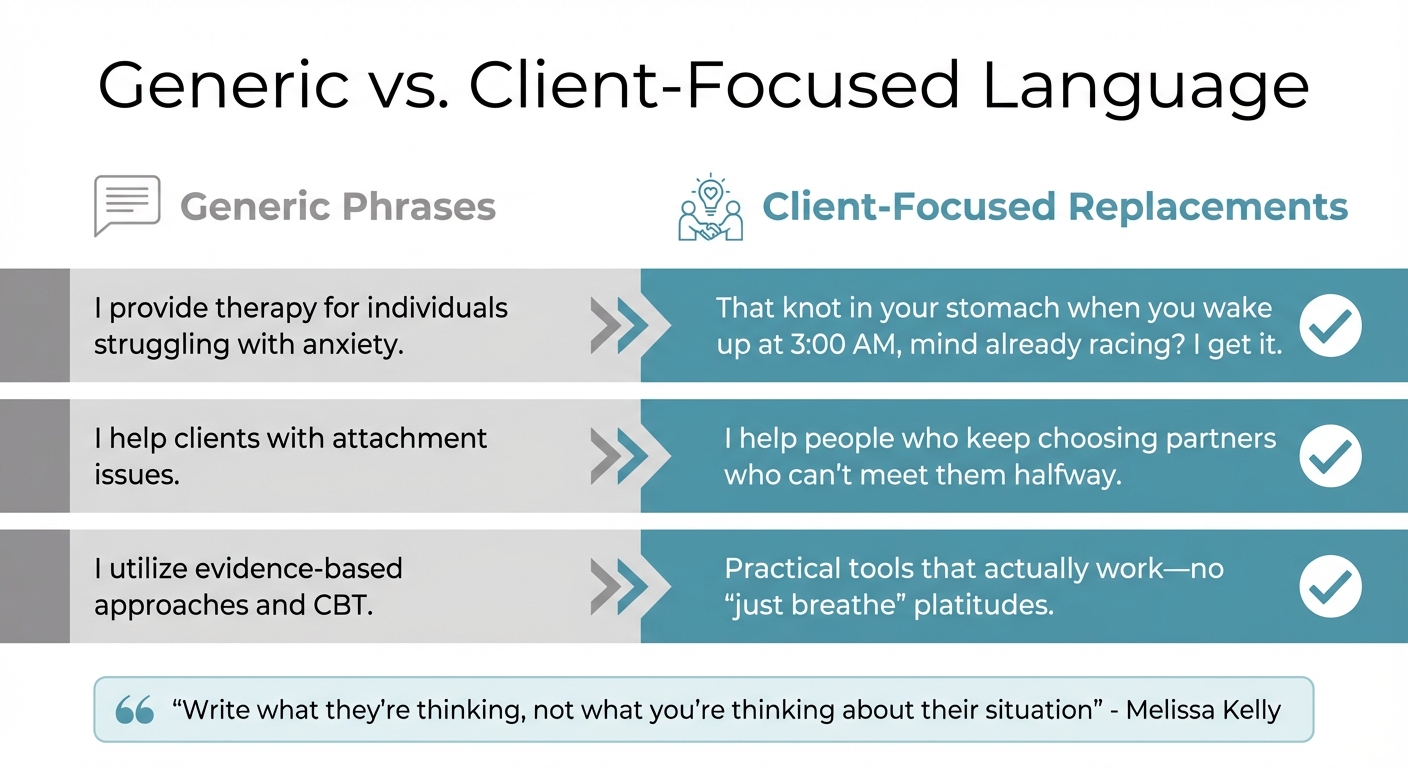
Here’s a quick comparison of generic versus client-focused phrases:
| Generic Phrase | Client-Focused Replacement |
|---|---|
| I provide therapy for individuals struggling with anxiety. | That knot in your stomach when you wake up at 3:00 AM, mind already racing? I get it. |
| I help clients with attachment issues. | I help people who keep choosing partners who can't meet them halfway. |
| I utilize evidence-based approaches and CBT. | Practical tools that actually work - no "just breathe" platitudes. |
Melissa Kelly, founder of Go Bloom Creative, encapsulates it perfectly:
"Write what they're thinking, not what you're thinking about their situation" [13].
Rather than making sweeping promises like "I'll transform your life", guide clients toward achievable steps. For example, say, "Let’s start by easing your day-to-day struggles." This kind of language not only builds trust but also creates a connection that feels genuine and approachable. By doing this, you’re not just offering services - you’re creating a web presence that feels like a safe and welcoming space.
5. Use Brandbase to Build Custom Landing Pages That Sound Like You
Sometimes, DIY methods just don’t cut it. That’s where a tailored solution like Brandbase steps in to capture your voice and turn it into something that truly represents you.
Brandbase starts with a 60-minute brand interview [15]. This isn’t just a casual chat - it’s designed to dig deep into your expertise, your coaching style, and the way you naturally communicate. Forget cookie-cutter templates. Brandbase takes what makes you unique and transforms it into landing pages that sound exactly like you.
As they put it, "Your website uses your actual words - not generic templates" [15]. During the interview, you’ll share your methodology, success stories, and insights. From there, their AI tools refine your input into personalized website copy that mirrors your tone and style.
But Brandbase doesn’t stop at just landing pages. They also offer Cora AI, a custom assistant built around your coaching methods. Cora AI works 24/7, answering questions and qualifying leads while staying true to your voice. And the best part? The entire system - including your website, AI assistant, and press features - can be ready in as little as 7 days [16]. Full-service engagements typically take 4 to 6 weeks [15].
Brandbase offers several pricing tiers, so there’s something for every budget:
- Starter: $18/month + $499 setup fee – includes a basic landing page.
- Essential: $99/month + $499 setup fee – adds a custom AI assistant, hosting, unlimited edits, and one PR placement every six months.
- Pro: $499/month + $499 setup fee – includes unlimited landing pages, LinkedIn lead generation, six PR placements per year, and nine SEO blog posts per month.
If writing isn’t your strong suit, Brandbase makes it easy to share your expertise and let them handle the rest.
Conclusion
Your coaching website shouldn’t feel like it was plucked from a cookie-cutter template. The strategies we’ve explored - recording yourself to capture your natural speaking style, sharing your personal story, fine-tuning AI tools to match your voice, replacing generic language with client-focused messaging, and using tailored landing page solutions - can help create a site that truly feels like you.
Did you know that 75% of judgments about your website’s credibility are based on its overall look and feel? [4] But credibility isn’t just about visuals; the words you choose play an equally important role. As Aliza Milburn, founder of Flourish Online, wisely says:
"A good rule of thumb is to stay true to the vibe your clients feel when they interact with you on a call. How do you show up in real life? Bring that energy online" [1].
By applying these strategies, you’ll create a consistent voice across all touchpoints - your website, emails, and social media. This consistency builds trust and establishes a brand that feels authentic. Remember, your website isn’t just a static resume; it’s a chance to start meaningful conversations, attract the right clients, and naturally filter out those who aren’t the right fit.
Start small: maybe record yourself explaining your coaching philosophy or rewrite your About page with a more personal tone. As Team Simply.Coach puts it:
"Great coaching doesn't sell itself, your words do" [14].
Your voice is your most powerful asset in a crowded market. Don’t let it get lost behind overused phrases or generic templates. Let your personality shine through every word on your site, and turn it into a genuine reflection of your coaching style. That’s how you transform your online presence into a true extension of who you are.
FAQs
What should I record to capture my real voice?
To truly reflect your personal voice, try recording yourself during casual conversations or while sharing personal stories. These moments often reveal your natural tone, style, and personality. Pay close attention to the words you choose, the way you pause, and how you express emotions. These little details can make your website content feel more authentic and aligned with the way you naturally communicate.
How do I train AI to sound like me?
To help AI reflect your voice, start by gathering samples of your writing. Pay attention to elements like tone, choice of words, and any humor or quirks that make your style distinct. Think of the AI as a junior writer - offer clear guidance and constructive feedback to shape its output. Regularly test and tweak prompts to refine results, and keep training it with your examples. Over time, this process will improve the AI's ability to create content that feels authentic and aligned with your style.
How can I make my copy more client-focused fast?
To make your copy resonate more with clients, speak directly to their needs and concerns. Use straightforward, empathetic language that shows how your services address their challenges and align with what matters to them. Keep your tone casual and genuine - ditch the stiff, corporate jargon. By focusing on what your clients care about most, your message will feel personal, relatable, and in tune with their expectations.
Related Blog Posts

Blog title heading will go here
Blog title heading will go here