

9 Personal Branding Strategies Coaches Are Using to Stand Out in 2026

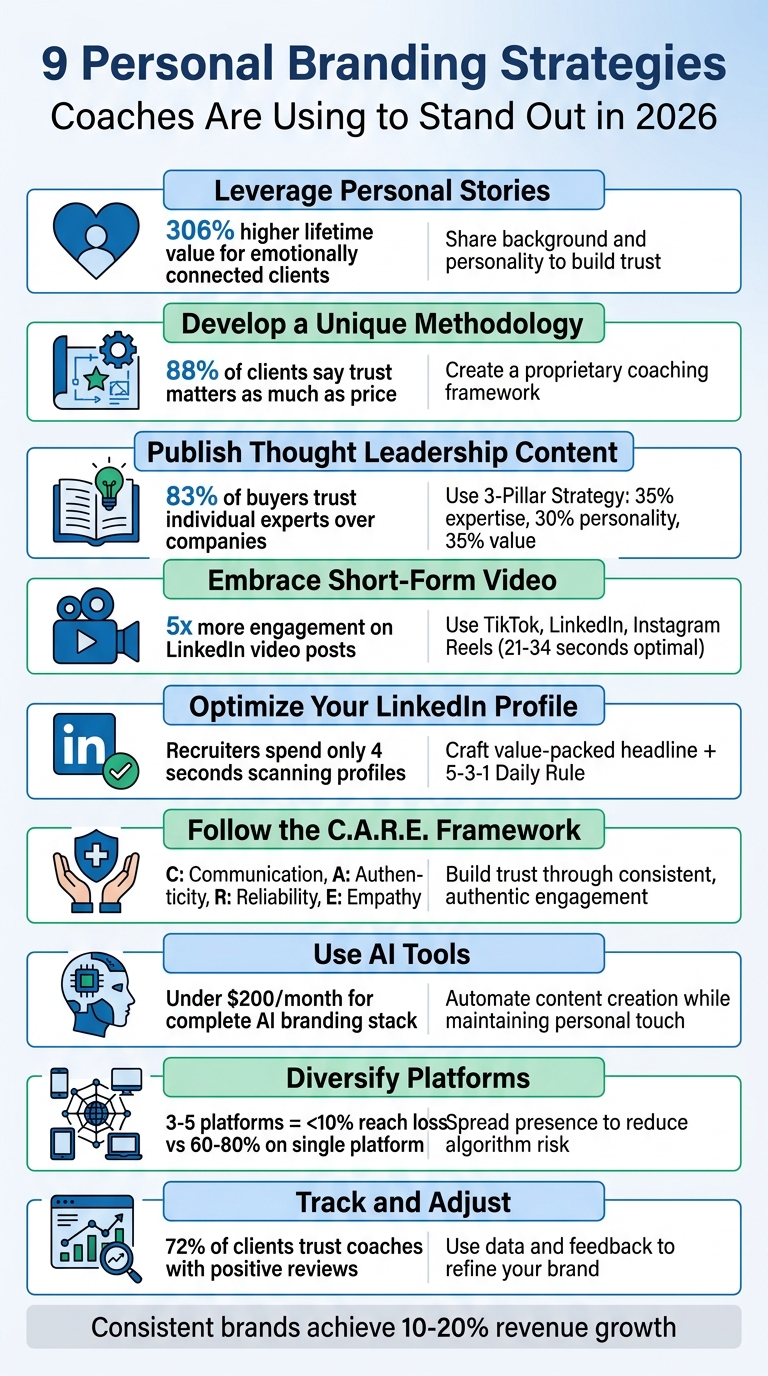
In 2026, the coaching industry is more competitive than ever. To succeed, coaches need to build trust, showcase their expertise, and stand out in a crowded market. Here's a quick summary of the strategies top coaches are using:
- Leverage Personal Stories: Share your background and personality to connect emotionally with clients.
- Develop a Unique Methodology: Create a clear, structured coaching framework to differentiate yourself.
- Publish Thought Leadership Content: Use long-form articles and a 3-pillar content strategy to establish authority.
- Embrace Short-Form Video: Use platforms like TikTok, LinkedIn, and Instagram Reels to expand your reach.
- Optimize Your LinkedIn Profile: Turn it into a professional showcase with a clear value proposition and testimonials.
- Follow the C.A.R.E. Framework: Build trust through clear communication, reliability, and empathy.
- Use AI Tools: Automate time-consuming tasks like content creation and scheduling while maintaining your personal touch.
- Diversify Platforms: Spread your presence across 3–5 platforms to reduce the risk of algorithm changes.
- Track and Adjust: Use data and feedback to refine your brand and ensure it resonates with your audience.
These strategies help coaches connect with clients, stay visible across platforms, and build lasting relationships in an increasingly AI-driven world.
9 Personal Branding Strategies for Coaches in 2026
The Only Personal Branding Guide Coaches and Consultants Will Ever Need
sbb-itb-f7e72a6
1. Use Your Background and Personality to Stand Out
Your personal story is your most powerful asset. In 2026, clients aren’t just looking at your credentials - they’re drawn to who you are and the experiences that have shaped you. As business coach Leonie Novorol explains:
"Personal branding is the way people consistently experience your thinking, values, energy, and leadership over time" [5].
In other words, your background isn’t just a detail in your bio - it’s the foundation for building trust and connection with clients.
The best coaches know how to balance professionalism with strategic vulnerability. By sharing selective personal challenges that resonate with your clients, you can show them how you’ve overcome obstacles, developed systems, and turned lessons into strengths [1]. This isn’t just about storytelling - it’s about proving that you practice what you teach, creating a deeper bond with your audience. These moments of reflection also help clarify your brand’s core values.
Trust is the cornerstone of client relationships [3]. And trust isn’t built through flashy marketing - it’s built through authenticity. Clients instinctively evaluate whether your energy feels steady or scattered and whether your methods align with how you live your life [5]. Sharing how your principles guide your daily actions shows integration, not just theory.
To solidify your brand, identify five to seven key personality traits - like grounded, empathetic, or detail-oriented - that reflect your essence [3]. Even small personal touches, like a quirky fact or hobby in your bio, can make your brand more relatable [4]. These details help clients feel an emotional connection, making it easier for them to decide if you’re the right fit.
And here’s why that matters: emotionally connected clients are proven to have a 306% higher lifetime value than those who aren’t [3]. Your background and personality aren’t just extras - they’re what turn clients into loyal advocates.
2. Create Your Own Coaching Methodology
Having your own coaching methodology sets you apart as an expert with a distinct approach. In 2026, clients aren't just looking for inspiration - they're looking for certainty. They want a reliable, structured system they can count on, not unpredictable sessions that vary each time [7]. By defining a clear process, you show clients exactly what they can expect and how you'll deliver on your promises.
88% of potential clients say that trust in a brand matters just as much as price or quality when deciding who to hire [3]. A well-defined framework builds this trust by demonstrating how you'll take them from their challenges to their goals. As brand positioning strategist Lori Young explains:
"A proprietary framework is what separates you from everyone else offering 'coaching' or 'consulting.'" [3]
To develop your methodology, start by identifying your Unique Value Proposition - the specific result you deliver and the unique way you achieve it [4]. Next, break your process into clear, actionable steps. This could take the form of a three-phase roadmap, a multi-level "success ladder", or any system that makes your approach easy to understand and follow [3][4]. The goal is to turn your expertise into something concrete that clients can immediately grasp.
Having a consistent methodology can increase revenue by 10%-20% [3][1] and opens the door to scalable options, like group coaching programs or AI tools designed around your unique approach [8]. In fact, 73% of marketers now see AI as a critical tool for delivering the personalized experiences that coaching clients expect [6].
Your methodology should reflect your unique perspective while clearly defining who it's for - and who it isn't for [3][5]. Being upfront about this ensures you attract the right clients and positions you as an authority with a distinct niche. This clarity not only strengthens your brand but also makes it harder for competitors to replicate your approach. Plus, it sets you up to integrate emerging AI tools seamlessly into your process, keeping your offerings relevant and forward-thinking.
3. Build Credibility with Thought Leadership Content
Establishing credibility often starts with showcasing your expertise. Research indicates that 83% of buyers trust individual experts over faceless companies [9]. A smart way to achieve this is by following the 3-Pillar Content Strategy: allocate 35% to expertise (research and analysis), 30% to personality (your unique perspective and stories), and 35% to actionable value (tools and frameworks) [9].
One effective tactic is publishing a detailed, 2,000–3,000-word article each month on a complex topic within your field [9]. These in-depth pieces not only strengthen your authority with search engines but also offer a goldmine of content for repurposing on social media. For instance, MEWR Creative successfully applied this strategy by creating 260 LinkedIn posts based on their 3-Pillar Framework. By posting five times a week and supplementing their efforts with long-form blogs and a weekly newsletter, they grew from zero visibility to 5,000 followers and 15,000 email subscribers in just 12 months. This approach also brought in over 50 inbound business inquiries [9].
Your thought leadership content should reflect your unique background and methodology. By sharing insights that reveal how you think - not just what you know - you can stand out. Perspective-driven content that simplifies complex ideas or challenges industry norms often resonates more than generic advice [5]. Detailed case studies, complete with metrics and the reasoning behind your strategies, tend to outperform basic testimonials [1]. And don’t shy away from transparency - 94% of consumers remain loyal to brands that embrace openness [3]. Sharing both successes and lessons learned fosters a genuine connection with your audience.
While AI tools can help format and repurpose your long-form content into social media posts [9], it’s essential to maintain your distinct voice and perspective. As positioning strategist Lori Young puts it:
"In 2026, it's not enough to be good at what you do. You need to own a specific space in your clients' minds." [3]
4. Use Short-Form Video to Expand Your Reach
Short-form video has become a go-to tool for coaches looking to boost their visibility in 2026. Platforms like LinkedIn show its power, with video posts driving five times more engagement than text-only updates [11]. Meanwhile, TikTok continues its meteoric rise, boasting 1.59 billion active monthly users worldwide [10]. The real challenge? Not deciding if you should use video, but figuring out where to post and how to craft content that grabs - and keeps - attention.
The Key to Viral Videos: Completion Rate
On TikTok, the algorithm sets a strict 3-second checkpoint. If viewers scroll before hitting that mark, your video’s distribution takes a hit [10]. To truly gain traction, around 70% of viewers need to watch your video all the way through [10]. To meet this standard, keep your videos short - ideally between 21–34 seconds - and start with a compelling hook. This could be a bold statement, a thought-provoking question, or a promise of clear value [10].
Choosing the Right Platforms
Different platforms excel at different things. Here’s how they stack up for coaches:
- LinkedIn: Great for attracting high-quality, professional leads.
- YouTube Shorts: Boosts long-term discoverability by ranking well on Google.
- Instagram Reels: Offers double the reach to non-followers compared to static posts [11].
- TikTok: Still the top choice for viral growth, with Gen Z increasingly using it as a search engine for how-to content [10].
Interestingly, coaches active across 3–5 platforms tend to maintain their reach, even when one platform’s algorithm shifts, often losing less than 10% of their total audience [2].
AI Tools: Streamlining Video Production
AI has revolutionized video creation. What used to take hours can now be done in minutes. For example, producing a 60-second video traditionally took around two hours, but AI tools can cut that time down to under 10 minutes [11]. Some coaches are even running faceless channels, relying on AI-generated visuals and narration to deliver value without ever appearing on screen [11]. As Chris Sherman, an AI Video Specialist, puts it:
"Video is how you build a personal brand in 2026" [11].
Crafting a Winning Content Strategy
A solid content strategy can make all the difference. Try the 70/20/10 rule:
- 70% educational content: Think frameworks, tips, and how-to guides.
- 20% opinion pieces: Share hot takes or personal insights.
- 10% promotional content: Highlight your services or products [11].
For TikTok, maximize your reach by speaking target keywords aloud so they’re picked up by the platform’s transcription feature. Also, include these keywords in your captions [10].
Want a smart way to repurpose content? Record a 20-minute masterclass and use AI to break it into 12 short clips tailored for different platforms. This approach ensures consistent messaging while reaching diverse audiences [12]. Short-form videos like these are a powerful addition to your AI-driven personal branding toolkit.
5. Turn Your LinkedIn Profile into a Professional Showcase
Your LinkedIn profile isn't just a digital resume - it’s a powerful tool that works around the clock to represent your personal brand. In 2026, recruiters spend an average of just 4 seconds scanning a profile (a drop from 7 seconds in 2024) [14]. This means that every section of your profile needs to grab attention and make an impact quickly.
Start with your headline. Avoid generic job titles and instead craft a value-packed headline using this formula: [What You Do] + [Who You Help] + [The Result You Deliver] + [Credibility Marker] [14][15]. For example, a headline like “Helping B2B SaaS Founders 3x Their Pipeline Through AI-Driven Marketing | Executive Coach” immediately communicates your expertise, audience, and results.
Your About section is another critical area. Think of it as your elevator pitch, designed to hook readers in just 3 seconds. Use the "Hook-Story-Proof" structure: start with a bold opening statement, share your professional journey, highlight measurable achievements, and end with a clear call to action [14]. Make sure the first two lines address your ideal client’s pain points, as these are visible before the "see more" button [15].
The Featured section is prime real estate. Use it to display lead magnets, case studies, or links to schedule consultations [14][15]. Recommendations are also key - profiles with at least five strong testimonials build trust, with 72% of clients more likely to engage with professionals who showcase positive reviews [4].
Additionally, enabling Creator Mode can help you expand your reach and position yourself as an authority. A professional headshot alone can boost profile views by 14x, and with 78% of recruiters relying on AI-assisted searches, optimizing your profile for both human and AI readers is a must [14]. To stay visible, follow the 5-3-1 Daily Rule: leave 5 thoughtful comments, send 3 personalized connection requests, and post 1 original piece of content each day [13]. This approach ensures your LinkedIn presence aligns with a broader digital engagement strategy, helping you connect with clients across multiple platforms.
6. Apply the C.A.R.E. Framework to Build Trust
While engaging storytelling and standout content grab attention, trust is what keeps people coming back. In 2026, trust has become the backbone of personal branding. The C.A.R.E. Framework - Communication, Authenticity, Reliability, and Empathy - provides a clear path to establish and maintain trust.
Communication in 2026 is all about clarity and focus. Think of it as crafting a simple yet powerful message, like: "I help [Audience] achieve [Outcome] without [Pain Point]" [16][4]. To strengthen this, create a signature format - whether it's quick 60-second insights or in-depth guides - so your audience knows exactly what to expect from you.
Authenticity doesn’t mean revealing every detail of your life. It’s about being real and relatable. Take entrepreneur Dylan Vanas, for example. In 2025, he openly shared the challenges of losing most of his staff due to a partnership conflict. By documenting his journey and the systems he built to recover, he didn’t just tell a story - he proved his credibility in the business coaching world [16][5]. Authenticity like this, paired with consistent results, builds lasting trust.
Reliability is about showing, not just saying. It’s delivering on promises with consistent quality. Liam Austin, co-founder of Entrepreneurs HQ, is a great example. Back in 2015, he launched his first virtual summit with a transparent approach, sharing the exact system he used. That event brought in over 15,000 leads and $50,000 in revenue. Fast forward to 2026, and his "3-Step Blueprint" coaching program continues to thrive because of his proven methods [4].
Empathy means truly understanding your audience’s struggles and creating a space where they feel seen and valued. When you acknowledge their experiences, you foster a sense of belonging. Consider this: emotionally connected customers are 306% more valuable over their lifetime compared to those who are just satisfied [3][5]. That emotional connection is a game-changer.
By weaving together Communication, Authenticity, Reliability, and Empathy, you can build trust that lasts. Start by auditing your brand for consistency across platforms. A simple "Work With Me" page can go a long way - include your services, starting prices, and 2–3 clear examples of results. Brands with a consistent identity often see revenue growth of 10% to 20% [3]. And as you scale, document your client interactions to maintain that same level of trust [1].
"Trust matters more than noise." – Leonie Novorol, Business Coach [5]
7. Use AI Tools for Personalized Brand Development
AI isn’t here to replace coaches - it’s here to handle the tasks that eat up your time, like formatting, scheduling, and distribution. This lets you focus on what really matters: sharing your expertise and unique perspective. In 2026, the most successful coaches are using AI to streamline these time-consuming processes while infusing their content with their personal stories and strategic insights [1].
Take entrepreneur and agency founder Dylan Vanas, for example. He uses AI tools like Opus Pro to transform a single long-form podcast into 15 captioned, optimized video clips. This strategy helps his brand push out over 100 pieces of content each month across both personal and company platforms [1]. The result? Consistent visibility and engagement.
MEWR Creative took this idea a step further in March 2026, creating 260 LinkedIn posts in just four weeks using AI-generated outlines. By automating their post scheduling for the entire year, they went from zero visibility to 5,000 followers and 15,000 email subscribers in just 12 months. This also led to hundreds of qualified leads. Their secret? A 3-Pillar Framework that splits content into three categories: Expertise (35%), Personality (30%), and Value (35%). This balance keeps their brand relatable and trustworthy [9].
For most coaches, building a high-end AI-powered branding stack costs less than $200 a month [1]. Tools like Monolit ($49.99/month) allow simultaneous publishing across LinkedIn, Instagram, X, Threads, and Facebook [2], while Opus Pro ($30–$100/month) makes video repurposing a breeze [1]. A multi-platform strategy is essential - coaches active on 3–5 platforms lose less than 10% of their reach when one platform changes its algorithm. Compare that to the 60%–80% loss experienced by those relying on just one platform [2].
AI isn’t just for creating content - it’s also key to making sure your brand is discoverable by AI search assistants. This dual benefit of boosting content production and enhancing visibility is reshaping how brands operate. One of the biggest shifts in 2026 is Generative Engine Optimization (GEO). With 24% of people already using AI shopping assistants to find services [3], being visible to AI tools like ChatGPT and Perplexity is critical. Dylan Vanas emphasizes that ignoring AI’s rapid growth is a mistake, calling it short-sighted [1]. To stay ahead, start by using AI to create consistent, multi-platform content, and track how often your brand appears in AI-generated recommendations with specialized tools [3].
8. Maintain Consistent Presence Across Platforms
Putting all your eggs in one social media basket is risky. Between 2024 and 2026, LinkedIn's organic reach dropped by 30%. For coaches relying on a single platform, algorithm changes can slash their total reach by 60%-80%. On the other hand, those active on 3-5 platforms usually see less than a 10% drop in reach, making diversification a smart move to keep your client pipeline steady[2].
Each platform plays a unique role, so it's important to tailor your strategy accordingly. For example, LinkedIn is ideal for showcasing professional authority and building B2B connections. Instagram works well for visual storytelling and creating personal connections, while X (formerly Twitter) shines for sharing industry insights and networking[2]. Adjust your content's format and tone to fit each platform. A detailed LinkedIn post can become a concise, engaging thread on X, or a visually appealing story on Instagram. The key is to make your message feel natural for the platform you're using.
"The history of social media is a graveyard of platforms that once seemed permanent... AI automation makes multi-platform presence effortless, turning platform diversification from a time-consuming burden into an automatic safeguard." – Monolit[2]
While AI tools can simplify content distribution across multiple channels, diversifying your strategy ensures your message reaches your audience, even if algorithms shift. To strengthen this approach, focus on building an email list. Social media is great for attracting attention, but email provides a direct connection to your audience. With email open rates hovering around 20%-30%, compared to the 5%-10% organic reach on most social platforms, email offers a more reliable way to engage with your followers[2]. Aim to convert 10%-20% of your social media followers into email subscribers within a year to create a dependable communication channel that algorithms can't disrupt.
9. Track and Adjust Your Brand Based on Feedback
Building a personal brand isn’t a one-and-done process - it’s something you need to tweak and refine continually. In 2026, successful coaches rely on data, not guesswork, to make these adjustments. And the focus has shifted: it’s no longer about vanity metrics like follower counts. Instead, it’s about leads generated and revenue influenced, as Allison Dunn, CEO of Deliberate Directions, explains:
"The measurement that matters is not follower count or engagement rate but leads generated and revenue influenced" [1].
This approach ensures your brand stays relevant and aligned with what your audience truly needs.
Start by gathering actionable data. Find out where your best leads are coming from. During discovery calls, ask prospects how they discovered you - whether it was through a LinkedIn post, a podcast, or a guest article. Coaches who document this information can pinpoint their most effective channels and double down on what’s working.
In today’s world, it’s also essential to track your AI visibility. With 24% of people already using AI shopping assistants to find services [3], tools like ChatGPT and Perplexity play a role in how your brand is perceived. Use platforms like AthenaHQ or Evertune to check if these systems represent your brand accurately. If the AI-generated portrayal of your brand doesn’t match your intended image, address the gap as soon as possible.
Quantitative data is critical, but don’t overlook qualitative insights. Client feedback can be a goldmine for understanding what resonates. Use tools like VideoAsk or Testimonial.io to collect video testimonials, or send out post-session evaluation forms. This isn’t just about improving your services - 72% of clients trust a coach more when they see positive reviews [4]. Authentic feedback also serves as powerful social proof. To dig deeper, track your Net Promoter Score (NPS) to measure client satisfaction and identify those who might refer others to you.
Finally, make it a habit to audit your brand quarterly. Ask yourself: Does this reflect who I am? Am I excited to share this? Is my audience connecting with my message? Regular check-ins like these help you refine your positioning and ensure your brand evolves with your audience. Consistent brands have been shown to achieve revenue gains of 10%-20%, but staying adaptable is just as important [3]. Regular audits keep your brand both steady and responsive.
Conclusion
Standing out today requires a mix of authenticity and smart planning. The nine strategies outlined here provide a clear path forward: draw on your personal experiences, develop your own methods, establish yourself as a thought leader, embrace short-form video, enhance your LinkedIn presence, implement the C.A.R.E. Framework, use AI tools wisely, stay consistent, and track your progress. Above all, trust is the foundation of success [3]. These steps offer a practical guide to navigating the challenges of today’s market.
Consistency plays a huge role in building a successful brand. It’s not about being inflexible - it’s about staying true to your core values while adapting to market trends. As Lori Young wisely said:
"In a crowded market, the clearest brand wins, not the loudest" [3].
Identify what makes your brand non-negotiable, document those unique traits, and show up with that energy across every platform - whether it’s social media, webinars, or one-on-one client meetings.
The coaching world is evolving rapidly. AI is changing how people discover services, organic reach is declining, and audiences are prioritizing authenticity over perfection. 76% of consumers are more loyal to brands they feel emotionally connected to [3]. That emotional bond comes from showing your human side - sharing not just your wins but also your challenges. Let people see the real person behind your strategies and frameworks.
By applying these strategies - using AI thoughtfully, maintaining a presence across multiple platforms, and building genuine trust - you can grow without losing your identity. Emotionally connected customers generate 306% more lifetime value [3], and that loyalty is built when you stay real and relatable. Regularly assess your brand, listen to feedback, and adjust your approach while staying true to your values.
As we move into 2026 and beyond, success won’t belong to the coaches with the largest followings. It will belong to those who earn trust, stay consistent, and adapt while remaining authentic.
FAQs
How can I turn my life story into a brand without oversharing?
To build a personal brand from your life story without revealing too much, focus on crafting a clear and relatable message that reflects your core values and expertise. Highlight pivotal moments that demonstrate your skills or personal growth, but steer clear of sharing overly intimate details. The goal is to create a connection with your audience by sharing experiences that align with your coaching niche while maintaining professionalism. Consistency in your message and authenticity in your storytelling will help establish trust and reinforce your brand.
What should a simple coaching framework include?
A straightforward coaching framework typically revolves around three key components: setting clear goals, uncovering underlying challenges, and helping the coachee gain meaningful insights. Popular models such as GROW or FUEL are often used to bring structure to this process. These approaches emphasize understanding, exploration, and practical steps, all aimed at fostering the coachee's development.
How do I track if AI tools are recommending my brand correctly?
Keeping tabs on whether AI tools are recommending your brand correctly starts with tracking your AI visibility score. This score reveals how often your brand is mentioned by AI models, how it's ranked, and the overall context of those mentions. It takes into account key factors like:
- Mention frequency: How often your brand name comes up.
- Ranking position: Where your brand stands in AI-driven recommendations.
- Domain citations: How frequently your domain is cited as a source.
- Sentiment: The tone or perception surrounding your brand in these mentions.
By routinely analyzing these metrics, you can make sure your brand is being represented accurately and positively in AI recommendations.
Related Blog Posts

Blog title heading will go here
Blog title heading will go here