
5 Signs Your LinkedIn Profile Is Costing You Clients Right Now

Your LinkedIn profile might be silently pushing away potential clients. In just 30 seconds, prospects decide whether to engage with you or move on. Here's what could be hurting your chances and how to fix it:
- Generic Headlines: A job title like "Marketing Consultant" doesn’t show your value. Use a headline that highlights what you do, who you help, and the results you deliver.
- Self-Focused About Section: Clients care about their problems, not your resume. Start with their challenges and how you solve them.
- Empty Featured Section: Without showcasing proof like case studies or resources, you miss a key opportunity to build trust.
- Unprofessional Visuals: A blurry photo or default banner can ruin first impressions. Invest in a clear headshot and a custom banner.
- Task-Oriented Experience Section: Listing responsibilities instead of results makes you blend in. Highlight measurable achievements and systems you’ve developed.
Fix these issues to stand out, attract high-value clients, and turn your LinkedIn profile into a client magnet.
How to optimize your LinkedIn Profile to get clients in 2026
sbb-itb-f7e72a6
1. Your Headline Is a Job Title, Not a Value Statement
If your LinkedIn headline simply says "Marketing Consultant" or "Agency Owner", you’re blending in with the crowd. Around 80% of LinkedIn users stick with the default headline - just their job title and company name[10]. That’s a missed opportunity to stand out.
Impact on Client Acquisition
A generic job title might tell people what you do, but it doesn’t explain how you can solve their problems. High-value clients are looking for professionals who can tackle specific challenges and deliver scalable results. Your headline should work as a filter, attracting the right prospects while discouraging those who aren’t a good fit[4]. For instance, a headline like "LinkedIn Ghostwriter for agency founders who close deals on sales calls" immediately communicates your expertise and the value you bring.
The stats don’t lie. Optimized headlines can increase profile views by 30–40%[10], and keyword-focused ones can triple inbound views[9]. Plus, 46% of professionals say the headline is more important than the Experience section[10]. With recruiters and clients spending just 7.4 seconds on average scanning a profile, your headline needs to make an instant impact[10].
"Your headline doesn't exist to attract everyone - it exists to repel wrong-fit prospects before they waste your time."
- Frank Velasquez, Social Media Strategist[4]
This is why crafting a value-driven headline is essential for LinkedIn success.
Alignment with LinkedIn Best Practices
LinkedIn gives you 220 characters for your headline, but only the first 60–80 characters typically show up in search results or feed posts[8]. That’s why it’s crucial to lead with your value proposition. Instead of wasting space on a generic title, use the "Role + Niche + Value" formula to clearly state what you do, who you help, and the results you deliver[8].
Additionally, LinkedIn’s algorithm prioritizes keywords when matching profiles to searches[10]. A headline like "Fractional CMO for SaaS founders $1M–$10M ARR | Built outbound systems for 12+ exits" not only includes searchable terms but also backs them up with concrete results[5]. This isn’t about cramming in keywords - it’s about proving your expertise with specific, verifiable details[5]. These strategies help professionals not only get noticed but also position themselves as credible experts to high-value clients.
By following these practices, you can enhance both your visibility and your personal brand on LinkedIn.
Effectiveness in Improving Personal Branding
When your headline highlights measurable achievements, it instantly communicates your expertise. Transitioning from a generic title to a value-packed statement changes how potential clients perceive you. Including details like revenue ranges, team sizes, or successful methodologies shows that you’re actively solving problems, not just reflecting on past accomplishments[2].
Using language that mirrors how your clients talk about you - what’s called referral language extraction - can make your headline even more relatable and impactful[6]. A well-crafted headline can boost your profile views by 37% within a month[9], making it one of the easiest and most effective ways to upgrade your LinkedIn presence.
2. Your About Section Talks About You Instead of Client Problems
Most LinkedIn About sections read like digital resumes, packed with achievements and credentials. The issue? Potential clients spend just 7–10 seconds scanning your profile, and they’re not looking for your autobiography. What they want is proof that you understand their challenges [15].
Impact on Client Acquisition
Starting your About section with something like, "I am a passionate professional with 15 years of experience", is a surefire way to lose attention. To make an impact, your profile needs to address the problems your ideal clients face. This matters because 75–85% of B2B leads generated on social media come from LinkedIn [11]. If your profile feels theoretical rather than practical, it might explain why sales calls don’t convert [2].
"Premium clients don't hire educators - they hire practitioners who happen to share what they're learning."
- Frank Velasquez, Social Media Strategist [2]
Profiles with a complete and thoughtful About section see up to 40% higher engagement, but here’s the catch: only the first 300 characters are visible before the "see more" button [11]. If you don’t mention your client’s problem right away, they may never click to read further.
Alignment with LinkedIn Best Practices
To make your About section resonate, focus on your client’s pain points right from the start. Use the AIDA framework: grab attention by addressing their challenge, build interest with a relatable tone, create desire by showcasing results, and finish with a clear call-to-action [11]. For example:
"Your agency hits $800k, and suddenly the systems that got you here start creating bottlenecks instead of revenue" [16].
Switching to a direct, first-person narrative helps build connection. Instead of saying, "Jane is a marketing consultant who helps…", try, "I help agency founders who are tired of..." Be clear about who you don’t serve as well, so you attract the right audience [12][13].
"The best About sections aren't structured around what you do. They're built around the one problem your ideal client can't stop thinking about."
- Frank Velasquez, Social Media Strategist [13]
Ease of Implementation Using Available Tools Like Brandbase
Tools like Brandbase make it easier to craft a client-centered narrative. Their interview-based approach turns your About section into a story that feels personal and authentic. Using AI, Brandbase analyzes your natural speaking patterns from consultations to ensure your profile reflects how you communicate during sales calls. This consistency builds trust across all profile sections [14][3].
The Essential plan at $99/month offers unlimited edits to your profile and landing page, letting you test different hooks until you find what works. For those actively pursuing leads, the Pro plan at $499/month combines LinkedIn lead generation with ongoing content updates, ensuring your About section evolves as your business grows.
Effectiveness in Improving Personal Branding
Your About section should pre-qualify leads by speaking directly to their needs. Here’s a quick test: remove your name and photo. If your ideal client wouldn’t recognize the voice, it’s too generic [3]. Using everyday language - what some call "Slack language" - makes your profile feel approachable and relatable [12].
Formatting plays a big role too. Use concise sentences, short paragraphs, and plenty of white space to avoid overwhelming readers with a "wall of text" [11]. Highlight key metrics in bold, use bullet points sparingly to outline services, and include a strong call-to-action. Instead of a vague "let’s connect", offer something specific: a free resource, a 15-minute strategy call, or a link to your Featured section showcasing client wins [11].
The numbers don’t lie: 45% of LinkedIn articles and profiles are read by high-level decision-makers like VPs and C-suite executives [11]. When your About section speaks their language and addresses their biggest challenges, you’re not just improving visibility - you’re setting the stage to close deals before the first call.
3. Missing Featured Section with Lead Magnets or Proof
Your Featured section sits right below your About section, making it one of the first things visitors notice - usually within the first 3–6 seconds of viewing your profile [1]. Despite its prime location, many service professionals leave this area blank. When you skip this section, it sends the message that you have little to showcase, which can hurt your credibility with potential clients.
Impact on Client Acquisition
A strong Featured section builds on the foundation of a compelling headline and a client-focused About section. Think of it as your "proof gallery", where curiosity turns into trust. Profiles with completed Featured sections see 30% more weekly views and are 40 times more likely to create opportunities [16][18]. Since 95% of potential buyers are not actively searching at any given time, a well-thought-out Featured section helps you stay top-of-mind for when they are ready to invest [17].
Professionals in different fields can tailor this section to their strengths. For instance, practitioners might highlight recent case studies that show their problem-solving skills, while educators could feature past speaking engagements or media appearances [2].
Alignment with LinkedIn Best Practices
To make the most of this section, aim to include 3–5 carefully selected items. These could be:
- A high-value lead magnet, like a playbook or template
- A top-performing post that demonstrates social proof
- At least one detailed case study [16]
The first item in your Featured section gets the most clicks, so make sure it’s your strongest resource or most impressive result [16]. For case studies, focus on creating mini success stories. Instead of vague claims like "helped a client grow their business", provide specifics: "Increased qualified leads from 3 to 22 in 90 days." Pair this with visuals or charts to make the results even more compelling [19]. This approach not only builds trust but also filters out prospects who aren’t a good fit, while attracting those who see their own challenges reflected in your examples [7].
Ease of Implementation Using Available Tools Like Brandbase
Building a standout Featured section doesn’t have to be overwhelming. Tools like Brandbase simplify the process by turning your best client stories into polished case studies. Their interview-based method captures your achievements in a natural way, while their AI pinpoints which results will resonate most with your audience. Brandbase even suggests the best order for your Featured items.
Plans start at $99/month for the Essential package, which includes hosting and unlimited edits. The Pro plan, at $499/month, adds LinkedIn lead generation campaigns to drive traffic straight to your Featured section.
Effectiveness in Improving Personal Branding
A well-crafted Featured section isn’t just for show - it’s a powerful tool for pre-qualifying leads and driving conversions. Including a downloadable resource or booking link can seamlessly move prospects into your sales funnel [16]. For example, one consultant saw a 178% increase in profile views from target industries after optimizing their Featured section with recent case studies [19].
Your Featured section should reflect the same proof points you use in sales conversations, creating a consistent and trustworthy narrative from profile visit to conversion [7]. In an age where AI-generated content is everywhere, showcasing real results - like charts, testimonials, and documented wins - helps you stand out as a reliable, human-led professional [16][19].
4. Your Profile Photo and Banner Look Unprofessional
Your visual presence on LinkedIn creates an almost instant impression. Research shows that potential clients form judgments about your profile in just 400 milliseconds [21]. That’s faster than a blink, yet it’s all the time they need to decide if you’re worth their attention.
Impact on Client Acquisition
The stats speak for themselves. Profiles with professional headshots get 21x more views and 36x more messages from potential clients [21][22][16]. With 86% of decision-makers spending less than 30 seconds making an initial judgment on a profile [22], visuals like blurry selfies or cropped photos from personal events can immediately send the wrong message - even before they’ve read your headline.
Your banner is another critical piece of your profile. It’s prime real estate, yet many professionals leave it as LinkedIn’s default blue gradient. A custom banner that highlights your value proposition and social proof can increase profile views by 30% [23]. Think of it as your personal billboard, answering the question, "Why should I keep reading?" in those first few crucial seconds [16].
Alignment with LinkedIn Best Practices
For your profile photo, follow the 60-70% rule: your face should take up 60-70% of the frame, ensuring it’s clear even in thumbnail views. Maintain direct eye contact with a natural smile to appear approachable [20][21][22][1]. Upload your photo at 800 x 800 pixels (minimum 400 x 400) to avoid blurriness after LinkedIn compresses the image [22].
When designing your banner, use dimensions of 1584 x 396 pixels. Keep important text or visuals centered or on the right side, as your profile photo will block the left portion on desktop views [20].
Tools to Simplify the Process
You don’t need to break the bank to upgrade your visuals. AI headshot generators now offer studio-quality results for as little as $10.49 to $29.99, delivering 40-200+ variations in less than a minute [22]. For those who prefer traditional photography, expect to pay $150-$500, with delivery times ranging from 1 to 3 weeks [22].
If you’re using your smartphone, switch to Portrait Mode, use natural lighting, and opt for a neutral background. Shades like white, light gray, or soft blue work best for a clean, professional look [21][22].
For banners, platforms like Brandbase make the process seamless. They create custom designs that incorporate your value proposition and social proof. Their Essential plan ($99/month) includes hosting and unlimited edits, while the Pro plan ($499/month) adds LinkedIn campaigns to drive traffic directly to your profile.
Effectiveness in Personal Branding
"Your headshot is your handshake." - Matthieu van Haperen, Founder & CEO, TeamShotsPro [22]
A polished headshot and a well-thought-out banner instantly build credibility. By 2026, adding a verified identity badge (using government ID or work email) has become a must-have to stand out from AI-generated fake accounts [16]. When your visuals align with your written content, you create a cohesive narrative that turns your profile into a client magnet, encouraging prospects to move from curiosity to conversation.
5. Your Experience Section Lists Tasks Instead of Results
The Experience section on your LinkedIn profile isn’t just a summary of past jobs - it’s where potential clients look for evidence that you can solve their specific problems. If it reads like a standard resume, with generic job titles and vague responsibilities, you risk blending into the crowd. This forces you to compete on price rather than value[24].
Impact on Client Acquisition
Clients looking for premium services don’t choose providers based on skills alone. They want to see judgment, proven systems, and a clear methodology[24]. Listing generic tasks or services doesn’t communicate your ability to solve complex problems. Instead, it creates doubt about whether you’re the right fit. In fact, profiles that include measurable results and specific metrics are up to 10 times more credible than those that rely on generic job descriptions[1]. Without this clarity, you may lose high-value opportunities to competitors who better showcase their expertise.
Alignment with LinkedIn Best Practices
To stand out, reframe your experience to focus on methodologies and results rather than just listing services. For example, instead of saying “LinkedIn Strategy,” describe the specific system or process you’ve developed: "Created a voice extraction system that reduced client churn by 60%."[24] This not only highlights your expertise but also positions you as a strategic partner, not just another service provider.
"The difference between 'Frank was great to work with' and 'Frank built the voice extraction system that reduced our client churn by 60%' is the difference between a service provider and a strategic partner." – Frank Velasquez, Social Media Strategist[24]
By quantifying your achievements and showcasing proprietary systems, you communicate your ability to deliver measurable results. For instance, instead of a generic statement like “Managed social media accounts,” a more impactful description would be: "Increased Instagram followers from 2K to 10K in four months."[1] This approach demonstrates your value in a way that resonates with decision-makers.
Ease of Implementation Using Brandbase Tools
Updating your Experience section doesn’t have to be overwhelming. Start by recording and transcribing your sales calls to capture the exact language you use when discussing results with clients[7]. Replace corporate jargon with these phrases to create a profile that mirrors how you naturally communicate value.
Conduct quarterly reviews of your profile to ensure it reflects your latest systems and client outcomes[24]. Remove buzzwords or vague terms that don’t directly support your positioning or provide measurable proof of your expertise[1].
If you need extra support, tools like Brandbase can simplify the process. Their Essential plan ($99/month + $499 fee) and Pro plan ($499/month + $499 fee) offer guided interviews to help you articulate your accomplishments in a way that aligns with your authentic voice. These tools transform your profile into a digital asset that reflects the way you sell and deliver results[7].
Effectiveness in Improving Personal Branding
When you shift from listing roles to documenting the systems and results behind your work, you establish yourself as someone who delivers unique value that can’t be easily replaced[24]. High-performing profiles focus on showcasing proven frameworks, which can lead to a 178% increase in profile views from target industries and generate 3–5 qualified leads weekly. Essentially, your profile becomes a mini sales page that attracts ideal clients[19].
Your Experience section serves as a filter. It weeds out prospects who aren’t a good fit while drawing in those who see their challenges reflected in your success stories[7]. This transformation positions you as a strategic partner, someone clients are willing to invest in at premium rates.
How to Fix These Issues with Brandbase Plans
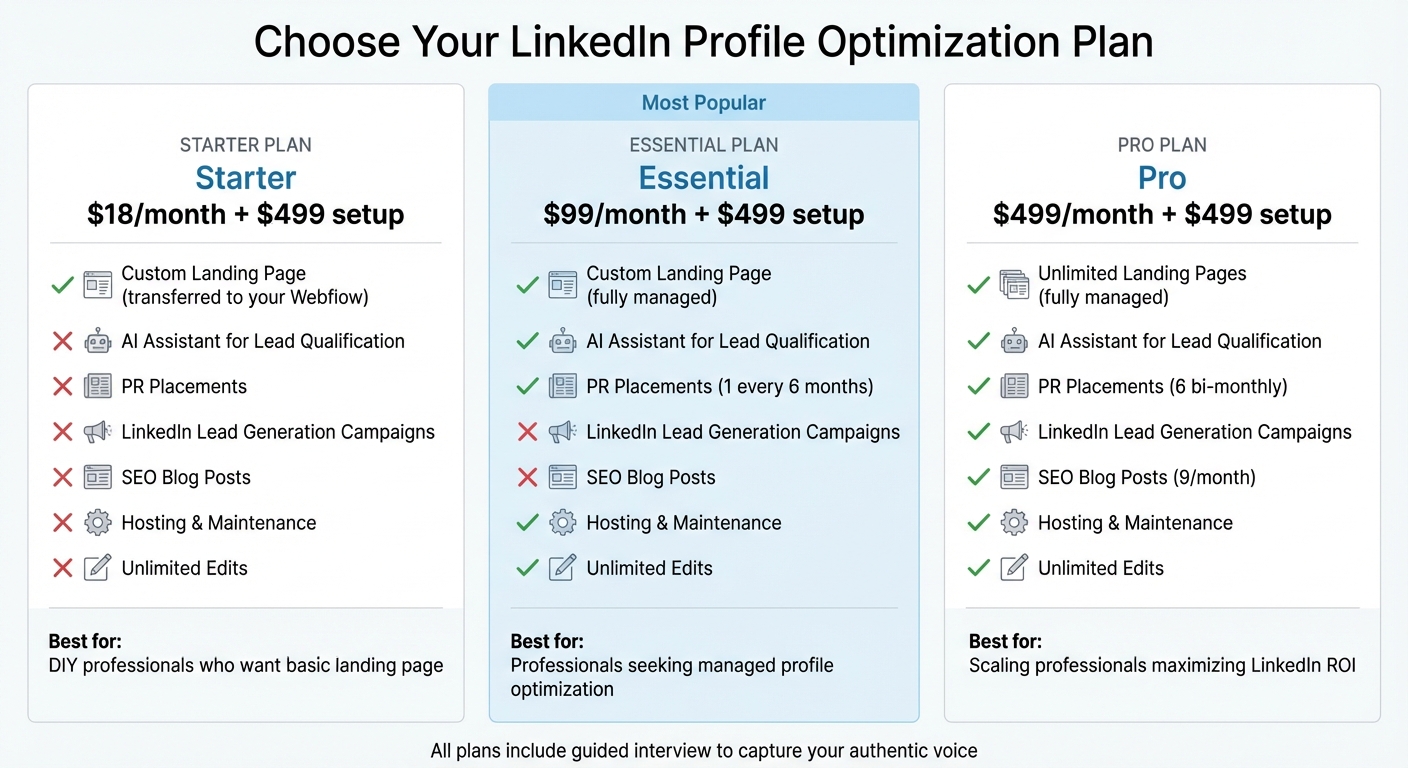
Brandbase LinkedIn Profile Optimization Plans Comparison
Brandbase plans offer tailored solutions to address the critical gaps in your LinkedIn profile, focusing on areas like your headline, About section, visuals, and Experience descriptions. These plans are designed to transform your profile into a client-attracting powerhouse, with varying levels of support and automation to meet your needs.
Here’s a closer look at each plan and how it tackles common LinkedIn profile challenges:
The Starter plan provides a custom landing page linked to your Featured section. This solves the lack of social proof by giving you a professional space to showcase your work, share lead magnets, and offer contact options. However, the responsibility for updates falls on you, as the page is transferred to your Webflow account for self-management.
The Essential plan takes things further with a fully managed landing page, unlimited edits, a custom AI assistant, and one PR placement every six months. The AI assistant analyzes your successful sales conversations to craft an About section and Experience descriptions that highlight client problems and solutions. The PR placement adds third-party credibility to your Featured section, addressing the trust gap that might deter potential clients.
The Pro plan is designed for those aiming to scale their professional presence. It includes everything from the Essential plan but adds unlimited landing pages, LinkedIn lead generation campaigns, six bi-monthly PR placements, and nine monthly SEO blog posts. The lead generation campaigns directly connect you with decision-makers, solving visibility issues, while the frequent PR placements keep your Featured section fresh with new validation. The blog posts enhance your authority in your field, reinforcing the value you bring as highlighted in your headline.
| Feature | Starter | Essential | Pro |
|---|---|---|---|
| Custom Landing Page | ✓ (transferred) | ✓ (managed) | ✓ (unlimited) |
| AI Assistant for Lead Qualification | ✗ | ✓ | ✓ |
| PR Placements | ✗ | 1 every 6 months | 6 bi-monthly |
| LinkedIn Lead Generation Campaigns | ✗ | ✗ | ✓ |
| SEO Blog Posts | ✗ | ✗ | 9/month |
| Hosting & Maintenance | ✗ | ✓ | ✓ |
| Unlimited Edits | ✗ | ✓ | ✓ |
| Monthly Price | $18 | $99 | $499 |
| Setup Fee | $499 | $499 | $499 |
Each plan starts with a guided interview to capture your authentic voice, ensuring that your profile content resonates with client challenges and expectations. Whether you prefer a self-managed approach or a fully automated setup, there’s a plan designed to align with your professional goals.
Conclusion
Your LinkedIn profile has just 30 seconds to make a strong impression and build trust [2]. The five mistakes we’ve discussed - generic headlines, self-centered About sections, missing Featured content, unprofessional visuals, and task-oriented Experience descriptions - can quietly derail your chances of connecting with prospects [3].
What’s at stake isn’t just visibility. When your LinkedIn profile doesn’t align with the expertise you demonstrate on sales calls, it creates a disconnect that pushes high-value clients away, often without you realizing it [7].
"The disconnect between how you sound on sales calls and how you read on LinkedIn costs you deals you'll never know you lost."
- Frank Velasquez, Social Media Strategist [3]
The good news? These problems are fixable. Start by crafting a headline that clearly states the value you bring and who you serve. Rewrite your About section to focus on the specific problem you solve, making it client-centric. Update your Experience section by including measurable results - profiles with metrics are 10x more credible [1]. Finally, use the Featured section to highlight visual proof of your expertise, such as case studies or client testimonials.
Taking these steps not only enhances your visibility but also positions you as a trusted expert, directly influencing client acquisition.
FAQs
What’s the fastest LinkedIn profile fix that can increase inbound leads?
The fastest way to attract more inbound leads? Focus on refining your headline and About section.
Start with a results-driven headline that emphasizes the outcomes you achieve for clients, rather than just listing your job title. This immediately grabs attention and sets you apart.
In your About section, be clear and direct. Explain:
- Who you are
- What you do
- The specific results you deliver
By making these updates, visitors can grasp your value in seconds. This clarity not only boosts engagement but also builds trust with potential clients.
How do I quantify results on my profile if client metrics are confidential?
If client metrics need to stay private, shift your attention to measurable indicators such as profile views, connection requests, and engagement rates (likes, comments, and shares). Another approach is to evaluate your profile's performance through tests that check for differentiation, alignment with your sales process, and how well your audience recognizes your expertise. By ensuring your profile is fully optimized and clearly conveys your value, you can attract the right audience and foster meaningful interactions - all without disclosing sensitive client information.
What should I add to my Featured section if I don’t have case studies yet?
If you don’t have case studies to showcase, consider adding standout items like your top-performing posts, portfolio highlights, or lead magnets to your Featured section. These elements not only demonstrate your skills but also offer value and help establish credibility. Use clear, attention-grabbing titles and strong visuals to make an impression, and always place your most engaging item first. Make it a habit to update this section regularly to reflect your current goals and turn profile visits into trust and potential opportunities.
Related Blog Posts

Blog title heading will go here
Blog title heading will go here