
9 Simple Ways New Coaches Are Building a Personal Brand From Scratch in 2026

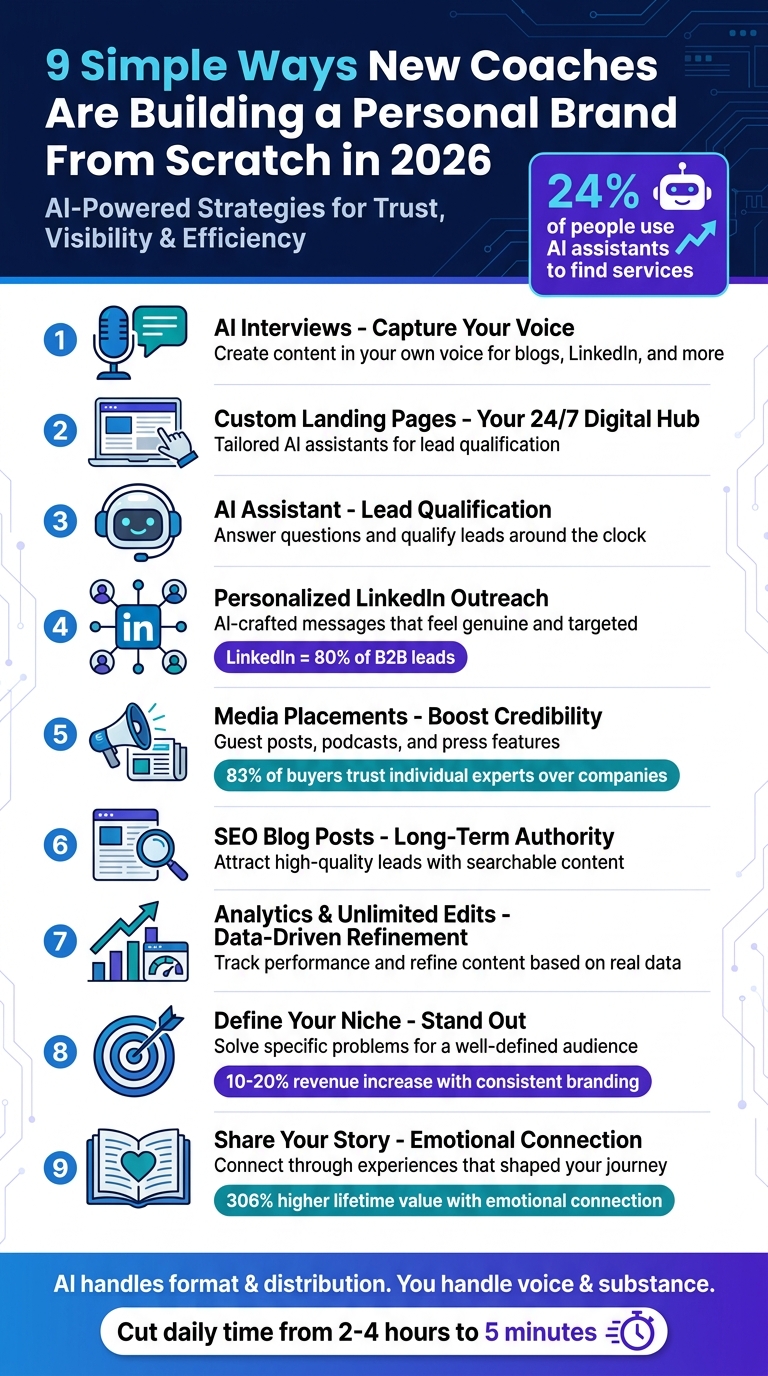
In 2026, building a personal brand as a coach means leveraging AI tools and focusing on trust, visibility, and consistency. With 24% of people using AI assistants to find services, aligning your brand with these systems is critical. Forget endless social media posting - modern strategies prioritize efficiency and personalization. Here’s a quick look at how coaches are standing out:
- AI Interviews: Quickly create content in your own voice for blogs, LinkedIn, and more.
- Custom Landing Pages: Act as your 24/7 digital hub with tailored AI assistants for lead qualification.
- Personalized LinkedIn Outreach: Use AI to craft messages that feel genuine and targeted.
- Media Placements: Boost credibility through guest posts, podcasts, and press features.
- SEO Blog Posts: Build long-term authority and attract high-quality leads.
- Analytics and Unlimited Edits: Track performance and refine content based on real data.
- Define Your Niche: Stand out by solving specific problems for a well-defined audience.
- Share Your Story: Connect emotionally by sharing the experiences that shaped your coaching journey.
9 Ways New Coaches Build Personal Brands in 2026
How to Build a Personal Brand From Scratch in 2026 (Step-by-Step)
sbb-itb-f7e72a6
1. Use AI Interviews to Capture Your Voice
Creating content that genuinely reflects your personality can be a hurdle for new coaches. AI interviews help bridge this gap by analyzing your existing writing - whether it's posts, emails, or articles - to develop a voice model tailored to you. These tools don’t just mimic your writing style; they study your sentence structure, word choices, tone, and how you present arguments. Unlike standard AI models that need constant re-prompting, these advanced platforms maintain a "voice memory", ensuring that everything they produce sounds like you.
Generic, template-based tools often make content feel impersonal, but voice-focused platforms adapt to your authentic communication style. Essentially, they create a digital representation of how you naturally write and speak. Even better, as you tweak the AI's output over time, it learns from those changes, becoming even more aligned with your voice.
"Voice replication is the foundation of personal branding. Without it, every other feature - templates, scheduling, analytics - produces content that sounds like everyone else."
– Sadok Hasan, Bloomberry
This ability to replicate your voice paves the way for fast, personalized content creation - a game-changer for busy professionals.
Practicality for Service-Based Professionals
For new coaches juggling multiple responsibilities, AI interviews can transform raw ideas into polished content in minutes. These tools make it easy to stay consistent with your personal brand. For instance, you can provide the AI with samples of your work - like emails, speeches, or articles - and it will create a voice model ready to use across platforms. With just a few spoken sentences or rough ideas, the AI can generate professional-quality content in under 10 minutes [8].
What's more, one idea captured in an AI interview can be repurposed into various formats, such as LinkedIn posts, blog articles, or video scripts, all while maintaining your unique voice. This efficiency ensures your content always feels personal and on-brand.
2. Create a Custom Landing Page
Once you've captured your authentic voice through AI interviews, the next step is to channel that personality into a custom landing page. This page serves as your digital hub, showcasing your expertise, filtering your audience, and converting visitors into leads - day and night [4][5].
AI-Driven Tools for Personalization
Modern AI tools make it easier than ever to create a landing page that genuinely reflects who you are. Instead of relying on cookie-cutter templates, these tools pull insights from focused interviews to craft copy that mirrors your expertise, story, and professional tone [10]. The result? A landing page that stands out by highlighting your unique approach and communication style - no generic feel here.
But it doesn’t stop at copy. AI can also power custom assistants trained specifically on your coaching framework. These assistants engage with visitors, qualify leads, and answer questions 24/7 - all in your voice [10]. This level of personalization ensures consistency across every interaction, helping you build trust and stand out in a crowded space.
Building Trust and Visibility
A well-designed landing page needs to work for both human visitors and AI-driven tools. By blending personalization with SEO best practices, you can make your page more discoverable. One key strategy is Generative Engine Optimization (GEO), which uses structured data and schema markup to help AI systems like ChatGPT and Perplexity recommend your services for relevant queries [3]. Considering that 24% of people already rely on AI shopping assistants to find services, optimizing for AI discovery isn’t just smart - it’s essential [3].
Trust is critical when converting visitors into clients. In fact, 88% of potential clients say trust is as important as price or quality when choosing a professional [3]. Your landing page builds this trust by showcasing social proof (like testimonials and success stories), outlining a proprietary framework that highlights your unique methodology, and offering tiered services that let clients choose based on their needs [3][4]. And brands that maintain a consistent identity across platforms - including their landing page - can see revenue increases of 10% to 20% [3].
"In 2026, it's not enough to be good at what you do. You need to own a specific space in your clients' minds."
– Lori Young, Founder, On A Mission Brands [3]
Why It Matters for Service-Based Professionals
A custom landing page gives you direct access to your audience - something social media followers alone can’t provide. By using your page to host lead magnets, you can collect contact information, qualify leads, and automate the process without the need for constant back-and-forth [4][6].
For example, Brandbase offers two plans tailored for professionals. The Essential plan ($99/month + $499 one-time fee) includes a fully managed landing page with hosting, maintenance, analytics, unlimited edits, and a custom AI assistant to handle lead qualification [10]. For those scaling quickly, the Pro plan ($499/month + $499 one-time fee) adds unlimited landing pages and LinkedIn lead generation campaigns [10]. This setup transforms your landing page into a 24/7 sales system, allowing you to focus on delivering results for your clients while your page works behind the scenes.
3. Set Up an AI Assistant for Lead Qualification
Your landing page is live, but what happens when potential clients visit after hours? That’s where an AI assistant steps in as your around-the-clock support system - answering questions, qualifying leads, and even scheduling calls. Let’s take a closer look at how these tools can fine-tune your lead qualification process.
AI-Driven Tools for Personalization
Today’s AI assistants go beyond basic automation. They can learn directly from your content - whether it’s blog posts, videos, PDFs, or session recordings - to reflect your brand’s voice and tone [11]. These assistants engage visitors with targeted questions, collect contact details, and sift through leads to identify quality prospects - all while maintaining your brand’s personality.
Take Rachel Okonkwo, for example. In early 2026, she introduced an AI scoring layer to her intake form for her boutique leadership coaching firm. The results? Over three months, she cut her discovery call volume in half while increasing her call close rate by 40%. Her monthly recurring revenue jumped from $18,000 to $31,000 [13].
"AI qualification is not about automating the sales conversation; it is about ensuring the only calls you take are worth taking."
– Arete Intelligence Lab [13]
Scalability and Automation of Branding Efforts
AI assistants don’t just qualify leads - they scale your efforts. By automating common inquiries and pre-screening prospects, they allow you to focus on what matters most, like delivering impactful coaching sessions. Plus, they analyze visitor interactions to refine your messaging, helping you connect with prospects on their terms [10][11].
For example, Brandbase offers tailored AI assistant solutions. Their Essential plan ($99/month + $499 one-time fee) includes a custom assistant that qualifies leads, answers questions in your voice, and integrates seamlessly with your landing page [10]. If you need more, the Pro plan ($499/month + $499 one-time fee) adds unlimited landing pages and LinkedIn campaigns, turning your AI assistant into a full-fledged lead generation powerhouse [10].
4. Start Personalized LinkedIn Outreach Campaigns
LinkedIn accounts for about 80% of all B2B leads generated through social media, making it an essential tool for new coaches looking to establish their brand[12]. However, the days of generic messages like "Hi [First Name]" are fading fast. These templated approaches often get ignored because they lack a personal touch. This is where AI tools can step in to help you craft messages that feel tailored and genuine.
AI-Driven Tools for Personalization
AI tools can help you scale your outreach while keeping it personal. These tools analyze a prospect's profile, recent posts, and work history to draft unique opening lines. From there, you can refine the message to ensure it reflects your voice. This process combines the efficiency of automation with the authenticity of human input.
Personalized messaging pays off. Sales reps who customize every interaction are 4–5× more likely to surpass a 40% connection acceptance rate. Even better, deeply personalized outreach can double the number of first meetings within just two weeks[15]. Some AI tools can even identify behavioral triggers, like when someone views your profile multiple times or comments on a post about burnout, and suggest the right moment to reach out[16].
Scalability and Automation of Branding Efforts
While automation can handle the heavy lifting, building real relationships still requires a human touch. Top-tier tools can manage outreach sequences, track deliverability, and filter leads based on niche, role, or intent signals - all at accessible price points[12]. Some platforms even mimic your messaging style by learning from your past interactions, ensuring your outreach feels natural and not robotic[16].
For best results, limit your outreach to 100 connection requests per week and 20–30 direct messages per day, with randomized delays to simulate human activity[12]. You can also use "social warming" - engaging with a prospect’s content (like liking a post or following them) before sending a direct message. This small step can increase the chances of your message being noticed and accepted[15].
Practicality for Service-Based Professionals
For service-based professionals, personalized LinkedIn outreach can be a game changer. Coaches just starting out often find LinkedIn outreach converts at twice the rate of cold calling or generic messaging[14]. Start by defining a narrow client profile - for instance, "Founders of SaaS companies with 10–50 employees who recently posted about burnout." Use LinkedIn's Boolean search to create a targeted list and follow up with a multi-touch sequence spaced 3–5 days apart[14].
If you want to streamline the process further, services like Brandbase's Pro plan can handle the entire workflow for you. For $499 per month (plus a one-time $499 setup fee), they manage everything from prospect research to sequence management. This allows you to focus on meaningful conversations, with most responses coming after the second or third touchpoint[12].
5. Get Media Placements for Visibility
After refining your online presence and streamlining lead generation, the next step is gaining external recognition through media coverage. Why? Because media coverage offers validation that self-published content simply can’t. When a respected publication highlights your expertise, it signals to potential clients that your work stands out - even in the eyes of an impartial editorial team. And in 2026, with 83% of buyers trusting individual experts more than faceless companies, this kind of recognition matters more than ever[17][1].
Effectiveness in Building Credibility and Expanding Reach
Strategic media placements can snowball into a cycle of growing credibility. A single guest post or podcast appearance can lead to bigger opportunities. For instance, a byline in a niche industry magazine might get you noticed by a podcast host, which could eventually lead to national exposure[19]. For coaches, this is a game-changer. Media placements amplify the trust you've already built through your website and outreach efforts[3].
"Media coverage provides third-party validation that self-published content cannot. When a credible publication writes about you, it signals to your market that an independent editorial judgment found your work worth featuring."
- Victoria Wilson, Author, CEO Medium[17]
How AI Tools Make Media Outreach Smarter
AI-powered platforms are reshaping how experts connect with journalists. These tools can match you with reporters looking for quotes in your field, sending real-time notifications when a relevant opportunity arises. Quick responses are key - replying within the first hour can boost your chances of being featured by over 60%[18]. On top of that, AI can draft initial responses for media pitches by analyzing your past interviews and thought leadership. This cuts the time needed to craft pitches from around 12 hours to just 4, all while keeping your unique voice intact[1].
Practical Tips for Service-Based Professionals
When pitching to journalists, make your expertise stand out by leading with specific, data-backed insights. For example, if you're a leadership coach, you might say: "In 50 client engagements, I found that 78% of founder burnout stems from unclear delegation frameworks, not overwork." Specificity like this captures attention and positions you as an authority.
For those who want to streamline the process, tools like Brandbase offer affordable options. Their Essential plan includes one PR placement every six months for $99/month (plus a $499 setup fee), while the Pro plan provides six placements annually - one every two months - for $499/month[10]. These placements are arranged through AI-driven interviews that ensure every pitch reflects your genuine expertise, not generic soundbites.
6. Write SEO-Optimized Blog Posts
Once you've secured media placements, it's time to focus on creating content you control. Blog posts on your website serve as long-term, searchable assets that grow in value over time. Unlike social media posts, which can quickly fade into the background, these posts build authority and trust consistently. For new coaches, this strategy acts as a marketing system that works behind the scenes, generating leads and establishing credibility without constant upkeep[1].
Effectiveness in Establishing Credibility and Visibility
Search engine traffic connects you with a different type of audience. When people search for solutions on Google, they’re often ready to take action, making them higher-quality leads compared to casual social media users[20]. If you publish at least two posts per month, you can start seeing measurable SEO growth within 3–6 months[21]. And the best part? Once your blog posts gain traction, they can continue bringing in clients for years.
"In 2026, trust matters more than noise."
- Leonie Novorol, Business Coach[6]
AI-Driven Tools for Personalization
Blog posts can do more than attract leads - they can also showcase your unique voice. AI tools can help refine and optimize your content, but the key is to blend AI's efficiency with your personal insights. Use AI for tasks like research, structuring, and SEO optimization, but make sure your posts include your own stories, examples, and even bold opinions to stand out[21].
For instance, tools like ChatGPT Plus ($20/month) can analyze your existing writing style using the "3-example method." By feeding it samples like Instagram captions or newsletters, you can ensure the AI-generated content aligns with your voice[21]. However, don’t rely solely on AI. Posts that include personal touches consistently achieve higher engagement than unedited AI drafts[21].
Here’s a quick tip: use the "Friend Test." Read your post aloud. If it doesn’t sound like something you’d say to a friend, it needs more personality[21].
Practicality for Service-Based Professionals
Start by identifying the questions your audience is already asking. Free tools like AnswerThePublic can help you uncover these topics[20]. AI can then analyze top-ranking articles to highlight gaps or outdated information, allowing you to offer a fresh perspective[21].
Don’t forget the technical details: every post should have a meta description under 155 characters that includes your primary keyword and sparks curiosity. Also, ensure your site has an SSL certificate (HTTPS) and loads within 1–2 seconds. Slow loading times - anything over 3 seconds - can hurt both user experience and your SEO rankings[20].
If you’re a coach using Brandbase's Pro plan, they offer nine SEO-optimized blog posts per month for $499. This package combines AI-driven technical optimization with your unique methodology, freeing you up to focus on creating meaningful content[10]. A smart content strategy balances 40% educational posts to showcase your expertise with 25% personal stories to foster connection[9]. This mix helps you solidify your authority while building a relatable personal brand online.
7. Track Analytics and Make Unlimited Edits
Building a personal brand in 2026 requires adaptability - tracking results, identifying what works (and what doesn’t), and refining your message based on actual data. Without analytics, you're left guessing. But with them, every tweak you make can lead to better outcomes over time. This data-driven approach also allows AI to step in and streamline your content updates effortlessly.
AI-Driven Tools for Personalization
AI tools have become essential for content creation and ongoing improvement. These tools don’t just generate content; they adapt to your editing habits through a "learning loop." This means they observe which phrases you keep, modify, or remove, helping you save time. In fact, editing time can drop from 45 minutes to just 5 minutes per post[7].
AI also provides insights into what resonates most with your audience. Instead of focusing on vanity metrics like likes, it highlights engagement trends. For instance, if a post about client transformation stories gets three times your usual engagement, that’s a clear signal to create more content like it[7]. The major shift in 2026 is moving beyond impressions and focusing on whether your content connects with your target audience[1].
Practicality for Service-Based Professionals
AI-powered analytics also make it easier to update your content across multiple platforms, ensuring your brand stays relevant and adaptable. The ability to make unlimited edits across all your materials gives you a level of flexibility that was once unimaginable. For example, when LinkedIn’s organic reach dropped by 30% between 2024 and 2026, professionals who relied solely on that platform saw their visibility plummet[2]. By contrast, those who diversified their content across LinkedIn, Instagram, X, Threads, and Facebook could maintain their presence with just a quick daily review[2]. This approach reduces the risk of being overly dependent on any one platform’s algorithm.
Take MEWR Creative as an example. Between March 2025 and March 2026, they created 260 LinkedIn posts in just 4 weeks. By scheduling these posts over a year and using AI to identify top-performing content pillars, they grew from zero visibility to 5,000 followers and 15,000 email subscribers. This strategy also generated over 50 inbound business inquiries in just 6 months[1]. Their success was rooted in regularly analyzing performance and cutting out content that didn’t convert.
If you’re using Brandbase’s Essential or Pro plans, you can make unlimited edits to your landing pages, blog posts, and other branding materials. This gives you the freedom to test new ideas, adjust your messaging as your niche evolves, and refine your positioning without worrying about revision limits. For new coaches, this flexibility is crucial - it helps you shape your voice and stay competitive in 2026’s fast-paced digital world. Continuous improvement is no longer optional; it’s the standard for success.
8. Define Your Niche and Value Proposition
Once you've fine-tuned your messaging with real-time edits, it's time to focus on defining exactly who you serve and why you're the best choice for them.
Your niche is all about clarity - who you help and why you're uniquely positioned to do so. A broad statement like "I help entrepreneurs" won't cut it anymore. The market favors those who narrow their focus, targeting specific groups with shared challenges. For example, instead of saying you assist "business leaders", you could refine that to "tech founders navigating leadership transitions." This level of specificity not only sets you apart but also makes your services more relevant and appealing.
AI-Driven Tools for Personalization
AI can be a powerful ally in refining your niche. It can sift through interview notes, sales call transcripts, and client FAQs to uncover recurring themes and language that resonate with your target audience. This helps you move from vague categories like "productivity coaching" to more precise outcomes, such as "helping mid-career caregivers reduce guilt and regain structure" [22]. Tools like XEngageAI can also analyze your writing style to ensure your tone remains consistent and recognizable across all content [9].
The combination of a well-defined niche and AI-driven personalization allows your messaging to feel tailored on a broad scale while still retaining that boutique, personal touch.
"Niching increases precision; AI increases throughput. Together, they create a business that feels boutique on the outside and systemized on the inside." – PersonalCoach.cloud [22]
This approach not only sharpens your communication but also streamlines your ability to meet the needs of your ideal clients.
Practical Applications for Service-Based Professionals
Once your niche is established, AI can simplify your workflow by helping you create a reusable library of prompts. These can standardize tasks like preparing for discovery calls, drafting intake summaries, and generating personalized habit plans. AI can also automate the creation of niche-specific lead magnets, such as diagnostics or scorecards that address the specific pain points of your target audience [22]. This means you can attract the right clients without having to manually tailor every piece of outreach.
With your niche in place, the next step is to clearly articulate why you're the best choice for your audience.
Building Credibility and Visibility
A strong value proposition answers the key question: "Why should someone choose you over another coach with similar credentials?" For 88% of potential clients, trust in a brand is just as important as price or quality when deciding whom to hire [3]. Developing a proprietary framework can turn your expertise into something tangible, making it easier for potential clients to understand and for AI systems to recommend your services through platforms like GEO [3].
"In 2026, it's not enough to be good at what you do. You need to own a specific space in your clients' minds. You need to be the obvious choice when they're ready to invest." – Lori Young, Brand Positioning Strategist, On A Mission Brands [3]
Coaches who define their niche and communicate their value proposition consistently often see revenue increases of 10–20%. Additionally, clients who feel an emotional connection to a brand have a 306% higher lifetime value compared to those who are merely satisfied [3]. By clearly defining your niche and delivering your unique value consistently, you're not just creating a brand - you’re building a business that attracts and retains the right clients. This clarity works hand-in-hand with automation and personalization to strengthen your overall strategy.
9. Share Your Personal Brand Story
Your personal brand story is what ties everything together - it's the human element behind your messaging. It’s not about listing your credentials but about sharing the pivotal moments that shaped your journey as a coach. Focus on the experiences that gave you a deep understanding of your clients' challenges. The best stories showcase how you’ve faced and overcome struggles similar to theirs, creating a connection that resonates on a personal level [24]. This story becomes the thread that links your credibility and outreach strategies, forming a unified and relatable brand identity.
Effectiveness in Establishing Credibility and Visibility
Sharing honest and heartfelt experiences builds trust. It shows your clients that you truly understand their struggles because you’ve been there yourself. A well-told story doesn’t just set you apart - it strengthens client loyalty. By sharing your challenges, mistakes, and lessons learned, you create a real connection that stands out, especially in a world increasingly influenced by AI-driven content.
"Your personal brand is what people say about you when you are not in the room." – Jeff Bezos, Founder, Amazon [23]
The trend of "documenting the journey" rather than presenting only polished results is gaining traction in 2026. Sharing the messy, real-time process - your work, your failures, and even your unfinished ideas - creates a level of connection that AI simply can’t replicate [23].
AI-Driven Tools for Personalization
AI can take your storytelling to the next level by transforming your core experiences into tailored, platform-specific content. Modern tools can analyze your most successful content to capture your tone, structure, and values, ensuring every piece feels like it came directly from you [9]. Using the 3-Pillar Content Framework, you can balance your storytelling effectively: 35% Expertise, 30% Personality (including personal anecdotes), and 35% Actionable Value [1]. With AI, a single story can be repurposed into dozens of pieces of content for various platforms - all while you stay in control of the message.
"AI handles format and distribution. You handle voice and substance." – MEWR Creative [1]
This approach allows you to scale your storytelling without losing its authenticity. AI takes care of the technical side, while you focus on sharing meaningful, personal experiences.
Scalability and Automation of Branding Efforts
A great example of this in action comes from MEWR Creative, which used AI in 2025-2026 to turn core story outlines into 260 LinkedIn posts in just four weeks. These posts were scheduled over the course of a year. Through consistent storytelling and engagement, they gained 5,000 followers, 15,000 email subscribers, and hundreds of qualified leads [1]. This shows how AI-powered storytelling can help you stay visible and connected without burning out. Automation handles the repetitive tasks, leaving you free to focus on building genuine, human connections through your unique story.
Conclusion
Building a personal brand as a new coach in 2026 doesn’t have to feel overwhelming. The nine strategies outlined here highlight how AI and digital platforms have transformed the process - allowing you to maintain a professional presence across multiple channels without spending hours every day creating content. These focused approaches give you the tools to establish a strong, enduring personal brand in today’s AI-driven landscape. With AI taking care of tasks like formatting, scheduling, and distribution, you can devote your energy to what truly matters: your unique voice and the value of your coaching [1].
A consistent brand identity is key to building trust and can increase revenue by 10–20% [3][4]. By using AI to capture your voice, design custom landing pages, automate lead qualification, and distribute content across 3–5 platforms simultaneously, you can create the trust and visibility that turn prospects into clients. Coaches with a presence on multiple platforms lose less than 10% of their reach when one platform changes its algorithm, compared to a 60% to 80% loss for those relying on just one [2].
The role of AI as a content gatekeeper is already here. With AI shopping assistants and recommendation systems like ChatGPT and Perplexity becoming part of your audience’s daily life, it’s essential to optimize your brand for both human readers and AI systems [3]. Strategies like Generative Engine Optimization, personalized outreach, and authentic storytelling ensure you’re discovered by the right clients at the right time. Aligning your efforts with AI and audience expectations positions you for immediate, measurable results.
Start by focusing on one or two strategies - such as defining your niche or creating a custom landing page - that align with your current goals. The most important step is to take action now rather than waiting for the "perfect" moment. With AI automation, you can cut your daily time investment from 2–4 hours to as little as 5 minutes [2], making it possible to build a thriving brand without risking burnout.
FAQs
Which 1–2 brand moves should I start with first?
To get started, concentrate on two essential elements:
- Define Your Personal Brand: Pin down what sets you apart, who you aim to help, and the values you represent. This clarity will make it easier to differentiate yourself and connect with the right audience.
- Build Your Online Presence: Develop a polished website, maintain active social media accounts, and ensure a consistent visual style. These steps will help you leave a lasting impression and build trust with potential clients.
How do I keep AI content sounding like me?
To make AI-generated content truly reflect your voice, take the time to review and tweak it. Adjust the tone, word choice, and subtle details so they match your style and brand personality. Trying out different prompt templates can also help fine-tune the content to better align with how you communicate. Consistently refining AI outputs ensures they stay aligned with your identity and feel genuine to your audience.
What does it mean to optimize for AI search (GEO)?
To stand out in AI-driven search platforms like ChatGPT, you need to adjust your content and online presence so these systems can easily find and recommend you. Here's how:
- Use structured data: Incorporate schema markup to help AI systems understand your content better.
- Provide clear, concise answers: AI platforms prioritize content that directly answers questions in a straightforward way.
- Keep content updated: Regularly refresh your material to stay relevant and increase the chances of being cited by AI systems.
These steps can help improve your visibility and make your content more accessible to AI platforms.
Related Blog Posts

Blog title heading will go here
Blog title heading will go here