5 Ways to Get More Discovery Calls Without Posting on Social Media Every Day
Tired of wasting hours on social media with little to show for it? Here's the truth: most discovery calls from social media attract browsers, not buyers. Instead of chasing likes, focus on smarter, more efficient strategies to consistently book calls with serious prospects.
Key Takeaways:
- Automate Lead Qualification: Use AI tools like Brandbase to screen and score leads 24/7, saving time and increasing call quality.
- Personalized LinkedIn Outreach: Craft tailored messages and interact meaningfully for higher response rates.
- Custom Landing Pages: Design focused pages with clear CTAs to convert visitors into scheduled calls.
- Media Placements: Build authority through podcasts, articles, and newsletters to attract high-intent leads.
- Leverage Analytics: Track key metrics to refine and improve your lead generation system.
By combining automation, personalization, and data-driven adjustments, you can generate more qualified discovery calls without the daily grind of social media. Let’s break down each strategy.
5 Strategies to Get More Discovery Calls Without Daily Social Media Posting
1. Use Brandbase AI Assistants to Qualify Leads Automatically
Automation Capabilities
Brandbase AI Assistants transform the traditional contact form into an interactive experience with qualification quizzes. Instead of filling out generic forms, prospects engage in real-time with targeted questions about their budget, timeline, decision-making authority, and project complexity. The AI responds instantly, operating 24/7 to ensure no lead slips through the cracks [3][5].
Each lead is scored on a scale of 0 to 100 based on criteria you set. High-scoring leads are automatically directed to schedule a meeting, while lower-scoring ones receive tailored resources or nurturing campaigns [3]. This system uses a two-step process: a quick filter for broad criteria and a deeper analysis to assess how well the prospect aligns with your offerings [1]. The result? You spend your time engaging only with prospects who are ready to move forward.
This approach doesn't just qualify leads - it creates a more efficient and effective lead generation process.
Lead Generation Efficiency
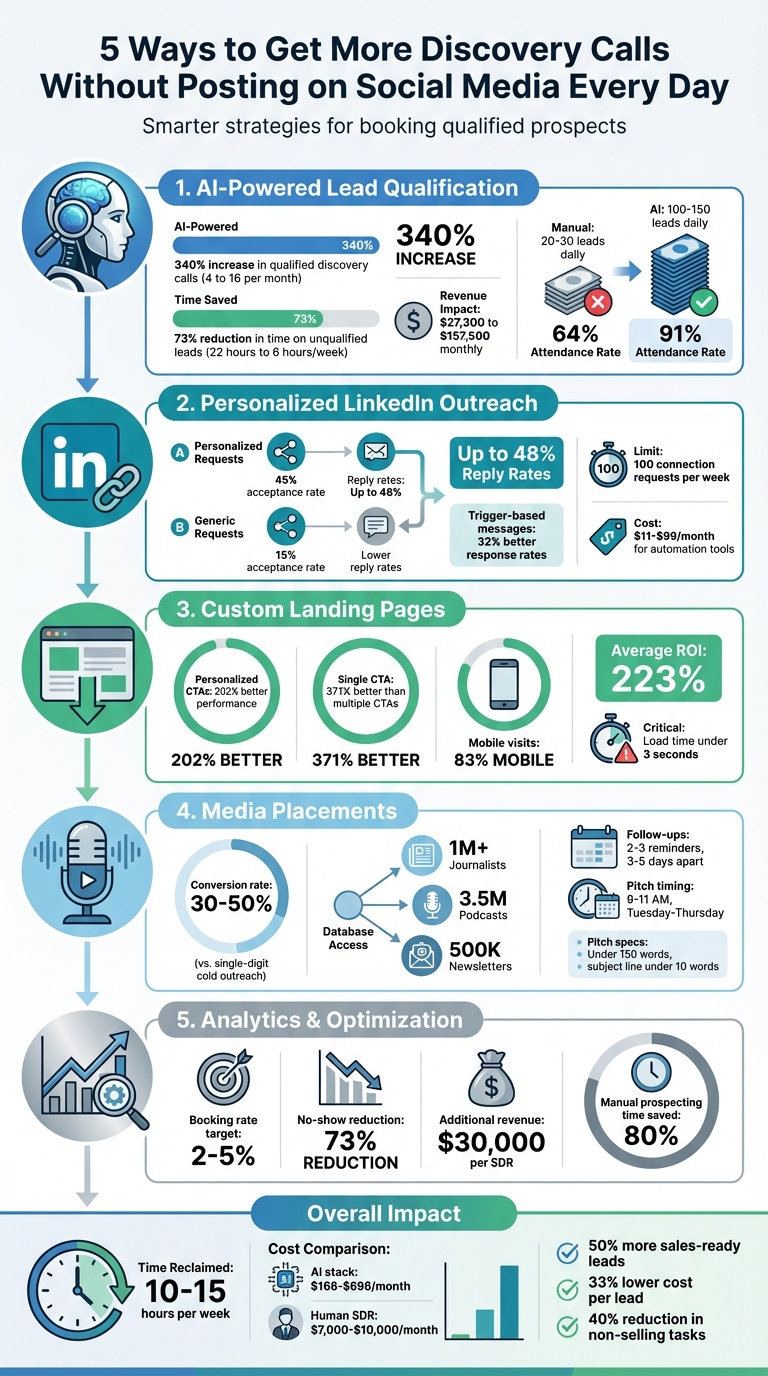
Here’s a real-world example: In April 2026, a mid-sized branding agency on the East Coast swapped its "Contact Us" form for a 7-question AI-powered quiz. Over the next 60 days, they cut time spent on unqualified leads by 73% - dropping from 22 hours per week to just 6 hours. Even better, their monthly qualified discovery calls skyrocketed from 4 to 16, a 340% jump. As a result, their monthly new client revenue surged from $27,300 to $157,500 [3].
AI tools like this can qualify 100–150 leads daily, compared to just 20–30 when done manually [4]. Discovery call attendance rates also improved dramatically, climbing from 64% to 91% under AI management [3]. Marcus Chen, an AI Automation Strategist, explains:
"Qualification is not rejection - it's routing. The quiz didn't turn away prospects. It directed them to the right resource for their current stage" [3].
This streamlined process not only increases efficiency but also lays the groundwork for scalable lead management.
Scalability and Ongoing Optimization
One practical tip: Place sensitive questions, like budget-related ones, later in your quiz. By the time prospects have answered a few initial questions, they’re more likely to provide honest answers about their budget. Additionally, analyze why your current discovery calls fall flat and use those insights to design your AI assistant’s key qualification questions [3].
The cost savings are hard to ignore. Deep analysis with AI costs about $0.01 per lead, and fast filtering costs as little as $0.001 per lead [1]. Compare that to the current reality where sales professionals spend only 30% of their time actually selling - the rest goes to administrative tasks [3]. By letting Brandbase AI Assistants handle the grunt work, your team can focus on closing deals with leads that are ready to convert.
sbb-itb-f7e72a6
How I Use Claude + Calendly + ClickUp To Automate Discovery Calls
2. Run Personalized LinkedIn Outreach Campaigns
Once you've automated lead qualification with AI, it's time to take your strategy further with LinkedIn outreach. Done right, this method can be a game-changer for building professional connections.
Personalization Potential
The key to LinkedIn outreach success? Making it feel real and tailored. Personalized connection requests can see acceptance rates as high as 45%, compared to just 15% for generic ones [6]. Why? Because people respond to specificity. Instead of sending a bland message like "I'd love to connect", reference something meaningful - a recent post they shared, a mutual contact, or a current challenge in their industry.
Keep your initial message short and focused - 200 to 250 characters is ideal. Include a hook, some context, and a soft call-to-action [6]. And once they accept? Don’t jump straight into a pitch. Instead, start by offering value. Share a helpful resource, ask a thoughtful question, or engage with something they've recently posted. As Gro Resources wisely notes:
"The hardest close often starts with no pitch at all. Ask a question or offer a resource" [9].
This approach not only builds trust but sets the stage for meaningful engagement, as reflected in the numbers below.
Lead Generation Efficiency
The stats don’t lie: Well-executed LinkedIn outreach can deliver reply rates as high as 48% [8]. Compare that to cold email's typical response rate of 1% to 5.1% [9], and the difference is clear. But here's the catch: warming up your prospects is critical. Interacting with their content - liking posts or leaving thoughtful comments - before sending a connection request can increase reply rates to 30–50% [10].
Timing plays a big role, too. Reach out during "honeymoon periods" like the first 90 to 120 days of someone's new role, or after major events like funding announcements or product launches [8]. These trigger-based messages can improve response rates by 32% compared to static outreach [9]. And with LinkedIn accounts generally capped at 100 connection requests per week [7], focusing on quality over quantity is crucial. Target decision-makers who align with your ideal client profile rather than casting a wide net.
Scalability and Ongoing Optimization
Scaling LinkedIn outreach doesn’t mean spamming identical messages to hundreds of people. Instead, it’s about blending automation with human insight. Automation tools can help with tasks like profile research and drafting messages, but the real magic happens when you add that personal touch. Tools range from browser extensions costing $11 to $55 per month to cloud platforms priced between $39 and $99 per month [7]. A hybrid model - where AI handles the heavy lifting and you fine-tune the details - can make your outreach both efficient and effective [6][8].
Experimentation is key. Test different hooks, value propositions, and tones to see what resonates [6]. Keep an eye on your Social Selling Index (SSI) score, as a higher score boosts your visibility and credibility on LinkedIn [6]. And here’s a surprising stat: 87% of LinkedIn connection requests lack any personalized message [6]. That means you don’t need to be flawless - just better than the generic noise filling most inboxes.
3. Create Custom Landing Pages That Convert Visitors
Custom landing pages are the final piece of your conversion funnel, working hand-in-hand with AI-driven lead qualification and LinkedIn outreach. While LinkedIn outreach grabs attention, your landing page seals the deal. Its focus? Driving visitors to book discovery calls. To succeed, it needs to feel personal, polished, and laser-focused.
Personalization Potential
Generic landing pages often fall flat. In contrast, personalized calls-to-action perform 202% better than their one-size-fits-all counterparts [13]. The secret lies in making the experience feel relevant. Imagine a visitor landing on your page and immediately seeing their company logo or a headline that directly addresses their biggest challenge. That kind of tailored touch builds trust instantly.
To take it further, customize elements like:
- Industry-specific messaging
- Testimonials or logos from similar businesses
- CTAs that align with the buyer's journey (e.g., "Get Expert Advice" for early-stage prospects versus "Start Your Free Trial" for those ready to commit)
As AJ Beltis from HubSpot notes:
"I've found that direct CTA copy tends to perform better than lengthier CTA copy. Succinctly pitching the value of what you're linking out to on a page... can act as an unambiguous directive." [13]
This personalized strategy creates a smoother path to conversion.
Lead Generation Efficiency
A strong landing page eliminates distractions. Pages with a single, clear CTA outperform those with multiple options by a whopping 371% [13]. Adding tools like an embedded calendar allows prospects to book calls instantly, cutting out the back-and-forth of email scheduling [12][14].
And don’t overlook mobile users - 83% of landing page visits happen on mobile devices [13]. To keep these visitors engaged, your page must load in under 3 seconds and use a simple, single-column layout. Slow-loading pages can lose potential leads before they even see your offer.
Automation Capabilities
Pairing personalized design with automation can supercharge your results. Modern tools now allow marketers to create custom landing pages in minutes, dynamically adjusting headlines, images, and CTAs based on visitor data [16][11].
Here’s how automation helps:
- High-intent leads are pushed directly into your CRM, ensuring you can follow up while interest is still fresh [15].
- For multiple campaigns, you can quickly spin up tailored variations without starting from scratch.
- Marketers using conversion rate optimization tools report an average ROI of 223% [13].
4. Get Media Placements to Build Authority
Appearing on podcasts, newsletters, or in news articles can transform your reputation. Instead of being just another vendor, you become a trusted expert - someone already vetted by your ideal clients through third-party validation [18]. This eliminates the need to convince prospects why they should trust you; your media presence does the heavy lifting.
The stats back this up. Leads driven by authority-based media placements typically convert at 30–50%, far outperforming the single-digit close rates of cold outreach [18]. Why? Because prospects reaching out after seeing your media coverage already believe in your credibility. As Jan van Musscher from Postiv AI explains:
"The agencies consistently landing $5K-$25K/month retainers aren't the ones sending the most cold emails. They're the ones their ideal clients already know, trust, and think of first." [18]
Automation Capabilities
Reaching out to journalists or podcast hosts manually is time-consuming. Researching each contact and crafting a tailored pitch can take 30–60 minutes per contact [17]. That’s why automation tools are a game-changer in 2026. These tools can search through databases of over 1 million journalists, 3.5 million podcasts, and 500,000 newsletter publishers to find the perfect contacts in seconds [17].
They also manage follow-ups - typically 2–3 reminders spaced 3–5 days apart - because most media placements are secured after the first or second follow-up [17]. This automation saves time and ensures you stay consistent.
Personalization Potential
Sending generic pitches won’t cut it. Journalists now receive 200+ pitches daily in 2026 [19], so standing out is crucial. AI-powered tools can analyze a journalist’s recent work or a podcast host’s latest episodes, helping you craft pitches that feel personal and relevant [17].
For the best results:
- Keep pitches under 150 words.
- Use subject lines with fewer than 10 words.
- Send them between 9:00–11:00 AM, Tuesday through Thursday, in the recipient’s time zone [17].
This approach ensures your outreach feels thoughtful and timely, increasing your chances of a response.
Scalability and Ongoing Optimization
Once you secure media placements, don’t stop there. Repurpose them into LinkedIn content - like carousels, posts, and updates - to amplify your authority over time [18]. Track metrics such as open rates, reply rates, and positive responses, and refine your strategy every 90 days [17][18].
This creates a powerful cycle: every successful placement boosts your credibility, making it easier to land the next one. Over time, this momentum generates more discovery calls from prospects who already view you as an expert. Use this credibility to guide a data-driven approach, ensuring continuous improvement in your media outreach efforts.
5. Use Analytics and Regular Updates to Improve Results
Getting discovery calls consistently requires fine-tuning your process. By combining automated lead qualification with personalized outreach, analytics becomes the key to improving results. The difference between a system that occasionally generates calls and one that consistently fills your calendar lies in tracking the right metrics and making data-driven adjustments.
Lead Generation Efficiency
Fast responses can significantly boost your conversion rates, and analytics help you identify high-intent prospects in real time.
For instance, tracking behavioral velocity is crucial. A lead who visits eight pages in 20 minutes shows far more intent than one who takes three weeks to engage with your content [20]. AI-powered tools can detect these patterns and trigger immediate follow-ups, ensuring you connect with prospects while their interest is still high. A great example is Kandji, which implemented an AI chat system that identified high-intent visitors and booked two qualified discovery calls within just eight minutes of activation [2].
By focusing on these efficiency metrics, you can continuously refine your system to deliver better, more consistent results.
Scalability and Ongoing Optimization
In the early stages, dedicate 3–5 hours weekly to reviewing your system. This includes analyzing chatbot logs and voice agent recordings to identify where prospects drop off or where your AI might need adjustments [20]. After the first month, you can scale back to biweekly reviews, eventually transitioning to monthly reviews once your system stabilizes.
Keep an eye on key metrics like cost per lead and meeting booking rates. Ideally, your booking rate should fall between 2–5% for optimized outreach [1]. For example, Connectteam deployed an AI SDR that reduced no-shows by 73%, generating approximately $30,000 in additional revenue per human SDR [2].
John V. Akgul, Founder & CEO of PxlPeak, emphasizes the importance of using AI effectively:
"AI lead generation works when it makes you faster at responding, smarter at qualifying, and more relevant in follow-up. It fails when you use it to increase volume without increasing value." [20]
To further refine your approach, link sales outcomes to your AI models. This feedback loop allows the system to learn which lead scores are most likely to result in closed deals [20]. Over time, this process ensures that every interaction improves your ability to book discovery calls with less effort.
Conclusion
These five strategies offer service professionals a way to fill their discovery call calendars without the constant hustle of daily social media posts. By automating lead research and outreach, you can reclaim 10–15 hours each week - time better spent on client work or strategic planning. These results build on the earlier tactics of automated lead qualification, personalized outreach, custom landing pages, and media placements.
Let’s break it down: sales professionals often dedicate nearly 40% of their workweek to tasks like prospect research and CRM data entry [21]. But with AI-powered lead generation, manual prospecting time can be slashed by 80% [1]. Additionally, companies using automated nurturing see 50% more sales-ready leads at a 33% lower cost [21].
The secret lies in selecting tools that combine these features into one streamlined platform. For example, an AI lead generation stack costs between $168 and $698 per month - a fraction of the $7,000–$10,000 monthly cost of human sales development [1]. Brandbase simplifies the process by integrating custom landing pages, AI-driven lead qualification, personalized LinkedIn outreach, and media placements into a single platform, making it easier to build a steady pipeline of discovery calls.
If you're tired of trading your time for visibility, consider how Brandbase can help you implement these strategies. Together, they create a scalable, reliable system for generating discovery calls, so you can focus on closing deals instead of chasing leads.
FAQs
What should I ask in an AI lead-qualification quiz?
An AI lead-qualification quiz should focus on identifying whether a prospect aligns with your offering. To do this, it’s crucial to ask the right questions that dig into their fit, needs, and readiness to buy. Here are some key areas to cover:
- Business type or industry: Understanding their field helps determine if your service is relevant to their needs.
- Budget: This ensures they have the financial capacity to invest in your solution.
- Decision-making timeline: Knowing when they plan to make a decision helps you prioritize leads.
- Goals or challenges: Ask about their objectives or pain points your product or service can address.
- Past experience: Find out if they’ve used similar solutions before - this can reveal their level of familiarity and expectations.
These questions act as a filter, helping you weed out unqualified leads early. The result? More time and energy spent on prospects who are genuinely interested and a better overall lead quality.
How do I get LinkedIn replies without sounding salesy?
To get replies on LinkedIn without coming across as pushy, focus on genuine and personalized outreach. People tend to ignore generic or overly formal messages, so take the time to tailor your approach to each individual. AI tools can help by summarizing profiles and recent activity, making it easier to craft messages that feel personal and relevant. Steer clear of hard sales pitches - your goal should be to build a connection and provide value. Thoughtful, well-targeted messages are far more likely to get a response than aggressive sales tactics.
What’s the simplest landing page setup to book more calls?
To simplify the booking process and build trust, start with a clean and straightforward landing page. Include a basic booking form or a direct link to a calendar. Keep the steps minimal by only requesting essential information, and add trust boosters like testimonials or guarantees to reassure potential clients. Use scheduling tools that automatically confirm appointments, so everything is handled seamlessly. This no-fuss approach makes it easier for prospects to book, boosting the likelihood of securing more calls.
Related Blog Posts

Blog title heading will go here
Blog title heading will go here