
3 Ways to Monetize Your Coaching Knowledge (Even While You Sleep)

Coaching doesn't have to mean trading hours for dollars. If you're feeling stuck in the one-on-one coaching grind, here’s good news: you can scale your expertise and earn income 24/7. Here are three proven methods to turn your coaching knowledge into passive income:
- Online Courses: Package your expertise into a course. With platforms like Teachable or Thinkific, you can reach thousands of students and earn while you sleep.
- E-books and Guides: Write a short, actionable guide and sell it on platforms like Amazon KDP or Gumroad. A single e-book can generate steady income for years.
- AI-Powered Outreach: Use tools like Brandbase to automate lead generation and client engagement, freeing up your time while expanding your reach.
These strategies require upfront effort but offer long-term financial and personal freedom. Start small, test your ideas, and build multiple income streams to secure your coaching business for the future.
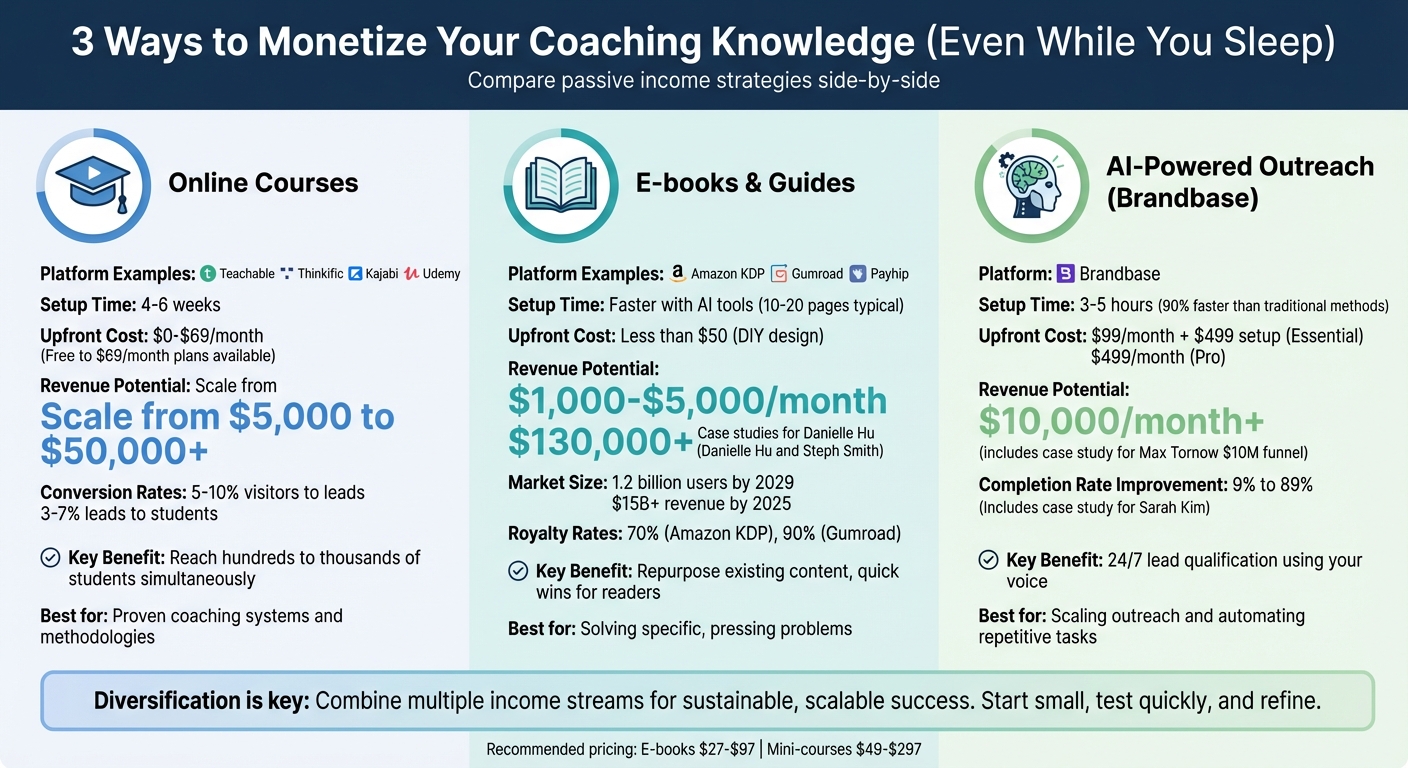
3 Passive Income Strategies for Coaches: Comparison of Costs, Effort, and Revenue Potential
1. Create and Sell Online Courses
Scalable, Passive Income
Online courses let you break free from the limits of one-on-one coaching. Instead of being tied to a set number of hours, a single course can reach hundreds - or even thousands - of students at the same time [4]. Think about it: instead of earning $5,000 from a handful of private sessions, you could scale that same knowledge into $50,000 by teaching it to a larger audience.
With a well-optimized evergreen funnel, you can convert 5–10% of visitors into leads and see 3–7% of a qualified list turn into paying students [2][3]. This setup transforms your expertise into a 24/7 income source, allowing you to earn even while you sleep.
Upfront Effort vs. Long-Term Benefits
Building an online course requires some upfront work - it usually takes about 4–6 weeks to create [3]. But once it’s done, you’ve got a system in place that can generate revenue for years. Start by validating demand through SEO research or by hosting a free workshop. Then, organize your content into 4–6 modules that focus on delivering clear, actionable outcomes for your students. When it’s time to record, batch your video lessons into sets of 3–5 for efficiency [3].
The good news? AI tools can now speed up the process. These tools can help you draft lesson scripts, summarize videos into notes, and even create marketing materials [3].
"Passive income just means money you're making without any additional effort on your part. You set up systems and let them run in the background."
– Teachable Blog [5]
Affordable Tools and Platforms
You don’t need a huge budget to launch your course. Platforms like Teachable offer a free plan (with a $1 + 10% transaction fee per sale) or paid plans starting at $39/month, which eliminate transaction fees. Thinkific provides a free option for one course, with paid plans ranging from $36–$49/month [6]. Kajabi includes email marketing, landing pages, and course hosting, starting at $55–$69/month, while LearnDash gives you full control on WordPress for $199/year [6].
If you’re just starting out and building an audience, Udemy can be a great option. It connects you to 70 million learners and lets you test your course ideas for free. However, keep in mind that Udemy takes 63% of sales generated through their marketplace [6].
The trick is to choose a platform that fits your current stage. You might want to validate your course idea on a marketplace like Udemy first, then move to a hosted platform where you can own your student data and build your brand over time [6]. Ready to explore the next way to turn your expertise into a lasting digital asset? Let’s dive in.
sbb-itb-f7e72a6
2. Publish E-books and Guides
Scalability for Passive Income
Why trade your time for money when you can create a digital product that sells endlessly? Publishing an e-book allows you to reach thousands of readers simultaneously [1]. Platforms like Amazon KDP make this even easier, connecting your work to over 48 million readers worldwide [7]. And the numbers are growing - e-book users are expected to hit 1.2 billion by 2029, with global revenues projected to exceed $15 billion by 2025 [8].
Take inspiration from success stories like Danielle Hu, a business coach who earns $1,000 to $5,000 monthly from just two e-books on her website [8]. Growth marketer Steph Smith went a step further, generating over $130,000 in sales with her self-published e-book, Doing Content Right, on Gumroad [8]. Each e-book you publish not only increases your reach but also builds a steady stream of income over time [7].
Now, let’s look at how the upfront work involved in creating an e-book can lead to sustainable earnings.
Upfront Effort vs. Long-Term Benefits
Creating an e-book used to be a daunting task, often taking months and requiring a hefty budget. But with today’s AI tools, the process is faster and more affordable [7]. You can even repurpose existing content - turn blog posts, newsletters, or transcripts into a concise, impactful guide [10]. High-value coaching guides often range between 10–20 pages, giving readers quick wins they can implement immediately [10].
The key is to focus on solving a specific, pressing problem [10]. For example, in 2020, ex-Amazon employees Daniel Vassallo and Josh Pschorr published The Good Parts of AWS, a guide packed with actionable cloud development tips. By targeting a niche audience, their e-book earned $97,000 in passive income within its first year [8].
Once your e-book is ready, the next step is to ensure cost-effectiveness in publishing and distribution.
Cost-Effectiveness of Tools and Platforms
Getting started doesn’t have to break the bank. You can use free tools like Google Docs or Apple Pages to format your e-book and export it as a PDF [9][12]. Designing a professional-looking cover can cost less than $50 with DIY tools [9]. From there, choose whether to sell through marketplaces or directly to your audience.
Amazon KDP is a popular choice, offering a 70% royalty rate for e-books priced between $2.99 and $9.99, with zero upfront costs [7]. For creators seeking higher profits, platforms like Gumroad charge a flat 10% fee, allowing you to keep 90% of your earnings [11]. Payhip provides another option, with plans starting at $29 per month and a 2% fee - or $99 per month with no transaction fees at all [11].
"Your ebook can do so much more than generate income - it can position you as the go-to expert in your niche, grow your audience, and attract dream clients with ease."
– Moriah Riona, Luxury Brand Designer and Coach [10]
3. Use Brandbase for AI-Powered Outreach
Scalability for Passive Income
Traditional coaching has its limits - most coaches can only work with about 20–30 clients daily because of time constraints [1]. But AI-powered outreach flips that model on its head. With Brandbase, your expertise can reach thousands of people at once, answering questions and qualifying leads 24/7 - even while you sleep. The platform uses your existing content (Zoom transcripts, blog posts, courses, recorded sessions) to train an AI assistant that speaks in your voice [16][17]. This approach has already paved the way for impressive success stories.
Take fitness coach Sarah Kim, for example. In 2025, she incorporated AI tools into her nutrition course and saw her completion rate skyrocket from 9% to 89%. Within six months, she tripled her monthly revenue by increasing referrals and upsells. Her AI system also re-engaged 22% of learners who were at risk of dropping out [13]. These results highlight how investing in AI can lead to significant, long-term payoffs.
Upfront Effort vs. Long-Term Benefits
Training an AI system to reflect your content and voice does require some upfront effort [1]. But once it’s set up, the rewards are undeniable. AI tools can slash development time by 90%, turning months of work into just 3–5 hours [13]. For instance, one content creator built a $10,000/month side hustle by using an AI platform to reduce article creation time from 4 hours to just 45 minutes [14].
"AI won't make you rich. But AI + a valuable skill + consistency definitely can."
– Zodot, Founder [14]
Max Tornow’s story is another example. In July 2025, he used AI for personalized outreach, content editing, and scheduling. The result? He generated over $10 million from a single funnel while managing multiple seven-figure brands. His strategy? Document your processes first, then let AI handle the repetitive tasks [15].
Cost-Effectiveness of Tools and Platforms
Brandbase simplifies your tech stack by combining multiple functions into one platform. The Essential plan, priced at $99/month (with a $499 setup fee), includes a custom landing page, AI assistant, hosting, analytics, and unlimited edits. For those looking to scale even further, the Pro plan at $499/month adds unlimited landing pages, LinkedIn lead generation campaigns, and SEO blog posts. By consolidating these tools, Brandbase ensures your AI assistant can qualify leads instantly, giving you more time to focus on high-impact coaching sessions.
How to Create an Ebook | Passive Income for Coaching Businesses
Conclusion
Your coaching expertise now opens up three solid ways to bring in passive income. Online courses allow you to turn your proven methods into scalable programs that can serve hundreds of students at once. E-books and guides help establish your credibility while generating revenue around the clock with little ongoing effort. And with AI-powered outreach through Brandbase, you can expand your reach by automating routine inquiries and lead qualification - using your own voice - 24/7. Each of these strategies builds on your skills and offers a clear path toward consistent financial growth.
The secret to long-term success lies in diversification. Relying only on one-on-one sessions leaves you exposed to shifts in the market and unpredictable client demand. By creating multiple income streams, you ensure your business remains steady and profitable, no matter how packed - or light - your personal schedule is [1]. This approach not only strengthens your business but also sets you up for immediate action.
Start with what aligns with your current stage. If you're still exploring a niche or building trust with a new audience, consider starting small with a low-cost e-book priced between $27 and $97 [1][18]. Have a proven system? Package it into a mini-course priced at $49–$297 to test demand before investing significant time into a larger program [1]. Feeling ready to scale? Deploy an AI assistant to handle repetitive tasks, freeing you to focus on work that drives real transformation.
"Building passive income streams has moved from 'nice to have' to 'essential strategy' for coaches who want sustainable, scalable success." – Coachvox AI [1]
Take action this week. Whether it’s outlining your first product in 30 minutes, launching a lead magnet within seven days, or training an AI assistant using your existing content, the key is to start. The coaches earning $6,000 to $10,000+ in monthly passive income didn’t begin with flawless products - they started small, tested quickly, and refined along the way [16].
FAQs
Which passive-income option should I start with first?
Creating and selling online courses is a great starting point for coaches. Why? Because online courses are scalable, establish your expertise in your field, and can bring in income without the need for constant one-on-one sessions. Once you’ve developed the course material, it doesn’t demand much maintenance. Plus, thanks to user-friendly platforms, marketing and selling your courses is straightforward - even if you’re not tech-savvy.
How can I validate demand before creating a course or e-book?
Before diving into a new project or product, it's smart to check if there's real interest and demand. This can save you from wasting time and money on something people might not want. Here are a few ways to do it:
- Research popular keywords: Use tools like Google Trends or keyword research platforms to see what people are searching for. If your idea aligns with trending topics, it could be a good sign.
- Monitor social media trends: Platforms like Twitter, Instagram, and TikTok can give you insights into what’s catching people’s attention. Look for hashtags, discussions, or viral posts related to your idea.
- Analyze competitors: Check out what similar businesses or products are doing. If they’re succeeding, it might indicate a healthy market. Pay attention to their reviews and customer feedback to spot gaps you can fill.
Another effective strategy is to test the waters directly. You can pre-sell your product or offer early access to gauge interest. For example, setting up a landing page to collect pre-orders or sign-ups can reveal how many people are willing to commit.
Tools like surveys and polls are also great for gathering feedback. Or, try offering a free mini-course or sample to measure engagement. The key is to ensure your idea solves a real problem or meets a genuine need before you go all in.
What content do I need to train a Brandbase AI assistant?
To train a Brandbase AI assistant, you’ll need to supply digital content that showcases your expertise. This could include online courses, e-books, coaching programs, templates, or guides. These resources allow the AI to understand your teaching style and approach, enabling it to provide tailored support that aligns with your audience’s needs.
Related Blog Posts

Blog title heading will go here
Blog title heading will go here