
Overlooked Income Streams for Coaches 2026 Guide

Coaches are leaving money on the table. Despite the coaching industry growing to $5.34 billion by 2025, over half of coaches earn less than $30,000 annually. The solution? Diversify income streams beyond hourly sessions. This guide highlights practical ways to boost your revenue in 2026, including:
- Digital Products: High-margin options like templates, workbooks, and AI prompt libraries.
- Membership Communities: Monthly subscriptions for consistent income.
- Online Courses: Structured programs with scalable earning potential.
- AI Tools: Automate tasks and personalize coaching at scale.
- Licensing Frameworks: Turn your expertise into recurring revenue.
The key is leveraging your expertise across multiple formats to create sustainable, scalable income. Whether you’re new or experienced, these strategies can help you break free from income limits and stay competitive. Let’s dive in.
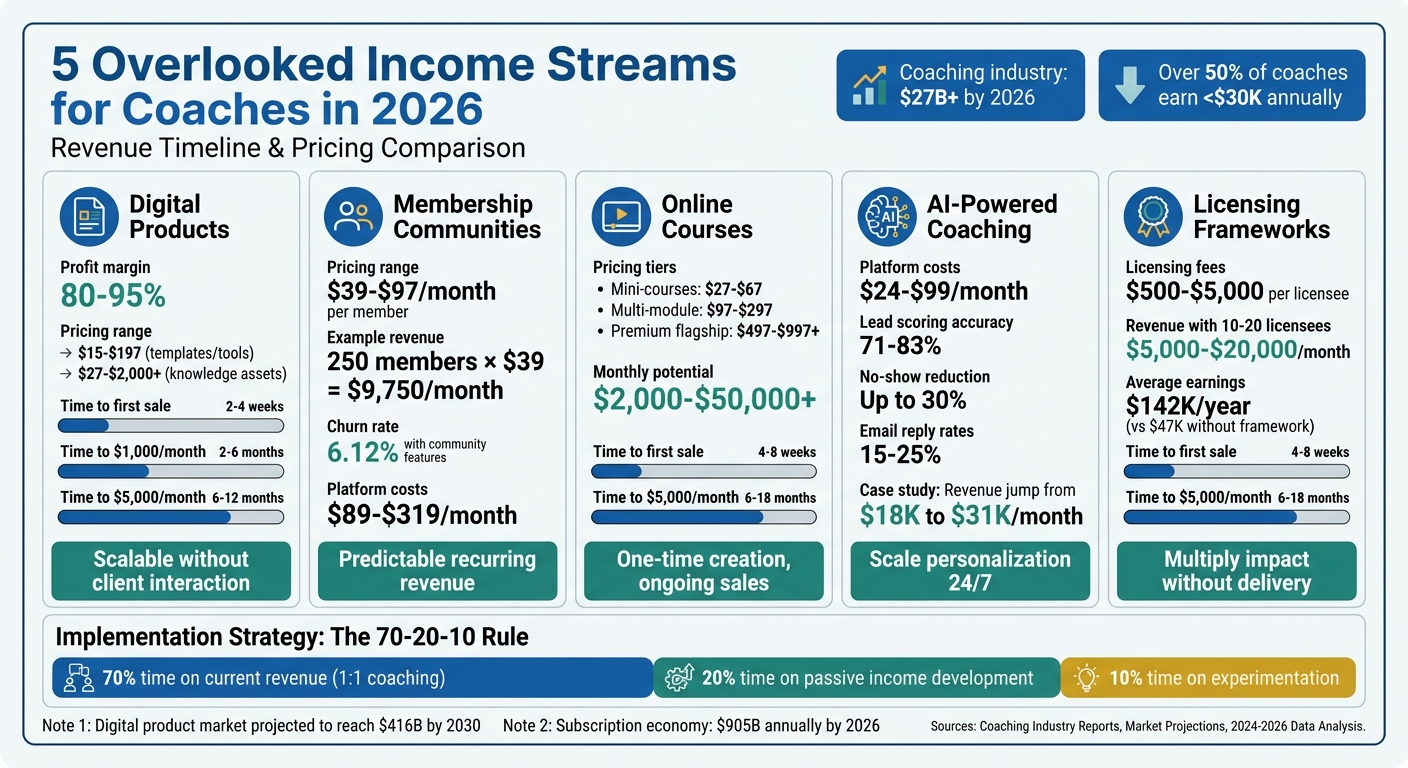
5 Income Streams for Coaches: Revenue Timeline and Pricing Comparison 2026
Moved Back Home at 44 and Built 7 Income Streams
sbb-itb-f7e72a6
Digital Products: Scalable Income Without Direct Client Interaction
Digital products free coaches from the limitations of hourly billing. With profit margins often hitting 80% to 95%, these products become highly lucrative once created, as ongoing costs are minimal[6]. And with the digital product market expected to hit $416 billion by 2030, coaches who invest in this now are setting themselves up to tap into a growing revenue stream[6].
Take a $47 workbook, for example. Whether you sell 10 or 10,000 copies, the effort to create it remains the same. This makes digital products a time-efficient way to scale income. They also work as a gateway for potential clients. Someone hesitant to dive into a high-ticket coaching package might start with an affordable option, like a $27 template or a $67 workbook. Once they see the value in your digital product, they’re more likely to trust you with your premium offerings[9]. This strategy fits seamlessly into a multi-stream revenue approach, paving the way for a diverse digital portfolio.
Types of Digital Products
Today’s coaches are creating ready-to-use solutions that save clients time and effort. Instead of teaching concepts, they’re offering tools and frameworks that deliver immediate results[7].
- Templates and Tools: These are easy to create and appeal to a broad audience. Examples include social media calendars, Notion planners, client onboarding kits, and Canva templates. They typically sell for $15 to $97 and can generate significant sales volume[5][6]. For instance, a business coach might sell a "Client Onboarding Kit" with email templates and intake forms, while a health coach could offer meal planning templates with grocery lists.
- Knowledge Assets: Products like eBooks, digital workbooks, video modules, and certification programs require more effort upfront but can command higher prices. The key is specificity. Instead of generic "Contract Templates", a coach could offer "Legal Contracts for Wedding Photographers", which boosts perceived value. Pricing ranges from $27 to $197, with certification programs sometimes exceeding $2,000[5][7].
- AI Prompt Libraries: A newer trend since 2026, these collections of structured prompts help clients automate tasks like content creation or strategic planning. Combined with implementation guides, they’re easy to produce but highly valuable[7].
The secret to success lies in targeting a niche. For example, a generic "Habit Tracker" might get lost in the crowd, but a "Habit Tracker for ADHD Entrepreneurs" addresses a specific need and can justify a premium price. The formula is straightforward: focus on a specific audience, solve an urgent problem, and offer a distinctive solution[7].
How to Sell Digital Products
Once you’ve created a high-quality digital product, the next step is to sell it effectively. The scalability of digital products offers incredible earning potential, but the right sales strategy is crucial. Platforms like Gumroad charge a 10% transaction fee and provide built-in traffic, while Shopify offers professional storefronts with fees of 2.9% + $0.30 per transaction. Alternatively, Paperbell charges no platform fees and connects directly to Stripe or PayPal[5][6][9].
Start by offering a free lead magnet, such as a checklist or mini-guide, to grow your email list. Then, introduce a low-cost product - priced between $27 and $49 - to convert subscribers into paying customers. This gradual approach builds trust and encourages customers to explore higher-priced options over time[7].
Email marketing remains one of the most effective tools for selling digital products. Focus on building your list - aiming for at least 1,000 subscribers before a major launch can significantly boost your first-month revenue[9]. Use automated email sequences, like welcome series and nurture campaigns, to showcase your expertise while subtly promoting your products[6][9].
Before committing to full product development, test demand with a "smoke test." Create a waitlist page or pre-sale offer to gauge interest. If at least 50 prospects don’t sign up, it might be a sign to rethink the product idea[6][7]. This approach saves time and ensures you’re creating something your audience genuinely wants.
Bundling products can also boost revenue. By pairing related items - like a budget template with an expense tracker - you can increase the average order value by 15% to 30% without needing additional traffic[6][9]. Offer tiered pricing options, such as a basic version, a standard version with bonuses, and a premium version that includes extras like group coaching access.
Timing is essential. Digital products usually take two to four weeks to make their first sale, and with consistent marketing, they can reach $5,000 per month within six to 12 months[1]. Many sellers hit $1,000 per month within six months of launching their first product[9]. However, the "set it and forget it" mindset doesn’t apply here - successful digital products require regular updates and active promotion to maintain revenue[8].
Subscription-Based Membership Communities for Recurring Revenue
Membership communities offer a steady, recurring income stream, creating a reliable financial baseline. With the global subscription economy projected to hit $905 billion annually by 2026, subscription-based businesses are growing 5 to 8 times faster than traditional models [12]. For coaches, this means breaking free from the unpredictable feast-or-famine cycle and enjoying consistent cash flow, where next month's income is tied to the current member count.
The financial benefits are clear. Compare a one-time $497 course to a $97 monthly subscription. That subscription generates $1,164 annually from just one member. Over time, the lifetime value of each subscriber grows significantly. Beyond revenue, memberships build strong community connections. Features like dedicated community spaces reduce churn rates to 6.12%, compared to 9.26% for memberships without such areas [11].
"The membership business model isn't just another income stream. It's the foundation for a predictable, scalable business that works while you sleep."
– Membership.io Team [10]
Today's members aren't just paying for information - they're investing in transformation and connection. Memberships thrive on a mix of exclusive content and the collective progress of the community.
What Makes Membership Communities Work
The most successful memberships rely on a three-part approach: core content, community interaction, and live elements. This structure keeps members engaged and justifies premium pricing. While a content library is valuable, it’s the ongoing interaction and live experiences that keep members invested [10].
The first 30 days are critical for retention. Members who actively engage in the first week are four times more likely to stay long-term compared to those who wait until week two [16]. Giving new members an immediate "quick win" can make all the difference. For example, in 2025, Mia, a wellness coach, shifted from seasonal one-on-one coaching to a $39/month membership that included workout plans and live Q&As. Within six months, she had 250 members and was earning $10,000 in monthly recurring revenue [4].
Engagement is key. Passive models, like self-paced courses, often see completion rates as low as 8% to 15%. In contrast, active models - featuring structured challenges, deadlines, and accountability - achieve much higher completion rates [14]. As a result, many coaches are moving away from static "content dumps" and toward dynamic, interactive programs that encourage participation.
Adding membership communities to your income strategy not only boosts recurring revenue but also strengthens your overall business model. With the right engagement strategy, choosing effective tools becomes the next step for sustainable growth.
Tools for Managing Membership Platforms
To maximize retention, coaches need the right platforms. In 2026, the choice often comes down to two types: all-in-one platforms (like Kajabi or Podia) or community-focused platforms (like Skool or Circle) [12].
- Kajabi: Offers an all-in-one solution with integrated email marketing, sales funnels, and course hosting. Plans start at $119 per month and include 0% transaction fees on paid plans [12].
- Skool: Focuses on gamified engagement, with leaderboards and a simple user experience. It charges a flat $99 monthly fee for unlimited members and courses [12][14].
- Circle: Provides AI tools for engagement scoring and organized discussion spaces, starting at $89 per month with a 2% platform fee [12].
- CommuniPass: Delivers content through familiar channels like WhatsApp or Telegram, achieving completion rates of 70% to 85% for paid challenges. It also offers 0% transaction fees on payment links [14].
- Mighty Networks: Specializes in mobile-first experiences with branded iOS and Android apps, reducing churn by 15% while increasing content watch time by 25%. However, requiring users to download an app can lead to a 40% to 60% drop-off during onboarding [12][14].
| Platform | Best For | Monthly Cost | Key Strength |
|---|---|---|---|
| Kajabi | All-in-one business | $119–$319 | Integrated email, funnels, and courses; 0% transaction fees [12] |
| Skool | Gamified community | $99 flat fee | Leaderboards and simple UX; unlimited members [12][14] |
| Circle | Structured discussion | ~$89 + 2% fee | AI engagement tools and "Spaces" for topics [12] |
| CommuniPass | Structured challenges | Varies | WhatsApp/Telegram delivery; 0% transaction fees [14] |
| Mighty Networks | Branded mobile apps | Varies + 2% fee | Mobile-first with native apps [12] |
Automated billing tools are also essential. Around 7% of subscription payments fail initially due to expired cards or bank declines [15]. Platforms with automated retry features can recover much of this lost revenue [13]. This is crucial, as involuntary churn can quietly erode profits as your membership grows.
Before fully committing to a platform, consider testing your idea with a beta group of 20 to 50 people. This allows you to gather feedback and fine-tune your offering [11]. Once your membership is live, prioritize retention over constant member acquisition. A 10% improvement in retention can have five times the impact on long-term revenue compared to a similar boost in new member sign-ups [16].
Making Money Through Online Courses
Online courses have become a go-to option for coaches looking to expand their income streams in 2026. They provide a way to scale without being tied to hourly commitments, offering a clear transformation within a set timeframe. Unlike membership models that require ongoing interaction, a well-designed course can generate revenue long after its creation. With the global online education market surpassing $400 billion in 2026, coaches are tapping into this booming industry [19].
What sets successful online courses apart is their promise of a specific outcome. Instead of offering generic coaching, these courses guide learners from feeling stuck to achieving a clear goal.
"An online course is how coaches stop capping their income at the number of hours in a week." – Liam Austin, Co-founder, Entrepreneurs HQ [17]
Pricing and Revenue Potential
Courses are often priced based on their depth and the value they deliver:
- Mini-courses: $27–$67
- Multi-module programs: $97–$297
- Premium flagship courses: $497–$997 or more, often including coaching or community access [18].
For instance, a beginner course priced at $197 could bring in $2,000–$10,000 per month once it gains traction. However, one major hurdle is completion rates - self-paced courses often see fewer than 15% of students finish [3]. This can make it harder to collect testimonials and prove the course’s effectiveness. To address this, many coaches start with live cohorts or paid challenges to demonstrate results before transitioning to a passive course format.
Choosing the Right Course Topic
One of the biggest mistakes is creating a course without confirming demand. Before diving into production, it’s crucial to validate your idea. Start by researching platforms like Udemy or YouTube to see if similar courses are performing well [18].
Next, engage directly with your target audience. Talk to five to ten potential students to uncover their specific pain points. Use their feedback to craft a compelling course title and marketing message. Hosting a free workshop or webinar can also help gauge interest.
"A course for 'everyone' is a course for no one. You need a specific person in mind when creating your content." – Joonas Rotko, Digital Marketing Expert [18]
Once you’ve confirmed demand, focus on delivering a clear transformation. Instead of generic advice, your course should guide students from their current struggles to a specific outcome. For example, a career coach might offer a course titled "Land Your First Remote Job in 60 Days." Structuring the content into 4–8 modules with short, focused lessons (5–15 minutes each) helps keep students engaged [18]. Tools like ChatGPT or Claude can assist with creating lesson outlines, scripts, and even quizzes.
For those just starting, the most profitable niches remain health, wealth, and relationships [20]. Within these areas, narrowing down to a sub-niche where you have expertise and proven results can set you apart.
Platforms for Hosting Courses
Once your course topic is validated and its transformation defined, the next step is selecting a platform for delivery. The choice often comes down to marketplace platforms versus hosted platforms.
- Marketplace platforms: These bring built-in traffic but take a significant cut of your revenue (e.g., Udemy charges 37%–63% per sale). Additionally, you don’t own the customer relationship, as the platform controls student data and email addresses.
- Hosted platforms: While you’ll need to drive your own traffic, these platforms offer full control over branding and better profit margins [19].
For example, earning $10,000 per month on a platform with a 30% commission means losing $3,000, compared to a flat subscription fee of $99–$300 [19].
Here’s a comparison of some popular platforms:
| Platform | Monthly Cost | Transaction Fees | Best For |
|---|---|---|---|
| Teachable | $0–$249+ | 0%–10% (plan-dependent) | Coaches seeking a simple setup with payments |
| Kajabi | $149–$399 | 0% | All-in-one solutions for running a business |
| Thinkific | $0–$199 | 0% on paid plans | Budget-conscious coaches |
| Skool | $99 (Pro) | 2.9% (Stripe standard) | Courses with community and gamified features |
| Podia | $0–$89 | 0% on paid plans; 8% on free plans | Selling courses, downloads, and memberships |
| Udemy | Free to list | 37%–63% revenue share | Coaches without an audience seeking traffic |
Before committing to a platform, try enrolling in a course as a student to evaluate its usability. Look for features like smooth loading speeds, mobile compatibility, and an intuitive interface. Also, ensure the platform allows you to export your content and student data to avoid being locked in.
If community and engagement are priorities, platforms like Skool or Mighty Networks offer features like discussion boards and gamification to boost completion rates. For those who prefer an all-in-one solution, Kajabi and Kartra combine email marketing, sales funnels, website hosting, and course delivery [19]. On the other hand, if you already have marketing tools in place, platforms like Teachable or Thinkific might be more cost-effective.
Mobile accessibility is another key factor. With many students accessing courses on their phones, a platform with a strong mobile app and effective push notifications can significantly improve engagement.
Lastly, calculate when a flat subscription fee becomes more economical than percentage-based transaction fees. For most coaches, this tipping point is around $3,000–$5,000 in monthly revenue.
AI-Driven Personalization and Automation for Scaled Coaching
As coaches look to expand their revenue streams, AI tools are becoming a practical way to improve service delivery and manage leads more efficiently. Instead of exchanging time for money, many coaches are automating repetitive tasks, giving them more freedom to focus on transformative client sessions. By using AI, coaches can offer structured, around-the-clock support while dedicating their energy to deeper, breakthrough work [21] [25] [26].
Using AI for Personalized Coaching Experiences
AI tools make it possible for coaches to digitize their proven methods, turning them into automated, personalized support systems. Platforms like Appaca (starting at $24/month) and Coachvox (starting at $99/month) allow coaches to train custom AI agents using their unique frameworks and exercises [21] [25]. These tools create structured, conversational experiences for clients. For example, Notion AI can quickly analyze months of client notes to highlight recurring challenges or milestones, saving hours of manual preparation before a session [22].
The key is to automate routine tasks - like scheduling, follow-ups, and basic guidance - so that your time is spent on high-impact sessions, such as discovery calls [26] [27].
"Think of it as cloning your knowledge. Your AI can guide a client through the basics at 3 AM while you sleep, so when you meet them for a session, you're tackling the real breakthroughs."
– Kelvin Htat from Appaca [21].
To get started with AI, use structured intake forms that capture one measurable goal and one emotional challenge from clients. This ensures accurate input for generating client briefs. Always review AI-generated content before sharing it with clients to maintain your credibility and add a personal touch. Also, avoid including highly sensitive or financial information in general AI tools [26].
By combining AI-powered personalization with careful oversight, coaches can not only improve client experiences but also save time for other critical aspects of their business, such as lead management.
Streamlining Lead Qualification with AI
AI doesn’t just enhance coaching sessions - it also simplifies lead management. Sorting through unqualified leads can waste valuable time, but AI-powered systems can automatically filter and rank inquiries before they even reach your calendar. Tools like CloseBot (starting at $97/month) use chatbots to collect essential information - like a prospect's goals, budget, and timeline - ensuring that only high-potential leads make it to the discovery call stage [25]. Additionally, AI lead scoring models can predict a lead’s likelihood of converting with 71% to 83% accuracy, helping coaches prioritize their outreach efforts [24].
Rachel Okonkwo, the founder of a boutique leadership coaching firm, saw dramatic results after implementing an AI-powered scoring system. By adding this layer to her intake forms, she reduced non-converting calls by 58%, cut her discovery call workload in half, and increased her closing rate by 40%. Her monthly revenue jumped from $18,000 to $31,000 [24]. Automated reminder sequences also played a role, reducing client no-shows by up to 30% [24] [25]. Meanwhile, AI-assisted outreach emails achieved reply rates of 15% to 25%, with open rates improving by 50% compared to traditional methods [23].
To implement these tools effectively, start by adding an AI scoring layer to your intake forms. This will help you prioritize high-fit leads for immediate follow-up. Use AI to draft personalized outreach emails based on a prospect’s LinkedIn updates or company news, but always keep your messaging authentic to avoid coming across as spam. Before using any AI tools for prospecting, define a clear Ideal Client Profile - AI will amplify whatever criteria you provide [24].
With 72% of coaching clients expected to prefer remote or hybrid sessions by 2026, the demand for digital AI solutions is only growing [25]. Coaches who combine AI’s efficiency with their personal expertise are well-positioned to expand their impact.
Licensing Coaching Frameworks and Methodologies
Licensing is another smart way to monetize your expertise, complementing strategies like AI-driven personalization and online courses. By turning your proven coaching process into a licensable framework, you can expand your reach and create a steady stream of recurring revenue. This approach fits seamlessly into a revenue-stacking strategy, as it transforms your intellectual property into a scalable income source. With the global coaching industry projected to surpass $27 billion by 2026, there’s significant potential here. Coaches with proprietary frameworks earn an average of $142,000 annually, compared to $47,000 for those without a clearly defined approach [2]. Like digital products and online courses, licensing allows you to leverage your expertise in a scalable way.
Benefits of Licensing Intellectual Property
When you document your unique and effective coaching process, it becomes a tangible asset that others can license. Giving your framework a memorable name, such as "The 5-Pillar Leadership Model", helps establish a recognizable brand [1][2]. Before licensing, test your methodology with a few coaches to ensure it delivers consistent results, even when applied by someone else. Once validated, you can license your framework to four key groups:
- Existing clients who already trust your methods
- Competitors transitioning out of direct coaching
- Agencies and nonprofits seeking ready-to-use content
- Corporations and universities for internal staff training [1][28]
"Licensing can be a game-changer, allowing you to multiply your impact and revenue." – April Beach, Founder, SweetLife Co. [28]
With just 10–20 licensees, you could generate $5,000–$20,000 in monthly revenue [1]. Licensing fees typically range from $500 to $5,000 per coach, depending on the complexity of your framework and the licensee’s capacity [1]. A common pricing strategy is the 25% rule: licensors earn 25% of the gross profit from products or services using the licensed intellectual property, while licensees keep 75% to account for marketing and delivery risks [29][30].
Examples of Licensable Coaching Assets
There are many types of coaching assets you can license, including assessments, programs, certification courses, worksheets, and structured methodologies. For instance:
- A leadership assessment measuring five core competencies could be licensed to corporate trainers or HR teams.
- A 12-week transformation program with workbooks, video modules, and client exercises could be licensed to other coaches serving the same niche.
Coaches who adopt structured delivery models report 34% less burnout and 23% higher client satisfaction scores [2].
To protect your intellectual property, use formal licensing agreements that prohibit unauthorized reproduction or commercial use [31]. Include clauses that restrict licensees from using your frameworks in AI training datasets without explicit permission [28]. A helpful time management rule is the 70-20-10 rule: dedicate 70% of your time to client revenue, 20% to creating scalable assets like licensed frameworks, and 10% to experimenting with new ideas [1].
| Revenue Stream | First Sale Time | Time to $1,000/month | Time to $5,000/month |
|---|---|---|---|
| Licensing Frameworks | 4–8 weeks | 3–9 months | 6–18 months |
| Digital Products | 2–4 weeks | 2–6 months | 6–12 months |
| Online Courses | 4–8 weeks | 3–9 months | 6–18 months |
Building a Professional Brand Platform for Multiple Income Streams
If you're looking to diversify your revenue streams, consolidating your tools into a single, professional brand platform can make a world of difference. Many coaches face the challenge of juggling multiple systems - one for scheduling, another for emails, a separate one for payments, and yet another for hosting courses. This patchwork approach not only drains time but can also cost anywhere from $127 to $317 per month, all while creating constant technical headaches [33]. By streamlining everything into one platform, you simplify your operations and amplify your brand's reach.
Creating a Centralized Digital Presence
An effective professional brand platform should allow you to manage all your activities in one place without hopping between dashboards. Key features to look for include:
- Landing page builders to promote your offerings.
- Automated email sequences for nurturing potential clients who aren't ready to commit just yet.
- Integrated payment processing that supports flexible payment options, like one-time purchases, recurring subscriptions, or high-ticket plans.
With these tools in place, you can seamlessly manage 1:1 coaching sessions, group programs, digital downloads, and even membership communities - all from a single system.
The financial benefits are impressive too. Unified platforms can generate anywhere from $500 to $15,000 per month through digital products with profit margins of 60%–80%. Premium courses can take it even further, earning $20,000 to $50,000 or more each month [1][32]. Plus, as your business grows, the right platform can scale with you, evolving from basic landing pages to fully functional membership sites. Beyond the income potential, a centralized system also reinforces your professional image, making your brand look polished and reliable.
Using Brandbase for Professional Branding
For a streamlined and elevated approach, Brandbase offers a tailored solution to enhance your professional presence. This platform goes beyond just unifying your tools - it actively works to grow your brand. Brandbase provides custom landing pages for each of your offers, AI assistants that qualify leads around the clock, and SEO-optimized blog content to drive organic traffic. These features are critical, especially since 73% of clients expect coaches to showcase professional credentials and proof of transformation [34].
Brandbase's pricing is designed to support coaches at various stages of growth.
- Essential Plan: At $99/month (with a $499 setup fee), this plan includes a managed landing page, a custom AI assistant, hosting, maintenance, unlimited edits, and one PR placement every six months.
- Pro Plan: For $499/month, this option adds unlimited landing pages, LinkedIn lead generation campaigns, six PR placements every two months, and nine SEO blog posts monthly.
Conclusion: Steps to Diversify Income in 2026
The coaching industry is expected to surpass $27 billion by 2026 [2]. The most successful coaches aren't sticking to just one revenue stream - they're creating interconnected systems that include everything from digital products to AI-driven automation [2].
To tap into this growth, it's essential to diversify your income using a strategic approach. One effective method is the 70-20-10 rule: allocate 70% of your time to your current one-on-one revenue streams, 20% to developing passive income options, and 10% to experimenting with fresh ideas. This way, you maintain steady cash flow while exploring scalable opportunities [1]. Coaches who focus on a specific niche and build clear authority tend to earn significantly more [2].
"The creator monetization playbook for coaches in 2026 is not about building the perfect passive income asset. It's about building the kind of transformation-driven experiences that make students finish what they started." - CommuniPass [3]
Start with active income models like paid challenges and subscription-based communities. These approaches help you quickly generate testimonials and build social proof. Active models also tend to drive higher engagement compared to self-paced courses [3]. Once you've validated your methods and earned trust, you can expand into passive income streams such as recorded courses, digital templates, or licensable frameworks. The key is to validate active models first before layering in passive options.
After establishing your income streams, bring them together into a cohesive system. Consolidating your strategies onto a single platform can boost both efficiency and credibility. Platforms like Brandbase streamline everything - landing pages, email automation, payment processing, and content delivery - while integrating tools for digital products, online courses, AI coaching, and licensing frameworks. By centralizing your efforts, you can build 3–5 complementary income streams, strengthening your business and ensuring long-term resilience [2].
FAQs
Which income stream should I start with first?
Creating passive digital products - such as online courses or downloadable resources - is an excellent starting point for building income in 2026. These products let you scale your earnings without requiring constant effort, making them ideal for reducing burnout while maximizing the value of your expertise.
By starting with digital products, you set the stage for long-term growth and flexibility. Once established, you can explore other opportunities like memberships or AI-driven community tools. This approach aligns with emerging trends and offers a scalable way to grow your income over time.
How do I validate demand before creating anything?
Before diving into a new coaching product or service, it's smart to check if there's actual interest in the market. Start by researching what’s already working in your niche. Look at successful offerings from other coaches - these can give you clues about what people are willing to pay for.
Next, connect directly with your target audience. Use surveys, polls, or even beta groups to gather honest feedback. Ask them about their challenges, what they’re looking for, and how your idea fits their needs.
You can also study how other coaches have turned similar ideas into profitable ventures. This not only confirms demand but also helps you refine your approach to match what your audience values most. By doing this groundwork, you’ll reduce the chances of pouring time and money into something that doesn’t resonate.
How can I use AI without risking client privacy?
To integrate AI into your workflows while keeping client privacy intact, prioritize methods that protect sensitive information. One effective approach is using on-device AI, which processes data directly on your device rather than relying on cloud servers. This reduces the risk of exposing client data to external systems.
Additionally, avoid sharing raw client information with third-party tools. Instead, ensure that all digital tools you use comply with established privacy standards. Only input data that adheres to confidentiality guidelines. These practices help you balance the benefits of AI with the responsibility of safeguarding client trust.
Related Blog Posts

Blog title heading will go here
Blog title heading will go here